Now that I am living without milk, I notice that…

  • oat milk is a poor replacement for the real stuff, as is margarine for butter
  • I really miss yoghurt, grilled cheese sandwiches, fresh warm bread with melting butter, and creamy sauces
  • I am spontaneously eating more nuts and pulses, probably because my organism needs alternative sources of protein
  • I never really feel full and sated after a meal – instead I stop eating when I think “surely this ought to be enough”
  • I am lugging home lots and lots of juice
  • ordinary restaurants have almost nothing on their menus with neither meat nor dairy

Adrian has been so much better during the past two weeks compared to the two preceding weeks, and our lives so much calmer, that I’m continuing for now. In a few weeks it should be time for a provocation – drink a glass of milk and see what happens to him.

Adrian was born at home, just like Ingrid. It was absolutely the right decision for us; everything went very smoothly and I will definitely aim for the same next time (if and when that happens).

I know many people think of choosing home birth as a brave thing to do. And I can sort of understand their point of view… but only in my head, not in my heart. For me, home birth is the easy choice, the alternative that does not require any bravery.

Perhaps it comes down to what you have more confidence in: your body, or the health care system. I know I have a healthy body that can do just about anything a body is supposed to do. It is rarely unwell, has no chronic problems, does not break easily.

Or maybe it’s about being in control. I have an aversion to other people making decisions for me, to not being in control of my own life. I dislike strangers, noise, hassle. A hospital birth would make me nervous and anxious. Machines that go ping, shift changes, strange smells, other mothers giving birth next door – I don’t even want to think about it. A home birth on the other hand is a calm, undisturbed experience.

People mention pain, too. That’s what everybody thinks about first when thinking about giving birth. This birth was definitely an easy one, but of course I made my decision not knowing that, based on how Ingrid’s birth went. And there was pain, of course, but it was never unmanageable. I really don’t know if it was less painful than the average birth, or if I am more tolerant of pain than the average mother, or if it is simply about expectations and perceptions. I accepted that it would hurt and decided to live with it, and not worry more about it.

  • I am tired of being pregnant. It is boring and inconvenient. I can barely bend enough at the waist to get my socks and shoes on. I have to go to the loo once an hour, at a guess. I spill food on my clothes because I cannot get close enough to the table. I cannot run with Ingrid. (On the other hand, I float much better than usual, which is nice when we go swimming.)
  • I am noticing a turning-inwards. I am less interested than usual in spending time friends and family, or going out to do things. I would rather just do stuff at home, preferably on my own. I am also feeling a drive to get things done, which is why my GTD list is getting leaner while the blog is getting less attention.

I am an underbuyer. When in doubt, it’s easier for me to decide that I don’t really need the whatever-I’m-considering. I’m more likely to feel bad about buying something that I then don’t use, than to feel bad about not buying something that I could have used.

Whenever I have to buy something expensive, I have to overcome a slight internal resistance – even though I know that we need it, and that we can afford it, and that it’s not worth buying a cheaper alternative, because you get what you pay for (most of the time).

Spending money is a little bit easier when it feels like a long-term investment, like a bicycle, or winter boots, or a computer. Even then, though, it takes a bit of an effort. The hardest for me is to buy things that seem frivolous, that I like but don’t really need. One winter scarf is perfectly enough, so even if I see another really pretty one, it’s unlikely that I will buy it.

Or fruit. There is a part of my brain that insists on telling me that apples for 19.90 SEK/kg are perfectly good fruit, though slightly boring, and there is no need to splurge on grapes for 49.90.

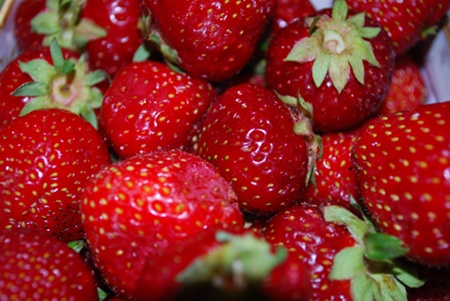
Lately, though, I have begun to train myself to ignore that part of the brain. If there’s one thing in my everyday life that I really enjoy, it is simple, fresh, good-quality food. Often when I look back at my day and think about the highlights, it’s the freshly baked bread, or the cereal with fresh strawberries, that comes to mind.

And it’s not like we cannot afford it. For various reasons, we do not spend money on a car, or eating out, or alcohol and cigarettes, or movies and such. We run a not insignificant surplus every month.

So now, when I feel like eating the season’s first Swedish strawberries, 60% more expensive than the Belgian ones, I just do it. (I’ve nothing against Belgians, but their strawberries are a poor substitute for the real thing.) When the veggie stand down at SpĂ„nga Square has in-season Pakistani mangoes at exorbitant prices, I barely hesitate. (They keep a few of them in a small box right next to the cashier, with a hand-written sign describing them as “the best fruit in the world”.)
I love having a garden. I love our garden. Even though I don’t spend much time there every day (because our evenings tend to be busy, and because we have no evening sun in the garden), I love having it nearby and around me.

I love being surrounded by greenery rather than houses, cars or people. Looking out through the kitchen window during breakfast and seeing green grass, trees and blooming lilacs. Being met by growing things when leaving the house in the morning, and when coming home in the evening.

I love the quiet. Which is not a direct effect of having a garden, really, but a neighbourhood with gardens mean less dense housing, which in turn means more quiet.

I love the air and the smells. I like to end my day by walking out onto the balcony when brushing my teeth and just inhaling the garden. Just a few moments’ exposure makes a big difference.

This weekend I sent Eric and Ingrid out to have fun (they went swimming, and to Junibacken) so I could finally clear all the papers off my desk and do a GTD (Getting Things Done) weekly review. It had been way longer than a week since last time and I felt like I had lots of uncaptured tasks floating around.

Well, now both the projects and next actions have been captured, and I have them all under control. The flip side is that I now know exactly how much stuff there is that I should be doing instead of spending time in front of the computer. The lists are shockingly long. My list of next actions, which I’ve previously mostly managed to fit onto Post-Its on one A4 page, now cover the best part of three pages.

The flip side of that, in turn, is that I feel challenged. There is nothing like a bit of pressure to get me moving. Time to get those lists down to size again!

I am experiencing a decline – presumably temporary – in the need to express my thoughts in writing. I don’t feel that I am doing or thinking or experiencing anything just now that is worth writing down. Hence the relative decline in posting frequency. When the writing urge returns, you will notice.

First I was happy to be here in Tartu, and had lots to do – people to meet, books to buy, etc.

After a week I was getting restless. I’m not used to doing nothing but hanging around at playgrounds, and occasionally shopping for groceries. I miss cycling, or some other kind of physical activity. I miss doing something productive.

Since then we’ve been slightly more active (longer walks, some visits to a beach) and had slightly more different people around us, and the restlessness has abated somewhat. And now that I have one more day left in Tartu, and two half-days in Tallinn, I’m already slightly sad about leaving.

But I’m thinking that next year I might rent a car (or perhaps a bike), so we can get out more.

I held a presentation again today, jointly with a colleague, at a conference organized by Konsultbolag1. (Ours is the last talk on the programme. I know my name isn’t there; the initial plan was that someone else would do this but I stepped in instead.) We spoke for 40 minutes, in front of ~60 people. I’m starting to think that I should do more of this: I enjoyed it even more than I anticipated, and got better feedback than expected.

Observations:

  • I need to feel comfortable with the content and the presentation materials, but once I have that, and a rough idea of what I want to say about each point, further preparation is not useful to me. Some people rehearse and memorize individual phrases they intend to use. I sometimes try that, thinking of good ways of expressing things, but when I’m standing there on the stage that all disappears, flies right out of my brain, and I end up improvising anyway.
  • Surprisingly many people deliver presentations without thinking through what they want to achieve. What is the purpose? What should the audience know or think or want or do after hearing your presentation? How does each page work towards that aim?
  • You don’t need to be a leading-edge expert in order to deliver a useful talk. You just need to know more than your audience, and know your limitations.

I’ve added a new link to the sidebar: My interests. It’s a rough listing of things I am interested in, things I enjoy reading about. This is going to be a permanent work in progress – I will add and update the list whenever I think of it.