
Six months.

Ingrid grows and develops so fast that sometimes I feel like she changes overnight. During the last month she has become so much more of a person, with character and habits and quirks of her own. Every day she seems to become more alert and aware of what is going on around her.

In less than a month she has learned to sit without support, although I do keep a pillow behind her so she doesn’t hit the floor when she falls. She can even twist and look over her shoulder without falling, and lean forward to pick up a toy and then straighten herself again. Very impressive, considering that she could barely sit at all a month ago.

And now that she has seen how nice it is to sit – how easy it is to reach for toys and what a great view one gets – she no longer accepts lying down. (Would you prefer to lie down all day, or to sit up and see what’s going on around you?) Now she rarely spends more than a minute lying down before she not-so-discreetly requests to be lifted up to sitting again.

Her hands can now not just pick things up but also pass them from one hand to the other, turn them around and drop them. And they can splash water in the bathtub. (Speaking of baths, we have definitely abandoned the bath support and she now sits up in the bath. Wobbly and scary, but it works.) The hands still have a life of her own, wandering around and gripping whatever they touch, even if she is busy with something else and not even looking at her hands. And they grip VERY HARD, so hard it hurts, because her grip is still all-or-nothing.

She is still very physically and visually oriented. She is strong and likes to move and be active. She also likes to see things happen – when she gets grumpy, my first move is to put her in a sling and let her watch me hang laundry or empty the dishwasher. She isn’t particularly interested in sounds or talking, however: apparently most children babble quite a lot at this age but I haven’t heard her babbling much at all.

Ingrid’s taken to eating (as opposed to drinking milk) like a duck to water. It’s as if this is what she had been looking forward to all her life. We started last weekend with one meal a day (the afternoon meal), but this Friday she was visibly disappointed when she wasn’t offered “real food” for the late-morning meal so we switched that one to solids as well.

She likes cauliflower and parsnip well enough, accepts small amounts of potato and broccoli but isn’t particularly fond of them, and adores carrots, apples and banana. Her mouth opens wide like the beak of a hungry little bird and if I’m too slow for her taste she starts chasing the spoon with her head. Definitely not a food refuser.

The great nappy experiment is now well past its experimental stage and I’m using cloth nappies all the time now.

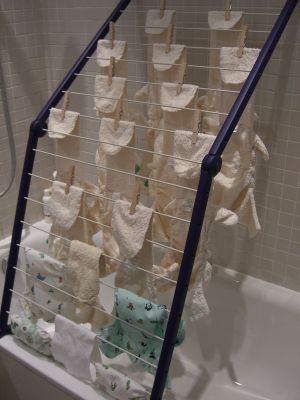
We have about 20 Tots Bots Bamboozles, 5 MotherEase AirFlow wraps, a few cotton terry boosters, and a roll of paper liners. I chose this setup based on expert advice from The Nappy Lady. It’s a lazy parent’s nappy solution, selected entirely for convenience and ease of use rather than price or environmentality.

The nappy is the part that absorbs water. The wrap goes on top of the nappy and provides a waterproof barrier between the nappy and the rest of the world. The liner (optional) goes inside the nappy and its task is to catch most of the poo, so the nappy itself stays cleaner. Finally, the boosters are like an extra nappy layer, making the whole package more absorbent, and we use it to get through the night without a middle-of-the-night nappy change.

This all works really well, I think. We no longer produce mountains of rubbish, and I find the nappies easy to use. Bamboozles are shaped and fasten with poppers, so there is no folding or pinning – they are as simple to put on as disposable nappies. And while they cost quite a lot of money, I will be able to use them on the next baby as well, or sell them – there’s a good second-hand market for cloth nappies.

Most of the things I was concerned about turned out to be no problem at all:

  • No leaks! I was constantly struggling with poo leaks from disposable nappies, especially early in the morning. Fresh, dry nappies only leaked every now and again. But when the nappy was already holding a lot of water, poo just slid right along the inner surface and leaked out through the nearest opening – within minutes, if left alone. It got to the point where I rushed to pick Ingrid up as soon as I heard a poo, to save her clothes and the area around her. Terribly annoying. But with cloth nappies I only had one tiny leak, and it really was tiny.
  • They really are easy to use. A nappy change now takes a bit longer than with disposables, because there are more parts, but not so much longer that it would get annoying.
  • Poo-covered nappies. But liners are a great idea, and they work well.
  • Storage. Dirty or wet nappies go in a lidded bucket lined with a mesh bag. When I have a day’s worth of nappies left, I lift the whole bag in the washer. The bin smells slightly when I open it, of course. But as long as it’s closed, there’s hardly any smell at all.

I am still a bit concerned about two things:

  • Drying time. Bamboozles are very absorbent, more so than cotton terry, but the flip side is that it takes a long time for all that water to evaporate. When I hang them indoors, it takes around 36 hours for them to dry completely. Outside on the balcony, around 24 hours is enough. It’s all right as long as I wash them every other day and hang them out straight away – but if it’s raining or I don’t wash on time, we will run out of nappies. This may well become more of a problem when I’m back at work. I’ve ordered a few more, and we’re keeping a stash of disposables in reserve as well, just in case.
  • Wetness. Cloth nappies cannot feel as dry as disposables, because the materials are different. I’ve noticed some redness of the skin, which didn’t use to happen. I’ve started changing a bit more often now, and if that doesn’t help I might switch to fleece liners instead of paper.

Things I hadn’t considered before:

  • Cloth nappies are quite a bit bulkier than disposables. They add about one clothes size, but not proportionately. A body that fits well lengthwise and around the bum will generally hang a bit too loose around the upper body, and sleeves have to be rolled up twice or they will dangle past her fingertips. However I found Cut4Cloth which sells baby clothes adapted for cloth nappies.

And finally, I actually enjoy using the Bamboozles. I like the way they feel, and I think cloth nappies are even kind of cool. I’m glad I switched.

Recently Ingrid has started to show a lot of interest in food and meals. During my meals, she sits and stares with great fascination as I eat and drink. I gave her a spoon of her own to play with while sitting at the table, so that she could take part in the meal. She chewed the spoon with great enthusiasm, and quickly figured out which way it fit best in the mouth. But after a while it was clear that an empty wasn’t entirely satisfying: she started trying to reach for my juice glass and my sandwiches.

We guessed that this might mean that she was ready for some real food, so today we tried to give her solids again (after having abandoned the first attempt). And what a difference it was! This time she devoured everything we gave her and demanded more. We started with some pureed carrot, same as last time. When that had been gobbled up and she was making very disappointed noises, we tried apple as well, and it vanished with similar speed. It got to the point where we didn’t dare give her more and switched to milk, even though she would happily have continued.

I was reminded of the way a friend of mine described her son’s first meal of solids: “he swallowed it as if he had been starving for 6 months”. That is exactly the way Ingrid behaved today! After having seen this, it was very clear that our first attempt really was too early. I suspect that stories about how hard it can be to get babies to accept solids are caused by the same mistake: starting before the baby is ready.

Coming soon: cauliflower, sweet potato, broccoli, and rice. (If we sneak in the broccoli early enough, she won’t know that children aren’t supposed to like broccoli, so perhaps she might even enjoy it.)

Having survived a whole week away from home, including 4 flights, I’ve concluded that travelling with a baby is perfectly doable, if not exactly relaxing. It helps a lot that Ingrid is happy to be transported in the sling, both awake and asleep, and that she is still fully breastfed. This makes her very transportable, without having to worry about getting home for naps or meals. All we need for a meal is a place for me to sit, preferably indoors this time of the year but I’m sure that in a pinch a bench outdoors in the sun would work as well. And all we need for a nap is a short walk to get her relaxed and sleepy.

Flights are still the least enjoyable part. She does not enjoy sitting still, strapped in and facing forward, with nothing to look at other than the seat back, and no one to “talk” to. And nappy changes on a cramped airplane were a bit tricky, too.

Nevertheless the overall experience was good enough to make me think seriously about planning an actual holiday for this summer. Maybe a walking holiday somewhere (day trips, I guess) or perhaps cycling.

The flight out to Tallinn with Ingrid yesterday was a disaster. Minutes after we got on the plane, she decided she didn’t like that place at all and burst into tears. The requirement to sit strapped in and facing forwards didn’t help her mood either. She was so upset she couldn’t even breastfeed without choking (try drinking while you’re crying!). After an hour she fell asleep. When it was time to strap in for landing I had to wake her again and of course she then cried again.

I was prepared for a rerun of the same performance on the flight back, but I got the exact opposite. She set off to charm everyone around her. There were a few whimpers as I woke her for takeoff. But after that she ate happily, played quietly, smiled at people around her, and didn’t even fuss when a stewardess wanted to squeeze her irresistibly chubby legs.

Who knows – maybe the first flight went wrong because she had to get up at 4 that morning, or because it was the first one. I fervently hope that future flights will be more like the second one!

Things learned:

  • You can never have too many muslins.
  • A sling is great for getting around, but not great for taxi rides.
  • You will neither need nor have time for any entertainment (like books or magazines) when flying alone with a baby.
  • Nappies take up lots of space. For any trip longer than a day, take enough nappies for the flights and buy more when you arrive.

Five months yesterday.

What have we done this past month? Ingrid has chewed and licked on a lot of things, above all. Hands. Toys. Spoons. Front bar of buggy. Empty milk carton.

In order to be able to chew on things, she has learned to grip them and take them to her mouth. That’s still very much a hit-or-miss procedure – her hand literally misses the thing she wants to grab, or misses the mouth and hits the ear instead. But she understands the concept, she just needs to practice. For now, it isn’t her preferred approach: she would rather dive with her mouth towards the toy than bring the toy towards the mouth.

For a while she was also interested in her feet and was pulling at them all the time, as soon as I lay her on the play mat. But then suddenly lying down became BOOOH-RING!!! and now she only accepts it grudgingly for short periods. She really wants to sit up all the time. And not in the same place all the time, please – she wants new things to play with or look at. Unfortunately she isn’t really able to sit up for very long without being strapped into something or other. Her toys, on the other hand, are not strapped in and tend to fall to the floor rather frequently, so sitting and playing in the highchair can be rather frustrating for both of us. But when I put her down to sit on the floor, where she can reach her toys, she sort of scrunches up into a little uncomfortable heap, and then topples. Sometimes head first and crying, sometimes just slowly and inexorably. Either way she ends up lying down, where she doesn’t want to be.

All this activity is upsetting her stomach – and it doesn’t help that she folds far forward (putting pressure on the tummy) as soon as she is sitting without some sort of support in front of her. She spits up food so frequently that I’ve stopped giving her a clean bib (and myself a clean skirt) after every mess. She gets two bibs a day. My skirts escape some of the messes and last a day or two before they get totally smelly.

Since the world is so new to her, the simplest things can be fun to watch. Me hanging up her nappies to dry. Me folding laundry. Me eating. The plants standing still and doing nothing. When she’s tired and I want her to wind down, I can park her in front of the washing machine, and she watches the clothes go round and round and listens to the soothing sound effects – or I put her in the bathroom and she listens to water gushing into the bathtub.

On the other hand, I believe she’s beginning to get bored with her limited range of toys, and I don’t have much else that she can play with without hurting herself or the object. It needs to be easily grippable, small enough that she can grab any random part and get another part to the mouth, and have no sharp points or edges. Some of the local leaflets and booklets here advertise toy libraries, which I guess work just like book libraries. I think I’ll try to get to one next week, and see what they offer.

There is a sizeable bunch of new photos of Ingrid in the gallery. My initial plan to post photos weekly did not survive, but I will try to post at least bi-weekly from now on.

With most skills, once Ingrid’s learned them, she doesn’t lose them. But rolling over seems to be different. She has been learning and re-learning it for the last 6 weeks. First she managed to do it in one direction (front to back, I think it was). Then she abandoned that and learned the other direction, and spent a good while doing that and “requesting” to be turned back all the time. Then she took a week’s break from both. Then she recovered both skills at the same time, and then forgot them again…

Right now she’s in a phase where she has forgotten both again, which leads to a fair amount of frustration, because I’ve only got a 50% chance of putting her down the way she wants, and of course sometimes she changes her mind after a very short while.

Very curious behaviour!


(Short blog post today because the title character in my current book is in mortal peril, and if he survives his current problem he will have at least 2 more sets of people after his blood, and I desperately need to know how he will get through this all!)

Having thought more about this weaning thing, and read more stuff on the internet, I’ve changed my mind about feeding Ingrid solids.

Ingrid liked the taste of carrots, but wasn’t that interested in them as food. So I guess she can live on milk for another while. We’ll try again in a month or so.


Addendum:
Why? Basically because I think she wasn’t really ready for solids. I wanted to try this because I was interested in seeing how she would react, not because I urgently want her to eat “real food”. The reaction told me that it was probably a bit too early.

I also read more about the official recommendations. The recommended earliest starting times ranged from 4 to 6 months, but no one ever said why. I got the impression that the recommendations focused on “breast milk is good” rather than “solids are bad”, so introducing solids alongside breast milk didn’t seem like a bad idea. Now I stumbled upon an article that actually explained what happens in babies’ guts, and that made up my mind.

Some studies suggest that waiting until 6 months gives a baby’s digestive system more time to mature. Some enzymes that break down foods don’t reach adequate levels until 6 or 7 months of age. Babies are also born with what is a called ‘open gut’ – this means the spaces between the cells of the small intestines will allow intact macromolecules to pass directly into the blood stream. This allows the beneficial antibodies of breastmilk to pass more directly into a baby’s bloodstream. But it also means that large proteins from other foods (which may lead to allergies) and disease-causing pathogens can pass right through too. This open gut closes anywhere between 4 and 6 months of age – but without looking inside your child’s intestines, you won’t know when it’s closed, so it’s best to wait. This applies to breastfed and formula fed babies.

I couldn’t find any more solid sources – all the articles I came across were about pigs, calves or rats. And because the audience for those is rather narrow, they were all very technical. If you know of any articles about the development of the human digestive system, I’d be interested!