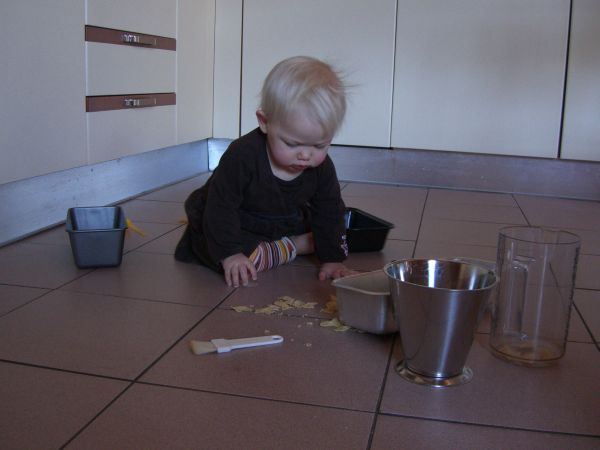
For over a month I’ve found myself thinking of Ingrid as “almost two”. She is nowhere near two, of course. But my brain wants the calendar to be decimal, so seventeen or eighteen months get rounded to twenty months, which should be the same as two years. I’ve now trained myself to ignore the months and just think of her as “about a year and a half”. Today she is exactly a year and a half.

The past month has been strongly language-oriented. Ingrid’s vocabulary is growing daily. Most of it is passive – she understands but doesn’t say the word herself – but her active vocabularly is also growing by leaps and bounds. And while much of what she says is still hard to decipher because many words sound the same, her pronounciation is definitely clearer as well.

I think there was a release, a step change, when she figured out that Eric and I have different words for the same thing. I knew that she had passed that important point when, one day, she pointed at an apple and said “äpp-e” to Eric, then turned towards me and said “õuu”. There aren’t many words where she actively uses both languages like that – for most common things she understands both names, but only uses one of the words actively herself. Trains are always called “taa” (Swedish “tåg”), navels (which she for some reason finds very entertaining) are called “naba” in Estonian.

Her vocabulary mostly consists of nouns and some verbs (especially for important things such as eat, sleep, go out, stand and sit). I don’t think she’s grasped adjectives yet. She is especially good at body parts, food (fruit in particular), things found around the house, items of clothing, and lots and lots of animals. She can point out parrots and turtles and butterflies and zebras and lions so on and on and on. Cats and dogs and pigs are particular favourites. Cats and dogs because she has seen real ones, and pigs because of their sound. Eric does a great pig grunt imitation, which Ingrid finds fascinating. She tries to imitate it but cannot. So instead she points out every pig she sees. It’s impressive that she can grasp the abstract concept of “pigness” so well that she recognises even stylized pigs in logos, with just the snout and half a head visible.

Stockholm has a lot more cats and dogs than central London. I think Ingrid has seen more of each during the last week than during all of her year and a half in London. There are two cats in our house who tend to hang around outside, so we often run across them when we’re going out, and my in-laws have a pair of schnauzers, plus we tend to meet many dogs while we’re out. All this has meant a lot of close contact with both cats and dogs. Ingrid is still cautious around them, but she is far more comfortable being close to them than before (although not to the point of petting them yet).

The other thing Stockholm has more of is good playgrounds. Playgrounds in London tend to be quite small and sterile things: a small rubber-covered area with a swing, a few spring riders, and a slide or two. The swings, spring riders and slides are present here, too, but there are also sandboxes, and the whole playground is usually covered with coarse sand rather than rubber – and sand (plus a bucket and a shovel) can keep a child occupied far longer than a spring rider. Even more importantly, the playgrounds around here always have other children, whereas in East London I was often alone with Ingrid, so we’ve been spending a lot more time in playgrounds here.

Initially, climbing, sliding and swings were Ingrid’s favourite playground activities. The small playground which is closes to our house (100 metres away) only has “big girl” swings made out of old car tyres, and she has learned to use those, too. She knows that she needs to sit still without twisting, and hold on hard with both hands. She has also learned to slide down Swedish slides, where the metal slide part has a rippled texture which makes them more slippery and faster, and to land on all fours (rather than her face) when coming down the bigger ones.

Sand only became interesting a few weeks ago, when she got to borrow a shovel from another child. Which is why it’s so nice to meet other families at playgrounds – I hadn’t even thought of buying her a shovel!

I think we found sandboxes at just the right time – I believe she enjoys playing with a bucket and a shovel because she just recently mastered the use of spoons. She can now get food onto the spoon, and get the spoon into her mouth, without turning the spoon upside down on its way. It also turns out that she can pick the husk off a physalis fruit, and spit out the seeds from a grape.

Speaking of food… bread, cheese and fruit are still among her favourite foods, but meatballs has now been added to that list, and butter. She now licks the butter of her bread and would probably be happy to eat butter with a spoon if we let her. Her interest in cooked food is a bit unpredictable, but I think in general she prefers sweet and fatty food. We went to IKEA today and ate at their restaurant. Ingrid got a traditional kids’ meal of meatballs, potatoes, sauce and lingonberry jam. She ate the jam and the meatballs, licked the jam off a potato, and otherwise ignored the potatoes completely. (We had been wise enough to not take the ice cream also included in the kids’ meal.) But in general she is now suddenly eating much bigger portions. If I had to guess, I’d say that a month ago she got half her nutrition from breast milk, whereas now it’s a small fraction.

Other favourite toys and activities: reading picture books about animals; moving fridge magnets between the fridge and the steel hanging folder file; the marbles and pebbles that decorate a few of the potted plants in this apartment; looking into kitchen cupboards; putting a plastic bowl on her head as a hat; looking through a sieve; pointing out people’s navels; carrying large objects such as her Wheely Bug.
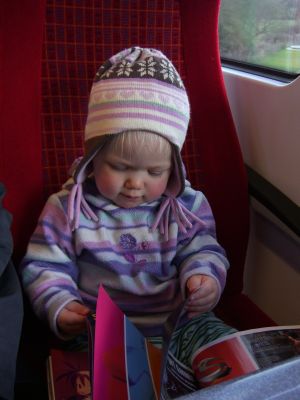
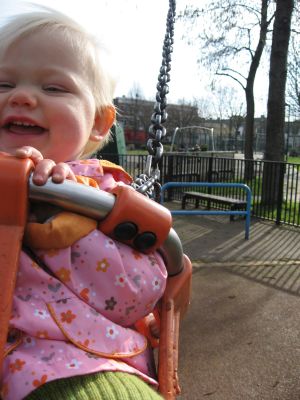
  1. Ingrid’s version of longer words often consist of the first syllable said twice (possibly with a difference in tone or stress). mandariin becomes ma-ma, magama becomes ba-baa, käru becomes tät-tää, and so on. It’s not just babbling: she knows that the words are not supposed to sound like that, but she cannot say them our way. My theory is that she cannot reposition her mouth quickly enough to string two different syllables together: she prepares the mouth once, and then just opens and closes twice.
  2. Her words generally end in vowels or in ll or ss. She cannot say bok or õun – it’s always boo and õuu. It makes me think of Japanese where (as far as I know) syllables consist of one consonant and one vowel (and McDonalds becomes Makudonarudosu). Perhaps there is a linguistic conclusion to be drawn from this?

I spotted a molar the other day. Lower right. There may be more but she won’t let me see or feel them, she guards her teeth jealously.

About a year ago, someone summarised Ingrid’s personality as “strong, glad and active”. (It was the staff at her first nursery, the one at my workplace, where she spent her first month in daycare.) While we didn’t disagree with that summary, it wasn’t something we ourselves had particularly remarked on at that time.

Over time we have come to realise just how apt that description was. To an outside observer who sees lots of different babies, it may have been noticeable a year ago. Now it is obvious to anyone who spends a few hours with her.

Ingrid is physically very active, and needs movement. She can not sit still for long, and she gets bored very quickly when there isn’t enough activity. Something needs to be happening all the time. On the days we are at home, she is usually ready to go out within two hours of getting up. (Which means that when she wakes at 6.30, she may want to go for a walk already by 8.) She gets incredibly restless if she is forced to stay at home all day, so during our long weekends We now try to go out twice a day, or for a full-day outing. Ideally we go some place where she can run and climb, but even a trip to the supermarket is better than sitting at home.

I have no other toddlers close by to compare her two, but from what I have seen, not all of them are like this. I hear of children who are happy to sit still and listen to mum read a story. When Ingrid reads a book, she is always actively involved: holding the book, pointing at things, saying their names. I see children who lean back in their pushchairs and don’t mind being carted around like a sack of potatoes. When Ingrid is out in her pushchair, she sits straight up and takes in the world. When I go grocery shopping, she always wants to be involved, to hold a bag of carrots or a carton of juice.

Her favourite activities tend to involve big, heavy things. I don’t know if she is strong because she likes heavy things, or if she likes heavy things because she is strong… She likes to lift milk cartons, to carry around pots and pans and big rucksacks, to push chairs around and to climb stairs.

And Ingrid has fundamentally a very glad and sunny disposition. At the nursery she just left, the staff said that they couldn’t remember her ever being angry. At home she definitely can be unhappy or upset at times, but it’s always for a clear reason: hunger, boredom, tiredness, or having her nappy changed, or not being allowed to play with the computer. There is no pointless, aimless whining. She is a joy to be around.

Ingrid is developing a temper. She has outbursts of anger when the world does not behave the way she wants. The trigger can be anything – seeing the wrong kind of food on the table in front of her; not getting to play with CDs or my wallet; not getting to see Teletubbies. (She is very fond of Teletubbies, but if she watches TV too late in the evening she can’t go to sleep afterwards, so she isn’t allowed to.)

If she is tired, the outbursts develop into full tantrums, complete with tears, screaming, arching her back, and throwing herself on the floor. She’s still new to this, so her tantrums pass quickly. The anger goes away, and we have a hug, and together we make the tears go away as well.

I definitely get the impression that the tantrums are beyond her control. Her initial anger may be such that she won’t let me hold her, but afterwards she is always a bit sad and wants a cuddle. She isn’t doing this to try to manipulate us. (If she did, she would have given up already, because throwing a tantrum has never led to Teletubbies.) She just can’t control her feelings.

When she isn’t tired, she often releases her anger by shouting, hitting or throwing something – knocking over her cup, or throwing her toy on the floor. Which is interesting, because it’s started all of a sudden, and she cannot have learned this from anyone (unless it’s other children at the nursery), so it has to be an instinctive reaction. It is funny – in a way that seems so grown-up, so un-babylike, but what it really means is that adults who throw crockery and slam doors have the emotional maturity of a toddler.

Ingrid is seventeen months old today. I’m still keeping track of months for these blog posts, but otherwise I now think of her age as “about a year and a half” – the months no longer feel relevant. She’s old enough for years now.

Ingrid reads Edge magazine

This month has been a continuation and a consolidation of the previous one. She is learning new words, although they all still tend to sound almost identical. I used to think that when parents say “We understand her” about their babies’ incomprehensible babbling, it was just wishful thinking, but it really works like that. I know that no one else could possibly understand Ingrid’s words, and even though we also have difficulty at times, we do generally understand what she means. But it only works because she only talks about things she can see, so the range of possibilities is limited. When we’re out and she suddenly shouts “paa!” I know that that means “dog” and not “book”, because there are no books out there (and also because only dogs generate that kind of excitement in her).

Trains and dogs are the two things that she always points out, with 100% reliability. If she sees a dog, she will say so. And she’s very good at spotting them. It’s the same with adults: we see what we’re primed for. When I was pregnant, I saw pregnant women everywhere; now I notice all the prams and pushchairs I pass. She notices trains and dogs.

Dogs are interesting but scary too. They’re best viewed at a distance of about one or two metres. When they get too close, she gets scared, turns away and closes her eyes – even if the dog is a quiet and well-behaved one. Cats are also very interesting, but there aren’t that many in central London, so until a week ago she’d only seen them in books. Last weekend we visited some friends who had cats (and chickens, too). The cats were initially as scary as dogs – 2 metres was close enough – but within a few hours that distance had been reduced to a few (baby) steps. The chickens were just scary.

Ingrid has Estonian words for most things (I spend most time talking to her) but Swedish ones for some, including sitta (sit) and strumpa (sock), although she also seems to understand when I talk about sokk (sock in Estonian). “Cat” used to be called kass (in Estonian) and was then katt (in Swedish) and is now some sort of mixture between the two. At nursery she waves bye-bye when we leave, but at home, we say hej då. During the weekend it takes her a day or so to switch from bye to hej då, and then the week after it takes a day to switch back. So perhaps she is on the verge of understanding that people speak different languages?

She is also understanding more and more how things work, how the world works. She likes to pull my shoelaces to untie them, and she’s got a vague idea of how zippers work. She likes to pick up litter and throw it in a garbage bin. She likes to brush my teeth while I brush hers, and to try and screw the lid on her sippy cup.

Fruit is still her favourite food, followed by bread and cheese. Other things are more unpredictable. Some things she devours every single time (Grassington’s Sweetcorn & Sweet Potato Waffles), others she rejects completely (porridge, no matter what I add to it). I’ve been trying to see a pattern there but not figured it out yet. Perhaps there is none. Whatever the food, though, it needs to be finger food, or possibly fork food. She will NOT let me feed her, and her ability with a spoon is still not so good. She’s much better with a fork, but she generally prefers to use her fingers.

Walking and climbing are as much fun as ever, as is jumping down from things. When we go swimming, she is always trying to get to the edge, so she can climb up and jump down again. When she’s bored with everything at home, a walk down and up the stairs often keeps her occupied for a while. With her longer legs and better balance, she now takes them standing up, not on all fours any more, although she needs to hold my hand (or two).

It seems she also likes balancing – standing and walking on wobbly things. When I help her up on a spring rider, she isn’t interested in sitting – she’ll climb on top and stand up. (Luckily she’s sensible enough to hold on to my hands when she does that.) When we’re on the Tube, she tries to stand and walk, too. She’s also more fond of her swing. We’ve had it for a good while now, and her interest in it has waxed and waned, and is at a high now.

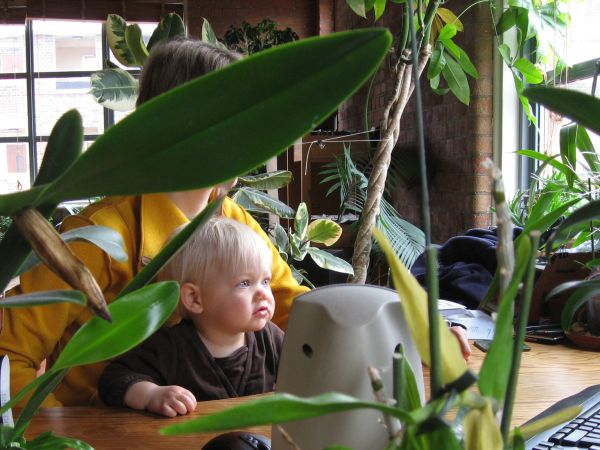
But her favourite pastime is watching Teletubbies. We don’t have a TV but we do have computers. Eric often watches movies and cartoons on his, and Ingrid likes to join him. In the morning when Eric has gotten up and is making his tea, Ingrid runs straight to his chair and waits for him to sit down there and lift her up as well. She likes Futurama, and she likes playing with the various small items on Eric’s desk while he reads the news, but she likes Teletubbies best. She is totally mesmerised by it.

Ingrid watching Teletubbies

I said the other day that adults live more boring lives than children because life does presents us fewer surprises. The other thing that sets children apart from us adults is that they don’t know their limitations, have unlimited ambition and are willing to cheerfully “try, try again” many, many times.

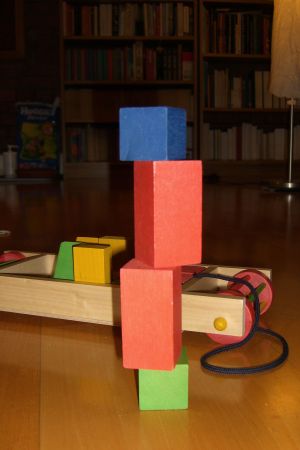
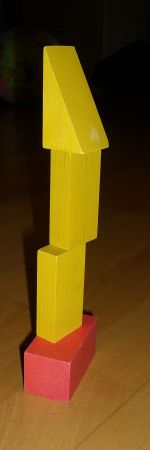
Case in point: building towers. When I build towers for Ingrid to knock down, they tend to be more or less straight, which lends them a certain stability but also predictability. When Ingrid builds a tower, she always stacks the blocks on their narrow ends and picks the tallest blocks, and she places the blocks whichever way they happen to land, which means it takes her about 10 tries to build something that’s more than 2 blocks high. (She also hasn’t understood yet that it is impossible to place another block on top of those narrow wedge-shaped ones.) While my towers don’t fall down when you breathe in their direction, Ingrid’s look more interesting.


Note: The second tower is a reconstruction; for some reason Ingrid tries to pick up her towers after she finishes building them, and they don’t generally survive that.

… of uninterrupted sleep last night, which is the longest I’ve had in about a year and a half. (Ingrid slept from 11 to 6:40.) Rather nice.

But, to be honest, it wasn’t that big a deal. Not a world-changing oh-wow experience. I think my body has actually gotten used to being woken once or twice every night. And if I could choose, I would rather wake once in the middle of the night but then sleep until 7:30, than not wake at night but have to get up at 6.

A month ago I was hard pressed to find much to say about Ingrid’s 15th month. It seemed that not much had changed: most of what I said was “this continues” and “more of that”. This month feels very different. I guess there’s some truth in what “they” say about children developing in spurts. (And it’s probably this spurt of advancement that has caused the uncharacteristic whinging.)

Where to start? Language, perhaps, because that’s where I’ve seen the greatest change. I think Ingrid has gotten over the big threshold and really understood the concept of words. She knows that certain sounds don’t just belong with certain things, but the sounds mean things. And she tries to make those sounds herself, too, although she’s naturally much better at understanding than at talking.

Whereas last month she had a handful of signs and even fewer words, I know for sure that she now understands dozens. She knows daddy. She knows hat, mittens, trousers, and boots; book, ball, lamp, pushchair, gate, train and car; dog and bird and duck. She knows eat, fruit, sit, stand, sleep, nappies and potty. And thanks to her books she knows cat and cow and sheep and cock and duck, and some of their sounds as well.

Pronouncing words is a lot harder. She can reliably produce half a dozen consonants (P, T, B, H and J – that’s the Estonian J by the way – plus occasionally M) and two vowels (A and I). Most words get reduced to these few sounds, so most words sound almost the same, except for small variations in tone. Daddy, lamp, and boot (pappa, lamp, saabas) all sound roughly like bapa. The intended meaning is only apparent from the context. The first clear word was ball (pall, which she pronounces as paj), but she can also say “thank you” very clearly (aitäh, which also means “give this to me please” and “take this please”) as well as boob (tiss, pronounced initially as tihh but now more and more as tii, or rather tii, tii, tiiii, TIIII!).

She also knows that cows say muu and sheep say baa and owls say uhhuu and cocks say kikerikii and is really fond of those animals’ pages in her books. For a while kikerikii was her favourite word, and she kept opening Muu, säger kon at the cock’s page while saying titetii with great enthusiasm.

Now that she has understood how language works she has also become better (or maybe just more insistent) at non-verbal communication. She points, or pulls my hand, or spurs me with her heels when I’m carrying her but not moving in the right direction. But at the same time she now has higher expectations. She expects to be understood, and is most upset when we don’t get it, which is still a very common occurrence.

Books remain popular, especially books that have pictures of things that she can recognise and point out. Our living room table is covered with children’s books. We’ve also started going to the local library now. The books are all in English but she doesn’t know that – all she cares is that they have pictures of familiar things. Picture books with a story are more hit and miss. She’s ignored some of them completely, but enjoyed others after a week or two of gradually increasing interest. The Gruffalo was boring at first but then she learned to recognise the fox, the owl and the snake, and then we’d read only the pages with those animals. The gruffalo itself was not interesting at all.

Ingrid is her usual active self and gets bored after just a few hours at home. We may get up at 7 and by 9 she can already be standing at the pushchair, trying to climb up and making very insistent noises at us. It used to be that we went out in the afternoon only, now we normally go out twice a day. I try to spread out my errands so I have reason to go out every day – or we just go to a playground or indoor play area somewhere. Anything to get out. And she generally prefers the pushchair to any kind of sling, because she can see more and move more freely. That lasts until she is tired; she usually prefers the sling for sleeping.

Playgrounds and parks are more fun now that she’s a more confident walker. She likes climbing, but unfortunately few playgrounds have climbing frames for children of her size. They tend to be geared towards much older children. We’ve found one in Stepney Green that’s just right for her: challenging, but small enough that she can manage some parts all on her own. In the absence of climbing frames, staircases are good fun, as well as simple grass slopes and pavement edges: anything that’s a bit tricky to walk. She especially likes to walk and jump down from things – walking down stairs, for example. And the best part of our weekly swimming sessions is sitting on the edge and jumping in. Sometimes we spend almost the whole half-our session jumping from the edge over and over again.

For some strange reason she also thinks it is very funny to sit on things (big bags or pillows, for example). She also enjoys unpacking bags again, but with a twist. This isn’t the old “tear everything out” game. No, now she takes everything out from the grocery bags after we get home from the supermarket, one thing at a time, and carefully hands them to me.

Clothes are interesting, especially hats and mittens and boots. She likes taking off her mittens and put them back on while we’re out. She points at her head when we’re about to go out and she hasn’t got her hat on yet (or when I haven’t put mine on). She carries her own boots around, talks about them, lifts up my large boots and puts them on the bench, carries Eric’s shoes around, tries to put boots on and take them off.

Teeth are still eight only (I think – I don’t get many chances to inspect her mouth for molars). Potty use is unchanged; one session in the morning just after we get up, but then almost nothing during the day because she won’t sit still. Eating habits generally unchanged: variable, but with a great emphasis on fruit, bread, cheese and breast milk.

Some new photos are up.