Every month when I sit down to write this monthly update, I think about how fast Ingrid is growing up. The big obvious milestones like walking and talking are well behind her now. But when you look closely enough, she’s still changing and learning all the time. In a way the changes now are more interesting, because they’re more subtle and more complex.

Speaking of walking and talking, she has just learned to jump with two feet and is very proud of it. Her jumps are tiny, with both feet just barely leaving the floor, but she enjoys it a lot and will happily demonstrate this skill for us many times.

On the language front she is now grappling with grammar. She understands singular/plural (koer vs. koerad) and genitive (pappas tallrik) as well as some basic verb forms (springa vs. springer). More recently I’ve noticed that she is starting to use the definite forms of Swedish words (hämta boken) and to figure out some Estonian verb forms (oota / ootama / ootan). That last one is going to be a hard one; Estonian grammar is not for the faint-hearted.

Her love of letters (which I mentioned two months ago has cooled somewhat, but now and again she still likes me to point out letters for her. Somehow she’s also learned to count to 10. It’s not something we’ve practiced specifically, but I do count to 20 while brushing her teeth to get her to sit still long enough. (I count very fast when she’s really tired and cranky, and really slowly when she’s preoccupied and happy to let me brush. Time is relative.)

Last month’s emotional turbulence has settled and life is calmer here again. Or perhaps we’ve just become more adept at managing it? It seems to me, anyway, that it’s not as important any more for Ingrid to control every small aspect of her life, and she doesn’t react as strongly when things don’t go her way. We have found a workable balance again between our wants and needs.

My life also became a fair bit smoother when she discovered the wonders of Teletubbies. Now she spends about an hour watching Teletubbies every evening. When she’s tired she wants me to sit there with her (so I read a book or a magazine) but quite often she’s happy to watch it on her own for a while, which leaves me time to prepare dinner (for example). Very convenient.

I was somewhat less happy when she discovered the joys of candy. Of course all candy is near the checkouts in the supermarket, at eye level for a toddler. I made the mistake of letting her buy candy a few times, and then she came to expect it every time. When I realised where this was heading and started setting limits (no, it is not OK to eat a pack of sweets every day before dinner) she was quite upset. Luckily she’s more interested in buying the candy than eating it, so my current solution is to let her buy some occasionally, but then only let her eat a small part of what she bought, so that next time we’re at the supermarket I can tell her that she cannot buy any more because we still have candy at home. Or even better, I do the grocery shopping on my own – this way she doesn’t even think about candy, and rarely asks for it at home.

Ingrid watching TV, with cow and sticky plaster

Luckily Ingrid has found several other new interests, too. Singing is one of them, and she likes it almost as much as reading books. She brings me a songbook and asks me to sing for her, one song after the other. She also knows a lot of them by heart and sings them herself. (Well, not quite sings, but she speaks the lyrics with a special tone of voice, and sometimes there’s a bit of melody and a rhythm.) Any mention of a star or sight of a star (quite frequent this time of the year, with Christmas decorations popping up everywhere) is likely to set her off singing “Twinkle twinkle little star”. And many times she just picks a random song and starts singing it. Of course with many of the songs she has no chance of understanding the lyrics (“fjärran lockar du min syn / likt en diamant i skyn”… no chance!) but she still generally manages to pronounce something that we recognise.

Drawing and painting is another favourite – but painting with a brush, rather than with her fingers, which toddlers generally begin with. She had tried finger painting a few times at nursery, but not liked it much, so I wasn’t in a hurry to try it at home. But when she got to try painting with a brush (at the Estonian playgroup we go to) she really enjoyed it. So now we occasionally do that at home, too. She generally doesn’t like to get “stuff” on her hands, whether it’s sand or mud or paint, and tries to wipe it off straight away. When she finger paints, she does it carefully with the tip of one finger. When she draws with a pen or a brush she seems to feel a lot freer, and the result is far more vigourous.

Even some toys are interesting now: all kinds of puzzles. We’ve got a whole bunch, ranging from stuff that we thought she had outgrown (a knob puzzle with five large wooden geometrical shapes of different colours) through just-hard-enough (a set of four wooden jigsaw puzzles of 3 pieces each, with pictures from Disney’s The Jungle Book) to some that she definitely needs help with (a nine-piece cube puzzle).

Ingrid’s approach to knob puzzles is clearly based on memory: she’s got one with four blob-shaped pieces with animal pictures, and she puts each one in the right slot without having to think about it. With the geometrical one, she knows where the pieces fit, but she tries other approaches, too, discovering that while the rectangle will fit into the square slot, the square then won’t fit; and that the circular piece can be rotated in place but the others cannot.

She solves the jigsaws in two phases. First she finds the three pieces of the elephant (for example) because she knows what the picture is supposed to look like. Then she fits them together, based on shape (knob vs hole) and picture. The pictures make it easy, because they’re generally cut in three (head, body, feet) and she knows that the head should be above the body and the feet below.

But with cube puzzles, where there are no knobs to guide her, she always needs help. She can find the cow pieces on all cubes, and lay out the cubes with the cow side up, but she hasn’t figured out how to match adjacent cubes. Sometimes she lays them in a row, sometimes in a square (if she has the box to guide her) but she puts them in random places and with random orientation. I try to tell her that she needs to turn them to make them fit together, or switch them around, but she doesn’t understand how it all works.
This is part two of a two-part post. You can read the first part here.

Yesterday’s post was all about Ingrid’s emotional rollercoaster life. Today’s is about more practical things.

Last month’s big news was the nursery start. This month it’s become routine, and Ingrid now really enjoys going to nursery. Most days I leave for work first, and later Eric drops her off at nursery. On the few mornings that I’ve done it, she’s gone straight to one of the nursery teachers, smiling all the way, and then carelessly waved good-bye to me. In the afternoon she’s always happy to see me and ready to go home, but already she’s sometimes telling me that she’d like to play some more, and that she wants to go to nursery the next day again.

While I don’t know exactly how she behaves there during the day, I get the impression that she’s as social there as she is at home. When I get there she’s almost always engaged in some activity together with a teacher. She knows the names of her own three teachers, and a few others that she sees when all the different groups are playing outside in the yard. She knows the other kids’ parents and tells me who’s whose mum.

Playing on her own is not her thing. In fact playing is not really her thing. At home her toys mostly languish in the box. If I join her, she doesn’t mind building with her Duplo blocks for a while, but not for long. She’d rather we read books together. I remember when she was smaller, she used to sit with her books all on her own. But that was before she learned that there are stories in the books, and I can get the stories out of the books, while she cannot. I’m very glad we got all those books when we went to Estonia in the summer: they’re very popular, and it’s great to be able to read in Estonian rather than translate Swedish books on the fly.

She’s also very fond of singing. They must do a lot of singing at nursery, because I often catch her singing snatches of songs that I don’t recognise. (Those songs are often followed by a “bravo!” which must also be something she’s picked up at nursery.) In Estonian we sing Põdra maja with all the movements, and Süda tuksub (which I remember my grandmother singing to me) and the one that goes mis need käivad kiiga-kääga. All sorts of “hopping” songs are great fun, too – Sõit, sõit, linna etc. I thought at first that I’d somehow only stick to Estonian songs, but I’ve realised that that plan was unworkable and abandoned it. Imse vimse spindel is too important, as are Bockarna Bruse and others.

I was a bit concerned that speaking Swedish all day at nursery would make her prefer Swedish, or that she’d be slower learning Estonian. No problems yet: most of the time she’s quite comfortable switching between languages. It gets a bit confusing for her when I’m also speaking Swedish (to the nursery staff, for example). But generally, when she says something that she only knows in Swedish, I reply in Estonian. She usually picks that up after a few repetitions and uses the Estonian word from then on. But there are some phrases that she has heard a lot in Swedish, and hardly ever in Estonian. She tends to stick to Swedish with these. (“Mummy will come in the afternoon” is one example that she probably heard many times during her early weeks at nursery.)

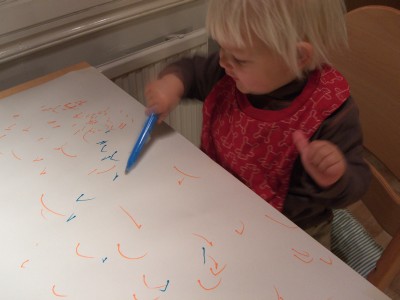
As a preventative measure we’re going to an Estonian playgroup every other Sunday. There’s a lot of singing there, which she likes, followed by some sort of creative activity. She’s tried painting with a brush there, and liked it a lot better than the crayons we’ve at home for a while. I think she was getting bored with them because there were too few colours, and she had to press quite hard to make a mark with them. The brushes made big marks quickly. Now I’ve bought a set of colourful felt-tip pens, and those are a lot more popular. She can draw things with these that she couldn’t make with crayons: small dots and big sweeping curves.

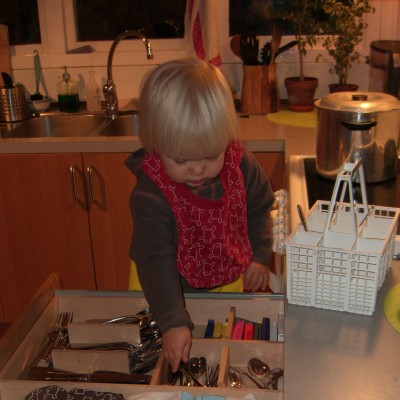
But I can’t spend all my evening drawing or reading, and it’s only fun for a short while if she’s on her own. She’d rather “help” me wash the dishes or load the washing machine. And in fact sometimes she does help rather than “help”. She can take the cutlery basket from the dishwasher and put away all the cutlery in the right compartments in the drawer (as long as I take care of all the irregular items there). She can put on her shoes and sometimes manages trousers or socks, too. Jackets and tops are harder: she can get them off but not on.

She wants to do like I do, and be like I am. When we eat dinner, and I lay out a fork and knife for myself, but only a fork for her, she wants a knife, too. When I hurt my finger, she wants a plaster, too. She points out all the things we have in common: that I put on a shirt, and that she is also putting on a shirt; that I go to work, and she goes to nursery.

Ingrid also points out all sorts of other things. We talk a lot when we’re out and about: both of us, not just me. She’s become quite verbal quite fast. We speak about how leaves fall off the trees, and how some trees are all bare now, and the leaves are on the ground. How the ground is wet after rain, and how it gets dark in the evening. We speak about things we pass: trees and cats and lawnmowers and garbage trucks. Quite often, she also mentions things that have happened before. This is where we saw the cat go into the bushes. This is where the garbage truck was standing yesterday. Here is where Ingrid fell from the swing and hit her head. And that was back in August I think: she’s got a long memory.

This post grew far longer than planned, so rather than subject you to a whole novella here, I’m publishing this in installments. Part 2 coming up tomorrow.

Twenty-four months. Two years. It feels like some sort of longer-term retrospective is in order but I can’t think of any good angle for it so it’s not happening today at least. Just the ordinary monthly thing.

In one sense, this has been a month of consolidation. She hasn’t mastered any major new skills, and there haven’t been any big changes in her life. But at the same time I feel that she’s changed a lot emotionally.

Ingrid’s become a lot more independent-minded. She has opinions on just about everything, and it’s become more and more important for her to have a choice, to make up her own mind, to feel in control, and to do things herself. She wants to choose what clothes she wears (which leads to some rather garish choices, such as an pink top paired with red and orange striped trousers). She wants to decide which towel I dry her with, and which route we take when we go home from nursery. She wants to turn on the bathroom light herself, and to take off the cap on the toothpaste herself, and to pour her own breakfast cereal. There’s a constant stream of “ise!” (“myself!”) all the time.

And these things are IMPORTANT to her. Her reaction to when things go “wrong” (meaning, not the way she would have done them) is instant and very emotional. There are floods of tears, and “Ingrid sad!”. (She generally reacts with sadness rather than anger.) She’s never been quite this emotionally fragile before. This independence and emotional fragility remind me of my own teenage years, as far as I can recall them. I’m guessing that this is as tough for her as teenage is for teenagers.

Quite often I forget these small things – I haven’t quite internalised the importance of who gets to turn on the bathroom light – so we end up redoing things. I turn off the light again and then she gets to turn it on. Since it’s obviously much more important to her than me, I don’t mind.

Of course, there are times when we will do things my way. We will take off a soaking wet nappy, no matter what she thinks about it. (For some reason she’s become really averse to nappy changes recently.) And we will go grocery shopping in the afternoon, even though she’d rather sit at home and read a book, because otherwise we won’t have anything to cook for dinner.

Those occasions are quite enlightening, actually, because I can see that her crying is not due to any sort of defiance or hoping to get her way, or a performance somehow aimed at me. She is truly upset. This afternoon, on our way out to go grocery shopping, she bawled all the way as she walked (on her own, ahead of me) out of the house and down the steps in the garden. She’d understood that I wasn’t going to change my mind, and that she had to do this, but she was still oh so unhappy about it. When both of us had reached the bottom of the stairs and I’d strapped her into her stroller, and we’d started walking, she wanted to point out a tree to me (because it had no leaves) and she could barely get the words out through her sobs.

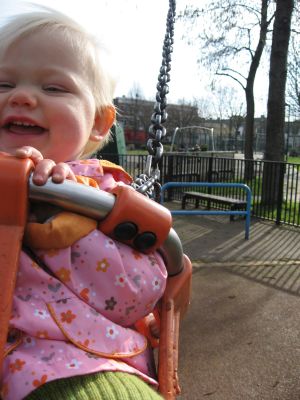
Running with a handbag in one hand and a dry leaf in the other

Luckily the emotional storms pass quickly. We hug each other, or something distracts her, or we get the unpleasant task done and move on. Distractions help: a nappy change is more OK if I sing to her while we do it (despite my total lack of musical talent) or if she gets some puzzle blocks to play with. Early warnings also make things smoother (“we will read one more story, and then we’ll go brush your teeth”) and so do promises of better things to come (“we will go grocery shopping now, and when we’re home again we will draw pictures”).

I’ve also noticed that she feels more comfortable when things follow a routine, and are done the same way every day. People always say routine is good for babies, but I notice it a lot more now that she’s a bit older. We have our going-home-from-nursery routine, and our morning bathroom routine, and our bedtime routine. She also likes small things to be done “the right way”: she quickly reminds me when I forget to light the candle on our dinner table, or when I give her a piece of bread but no plate.

Sort of in the same vein, fixed rules often work better than one-off decisions, assuming the rule can be explained in terms that she understands. “You cannot splash in puddles without rubber boots. No nursing during the night. You cannot sit in my lap while I’m eating. No drawing on hands, clothes, or table: only on the paper. We can eat when the timer rings.” She understands these kinds of rules very well and can repeat them to me herself. It’s harder to get her to accept decisions like “we must change your nappy now” or “we cannot go for a bus ride now because we need to go home and cook dinner instead”.

Our weekends are routineless almost by definition, firstly because she’s not at nursery, and secondly because that’s when we do all the odd tasks we don’t have time for during the week. But I believe I will try to find a fixed routine our weekday afternoons, going grocery shopping every day even though every other day is really enough, just to make life run more smoothly.

The main news of this month was Ingrid’s nursery start. After a settling-in period of two weeks, she’s now there full time, 8 hours a day, 5 days a week. During most of the settling-in period the children all had a parent there as well; the last few days were parentless. Ingrid had no objections at all to being there with Eric: a new place with interesting toys, and with other children to play with!

It was a lot less fun without Eric. For about a week everything was in upheaval: she was sleeping badly, really clingy while at home, and generally in a bad mood. Before this upsetting period she had almost stopped nursing at night, without much pushing from me. Now she went back to waking three, sometimes even four times a night. She’d wake up inconsonable and cry “not work, not work!” (meaning that she didn’t want me to go to work).

As she has gotten used to the new situation, she’s come to accept it. She’s gotten to know the teachers and the other children, and learned that she will not be left there, we will pick her up every afternoon. She grumbles a bit in the morning, but now when Eric drops her off she walks straight to the teacher she feels closest to, sits in her lap, and watches Eric leave. During the day she sleeps well, eats well, and plays happily. Only late in the afternoon, when she knows it’s almost time for me to come, and when the other children start leaving, does she get a bit sad.

By now our evenings are mostly back to normal. She is somewhat clingier than she used to, but that’s understandable: she’s squeezing a day’s worth of closeness into just a few hours. Nights have improved markedly, too.

With this major change, routine and familiarity seems to have become more important to her. Or perhaps it’s because she is older and has clearer expectations? In any case, she likes us to do things the same way and in the same order every afternoon. I meet her at the nursery. We go and pick up her nappies and then her clothes bag. We take all the bags outside and we put them on the bench. She puts her little red bag on the bench. We get the buggy out of the buggy storage shed. She climbs up. I pack in the bags. We take the same route home every day. We open the mailbox and she gets out the mail. And so on.

The same preference for familiarity recurs in many settings, and she is starting to have favourite things. Previously she’s never cared much about what she wears or what glass she drinks from. But now she wants the blue glasses, and she likes to take her little red bag to nursery every day, and she prefers her yellow leggings to all others. She wants the same jacket every day, and the same shoes. (The jacket is too small for her, about two sizes smaller than what I’d buy today, and yesterday I finally confiscated and hid it. I’m accepting her choice of footwear, even though it’s sandals, as long as the temperature is above freezing and she is wearing socks with them.)

Sometimes she seems to like things in theory but not in practice. Or perhaps she just doesn’t know what she wants. For several days she’s been telling me how she wants to go to the swimming pool – and yet when we get there she’s not particularly interested and wants to get out after barely 20 minutes. She begs for an apple, and then takes two bites and changes her mind.

As always, books are important to her, far more so than any toys or dolls. The first thing she wants to do in the morning is “läsa bok!” and it’s also the first thing we do when we get home in the afternoon. She remembers random phrases from her books and quotes them to me half a day later. Late in the evening as we’re preparing for her bedtime she can suddenly say “pappa kiigub” (daddy is swinging) and expect me to remember that in one of her books, the piglet had to wait in line while his daddy and the other piglets were swinging. Good memory training for both of us.

She has favourite books, and favourite pages in those books, and favourite phrases in those pages, which she starts repeating to me as soon as we get to that page.

H: Then the chicken went to the cat and asked, “I’m all alone and looking for a friend. Do you want to play with me?”
I: Rats of course!
H: “No, I’m busy,” says the cat. “What are you doing?” asks the chicken.
I: Rats of course!
H: “I’m hunting,” says the cat. “What are you hunting?” asks the chicken.
I: Rats of course!
H: “Rats, of course,” answers the cat. “Why don’t you talk to the goat instead?”

The alphabet book we bought in Estonia remains one of the favourites. Eric also bought a set of large colourful letter magnets, and she enjoys picking out the letters she knows (A, I, O, Ö, Ä, K, T, S, M, N, R and possibly some that I’ve forgotten). To reduce confusion, he removed all the lowercase letters, but of course an s looks the same as an S, and P and p and d are all the same too, so we have lots of these.

Sometimes we pick out all the Ss and put them on the fridge door. Sometimes we puzzle over Å and its similarity to both A and Ä. Sometimes we put Os on our fingers like rings, and look at the Os with little tails (Q) and the Os with the little openings (G). But the letters are amazingly versatile: there’s also the game of putting them all in a box and then pouring them out on the kitchen floor again, as well as the game of trying to sweep them up on a dustpan, and the game of poking them in under the fridge and then asking me to fish them out with a broom handle.

Some toys are for mess-making (the letters, for example, and a bunch of old phone cards, and marbles). All great for pouring on the floor and then picking up and putting somewhere else. Other toys seem to bring out her sense of order. Wooden blocks or toy cars, for example, are now lined up very carefully. And when she plays with her Duplo blocks (which she does almost every day now), she carefully builds straight lines (straight up, or end-to-end, or side-by-side). I don’t know if that’s a natural development or something she’s picked up from myself and Eric – we are rather orderly types, both of us.

I have seen inklings of pretend play – very occasionally she will pick up a piece of cheese from her plate and say that it’s a boat (and it does in fact look like a boat), or a horse, or a train. But mostly it’s just “doing stuff with things”.

Now that she’s spending much of her day at nursery, we don’t spend much time playing together, and especially not on workdays. Instead I try to get stuff done (dinner, laundry, shopping, cleaning) and that generally means I have to try to involve her, too. She’s a social creature and would much rather join me than play on her own.

With most activities her contribution to the practical aspect of things is about zero, which is not so bad, because it is not a negative contribution. And sometimes she likes the activity so much (in a very serious, concentrated way) that it becomes enjoyable for me, too. She really likes sweeping the steps from the gate to the door, for example.

Shopping with her is a fast-paced activity but calmer than it used to be, and I’m not so anxious about her eating all the fruit she can get her hands on. (Except if we happen to get close to the candy section: somehow she’s learned about candy and wants to have it right then and there.) She knows that we go to the shop to buy food, and she knows where some of the stuff is, and she understands that when we’re done we go to the till and give money to the man or woman sitting there.

On the other hand, food preparation with Ingrid is messy and hectic. She wants to do all the things that I do: chop veggies, and to whisk sauces, and to open jars, and to pour water in the saucepans, and so on. Most of the time I can keep her on a parallel track – she gets her own chopping board and her own little knife, and a measuring cup with which she can fill a saucepan, and her own dish brush. But even then it all ends up very messy and wet. Other things remain off limits, especially anything to do with the hot stove.

And of course she wants a taster of everything that goes in the food. I’m OK with her tasting tomato purée and sour cream, but I’ve thus far refused her pleas for black pepper and raw garlic. Not because I think it’s a bad idea but because I don’t have the time to deal with the aftereffects at the same time as I’m preparing a meal.

Her language development has gotten to a point where I can have actual conversations with her, and see that she understands what I’m talking about. It’s mostly simple, everyday stuff. We’ve spoken a lot about autumn recently (leaves turning yellow or red and falling down). We talk about puddles, and how there are big puddles that you need rubber boots for, and small puddles that you can sometimes walk in with your sandals, and the very small puddles that collect on our crumbling stairs. We talk quite a lot about other people, and about “ours” and “someone else’s” and “her own” etc – how we have our home, and the other children from the nursery go to their own homes, and the houses we pass are someone else’s homes. We talk about other children also having mummies, and other adults also going to work. We talk about our train station being the right station for us, and other stations being wrong for us, but right for the people who get off the train there. We talk about how to make sense of the world.

Language development continues apace. Two-word combinations are now old hat, and combinations of three words and more happen every day. In fact they are so common that I’ve stopped noticing them. She also learns new words at such a speed that my astonishment has worn out and I am simply accepting this miracle as an ordinary thing.

We’ve just spent two weeks in Estonia, and she figured out very quickly that Estonian is the thing that works with those people. By the end of the two weeks she was using very few Swedish words when talking to us. But for some words she took care to point out that pappa says something else. She might say muna about the egg on her plate, and then look at me and say pappa ägg. Bilingualism is obviously not going to cause any difficulties for her.

Some of the words she learned very early on remain in their early state – she still says “Ije” for “Ingrid” for example. Otherwise her pronounciation is now good enough that even strangers can understand some of what she says. As long as she picks the right language, that is.

I love all this talking. It’s so nice that she can tell me what she wants, point out things that she sees or hears or wonders about, or just express her thoughts. The best thing about it is the insight I get into what is going on inside that head, what she understands, what she is interested in, what she thinks she is doing. A window into her mind. Today, for example, she has been commenting a lot on noises she hears, such as airplanes, passing cars that she cannot see, PA announcements and so on. Had she not been speaking, I would probably not have noticed it, because it’s not something she can point at.

Puddle!

Her talking has also made it clear to me just how much she understands: concepts like soon vs. later, things happening quickly vs. taking a long time, “first we do this, then we do that”, etc. I’ve also realised how much she remembers, and thinks about things we have seen or done or read during the day. When we run out of milk during breakfast, and I tell her that we’ll buy more in the afternoon, she confirms this at lunch, and then mentions it again when we go out in the afternoon. At bedtime she may repeat the ending of a particularly memorable book we read in the morning, or remind me that I promised we would buy her a pair of rubber boots soon.

Ingrid is still very fond of books, and now it’s definitely stories she wants. Preferably stories with pictures on every page, and no more than a few sentences per page, so we don’t have to look at the same page for too long. Rhymes are also good. She has never yet turned down an offer to read a book. And while previously she would often begin the day by telling me “uuut!” (go out), now she is more likely to tell me “läsa bok!” as soon as we get up.

On a whim, while we were stuck waiting somewhere and she was bored, I started pointing out letters to her, and how they make up words. She loved the game! Then she would pick up a newspaper or some advertising material with big letters on it, and point at them and say “I, E, O, E” as if reading, to show me that she wanted to play that game again. We bought an ABC book and it’s a great favourite.

We’ve also counted things a lot. She has a firm grasp on the concepts of one and two, and often tells me, for example, that she is putting two berries in her mouth at the same time. But beyond that I’m not sure. I know that she knows that number words come in a certain order, and she knows how they are used, but her own counting often goes üks, kaks, viis, kuus, kümme, meaning “one, two, five, six, ten”. And it’s always those specific ones, plus sometimes kaheksa (“eight”) in the right place, too. She always, always skips three and four. I suspect it’s because she cannot say the L sound (the words are kolm and neli in Estonian) so she doesn’t like to even try to say those words.

Lifting, not pushing the wheelbarrow…

On the physical side, I’ve noticed improved dexterity. She can now eat quite well with a fork, and can build towers out of Duplo blocks. Long and slim towers, preferably of the smallest 2×2 pieces… But she still prefers large things and big movement. Climbing frames are great, especially those that are really meant for older children, so that she really has to stretch to reach. Otherwise it’s too easy, I guess. Kicking a ball, balancing on things, hanging from things… The best toys are the large ones, and the best use for them is to carry and lift them. We bought her a chair, and while she does sometimes sit on it, she mostly carries it from one room to another.

Dolls are beginning to become more interesting. Dolls get to eat cheese, and wear her bibs, and sleep in our bed, sit on our chairs. (One of them apparently needed a nappy, too, but unfortunately the mismatch in size was just too big.) She even let me brush her teeth without struggling when she got to brush a doll’s teeth at the same time. Dolls and toy animals all like kisses, too: give her two stuffed animals and they will soon be rubbing their noses together while she says “puss!”.

The most memorable change for Ingrid this month was the advent of two-word sentences. Now she often says things like “Ije baga” (Ingrid magama = Ingrid sleep), “toga pall” (stor pall = big ball), “atta ommo” (vattna blommor = water the flowers), “emme itta” (emme sitta = mummy sit) and so on. Sometimes when I say a longer sentence (“The boy is playing with a big ball”) she tries to repeat it by makes several shorter ones out of it: “boy play” plus “boy ball” plus “big ball”.

She also uses language in more varied ways now. She can point out things, and describe things, and ask for things – but she can also make suggestions, which are clearly less determined in tone than pure requests (“Ije?” while pointing at Eric’s sunglasses, meaning “could I play with those?”) and ask questions (“onu?” while pointing at a newspaper means “are there any pictures of people in there?”). (We’ve been focusing on people words such as “man” and “woman” and “boy” and “girl” recently.)

I’ve noticed is that she is more adept at listening, too. What I mean is that she notices which words are important to the speaker, which words are said with extra stress or attention or emotion. The one time one of us said a (very mild) swear word (“jäkla sniglar” = “darn snails”) she immediately picked up on the “jäkla” and repeated it many times with great glee.

Her pronounciation is a lot clearer (most notably P and K are now separate sounds, so a tree is no longer called a moon) but as you can see from the examples, her language is still very much in a state where only a parent would understand her. We generally understand most of what she says now, even though we sometimes struggle when she freely mixes Swedish and Estonian in a single sentence. Generally she knows the names of the most important things in both languages, but for other things she often only has one of the words. Sometimes, though, I suspect that she switches to a language of her own, because suddenly she says something long and fluent but completely incomprehensible.

A few weeks ago I wrote that ise (= myself) was a much-used word. And it still is, because she likes to try to do things on her own. She’s getting better at it, too: just this evening she managed to get both legs into her pajama bottoms, and her attempts to wipe up spilled food from the table now actually make the table slightly cleaner.

But the world is now less black and white: it’s not a choice between “mummy do” and “Ingrid do”. She has now added the word koos (= together) to her vocabulary and uses it when she wants us to do something together, such as sit in the sofa and read a book. Likewise she’s understood that sometimes ise is not best, and it is good to have some help, so she says aita (= help).

And of course, whatever we do, she wants to join or copy. Mummy takes a handbag when she goes out? Ingrid takes her bag, too. (The bag is one of her few important possessions right now.) Daddy climbs a ladder to pick cherries? Ingrid wants to stand on a ladder and pick cherries, too. I generally try to accommodate her as much as possible in these situations. When Eric is on a ladder picking cherries, the option of doing nothing does not exist: she would climb up after him. I could take her away so she cannot see that he’s climbing. But if I’m going to be busy keeping her out of his way, I might as well do it so that she is a part of the action: bring out the small stepladder and find a low-hanging branch that she can eat from.

In fact the surest way to make her angry is for one of us to do something that she can see, and finds interesting, but isn’t allowed to copy. And of course it must seem terribly unfair. The other sure way to anger her is to ignore her: to sit in the sofa and try to read, and tell her to play on her own. For everyone’s peace of mind we try to avoid both, if possible.

Of course it isn’t always possible. When I’m eating dinner, I’m not going to stop just because she wants to play with me. And then she gets angry. Being upset and crying is nothing new of course, but now she displays proper anger and sometimes starts hitting and throwing things. She has no other way to diffuse her anger, I guess. Sometimes she sits down on the ground and picks up whatever is closest and throws it, and then goes after it and throws it again, and again. It’s kind of funny when that thing is a small piece of crumpled-up paper… Less funny when she’s sitting at the kitchen table and we see she’s about to get angry, and the closest thing is a glass of water. (The glass gets quickly moved out of range.) But the violent anger dissipates quickly, and she calms down enough to come to us for a cuddle of consolation.

When she isn’t joining in our activities, we’re often out doing something active. We go to playgrounds (climbing, swinging, splashing in a pool), or kick a big beach ball around the garden, or simply run up and down the lawn. All of these are quite social activities: she quickly loses interest in the ball if I’m not there to kick it with her (and when my attention wanders she reminds me that it’s my turn now), and running is a lot more fun when she can hold my hand.

A relatively new favourite is spinning around in circles. Ideally she’d hold my hand and then we’d both spin until she is so dizzy she falls over. Unfortunately I feel nauseous well before we get to that point. I generally try to convince her to run around me while I sit on the ground and hold her hand.

Books are still popular. She’s now getting interested in actual stories, not just pointing out things that she sees. Some of the baby books are going out of favour, while others that she had ignored are now suddenly interesting, because they have a story. And she listens attentively to the bedtime stories I tell her. I’m planning to do some major book shopping when I go to Estonia later this summer.

Drawing is another nice indoor activity. She used to enjoy scribbling with crayons, but now she prefers to watch me draw, and then either guess what I’m drawing, or suggest things for me to draw. Her own scribbling used to be forceful but artless, focusing mostly on making as big a mark on the paper as possible. Now I think she has once or twice tried to actually draw something. At least she once drew a brown line and then a green one, and said “puu” (= tree), moments after I had drawn a tree for her with the same crayons.

Ingrid is definitely “almost two” now: a “big girl”.

More and more, she wants to be like us and to join us in whatever we’re doing. When I am cooking dinner, she wants to stand on her step stool and watch me chop the veggies. (And have a little taster of everything. It turns out that she really likes raw mini sweetcorn, will eat raw aubergine and potatoes, as well as uncooked beans.) When I’m doing the laundry, she wants to be there to help me pull the clothes out of the washer and hang them up to dry. When the table in front of her mysteriously acquires splashes of food, she wants to wipe it with a paper towel, just like we do. When I go grocery shopping she gets a little trolley to push, and loves to put our shopping in it.

Watering flowers Watering the cat

Shopping actually goes faster this way, because she is in constant movement. The moment we’ve picked up the milk, she’s rolling onwards, and I have to either keep up or stop her trolley (in which case she’s likely to toddle off without it). I try to have a detailed list with me so I don’t need to stop and think while we’re in the shop, and it means that we walk through the shop in one long smooth movement.

Speaking of walking, she’s got much better stamina now than just a month ago. She often prefers walking to sitting in the pushchair. The shop we normally go to is, I’d guess, about 15 minutes’ walk away, and it isn’t uncommon for Ingrid to walk half the way there before climbing up into the pushchair, then come down again to walk through the shop and halfway home, too.

Meanwhile Ingrid has also discovered / understood pretend play. I’m not sure if this is related to participating in our activities, or just happened at roughly the same time. Her stuffed penguins walk, and her cow sits and sleeps. (Any animal or toy that lies down is always “sleeping”.) She also has her doll, and quite often doll wants to sit next to us on the sofa, or reads a book, or sleeps. Doll sometimes also wants to drink water from a cup, or to breastfeed. This morning doll was apparently hungry and was carefully fed with yoghurt. Occasionally Ingrid also enjoys feeding me (although my patience lasts through about two or three bites).

Speaking of eating… she’s now quite competent at feeding herself with spoon and fork, and reliably manages a glass or a cup. When she wants to, she can get stuff in her mouth without spilling much at all. The bib is there just in case, and remains clean after many meals. Messes arise when she gets bored with eating and starts to play with her food instead. She dips her pasta in her milk, or eats orange juice with a spoon, or tries to eat yoghurt with her fingers, or stuffs her mouth full of grapes and then spits them out half-chewed. At least she’s now learned that hand-washing after a meal is an unavoidable step.

It’s hard to say anything meaningful about her language development. I know her vocabularly keeps growing, and that it now includes a good amount of verbs, as well as simpler adjectives (big, small, hot, cold, wet, etc, plus a few colours I think). But I really only know about the ones she uses actively. I know that she understands an awful lot more than she says. I can give her instructions using words she’s never said – “put that nappy in the bin in the kitchen, please” or “climb up on the bench and I’ll help you open that box”, and she’ll follow them without hesitation.

Books remain as popular as ever. She still likes to point out things in books, but now I think she’s beginning to be interested in actual stories, in things happening after each other, in the same order. She likes to predict what will be on the next page: turns a corner and peeks enough to be able to guess, then turns the whole page and is happy when it turns out that, yes indeed, there is a cow on that page.

I’ve recently started telling her bedtime stories, too. It’s hard to know how much she understands of the actual story, but hearing my voice drone on keeps her relatively calm and makes bedtime a bit shorter. Before I started telling stories, she’d spend upwards of half an hour kicking and climbing around in the bed. Now it can sometimes take as little as 15 minutes, although half an hour isn’t at all rare. But at least she doesn’t kick me in the ribs, or climb over me while supporting herself with a knee in my groin, or accidentally headbutt me while trying to walk on the bed.

In fact I hope she doesn’t understand too much of the stories, because otherwise she’d probably be too scared to sleep: the only stories I know well enough to tell without much thought are the classics, Little Red Riding Hood, The Wolf and the Seven Little Kids, Hansel and Gretel, and other scary stories where someone generally gets eaten alive.

Ingrid has spent the past month naming things, especially animals. Man gave name to all the animals / in the beginning… She has a favourite book: Djurlexikon. It is big and has lots of pictures of all kinds of animals, and Ingrid’s appetite for this book is unsatiable. She knows cats and lions and wolves and apes, but also bats and butterflies and owls and penguins and snails and sharks and skunks and ostriches and snakes. Her pronunciation of all these words is often very remote from the real thing, but it’s clear that she knows the word and knows what she wants to say.

Ingrid and Eric reading about tigers

Some animals have Swedish names, some have Estonian ones. A moose is always põder, while an ostrich is a struts and nothing else. I think she goes for the language with the shorter, punchier word. And when the “wrong” parent “reads” the page about the ostrich, for example, she takes the book to the other parent because she wants to hear the “right” word. (The skunk is a good animal because it has the same funny-sounding name in both languages.)

And other animals she only calls by their sound. A lion is neither lejon nor lõvi but a roaaar, even though she understands both the real words as well. Mice, likewise, are called piip. Wolves are interesting because she uses both parts for them: they’re called uuuuu…. varg.

Lately she has been particularly fascinated by all the animals’ tails. She points out tails on all the animals, even those where she knows there should be one, but it isn’t visible.

Speaking of naming animals, Ingrid has finally also started saying emme (“mummy”). She started saying pappa months ago, but managed to get by without a name for me. Which is logical, I guess, since I was there with her. There was no need to talk about me, but there was need to say “go see if daddy is awake” or “look, daddy’s coming home”. Now that I am away during the day and Eric is at home, I am greeted by a loud happy “emmmeee!” when I get home from work in the evening, a sad “emme!” in the morning when I leave, and lots of “emme, emme, emme” while I am at home.

Just in the past week or so Ingrid has also started saying her own name. She pats Eric and says “pappa”, points at me and says “emme”, then pats her own chest and says “Ittii”, beaming with pride.

Her vocabulary is still almost all nouns. There are a few important action words like “go out” and “sleep”, and we have tried things like “stripes” and “spots”, “big” vs “small”, but I don’t think she’s really understood those.

She has also started mimicking the various small words that we say often without thinking much about them, with the very same tone that we use. The “jaa” where the tone goes down-down-down-up (“Do you think it will rain? Jaa, who knows…”). The confirmatory “neh” (“That wasn’t so good. Neh.”). And above all “oj” which for us means “oops” and for Ingrid means “look at this interesting thing that happened”. “Oj”, I poured water on myself. “Oj”, I threw food on the floor.

Pouring water

She wants to do like we do and be like we are. She wants to brush her own teeth, hold a phone to her ear and talk into it, splash with water in the kitchen sink while we are doing the dishes, and “help” us peel vegetables. She doesn’t get to play with phones very often (she won’t accept fakes, and we are not particularly willing to let her play with ours) but she did get a step stool and a waterproof smock so she can help in the kitchen. The stool was an instant hit and gets lots of use.

The best thing about the stool is that she can get up on it on her own. She likes climbing. She can climb into her (rather high) pushchair, and onto the sofa as well, and of course all sorts of climbing frames and other such things (including climbing up slides, from the wrong side). Either she has become taller or she’s developed better technique, because she didn’t manage the pushchair a month ago.

Odds and ends:

She enjoys lifts and escalators. She tends to walk up stairs with the right foot first, and down with the left foot first. She does not like having sand or dirt or other icky stuff on her hands or clothes, and makes great efforts to brush it off. She doesn’t like being dried after her bath, but she likes rubbing lotion on her tummy.

She likes beans but doesn’t like ice cream. She likes milk. We last tried offering her milk about half a year ago, and she rejected it very firmly. Now she loves it. She also loves yoghurt, juice, and pasta.

She is starting to look like a girl, so now maybe only half the strangers we meet refer to her as “him”. She sometimes lets us cut her fingernails while she’s awake and not even breastfeeding, without jerking the hand away. Her hair is still like a crow’s nest at the back of her head, with lots of broken hairs, because she tosses and turns so much in bed. She has 10 teeth (4 + 4 in the front plus 2 molars) and a hint of an eye tooth. She takes one nap during the day, preferably in the cycle trailer.

For over a month I’ve found myself thinking of Ingrid as “almost two”. She is nowhere near two, of course. But my brain wants the calendar to be decimal, so seventeen or eighteen months get rounded to twenty months, which should be the same as two years. I’ve now trained myself to ignore the months and just think of her as “about a year and a half”. Today she is exactly a year and a half.

The past month has been strongly language-oriented. Ingrid’s vocabulary is growing daily. Most of it is passive – she understands but doesn’t say the word herself – but her active vocabularly is also growing by leaps and bounds. And while much of what she says is still hard to decipher because many words sound the same, her pronounciation is definitely clearer as well.

I think there was a release, a step change, when she figured out that Eric and I have different words for the same thing. I knew that she had passed that important point when, one day, she pointed at an apple and said “äpp-e” to Eric, then turned towards me and said “õuu”. There aren’t many words where she actively uses both languages like that – for most common things she understands both names, but only uses one of the words actively herself. Trains are always called “taa” (Swedish “tåg”), navels (which she for some reason finds very entertaining) are called “naba” in Estonian.

Her vocabulary mostly consists of nouns and some verbs (especially for important things such as eat, sleep, go out, stand and sit). I don’t think she’s grasped adjectives yet. She is especially good at body parts, food (fruit in particular), things found around the house, items of clothing, and lots and lots of animals. She can point out parrots and turtles and butterflies and zebras and lions so on and on and on. Cats and dogs and pigs are particular favourites. Cats and dogs because she has seen real ones, and pigs because of their sound. Eric does a great pig grunt imitation, which Ingrid finds fascinating. She tries to imitate it but cannot. So instead she points out every pig she sees. It’s impressive that she can grasp the abstract concept of “pigness” so well that she recognises even stylized pigs in logos, with just the snout and half a head visible.

Stockholm has a lot more cats and dogs than central London. I think Ingrid has seen more of each during the last week than during all of her year and a half in London. There are two cats in our house who tend to hang around outside, so we often run across them when we’re going out, and my in-laws have a pair of schnauzers, plus we tend to meet many dogs while we’re out. All this has meant a lot of close contact with both cats and dogs. Ingrid is still cautious around them, but she is far more comfortable being close to them than before (although not to the point of petting them yet).

The other thing Stockholm has more of is good playgrounds. Playgrounds in London tend to be quite small and sterile things: a small rubber-covered area with a swing, a few spring riders, and a slide or two. The swings, spring riders and slides are present here, too, but there are also sandboxes, and the whole playground is usually covered with coarse sand rather than rubber – and sand (plus a bucket and a shovel) can keep a child occupied far longer than a spring rider. Even more importantly, the playgrounds around here always have other children, whereas in East London I was often alone with Ingrid, so we’ve been spending a lot more time in playgrounds here.

Initially, climbing, sliding and swings were Ingrid’s favourite playground activities. The small playground which is closes to our house (100 metres away) only has “big girl” swings made out of old car tyres, and she has learned to use those, too. She knows that she needs to sit still without twisting, and hold on hard with both hands. She has also learned to slide down Swedish slides, where the metal slide part has a rippled texture which makes them more slippery and faster, and to land on all fours (rather than her face) when coming down the bigger ones.

Sand only became interesting a few weeks ago, when she got to borrow a shovel from another child. Which is why it’s so nice to meet other families at playgrounds – I hadn’t even thought of buying her a shovel!

I think we found sandboxes at just the right time – I believe she enjoys playing with a bucket and a shovel because she just recently mastered the use of spoons. She can now get food onto the spoon, and get the spoon into her mouth, without turning the spoon upside down on its way. It also turns out that she can pick the husk off a physalis fruit, and spit out the seeds from a grape.

Speaking of food… bread, cheese and fruit are still among her favourite foods, but meatballs has now been added to that list, and butter. She now licks the butter of her bread and would probably be happy to eat butter with a spoon if we let her. Her interest in cooked food is a bit unpredictable, but I think in general she prefers sweet and fatty food. We went to IKEA today and ate at their restaurant. Ingrid got a traditional kids’ meal of meatballs, potatoes, sauce and lingonberry jam. She ate the jam and the meatballs, licked the jam off a potato, and otherwise ignored the potatoes completely. (We had been wise enough to not take the ice cream also included in the kids’ meal.) But in general she is now suddenly eating much bigger portions. If I had to guess, I’d say that a month ago she got half her nutrition from breast milk, whereas now it’s a small fraction.

Other favourite toys and activities: reading picture books about animals; moving fridge magnets between the fridge and the steel hanging folder file; the marbles and pebbles that decorate a few of the potted plants in this apartment; looking into kitchen cupboards; putting a plastic bowl on her head as a hat; looking through a sieve; pointing out people’s navels; carrying large objects such as her Wheely Bug.

Ingrid is seventeen months old today. I’m still keeping track of months for these blog posts, but otherwise I now think of her age as “about a year and a half” – the months no longer feel relevant. She’s old enough for years now.

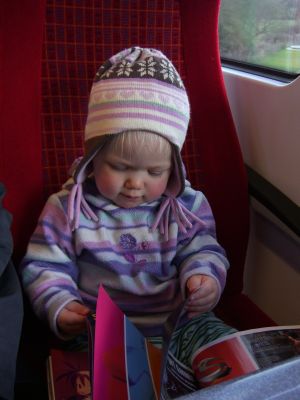
Ingrid reads Edge magazine

This month has been a continuation and a consolidation of the previous one. She is learning new words, although they all still tend to sound almost identical. I used to think that when parents say “We understand her” about their babies’ incomprehensible babbling, it was just wishful thinking, but it really works like that. I know that no one else could possibly understand Ingrid’s words, and even though we also have difficulty at times, we do generally understand what she means. But it only works because she only talks about things she can see, so the range of possibilities is limited. When we’re out and she suddenly shouts “paa!” I know that that means “dog” and not “book”, because there are no books out there (and also because only dogs generate that kind of excitement in her).

Trains and dogs are the two things that she always points out, with 100% reliability. If she sees a dog, she will say so. And she’s very good at spotting them. It’s the same with adults: we see what we’re primed for. When I was pregnant, I saw pregnant women everywhere; now I notice all the prams and pushchairs I pass. She notices trains and dogs.

Dogs are interesting but scary too. They’re best viewed at a distance of about one or two metres. When they get too close, she gets scared, turns away and closes her eyes – even if the dog is a quiet and well-behaved one. Cats are also very interesting, but there aren’t that many in central London, so until a week ago she’d only seen them in books. Last weekend we visited some friends who had cats (and chickens, too). The cats were initially as scary as dogs – 2 metres was close enough – but within a few hours that distance had been reduced to a few (baby) steps. The chickens were just scary.

Ingrid has Estonian words for most things (I spend most time talking to her) but Swedish ones for some, including sitta (sit) and strumpa (sock), although she also seems to understand when I talk about sokk (sock in Estonian). “Cat” used to be called kass (in Estonian) and was then katt (in Swedish) and is now some sort of mixture between the two. At nursery she waves bye-bye when we leave, but at home, we say hej då. During the weekend it takes her a day or so to switch from bye to hej då, and then the week after it takes a day to switch back. So perhaps she is on the verge of understanding that people speak different languages?

She is also understanding more and more how things work, how the world works. She likes to pull my shoelaces to untie them, and she’s got a vague idea of how zippers work. She likes to pick up litter and throw it in a garbage bin. She likes to brush my teeth while I brush hers, and to try and screw the lid on her sippy cup.

Fruit is still her favourite food, followed by bread and cheese. Other things are more unpredictable. Some things she devours every single time (Grassington’s Sweetcorn & Sweet Potato Waffles), others she rejects completely (porridge, no matter what I add to it). I’ve been trying to see a pattern there but not figured it out yet. Perhaps there is none. Whatever the food, though, it needs to be finger food, or possibly fork food. She will NOT let me feed her, and her ability with a spoon is still not so good. She’s much better with a fork, but she generally prefers to use her fingers.

Walking and climbing are as much fun as ever, as is jumping down from things. When we go swimming, she is always trying to get to the edge, so she can climb up and jump down again. When she’s bored with everything at home, a walk down and up the stairs often keeps her occupied for a while. With her longer legs and better balance, she now takes them standing up, not on all fours any more, although she needs to hold my hand (or two).

It seems she also likes balancing – standing and walking on wobbly things. When I help her up on a spring rider, she isn’t interested in sitting – she’ll climb on top and stand up. (Luckily she’s sensible enough to hold on to my hands when she does that.) When we’re on the Tube, she tries to stand and walk, too. She’s also more fond of her swing. We’ve had it for a good while now, and her interest in it has waxed and waned, and is at a high now.

But her favourite pastime is watching Teletubbies. We don’t have a TV but we do have computers. Eric often watches movies and cartoons on his, and Ingrid likes to join him. In the morning when Eric has gotten up and is making his tea, Ingrid runs straight to his chair and waits for him to sit down there and lift her up as well. She likes Futurama, and she likes playing with the various small items on Eric’s desk while he reads the news, but she likes Teletubbies best. She is totally mesmerised by it.

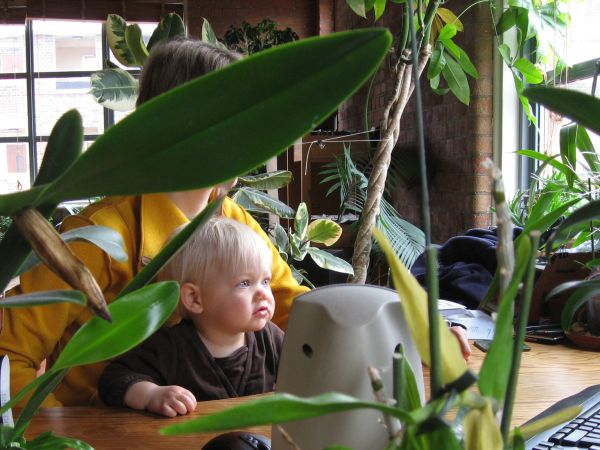
Ingrid watching Teletubbies