My best buy during my time on maternity leave with Adrian was my shopping trolley from IKEA. I wouldn’t call it life-changing, and it doesn’t rank quite as high on the awesomeness scale as baby slings, but it made a big difference: it let me get things done with a lot more ease.

Now that I am back at work, transporting kids and things is still a major part of everyday mothering. This season the challenge has grown because they need to go to different places: Adrian is still at nursery but Ingrid goes to school. Ingrid transports herself, really, but she is not old enough to do it all on her own, so I get to do a lot of walking.

On a normal Friday afternoon I spend just about two hours walking back and forth across Spånga. Train station, school, other school, nursery, supermarket, other school, home.

Spånga is full of hills, and this has been a rainy autumn. So this season’s best buy is a rain coat. Not a waterproof jacket but a proper coat in rubberized nylon that reaches down to my knees and keeps me drier than an umbrella. Just like the trolley, it is not life-changing but it makes daily life a lot easier. No more struggling to push a stroller up a steep hill with one hand, while holding my umbrella with the other (and a bag of groceries with the third).

A lot of mothering seems to boil down to having enough hands. I’ll buy anything that frees up a hand or two.
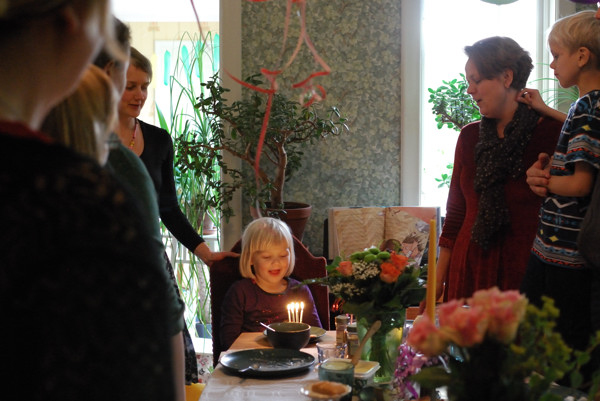

(In Sweden it is traditional for everybody to stand up while singing Ja må hon leva, while the person whose birthday it is remains seated. Kids stand on their chairs.)

When you see a piece of clothing in a shop and immediately think wow, this is exactly what I have been hoping to find, this is it! and then you look at the price tag and realize that it is about 3 times more expensive than the most expensive item of clothing you have ever bought. Then you decide to try it on anyway, just because – and you realize that it looked much better on the hanger than on you.
Phew.

We’ve been car owners for over a year, but it still feels like a fairly new thing to me, because I don’t drive very often at all. I have no reason to drive anywhere on weekdays, and not all weekends either. And when the whole family drives somewhere, Eric is in the driver’s seat. Adrian is not always fond of sitting in a car, and I find it really hard to concentrate when he is crying or screaming. I’d rather take the thankless job of trying to keep him entertained, than have to listen to his complaints.

My previous driving experience before buying the car came from our vacations in various parts of Great Britain. Until Ingrid was born, we used to set aside the long Easter weekend for driving and hiking. We went to Cornwall, Wales, Scotland, the Lake district…

With that in my baggage, the roads all feel very wide here. In Britain I got used to driving on narrow winding country lanes, because that’s the kind of routes we’d take during our vacations.

My impressions of current Swedish approach to traffic safety can be summarised by one word: micro-management. I don’t know if this actually differs from the reality in Britain, or if it’s even a country-wide thing here. But it is very conspicous.

The most glaring example that I regularly encounter is on Täbylundsvägen, on our way home from the parent-and-child judo class that Ingrid goes on Sundays. The speed limit there is generally 50 km/h, but at one particular zebra crossing it goes down to 30 km/h. For about 30 metres, the distance from one house to its neighbour.

I suppose that at some point an accident happened, or maybe the crossing is on a school route. Somebody wanted to do the right thing and reduce the risk of accidents.

The result? Instead of making me drive more carefully, it distracts me. Being a law-abiding citizen and driver, I pay attention to the signs. A significant chunk of my attention is directed away from the traffic situation, towards the obviously silly instruction to brake and then speed up again.

Luckily the road is always empty there on Sunday mornings and I have never seen a single pedestrian trying to cross the road there. If one day one turns up, I may well not notice them because I am thinking of that stupid hiccup of a speed limit.

Image from www.hitta.se.

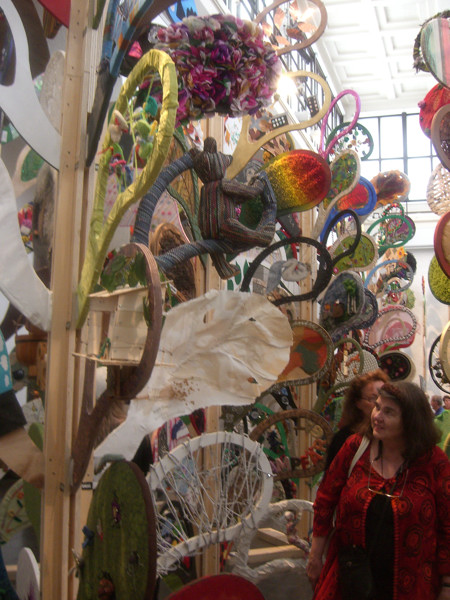
Remember the exhibition with beautiful leaves that I visited in July? And that those two thousand leaves were going to be auctioned off?

The auctions ended last weekend. Altogether they brought in 499,551 kr for charity. Pretty impressive, isn’t it? 170 of those kronor came from me, and now I am looking forward to getting our beautifully crafted leaf.

dn.se has an infographic about this summer’s weather. As infographics go, this is a lousy one, but the information is interesting. Basically they count the number of days of “high summer temperature” (daily maximum of 25°C or above) for the last five summers. For Stockholm the count is 19 (for 2008), then 18, 28, 28… and for 2012, the count is 6.

Really, high temperatures are not my favourite thing, and I can’t say I’ve missed the heat much. But at the same time, it’s been a weird summer. I think we’ve been to the beach three times in total during this summer. That’s it.

And now even that summer is behind us. The evenings are chilly. Both yesterday and today we’ve had pouring rain while on our way home after nursery and school.

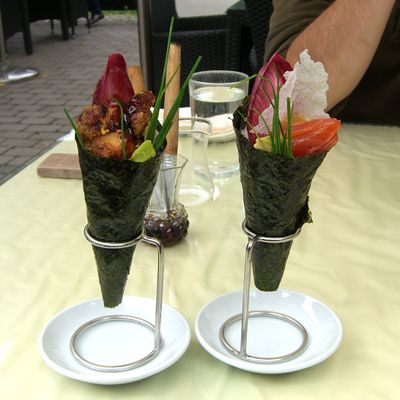
Today Eric and I celebrated our 10th wedding anniversary with half a child-free day, just the two of us – our first since Adrian was born. We went to Råkultur for a fancy sushi lunch, and then to Fotografiska.

We’ve been in Estonia for the past 10 days – our annual trip to Tartu to meet friends and family, and for language immersion for the kids. That last part has worked wonders, by the way: Ingrid’s Estonian is a lot more fluent than before.

One thing I’ve noticed is the popularity of ethnic patterns in design of all sorts. (Ethnic Estonian, that is, not the fashion trend that involves wearing fake Indian clothing.) I try to think back 10 years, and I believe that at that time I almost never saw any of the traditional Estonian patterns, except for maybe mittens in some weird craft shop, and tourist souvenirs. The folk costumes came out for the song festivals, and that was that.

Now I run into ethnic Estonian patterns everywhere. The stripes are the most popular ones: there are fabrics in various materials, there are throw pillows and oven mitts and bags, there are mugs and boxes and so on. The traditional floral embroidery designs turn up in children’s socks and women’s tights – and those are everyday tights you can find in high street sock shops, not souvenir or craft items. And in paper napkins and kitchen towels, etc. The more geometric patterns that I associate with knitwear appear everywhere from embroidery and felted wool to pottery and leather.

It is so lovely to see that traditions that were getting marginalized are now getting new lives, in new places, new materials, new variations. I hope that this is not a temporary whim of fashion or burst of nationalism, but that it stays.

Still alive, but in vacation mode rather than blogging mode.