… I’d go into space.

I’ve been fascinated by space for many years. Other girls want to be doctors and teachers when they grow up; I want to be an astronaut. I’m not so interested in the particulars of space technology – I don’t collect miniature space crafts or read all about the physics involved – but more in the social and human aspects of it, and the endless possibilities it can lead to. A lot of good science fiction has been written about orbital cities or manufacturing bases, lunar colonies, exploration of other planets…

Many reasonable people have many reasonable arguments against manned space flight: it is a waste of resources, since it’s much cheaper (not to mention safer) to send little electric cars to Mars and just follow them remotely.

Regarding publicly funded projects such as NASA, I’d probably agree: if the aim is to generate useful scientific results, you get more bang for the buck if you keep human bodies out of the picture. But for the rest of us, there are good arguments for manned space flight: it’s exciting, it’s interesting, it’s a challenge. Exploring the world lies in man’s nature. Space is like a mountain waiting to be climbed.

Luckily I’m not the only one to think so, and state-funded space projects are no longer the only ones around. Scaled Composites kicked off private space flight two years ago, when their SpaceShipOne won the $10m X-prize for being the first private manned spacecraft to reach an altitude of 100km. It only took a year for them to announce plans for commercial space flights. Virgin Galactic has not only a very cool brand name, but its mission statement includes the simple yet fabulous goal to “allow affordable sub-orbital space tourism”.

They’re not alone in trying to get people into suborbital space: there’s Space Adventures’ Explorer, XCOR’s Xerus, Incredible Adventures’ Rocketplane XP and Blue Origin’s New Shepard, and probably others that I don’t know about. (No, I don’t follow them all – the Economist kindly listed them all a year ago (subscription).)

Transport is of course more useful if there’s something at the other end of the trip (those orbital stations and moon bases). Last week I read that another private venture is now taking care of that as well. Bigelow Aerospace launched Genesis I, a prototype for an inflatable orbital station. And in order to help space business along, he’s financing a follow-up for the X-prize: $50m for taking at least five people to an altitude 400km and completing two orbits.

I’m excited by this. I want to see the Earth from space, and stars in an endless black sky. I want to float around in weightlessness. I want to feel that the universe is a vast and wonderful place. And I simply want to go into space just because.

The cost of space tourism is no longer in the millions. Still well beyond the reach of my bank account, but if development continues at the current pace, it’ll be down at reasonable levels – comparable to long trips to exotic places on Earth – before I grow old.
Indoor temperature in our living room, as I got home about 7 pm today: 31°C. I am not enjoying this. At all. Tempted to stay longer and longer in our nice air-conditioned office.

Best for cooling: ice cream and cold showers.

Best for rehydrating: apple juice diluted with water (50/50), or weak cordials (elderflower is good) with extra lemon and salt, or just a lemon/sugar/salt drink.

There are way too many useless pretty things circulating in the world. You know, glass bowls, candlesticks, that sort of things.

Today I wanted to clean out some clutter that has accumulated in our home over time: things that we never use that just take up space. The most obvious candidates were some so-called “decorative items” that we’ve been given as gifts years ago, that have only been sitting somewhere gathering dust since then. There’s nothing wrong with them – they are just not our style.

I thought I might try and sell them on Ebay – they may be useless to us, but perhaps someone else wants such things. But when I looked on Ebay to see what category to put them under, I realised that this was completely hopeless. There were hundreds of unsold candlesticks there, with no bids. There are far more candlesticks in the (Ebay-connected) world than there are people who want candlesticks.

I gave my things away to a neighbourhood charity shop instead. I cannot be sure that anyone will ever buy them there, either, of course… It feels like such a waste. I wish no one would ever give me another useless vase again. I’d rather not get a gift, than get another dust-gatherer. Give a gift voucher instead. Or buy an acre of rain forest – at least it won’t take up space at home!

Today has been the year’s hottest day. I’m not sure what the official temperatures are, and in any case they only apply to shade, whereas in reality it feels like there is no shade to be found. We are stewing.

Luckily we’re just about to leave the country for a nice, cool, refreshing week in Iceland. It should be around 10–15 C there, which will be a nice change. And long hours of daylight.

It’s a place that both of us have long wanted to visit, but never gotten around to. I had always had in mind a trip full of walking and climbing, but I guess we might have to limit that a bit. The walking boots are in the pack, in any case.

So this place will be quiet until next Sunday at least.

Another routine check-up at the hospital today. At one of the hospitals, that is: East/Central London seems to be cared for by a NHS trust that’s split between two hospitals – the Royal London Hospital and St Barts Hospital and they specialise in somewhat different things. So I go to one of them for obstetric check-ups, and the other for endocrine check-ups. Luckily we happen to live very close to one, and work very close to the other one, so both are easy to get to.

Just like with all my previous visits, the waiting time was really disappointing. I was there 10.25 for a 10.30 appointment, and didn’t see the doctor until 11.30. An hour’s wait for 15 minutes with the doctor… And this isn’t the accidents & emergency unit, where a sudden surge of patients could conceivably overload the staff for a period. This is routine care, booked months in advance. Furthermore, 10:30 is early in the day – I believe the earliest one is at 9.45 or possibly 9.30, so they shouldn’t have time to fall so far behind.

Looking back over last year, I don’t think I’ve ever been seen within 30 minutes of the appointed time, at either of the hospitals. There seems to be a fairly consistent 30–60 minute delay. This isn’t coincidence any more; there has got to be a systematic problem behind these delays. Are the doctors all chronically late getting into the office in the morning? Or is it the day’s first patients that are late and disrupt the schedule? Or do doctors all overbook (like airlines)? I did overhear once that a lot of patients never cancel their appointment if they can’t make it – they just don’t turn up. So perhaps doctors count on these cancellations to balance out the workload, on average, throughout the day… Otherwise I can’t see how they would ever have time for lunch, or see the last patient before closing time.

Interestingly, my experience from my local clinic, which is also NHS-run, is different. There is often some waiting time, but it’s in the range of 5–15 minutes or so. Another telling fact: the hospitals have piles of dog-eared magazines in their waiting rooms (today’s crop: Saga Magazine from Nov and Dec 2005, and National Geographic Magazine) and the chairs are wide and soft, if worn. The clinic on the other hand has no magazines and simple plastic chairs. Part of the difference is probably due to cash constraints, but part of it might well reflect awareness of real differences in expected waiting times.

It’s a good thing that I don’t have many more of these appointments coming up.
I’m even considering an experiment: try and see what happens if I just turn up 30 minutes late. If I still get slotted into the right place in the queue, then that would save me 30 minutes of hanging around. On the other hand, they might just consider me a no-show and cancel my appointment…

We had a class reunion for my Estonian school last summer. It was 10 years since the class graduated high school, and 13 years since I left to move to Sweden.
This summer, it’s 10 years since I graduated high school in Sweden. (One year got “lost” in between because Swedish children start school later, and because I spent that year learning Swedish and “getting integrated into the Swedish school system”.)

The interesting point is how differently the two events were organised. The Estonian event was planned half a year in advance – first contact was made in January I believe, and the final reunion was in August. For the Swedish one I had less than a month’s advance notice. One explanation that came to mind is that Estonians are more mobile. A larger proportion of the class has moved to other cities and other countries – I think about a third of us were living abroad at that time – so everybody was conscious of the need to give people time to plan. With the Swedish class, on the other hand, most seem to have stayed in Sweden. Out of 14 country-specific domains (i.e. excluding things like hotmail and gmail) only two were non-Swedish.

Of course, another reason for the short planning horizon may just be that nobody cared strongly enough to start working on this until now. 12 years tie people together a lot more closely than 3 years do. Last year’s Estonian reunion was more important to me than this year’s will be – I’m not even sure yet whether it’ll be worth making a trip to Sweden just for that.

Saturday:

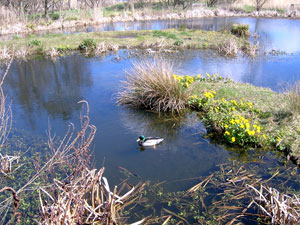
Good weather, so we went (cycled, really) to the London Wetland Centre. Part of it is sort of a bird zoo, with water birds from various parts of the world. They live out in the open but have had their wings clipped, I think. A larger part is just wetlands, open for any bird who happens to pass. A fair proportion of their guests are common ones such as mallards (Swe. gräsand, Est. sinikael-part) and Canada geese, and quite a lot of pigeons as well… Also coots and moorhens (sothöna and rörhöna / lauk and tait), gulls and terns, and then of course numerous other critters we had no names for.

(Nice to link Swedish names of birds I know, to English names of birds I’ve heard of. Google is good! I now also know that kabbleka / varsakabi is called marsh marigold in English.)

In fact we were a bit surprised that the pigeons hadn’t just taken over. There’s free food after all. We asked one of the staff what they did to control the pigeons. He didn’t really know (I guess we picked the wrong person) but mentioned that they try to make the feeding stations less appealing to pigeons – covered trays on the water’s edge, instead of open trays, etc.

Mallards are all used to people I guess, and coots were walking happily on the paths. For shyer birds, a large area had been declared off-limits for walkers. There are viewing stations (huts with lots of windows on all sides) on the edge of that area for bird-watchers. The most serious ones had obviously installed themselves for a long session, with big cameras / telescopes, books and notepads. The Wetland Centre even publish their sightings of rarer birds.

Me, I didn’t really care much about what species they all were… I just liked the sunshine, greenery and open air, and seeing birds up close. For example, one small group of ducks very kindly did their diving in shallow water just next to a wooden platform, so we could see them from above as they dived down and swam underwater. It was interesting to see how they moved – for example, how they flexed and folded their feet, how they held them out towards the side while swimming, and how they spread out their tail feathers for better control under water.

Sunday:
Household tasks – ironing shirts, shopping for groceries, cooking dinner. Plus baking a cake, the first one I’ve made since Christmas – I got a sudden longing for rhubarb cake. I found an Estonian recipe on the web, and it came out just like a rhubarb cake is supposed to be: juicy-soft and sour-sweet. Mmmm.

I’m spending all of this week on a Java course (J2EE). It’s a broad but shallow course, giving an introduction to a number of things in the J2EE SDK, but not going into much detail on any of them. Yesterday and today, for example, we’ve covered JDBC (database access), JNDI> (which doesn’t really have a VB equivalent as far as I know – it’s a service that allows objects to be looked up by name), sending and receiving mail, and servlets (dynamic web pages – the Java equivalent of ASP). Dizzying.

You’re probably all getting rather bored with all these posts about how excited I am about learning all these things… But that really is all that’s going on in my life at the moment. So that’s what you get.

The only other event worth noticing is the long-awaited arrival of spring. We’ve had winter here all the way until this weekend – temperatures barely above freezing, even though it’s already the end of March. Wool-lined gloves and thick woollen scarfs in March! Now at last we’ve turned the corner, it seems.

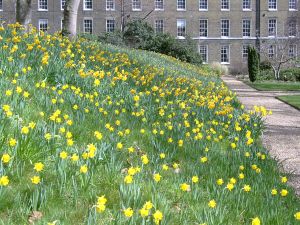
Daffodils

It was even warm enough at midday today that I spent half of my lunch break walking around in a tiny park at Gray’s Inn. It’s a private garden, really, open only for 2 hours around lunchtime on weekdays. And it’s only got two entrance gates and no straight way through, which gives it a peaceful atmosphere – there’s no through traffic. And full of cheerful daffodils. A nice spot to spend half an hour in the sun.

First yoga class since some time in October. Wonderful.

Now that I have a permanent contract and a full-time job again, I immediately became a member of the corporate gym again. It’s all for the yoga classes – I’ve never used the gym for much else. The same instructor is still running the class, which was very good news, because I like his style. The classes he does at our gym are “dynamic vinyasa yoga”, which is mostly based on ashtanga yoga. He deviates a bit from the standard sequence, so each class doesn’t follow the exact same pattern, but in general his approach is quite close to ashtanga yoga.

Yoga appeals to me for several reasons. One of the most important ones is that it requires your mind to be present and active as well as your body – if only your body is involved, it isn’t yoga, it’s stretching. Unlike something like, say, aerobics, you need to think about what you are doing, you cannot just ape the instructor. In fact if you try to imitate someone else, the postures are likely to either hurt you or be ineffective.

A necessary side effect of this focus on awareness is that yoga is never rushed. (As long as the teacher is any good.) There is time to explore each posture, tweak it slightly and feel which way is more “right” – even though ashtanga yoga is a dynamic kind of yoga, with a lot of movement. And there is no one in the front of the class shouting at you (we’ve got a boxercise class next door, and their instructor seems to shout all the time) or pushing you to do more. The only thing a teacher can do is show the postures and correct your pose. The rest of it is up to the individual.

Ashtanga yoga also pays a lot of attention to breathing. Every movement is syncronised with the breath. Breathe in – stretch up. Breathe out – bend forward. Etc. In addition to the direct physical effects, i.e. breathing that fits the exercise, this helps me concentrate. It also gives the exercises a definite rhythm – sort of like a dance, without any music.

Some people like to do yoga in the morning. I much prefer the evening. I don’t want to go straight to my desk after a yoga class. After yoga, I feel so pleasantly tired, but at the same time very relaxed, both in the body and in the mind. I like to just savour this feeling for a good while.


Common types of yoga in England:
Ashtanga yoga focuses on movement in sync with breathing.
Iyengar yoga emphasises precision and tends to hold each posture quite long.
Classes labelled as hatha yoga or just yoga can be anything, but tend to be less vigorous.

Interesting tidbit I learned today:
The main physical constraint for our firm’s expansion, and for large firms in the City of London in general, is access to electrical power. With all the computing power we’ve got in our London buildings – a couple of thousand employees, each with at least one workstation, many of them quite powerful, plus innumerable servers – and the air conditioning needed to keep them all cool, we suck huge amounts of power out of the grid. And now it’s apparently gotten to the point where we can’t take much more than we do today. It will be interesting to see whether we move out (we wouldn’t be the first bank to leave the City) or just shift the servers to an external data centre.