My ants are lazy and rebellious.

Following the instructions I made 4 holes in the surface to get them started. They briefly nibbled on one of them and then ignored all 4 completely. Instead they started on their own holes.

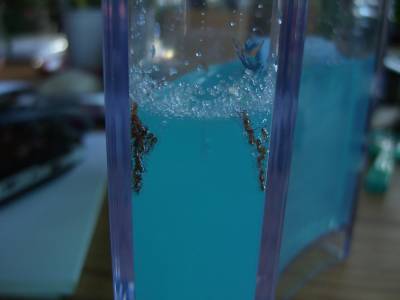
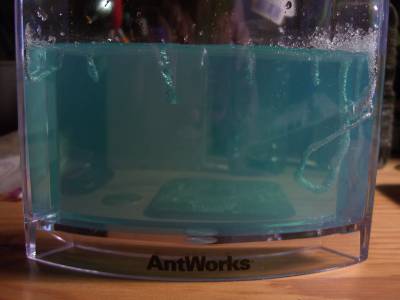
All three holes were started in corners, and initially aimed straight down. The two next to each other were later joined by a tunnel. The short tunnel at the opposite end of the habitat is almost U-shaped, aiming for the 4th corner, but its other end hasn’t yet reached the surface yet.

They took some interesting approaches here and there. When they were working on their two main digs, 90% of the ants piled into one tunnel and only a few went for the other. This left the first tunnel so crowded that they often got stuck behind each other and couldn’t get out with the stuff they had dug out. So the 10%-tunnel grew much faster than the 90%-tunnel.

That tunnel “complex” has two loops: a short one along the end wall of the habitat, and a longer one that goes down and towards the middle. They completed the shorter loop first and used that to live in, and a few of them kept working on the longer one. The long loop was so narrow that the digging ants often had to come out backwards – they had no space to turn around. And they didn’t think of digging from both ends and meeting in the middle – even when they had almost rendez-voused with the shorter loop, they went the long way round.

And now they seem to have almost stopped digging. They just huddle in one of their two favourite tunnel sections, or walk around on the surface and the walls. And I suppose they must be eating, too. But no digging! They’re supposed to dig lots of tunnels, and here they are, just lazing around. What sort of ants are these, anyway?

On the whole they seem to be more interested in the walls of the box than in the gel. I’m supposed to let in a bit of air once a week or so, but there’s always a crowd of ants exploring the edges of the lid, so it’s hard to find a time when I can open the box without letting them all out.

I hope they do more digging soon. Otherwise I guess I will have to wait for them to die of old age and then hope that the next batch will spurn the old “house” and dig new digs.


English medicine for baby tummy problems:
Comes in a heavy glass bottle that is unstable, slippery, impossible to open or close with one hand, and impossible to pour slowly without spilling more than you pour. And the medicine tastes bad so Ingrid hates it, and when she spills some her clothes stink for hours afterwords, and it doesn’t work either.

Swedish medicine for baby tummy problems:
Comes in a light plastic bottle that is easy to open and close with one hand, has a drop opening, and definitely won’t break if it falls. And the taste is such that Ingrid doesn’t mind it at all, and it actually works.

Baby medicine the English way Baby medicine the Swedish way

I got an AntWorks for Christmas, and yesterday the ants themselves arrived. Ants are ordered separately – this way the shops can stock AntWorks without worrying that the ants will die before anyone buys them. The ants apparently only live for a few months.

Yesterday evening I introduced them to their new home, and they seem to be happy with it. When I came to see them this morning they had already started digging three tunnels.

The instruction booklet suggested that I poke 4 holes into the surface to get them started, but they were not particularly interested in my hole. One of the holes got a little bit of digging, but then it was abandoned. Instead the ants congregated into two of the corners and started digging straight down. They chop the blue gel into small grains and carry these onto the surface where they leave it in an untidy pile. Some of it they even carry up the walls for some reason.

My ants are also quite interested in the outside world. Or perhaps they have an instinctive desire to climb upwards? In any case they tend to climb up to the top corners and hang around there, as if they found something of interest there, until they drop down. The sheer plastic walls are apparently not so good for climbing.

Where there’s an ATM, there’s a queue. And in London, the queue is almost always at right angles to the wall. If the pavement is too narrow for the whole queue, the queue is likely to first cross the pavement and then turn and continue alongside the road. In extreme cases I’ve seen the queue go across the pavement and then out into the street between parked cars. And if the pavement is a heavily trafficked one, the queue splits into two – one part by the ATM, then a gap to let people pass, and then the other end of the queue.

But they never turn the queue to go along the wall, which would seem to be a more natural and efficient solution – it adapts easily to longer queues, doesn’t block the pavement, and doesn’t introduce confusing gaps into the queue.

Why do Londoners choose such an awkward way of queueing? Is there some secret rule of etiquette I’ve missed? A commandment taught to all English children from an early age – “Thou shalt make the queue perpendicular”? Or is there some advantage to this method, that I have yet to see?


PS: I googled to see if anyone else found this odd, but found nothing. I did find a blog dedicated to queueing, and after a bit of browsing there found this slightly blurry picture of a queue going across the pavement, exactly the type of queue I meant. The picture was taken in Sheffield so this is obviously a wider English habit and not limited to London.

The NY Times has a long article titled “What’s wrong with Cinderella”, where the author bemoans the monoculture of princesses and pink things for girls. I found the article a bit hysterical, although I can sympathise with her point. It’s hard to find baby clothes that aren’t baby pink or baby blue. But I’m not going to worry about the whole princess thing yet – it’ll be a few years before Ingrid will have opinions about the colours she wears, or be able to demand princess toys. Right now she has no choice, ha ha!

One side note that I found really interesting, about girls and pink colour:

Girls’ obsession with that color may seem like something they’re born with, like the ability to breathe or talk on the phone for hours on end. But according to Jo Paoletti, an associate professor of American studies at the University of Maryland, it ain’t so. When colors were first introduced to the nursery in the early part of the 20th century, pink was considered the more masculine hue, a pastel version of red. Blue, with its intimations of the Virgin Mary, constancy and faithfulness, was thought to be dainty. Why or when that switched is not clear, but as late as the 1930s a significant percentage of adults in one national survey held to that split. Perhaps that’s why so many early Disney heroines – Cinderella, Sleeping Beauty, Wendy, Alice-in-Wonderland – are swathed in varying shades of azure. (Purple, incidentally, may be the next color to swap teams: once the realm of kings and N.F.L. players, it is fast becoming the bolder girl’s version of pink.)

It wasn’t until the mid-1980s, when amplifying age and sex differences became a key strategy of children’s marketing (recall the emergence of “ ’tween”), that pink became seemingly innate to girls, part of what defined them as female, at least for the first few years. That was also the time that the first of the generation raised during the unisex phase of feminism – ah, hither Marlo! – became parents.

This is, I think, our most low-key Christmas ever. We have the important ingredients: a tree, masses of gingerbread cookies, and julmust. But celebrations have been small and spread out. Most years we’ve celebrated either with my mother (who also lived in England for about 5 years) or Eric’s family in Stockholm. This year my mother is back in Sweden, and we thought Ingrid was a bit too young for long-distance travel, so we’re on our own and hadn’t planned anything particular for Christmas at all. Not even a Christmas dinner: a large part of our evenings is occupied by getting Ingrid ready for the night, which makes it hard to fit in any major dinner preparations. My father visited us a week before Christmas, so with careful organising we managed to have a Christmas-style dinner then (roast veg, a veggie loaf and homemade cranberry sauce – yum). I enjoyed cooking it – the first time in about 2 months that I cooked a proper meal – but that required a fair amount of planning, and right now I’d rather relax than undertake a project like that.

For Christmas Eve we were invited by a couple of friends to a Glöggfest in Brockenhurst outside of Southampton. Brockenhurst is 2 hours by train from London, which made it by far our longest trip yet with Ingrid. We’ve only been to Central London a couple of times. The trip there went well – she slept well in the sling, and ate well, even though she seemed to be quite distracted by the landscape rushing past.

The moment we set foot inside our friends’ house, Ingrid started screaming. Not crying, but screaming as if she was in terrible distress. She really, REALLY, didn’t want to be there. Since she got upset so immediately after we entered, we guessed it must have been the smell of incense in the house. And the only way to calm her was to take her outside… so Eric spent the first hour and a half standing outside in the front garden, with Ingrid asleep in the sling.

When Ingrid had woken and eaten, and the incense smoke had dispersed, she was content and social for half an hour, even smiling at the other guests! But then something went wrong again, and the screaming came back. This time she agreed to almost calm down in a quiet room far from everybody else, but even then she wasn’t happy. So we gave up and headed home pretty soon. She calmed down after only 10 minutes outside, and was perfectly happy on the train home. She was probably simply overwhelmed by the new sights and sounds and smells.

Conclusion: Ingrid doesn’t mind travelling, but is no more fond of noisy crowds than I am.

But the best part of this Christmas holiday has been having Eric at home for almost two weeks. I am so glad to not be alone all day, and immensely relieved to have someone to share the work of taking care of Ingrid. Eric’s been taking care of Ingrid’s long midday nap, which has given my back (and my patience) a very welcome break. Even though I’m not working, I get a Christmas vacation! I feel rested, and actually enjoy my time with Ingrid now.

In Sweden there are floods. And in Estonia as well. North London had a tornado. Why am I never there when exciting things happen? Give me a good thunderstorm at least!

… much better than movies, and why I don’t like TV at all.

But the problem with readers, the idea we’re given of reading is that the model of a reader is the person watching a film, or watching television. So the greatest principle is, “I should sit here and I should be entertained.” And the more classical model, which has been completely taken away, is the idea of a reader as an amateur musician. An amateur musician who sits at the piano, has a piece of music, which is the work, made by somebody they don’t know, who they probably couldn’t comprehend entirely, and they have to use their skills to play this piece of music. The greater the skill, the greater the gift that you give the artist and that the artist gives you. That’s the incredibly unfashionable idea of reading. And yet when you practice reading, and you work at a text, it can only give you what you put into it. It’s an old moral, but it’s completely true.

(Zadie Smith quoted at Orange Crate Art, found via BoingBoing.)

A book requires attention, and you have as much time as you want, to give it that attention.

A movie or a TV programme goes on in its own pace, and all you can do is try to absorb as much as possible. You cannot easily re-read a paragraph or compare two sections side by side. Well, technically you can, but in practice it doesn’t work.

The year’s first snow has fallen in Tallinn.

Here in London it’s mostly sunny and about 15°C. It’s not supposed to be like this – not in late October!

I don’t get the Google / YouTube deal. In fact I don’t get the News Corp. / MySpace deal either. Pay a gazillion for something that hasn’t even been close to making a profit – because it’s got lots of viewers. Are we back to the bubble-time habit of paying for “eyeballs”? Size for the sake of size? That is what most commenters seem to focus on: how MS and Yahoo “need to move quickly” while there’s something left to buy out there.