The company had a summer party this Tuesday. I hesitated for a short while, but in the end the decision was easy.

On the one hand: I could go to a crowded bar, with lots of people who are drinking, staring at TV screens (some football game) and occasionally shouting loudly. Possibly, if we can hear anything, we might talk about nothing in particular.

On the other hand: I could go home where I will be greeted with cheers of “emme, emme, emme, emme!” from the moment I put my key in the lock, and then I would get a big hug from Ingrid, and maybe one from Eric too. And then Ingrid and I would hold hands while we go downstairs and out to the laundry room next door. And then we would come back to a nice home cooked dinner with Eric.


I don’t spend much time thinking about home and family while I am at work. But the moment I step out through the door, I long to get home to them. The longing grows as I get closer, and by the time I step off the T-bana I am almost ready to run.

Rare goods

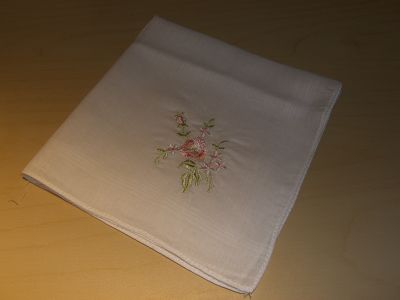
I like comfortable things. I never buy clothes that feel scratchy or stiff – no jeans, no crackly polyester fabrics. I cut off labels from t-shirts. And I use cotton hankies instead of paper tissues. They are softer and more pleasant for everyday use, and so much gentler than paper on tender skin when I have a cold.

In the Soviet Union cloth hankies were the standard solution – there was nothing else. The habit also seems fairly common in England: it wasn’t too hard to find hankies when I needed new ones. But in Sweden, apparently, people don’t use them.

NK, the upmarket department store in central Stockholm, used to be the place to go for ladies’ hankies. One went to NK’s ladies’ accessories department and asked for them: the demand was so low that they weren’t even on display. Now even NK has stopped selling them. When I asked why, I was told that for years NK kept stocking hankies as a service to people who had come to rely on them – it wasn’t really worth it economically.

So now I am buying cloth hankies online. It’s ridiculous… It’s the cheapest, simplest accessory you could possibly imagine – a simple square of thin cotton cloth – and they are being shipped to me from England. Eric is going to England soon and I have asked him to buy me some more, since almost all hankies I found on eBay were embroidered and I’d rather have plain ones.

By the way, I still have and use several of my Soviet hankies. No holes, all seams are intact, and the fabric is softer than ever. How’s that for quality?

We are living (temporarily) in the same apartment in Stockholm that we left 7 years ago when we moved to London. And it feels weirdly familiar.

For several weeks, whenever I wanted to throw something in the garbage bin, my legs would automatically take me towards the cupboard under the sink, where the bin used to reside 7 years ago, even though we now have a bigger bin standing in a different corner of the kitchen. Sometimes I would even reach to open the cupboard door before my conscious mind caught up with what was happening and steered my legs in the right direction.

One evening I had cooked dinner and picked up the cookbook to put it away. I started walking very purposefully towards the kitchen window with the book in my hand. Halfway there I had to stop and think for several moments. Why on Earth am I going towards the window? Then I remembered that we used to keep our cookbooks on the windowsill.

Seven years have passed, but the body still remembers.

A fashion wave has flooded Sweden, and half of the girls and women in this country, or in Stockholm at least, wear almost identical outfits. This spring’s “must have clothes” and “essential look” consists of 1 pair black leggings, 1 pair canvas shoes, 1 tight micro mini skirt (preferably black, and just long enough to hide the crotch) and some sort of fitted jacket. They are everywhere. Last weekend while I was out with Ingrid I ran across a group of five teenage girls, all wearing “the look” – although one had a white mini skirt instead of black – plus identical half-long blonde hair. Attack of the clones!

What makes these people want to look just like everybody else? I can agree that leggings are practical and comfortable, and I could imagine myself looking reasonably good in them, but not now! There is no way I would, of my own free will, buy clothes that I would see mirrored on every other woman I meet in the street. My instinctive reaction to seeing all these uniformed women is to resist, pull back, find something different.

As an unfortunate side effect, all shops are full of chunky leggings (especially black, but also bold bright colours) and there are hardly any nice tights to be had anywhere.

TV

We’re living in a borrowed flat now. The owner has a TV, so after seven TV-less years we are now sharing a room with a TV set again. (Technically we did have a TV before we moved to England 7 years ago, although we really didn’t use it much.)

Apparently seven years is long enough to totally kill off the habit of watching TV. I haven’t turned it on even once during the past month. Eric has used it for watching DVDs (instead of watching them on the computer), but I don’t think even he has turned it on to watch an actual TV programme.

I have to admit it’s nice to be able to sit in the sofa while watching a movie, instead of a chair in front of the computer. Not nice enough to warrant buying a whole TV, though. I don’t think we’ll be buying one when we finally find a house.

Things from London that I miss:

  • Sandwiches and sandwich shops. Well-made sandwiches are one of the best parts of British cuisine, and besides, they’re very practical as a quick lunch. M&S’s Wensleydale and caramelised carrots, for example, or their Mexican bean wrap, or Pret’s Brie & cranberry Christmas specials.
  • Spitalfields market. Not because I bought much there (apart from the occasional pie or brownie) but because it was fun to browse. The same goes for all the odd little shops in the small streets of East London. I’d never even go in, but it was fun to walk past and peer into their show windows full of things like Indian wedding accoutrements, cheap household electronics, or exotic vegetables. The neighbourhood where we live now is purely residential, and the few shops to be found are all eminently ordinary and practical, such as a hairdressers’ or a pizzeria.

Things in Stockholm that I like:

  • Wide open blue skies. London is clouded over quite a lot of the time. Must be a local thing, maybe caused by all the traffic pollution? And even when it isn’t cloudy, the sky is never as in-your-face as it is here in Stockholm. The sky here is bluer, the streets wider and the houses lower, so the bright blueness of the sky hits me with a big smack whenever I go out. I also feel that the sun is brighter here: I cannot go out cycling during the day without wearing sunglasses, whereas I hadn’t yet brought out my sunglasses in London during the spring.
  • Hot water as soon as I turn on the tap.
  • Lifts in every single tubeT-bana and train station. And they always work, and they’re almost always clean. The whole experience is so smooth that I don’t think twice about taking Ingrid on the T-bana in her pushchair, whereas in London I would try to avoid trips to town if possible. Not surprisingly, therefore,
  • The town is full of parents with pushchairs and prams. They are everywhere. Really, one can get the impression that the fertility rate in Stockholm is about three times that of London.

On Wednesday the contents of our home arrived, so we spent almost all of the day unpacking and organising.

On Thursday I had two job interviews and we met the in-laws in the afternoon.

On Friday it was unpacking and organising again.

On Saturday we visited Eric’s sister and her family.

Today we went house-hunting and saw three houses.

In the evenings I have learned enough ASP.NET to complete a basic exercise as a follow-up for one of the interviews. It was almost like being back at work: all weekend evenings spent working.

All this plus a lot of toddler activities has meant that the blog has suffered from an unusual lack of posts. Since the ASP.NET thing is now as done as it’s going to be (I have a second interview tomorrow morning with the same company) I will hopefully be able to catch up next week. And there is a lot to catch up with!

Victoria, Crown Princess of Sweden, is just about two weeks older than me. The Swedish media report on her doings regularly. I can’t say I follow them with much interest, but I’ve enjoyed the occasional updates on her “milestones”, because mine happened at about the same time. Victoria finishes high school. Victoria goes to university. Etc.

Today Svenska Dagbladet reported on Victoria’s name day celebrations. (Name day is a European concept and a reasonably popular thing in Sweden.) And I couldn’t help thinking – she looks like a tant, like an old lady. And she is my age! She may be a crown princess but at least I don’t look like a tant.

TfL is currently running an ad campaign “to encourage more considerate behaviour on London’s transport system”. There are posters on buses and in Tube stations, and films, too, apparently.

This seems like a pointless waste of money to me. People do not litter / make noise / put their feet on the seat because they don’t know better. They litter because they don’t care. The people who litter will not pay any attention to these ads, and if they do, they won’t change their behaviour.

It’s the same with all these reminders to “please remember to take all your belongings with you when leaving the train”. A passenger who’s attentive enough to listen to announcements will need no prompting to count their bags and coats before getting off.

I wonder if anyone has studied the effectiveness of such ads. Apparently public service announcements can be effective. And I can see how ads might work well when the aim is to raise awareness of an important issue (smoking kills) or to gather support for an important question (political protests). But the fundamental assumption has to be that your audience wants to hear your message!

Two interesting blog posts about programmers and their preferences.

Here’s one that explains the fundamental difference between (most) programmers and (most) managers:

So here’s my theory: Managers must work shallow and wide, while programmers must work narrow and deep. People who are naturally tuned to one particular method of work will not only enjoy their jobs a lot more, but be better at them. I’m a deep guy, I should be doing deep work.

I didn’t say it was a particularly insightful theory.

It may not be an insightful theory but it certainly strikes a chord with me. I’ve said many times to both to my current manager and the two previous ones that I have no aspirations whatsoever to move up the traditional career ladder that inevitably leads to managing people. In fact if I was forced to I’m pretty sure I’d rather quit. Wide vs. deep is not the only reason for this preference but is certainly a big part.


The other talks about the role that personal preferences play in technological choices, and about why you need to know your audience before you can tell them what they should do.

When someone tells you “you need better tools: try Lisp”, ask “what about Lisp do you think would help me?” If they start listing reasons without first trying to understand who you are, may I say there’s a problem.

This is something I have encountered many times. People who recommend me some music or other, and when I ask them why they think I would like it, their only reason is “because this band is great” or “well I just think you would”. Book reviews that effectively say “everyone will like this book” or “best book of the year”. Of course they may sometimes be right, but more often it’s just a sign of sloppy thinking.