Every other fantasy book and RPG, and pretty much every fantasy book or game where a significant part of the action takes place in a major city, has a Thieves’ Guild, possibly a Beggars’ Guild, and an Assassins’ Guild.

Now I can understand the reason and rationale for the first two. Thieves and beggars could well want to prohibit outsiders from crowding onto their turf, divvy up the city, and impose other rules. But I really have trouble understanding how an Assassins’ Guild could possibly exist.

Quite apart from such mundane concerns as “wouldn’t it be rather dangerous for someone to be a registered assassin?”, there is the issue of volume and sustainability. Let’s think about the numbers.

How many members does a guild need to have in order to be called a guild and not just a bunch of guys? A few dozen at least, I’d think. Let’s say 30.

How often would an assassin need to kill someone in order to keep his skills sharp? Once a week seems like a reasonable minimum. That’s 52 kills per assassin and year, and 1560 kills for the entire guild.

How many people in a city? Most fantasy takes place in a late medieval or renaissance-equivalent era. The top 10 cities in this world in the year 1500 ranged from 150,000 inhabitants to 670,000 inhabitants (About.com). Let’s assume, generously, that the cities in the books are really grand ones, say 300,000 souls.

Assuming a life expectancy of 30 years (Wikipedia) and a stable population, there would be 10,000 births and 10,000 deaths every year. Of those 10,000 deaths, about 3,000 would be children in their first 5 years of life. That leaves 7,000 deaths of other causes.

1560 assassinations out of 7,000 deaths would mean that one death out of every 4 or 5 is an assassination. Or to put it another way, deaths from all other causes would need to be 20% fewer than in our average medieval city, or else the city will be emptied pretty quickly.

If we reduce the assassins’ activity level to one kill per month, that’s 360 kills per year or rougly 5% out of all non-infant deaths, which is rather more reasonable. But it means that, on the one hand, the guys wouldn’t get much practice, which means they would not be as skilled, so they would get lower pay, and they would need to have day jobs. And once you’re spending 90% of your time working as a messenger, thief, horse trainer, or whatever, and only killing someone once a month, can you really call yourself an assassin still?


PS: For more medieval demographic calculations, try Medieval Demographics Made Easy.

Today is Advent Sunday, which marks the beginning of Advent. Advent has mostly lost its original religious meaning here in Sweden and is, effectively, “the time of waiting for Christmas”.

Thus, Advent Sunday and the first weekend of Advent is the time for hanging up Christmas decorations and lights. At home, that is: shops and businesses have had theirs up for weeks already (since they cleared out all the Halloween stuff). After weeks of creeping, gradually increasing darkness, there is just a little bit more light out there. I love the way our neighbourhood looks, with sparkles of light in just about every window.

We have our two advent stars that I bought last year, but not much more in the way of decorations. I don’t like visual noise, our living room feels cluttered already, and traditions are not very important to me. But I think Ingrid would enjoy having a bit more Christmas feeling at home. She’s been pointing out every single Christmas tree, Santa and fake snowman we’ve passed. I guess I will try to figure out some way to introduce some more Christmas cheer here. If not in time for this Christmas, then definitely for next time.

I did, at least, manage an Advent calendar for Ingrid. Nothing fancy, since I didn’t start planning in time – just a 24-piece puzzle in 24 red envelopes.

I have found a single Estonian book shop on the web that I can buy from – others either don’t do international deliveries, or only accept payment via an Estonian online bank. So when I found a book I wanted but couldn’t find in that single shop, I asked a friend in Estonia to buy a book for me. (In fact by now I’ve asked two friends to buy a book each.)

Then of course I need to reimburse them for their expenses. And what is the easiest, quickest, cheapest way to send money overseas? Why, by post, of course, by sending them cash by snail mail. Way cheaper, about as fast, and (for these small sums) not significantly less secure than wire transfer.

Somehow it feels like I’m in the 18th century.

A thought that keeps occurring to me, again and again:

I hope that I live long enough to see and hear what the coming generations will say about this time in human history, say from 1950 onwards. The time when mankind had actually become aware of how it affects the world, but kept on going anyway, wilfully destroying most things around them. Us. Spreading noxious gases and hormone-disrupting chemicals and plastic junk, burning and chopping down rainforests, fishing out the seas, and so on and on.

I hope this doesn’t sound like whinging. I really am curious to see when the insight will hit us, and how that will feel.

You know you are an Estonian when (in addition to the 148 other things that mark an Estonian) your breakfast consists of rye bread and freshly pickled cucumbers.

(I found an English-language version of the “slow pickle” recipe, but nothing for the “quick pickle” that is ready after a day or two, which is what Eric and my mum made.)

I went to the dentist today, after a longish gap (last time was back in London). Happy news – for the first time in years I had no cavities!

I have lousy teeth, for some reason. Even though I brush morning and evening, floss frequently, rinse with a fluoride mouth wash, avoid snacking between meals, etc etc, my teeth still decay. Either it’s hereditary (my mother’s teeth are no better) or perhaps it’s due to some nutritional influence during childhood. Whatever the cause, I’ve pretty much gotten used to the need for frequent repairs.

I’m barely past 30 and I’ve got 13 or 14 fillings on my 20 premolars and molars, so occasionally I worry about what will be left of my teeth by the time I’m 50… I also dream (infrequent) nightmares about losing my teeth. I understand that it’s quite a common dream topic and has all sorts of symbolic meanings but for me the literal interpretation is pretty valid, too.

Today we were three people in the office! Spread out, each one in their own corner, so it almost felt like I was still there alone – especially since no one from my team was there.

It’s not a bad way to get back to work. Week 1, get used to being in an office. Week 2, get used to other people in the office. Week 3, get used to office noise.

This reminds me of a humorous document, making its rounds by email many years ago I think, with tongue-in-cheek instructions for how to ease your employees back to work after a vacation. It was roughly in the same vein. Day 1, let the employee spend some time sitting behind a desk, and so on. I couldn’t find it on the internet though.

This is my first week back at work, after four weeks of vacation. I was getting used to the vacation lifestyle: pottering around, with no musts (other than keeping everybody fed and clean). The only downside (if you can call it that) was all the cakes we were eating, because every time we visited some friends or family, they’d naturally offer us some. Which is nice once in a while, but not twice a day three times a week.

The office is dead empty. I am the only person there this week. I think there might be more of us next week, but it’s not going to be a normal week, and we’re definitely not going to start on a sprint. There are hardly any phone calls, either, so I have all day to (a) focus, and (b) work on things I have long wanted to get done but never found time for.

These first three days, I’ve mostly spent refactoring and cleaning code. Small refactorings get done in the course of ordinary work, but larger chunks (half a day and up) are harder to fit in, unless there’s an immediate payoff.

The next few days, I’ll be spending more time on is planning and thinking. As with refactoring, it’s hard to find the time to focus on not-immediately-productive thinking. Prioritizing our technical debt, thinking about how to improve our processes, looking at new tools and technologies we might be able to use.

I’ve been browsing the web sites of various pushchair makers this evening, since our current Stokke pushchair is slowly falling apart. And the sites totally suck. There is no other word for it.

They are Flash-based so I cannot bookmark the models I am interested in. I have resorted to taking notes on a piece of paper. And every time I want to look at another detail, I have to start all over again.

They have start pages with f***ing soundtracks. (Yes, I’m talking about you, Emmaljunga! Hello webmaster, do you really think that your site is the only thing I currently have open on my computer?)

They pay more attention to letting me choose the right colour than on the specifications and functional details.

They are only partially translated. The worst one (Quinny) mixed three languages on one page, even though I had selected Swedish. Later I discovered that some rather crucial parts of the Quinny site (such as the specifications for each pushchair) were not even available in English. Switch to Swedish – link is there; switch to English – link gone.

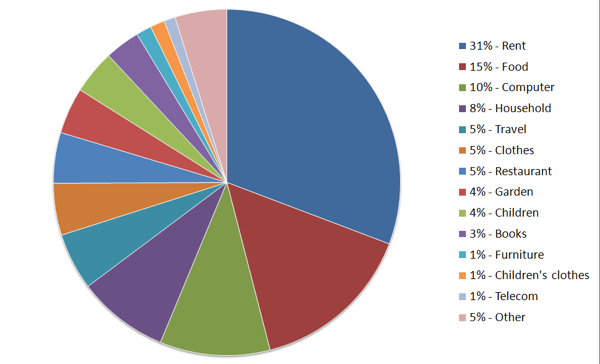
Our spending (year to date):

Average US household:

(source)