Isn’t it bizarre that the online edition of a newspaper can publish an article about an online phenomenon, and yet not post a link to the site they talk about?
While I was away in Estonia, SIFO (a Swedish polling / market research firm) sent me their Sverige Nu 2010 questionnaire (Sweden Now 2010). A few days ago I finally finished filling it in.
Filling in the questionnaire took a while – the questionnaire is 40 pages, all of them packed with checkboxes. There are so many boxes it becomes physically tiring to check them. Not all of the boxes need to be checked, of course, but I counted 87 checks on the center spread, which is reasonably representative of the whole thing.

I like questionnaires. I like seeing what kind of questions they ask. What is important to these people? What do they care about? And I like answering them, because I think in many respects my answers are different from the average respondent’s. I feel like I provide some balance and perspective to their data.
In this case, the focus of the questionnaire was on two things: what do I consume (and what could I be induced to consume), and what does my media consumption look like. On the whole, I got a distinct impression that this data will primarily be used by all kinds of firms to plan their advertising strategies.
How much do I earn? How much do I spend on clothes? Which hobbies do I have? What capital goods do I have in my household?
The categories for my spending were a bit odd: very detailed in some cases and yet not comprehensive. But when seen from an advertising angle, the questions all started to make more sense.
(First they ask me how much I spend on women’s clothing. Then two rows further down they ask specifically about underwear. Or, to take another example, there are separate categories for each of wine, spirits, and beer, and a category for weight loss products – but none for food, or household products.)
Which newspapers and magazines do I read? How often do I watch TV? Which channels? Which programmes? Which time of the day? Which Internet sites do I visit? (Some of this was spectacularly boring to answer. I watch no TV, I read a single Swedish newspaper and a single Swedish magazine, and visit almost no Swedish web sites. Swedish ones were the only ones they cared about, and a few large sites like Google and Facebook. Swedish companies aren’t going to advertise in the Economist or on NYTimes.com after all.
There were also some questions specifically about my opinions about advertising – what are my views on ads on TV, Internet, radio; do I open unaddressed mail, etc.
The other interesting thing about this questionnaire (apart from its unstated and yet clear focus on advertising) was its unevenness.
Some questions are very broadly applicable and SIFO will likely be selling those data to many of their customers. Other questions appear to be included by request of some specific company. (“How often do you visit Casino Cosmopol?”)
The questions appear to be designed by different people, with no one person responsible for co-ordinating the entire thing. Many questions have a scale of responses: how often do I do something, or how much do I spend on something. The questions will naturally have somewhat different scales – some things you do frequently, others less so. But the scales sometimes differed in detail when the overall range was similar. E.g. one question might have the alternatives “never, a few times per year, a few times per quarter, a few times per month, every other week, every week, daily / almost daily”, whereas another would have “never, a few times per year, a few times per quarter, a few times per month, 1-2 times per week, 3 times per week or more”, and a third would have the same as the second but add even more detail at the end. A few more hours of work would have made the whole questionnaire easier to use. At least they had a clear layout guideline – the smaller amounts always came first.
Some questions had noticeably badly designed response ranges. “How many times have you used the following sections of the Yellow Pages during the last 12 months? None, 1-2, 3-4, 5-6, 7-8, 9-11, 12-14, 15-19, 20-29, 30-49, 50+”. Who could possibly recall if they opened the Yellow Pages 6 times or 9 times in the past year? It’s going to be pure guesswork, and not very reliable data.
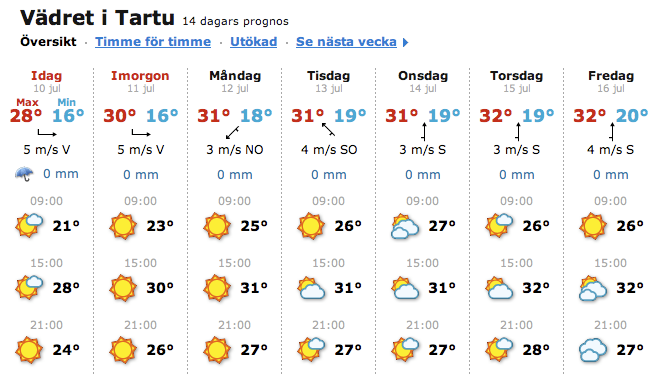
The weather forecast for the next 7 days in Tartu: more of the awful heat. I thought today was disgustingly hot, and it’s not going to get better any time soon. Gaah!
And Tartu doesn’t even have a lake, a public pool or any other kind of outdoor swimming. (That’s puzzled me for years now. A simple wading pool would make a huge difference.)
We’re back from Beijing, alive and well. Photos and trip report will have to wait, as I am feeling slightly less than perky after about 20 hours of awake time.
We’re off on vacation from now until next Saturday, touristing in Beijing. We’re thinking that right now should be a sweet spot for a non-trivial vacation, i.e. not Estonia, and not a week of hanging around on a beach. Ingrid is old enough to not require constant maintenance and might actually enjoy a new environment – and baby 2 is not yet here.
I have no information about whether an Internet connection will be available at the hotel, so I may be incommunicado for the duration of the trip.
A conversation at work today:
– Dev 1: How did you become interested in Middle Eastern music?
– Helen: I guess I heard a good CD somewhere, and went on from there…
– Dev 2: A CD? That is so 2006.
– Dev 1: 2006? Were you still listening to CDs in 2006?
See what having a family does to you… our age difference is about 4 years but it sometimes feels like a whole generation. They can sit attached to their computers by a headphone cord all evening, while I am walking around the house all the time. And even when I’m not, I wouldn’t want to be cut off from Eric and Ingrid by a pair of headphones.
… I submitted my Swedish tax declaration by phone, entering two numeric codes from the declaration form to confirm that I agreed with their pre-printed numbers. Turns out I have underpaid by 1740 SEK while Eric has overpaid by 1790.
… I searched the web for maternity swimwear and found nothing I would want to wear. Which came as no surprise whatsoever, since I had difficulties finding normal non-maternity swimwear to suit my taste, and of course the maternity selection is much narrower.
… I made myself a kogel-mogel for the first time in years.
Keeping me busy right now:
- Preparing for the planned refurbishment of our house. The discussions with the architect are more or less finished. Next steps: seek planning permission, find a builder, plan bathroom.
- Preparing for our upcoming vacation. This is our chance: Ingrid is (hopefully) old enough for a real vacation, and Baby 2 is not yet a hindrance. We’re going for a week in Beijing.
- Planning for this summer’s gardening activities. I’m thinking tomatoes, peas and herbs for the kitchen garden.
This weekend I sent Eric and Ingrid out to have fun (they went swimming, and to Junibacken) so I could finally clear all the papers off my desk and do a GTD (Getting Things Done) weekly review. It had been way longer than a week since last time and I felt like I had lots of uncaptured tasks floating around.
Well, now both the projects and next actions have been captured, and I have them all under control. The flip side is that I now know exactly how much stuff there is that I should be doing instead of spending time in front of the computer. The lists are shockingly long. My list of next actions, which I’ve previously mostly managed to fit onto Post-Its on one A4 page, now cover the best part of three pages.
The flip side of that, in turn, is that I feel challenged. There is nothing like a bit of pressure to get me moving. Time to get those lists down to size again!
Snow, of course, does not just land in the streets, on the train tracks and in our garden. A lot of it lands on roofs. There it gathers, perhaps melts a bit when the weather gets warmer, slides towards the edge of the roof and forms overhangs and icicles. Pretty, but also pretty dangerous.
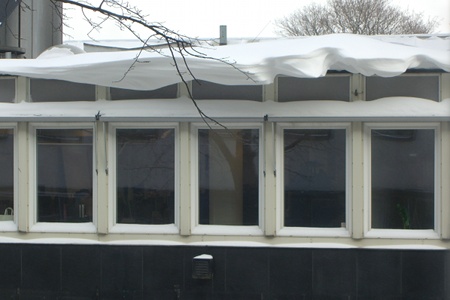
Every winter a bunch of people get hurt (and occasionally killed) and vehicles get seriously damaged by falling snow and ice. As a pedestrian you can’t do much: since the chunks of snow and ice will be sliding off the roof, they won’t fall along the wall but may well land several metres away from the building.
Luckily there are laws that oblige the owners of buildings to make sure snow and ice which could fall down are removed as soon as possible. In the meantime, if there is risk of stuff falling down, they’re obliged to put up warning signs and, if necessary, rope off the sidewalk.
Today, all day today, there were workmen clearing snow from the roof of the building where I work. (The workmen were still at it when I went home in the afternoon.) As I got there in the morning, about 20 metres of sidewalk was closed off and chunks of ice and snow were flying down. There’s a spotter on the ground who makes sure that people don’t wander into the cordoned-off area, and shouts to the folks on the roof when to stop and start. On taller buildings I’ve heard them use whistles.
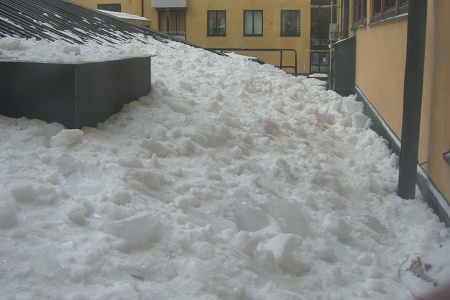
Some time in the morning they shifted to the other, courtyard side of the building: the one right behind my back. The amounts of snow and ice coming down there was unbelievable. Every now and again everyone on that side of the office would jump, as some icy lump hit our window, or some particularly large chunk hit the roof of the courtyard hard enough to make the floor tremble and our monitors shake. The largest ones I saw were about the size of a human torso. Luckily those were mostly snow rather than ice – I don’t think the tin roof would have survived it.
If you’re interested, Svenska Dagbladet has photos of the roof-cleaning process.
| « Older posts | Newer posts » |
