Today, three and a half years after leaving the UK, I finally learned why they have separate taps for hot and cold water. Well, actually, I read two separate explanations that both make sense, but I don’t know which one it really is.

(1) Fluctuating pressure. Mains water pressure can be unreliable in parts of the UK. Hot water coming (with constant pressure) from a hot water tank in your house, mixed with cold water (at variable pressure, especially if someone nearby flushes a toilet) from the water mains can lead to dangerous fluctuations in temperature.

(2) Hygiene regulations. Water in a hot water tank is not boiling and germs could start breeding. If you keep the hot and cold water strictly separate, you can be sure that the cold water (which you use for drinking after all) cannot get contaminated. So mixing mains water and cistern water was actually forbidden in the UK.

By now of course there are taps in the UK that mix the two, but retrofitting all old houses with new taps, new sinks (with one hole instead of two) and possibly new plumbing, too, would be too expensive compared to the limited benefits.

Photo: UNICEF

(Scroll down for an English translation.)

Varje dag dör 21 000 barn under fem år. 40 procent dör redan under sin första månad i livet. Den här tragedin brukar benämnas “den tysta katastrofen” eftersom den sällan uppmärksammas annat än som statistik i rapporter.

De flesta barnen dör av näringsbrist, diarré eller andra sjukdomar. De dör av orsaker som med enkla medel skulle kunna förebyggas. Det som saknas är vaccin, medicin, rent vatten och näringsriktig mat. Saker som UNICEF kan leverera.

Den här bloggposten är en del av mitt bidrag. För i och med att jag publicerar den här bloggposten blir inte bara fler uppmärksammade på den tysta katastrofen utan dessutom innebär det att re:member skänker sex påsar av den nötkräm som UNICEF använder vid behandling av undernärda barn. Tre påsar nötkräm om dagen är allt som krävs för att ett barn som lider av undernäring ska kunna överleva.

Har du också en blogg och vill göra något viktigt i jul? Hämta bloggmaterial här! Annars kanske du kan hitta en julklapp i UNICEF’s gåvoshop.


Every day, 21,000 children under the age of five die. 40 per cent die already during their first month of life. This is a “silent emergency” and rarely gets much attention, other than as a statistic in some report.

Most of the children die of malnutrition, diarrhea or other diseases. They die from easily preventable causes. What’s missing is vaccines, medicine, clean water and nutritious food. Things that UNICEF can deliver.

This blog post is a part of my contribution. Through publishing this post I will make more people aware of the silent emergency. In addition this blog post means that re:member will donate six bags of the peanut butter that UNICEF uses for treating malnourished children. Three bags of peanut butter a day is all that’s needed for a malnourished child to survive.

This blog campaign is aimed at a Swedish audience. But do look up the home page of your local UNICEF office and see what you can do to help.

Every afternoon I cycle through central Stockholm. Every afternoon Stockholm City’s Christmas lights programme makes me all tingly and happy.

I love the way they have gone “all in”, with beautiful LED lighting all along the major streets in the city centre. (Somewhere between 600,000 and 700,000 LED lights – the various sources differ on the exact number.)

I love the breadth and variety: glowing red orbs, sheets of light, trees draped in lights, even LED-covered reindeer shapes. It may not be high art but it is heart-warming.

I wish I had the equipment to take some proper pictures of it all. You can see some photos on Stockholmsjul’s Facebook page.

Today we went pre-shopping for sofas. Not buying, not even quite deciding yet, but looking at what is available, roughly what things cost, what the different parameters are. We visited three furniture stores, conveniently located close to each other in Barkarby.

And all the sofas in their showrooms were either in non-colours (black, white, grey, beige) and in red. If you want colour, you get red. I think there were also two sofas in purple, but that’s it.

Oh, of course, if you go digging through all the fabric samples you will find some alternatives, but it is very clear what most people want. And your choice is narrowed down significantly if you want a sofa in, for example, green, as opposed to grey.

I’ve previously noticed that red is also almost always the only colour for leather goods. Any normal shoe brand will have shoes in black and brown, and if they have shoes in other colour, those will be red. Same for gloves and bags.

Somewhat tired for no particular reason. Well, a bit of autumn darkness, the tail end of a slight cold, and a few nights of not-so-great sleep. Thus, no inspiration for blogging.

Ingrid’s swimming lessons brought to mind my own first ones. We had mandatory swimming lessons when I was in 2nd grade, 8 years old. I remember them as scary and not much fun, and I remember how the pool water made my eyes sting and how awful those exercises were where we were supposed to keep our eyes open in the water in order to pick up some ball or thing from the bottom of the pool. I still totally hate opening my eyes underwater, it makes my eyes itch and my tears run.

I didn’t learn to swim in those lessons, because I fell ill with pneumonia after a few of them, and you weren’t given a second chance if you missed the first one. I later picked up swimming on my own, in a lake during the summer.

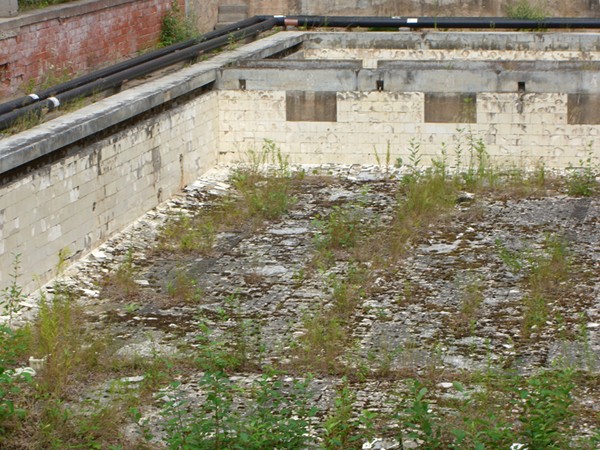
Tartu’s old swimming pool has been abandoned in favour of the new water centre that was built some years ago. We walked past the old one this summer. For some reason the pool is still there, and so are the poolside seats, although the building around it has been torn down, and a new building is standing where the showers and changing rooms used to be. In the photo below the big pool is in the front – you can see the darkish rectangles at the end of each lane as well as the spots where the lane marker ropes used to be attached. The teaching pool is in the rear, behind the big one.

After over two years of waiting, I have finally found and bought some more green bowls. Patience wins.

One disadvantage of having a large door towards the garden that stays open most of the day is that lots of insects find their way into the house. The old veranda served as a sort of a buffer; the insects gathered there and not many came all the way into the house. Now they come inside.

Daily, I find dead flies and other small insects here and there in the house. In the beginning I found them mildly disgusting but now I’m so used to them that I don’t react much, just pick them up or sweep them into a wastepaper basket.

It feels like I take out at least one (live) wasp per day. So I guess they built a new nest somewhere after we interrupted their building works in Ingrid’s play house.

For a while we had moths who for some reason tended to congregate in the bathroom. Every evening I found several moths there, on the window, on the windowsill, on the wall, and almost daily one in the washbasin. (That last one got mercilessly flushed down the drain.) Now the moths are gone, I guess their season is over.

Once one of them went and died inside the bathroom fan. The fan made its wings vibrate so it sounded like there was a bee in the room. I kept looking for it and it took me several days to realize where the buzzing was coming from.

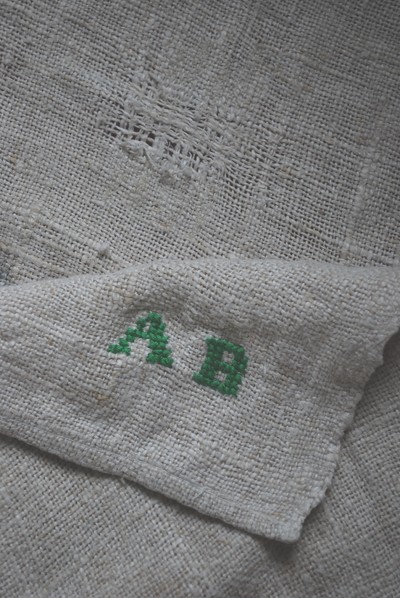
We have a bunch of linen kitchen towels of varying age and origin. The most interesting one among them is this one. I don’t remember its provenance. It is a simple square of relatively coarse unbleached linen, no woven pattern or anything. It is monogrammed AB, and the embroidery is as simple as the towel itself. And the towel has been darned, carefully, in the middle.

Nowadays most of us don’t mend holes in clothes. We just throw them out and buy a replacement. When did you last see a darned sock? When did you last darn a sock yourself?

I mend minor holes and tears in the kids’ clothes and in some of mine. (Expensive tights in particular, if the hole is in a place where it won’t be seen.) I restitch unravelling hems and seams. But I can’t imagine darning a towel.

I wonder what made the previous owner care so much for a simple towel that they would mend a hole in it. Was it a question of economy? Or did the towel have emotional value for them? A gift?

It makes me really like this towel.