In the middle of summer, I am knitting the thickest, warmest, woolliest sweater I’ve ever made. With every sweater or cardigan I make, I realize another gap in my winter wardrobe; this is filling the one for something simple and rustic to wear at home on the coldest days. Not that it won’t be stylish enough to wear to the office! But it will be bulky enough to be somewhat difficult to fit under a coat.

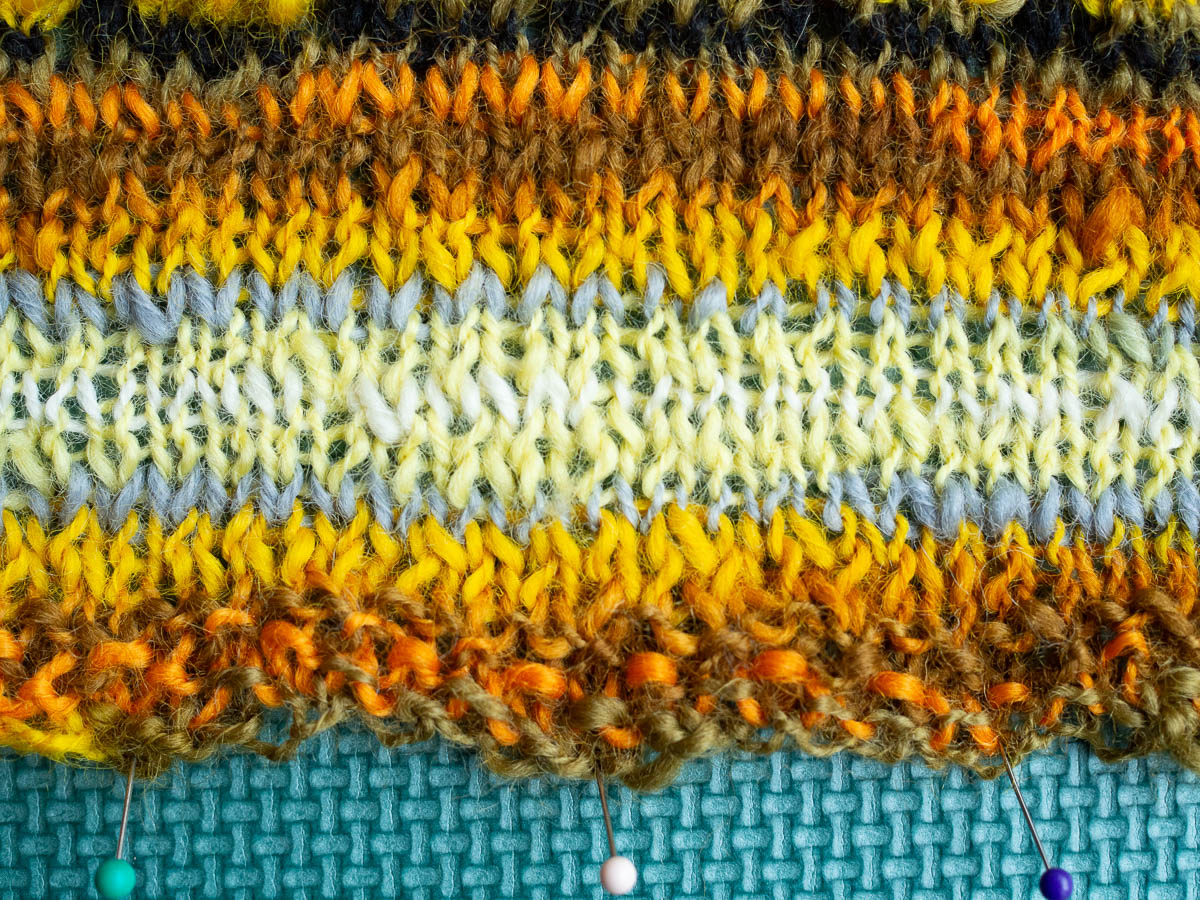
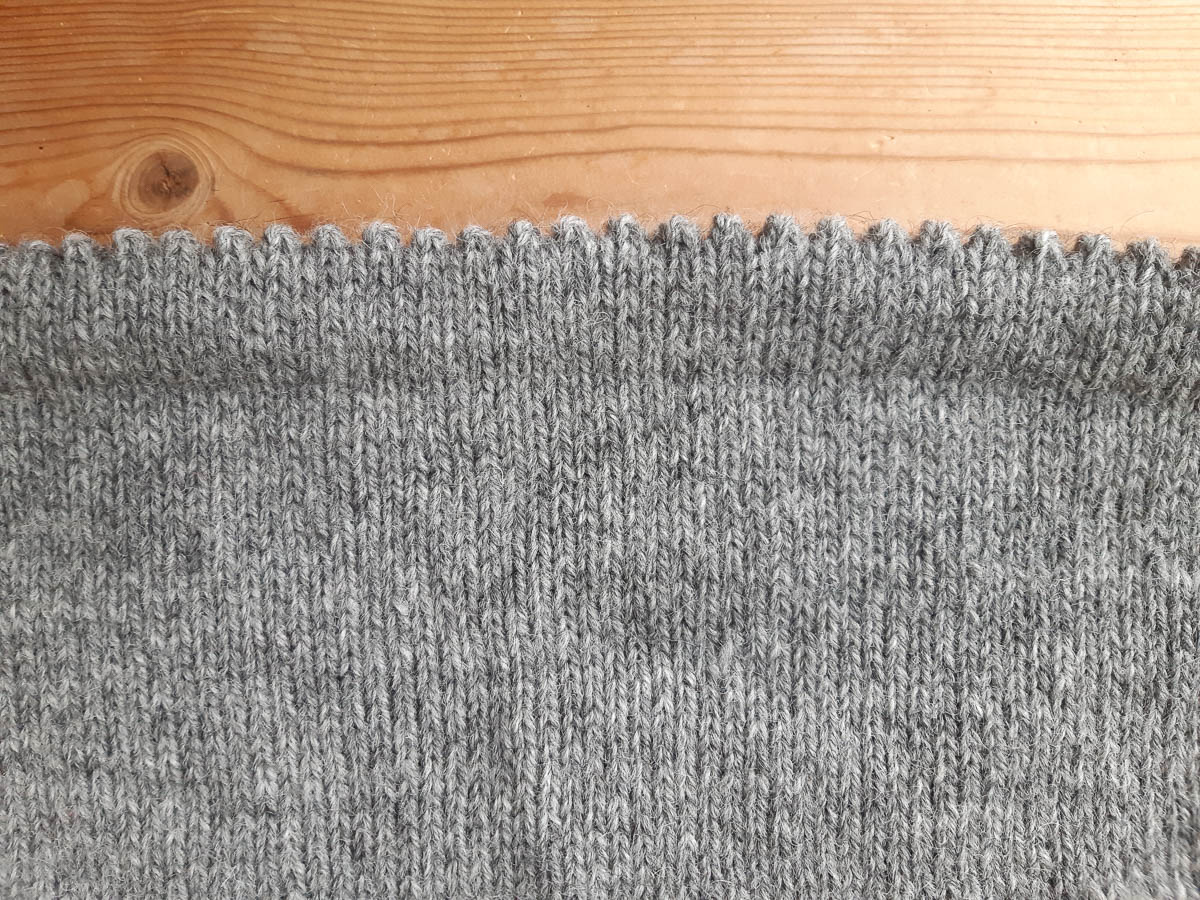
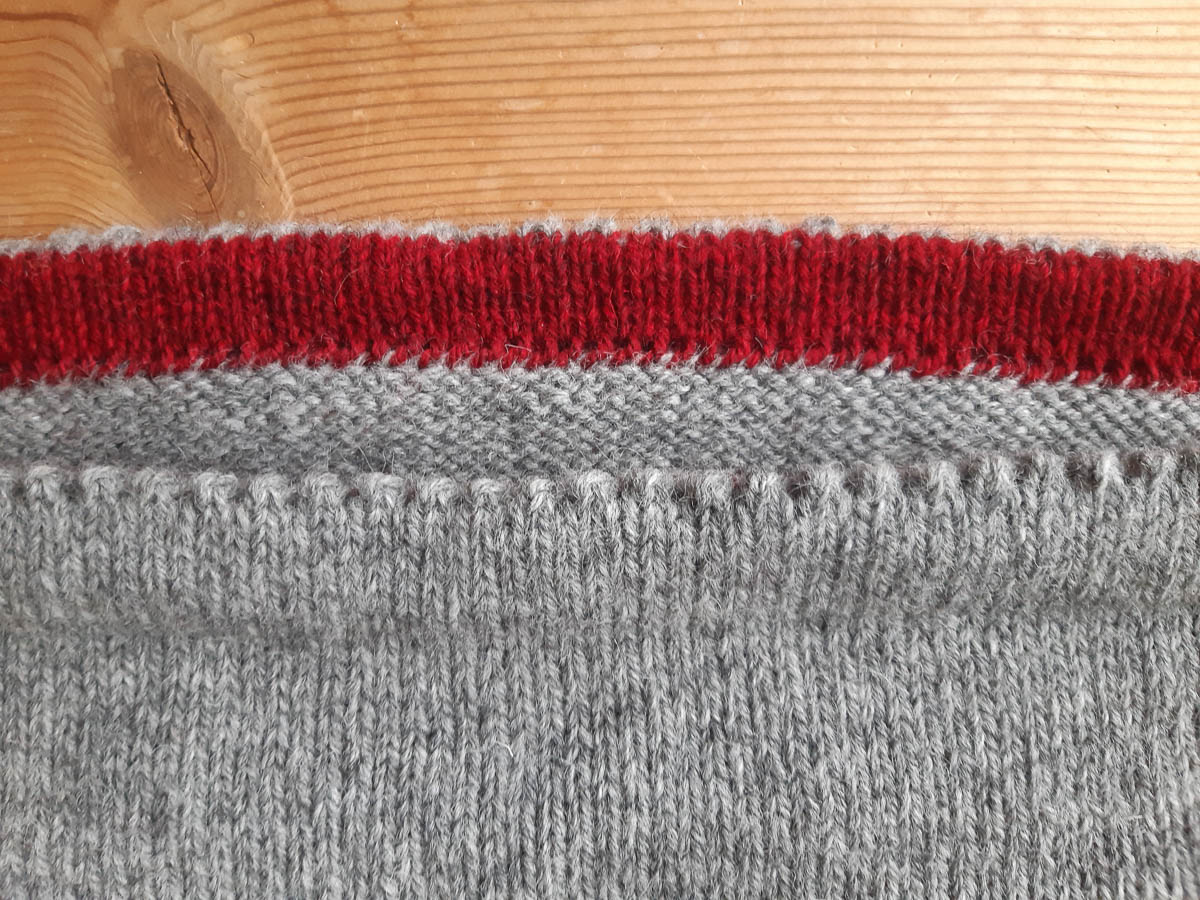
I’m not fond of ribbed hems, and I’ve also learned that rolled hems are not my thing, so here I tried a folded picot hem. Quite nice.

I ran out of the dark gray yarn just after the fold, so there’s a hidden, secret red stripe on the reverse side.

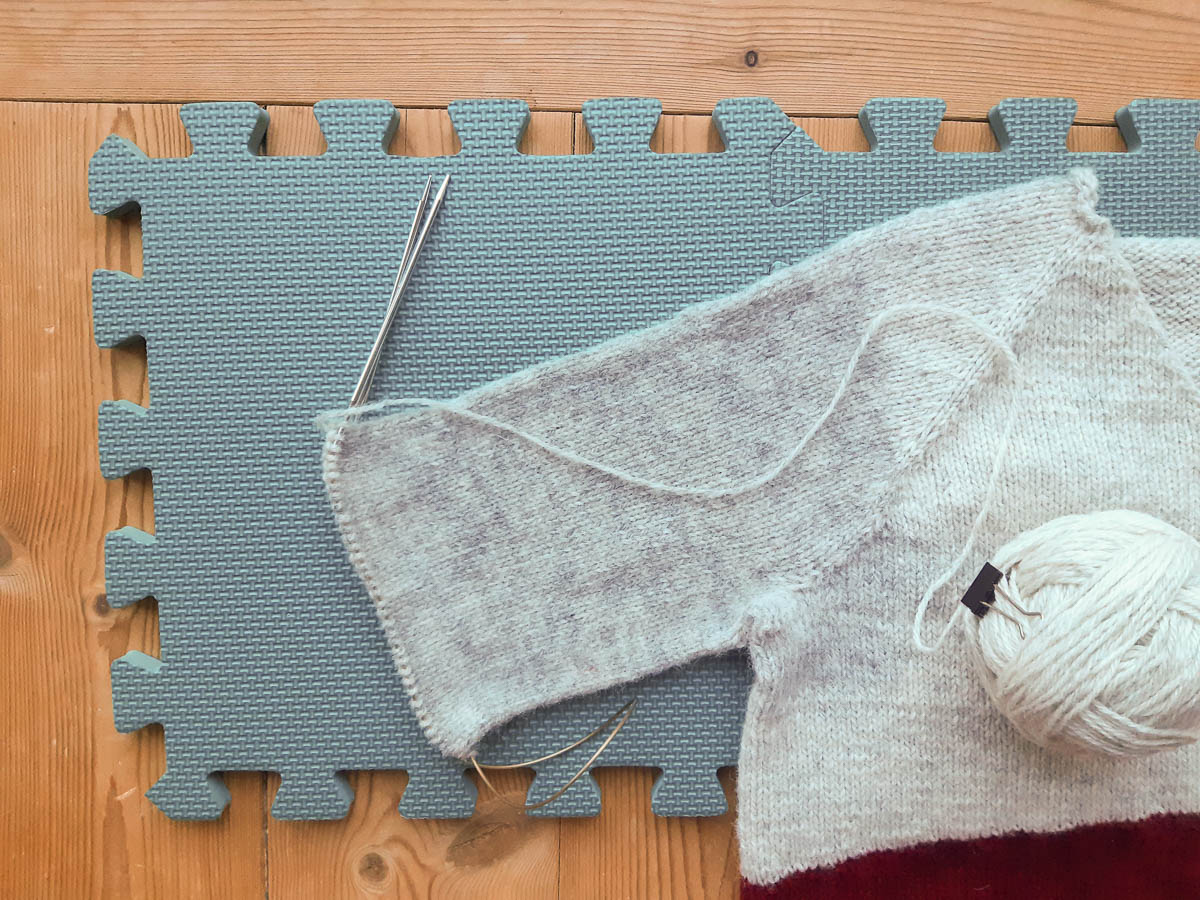
It looks like the sleeve will turn out too narrow. I think I underestimated how much the bulk of the fabric itself would affect fit. My gauge swatch grew a little bit in blocking, so the sleeve *might* be OK after blocking, but I’m sceptical. Nevertheless I blocked just the half-finished sleeve, to check, and now the living room smells like wet sheep.

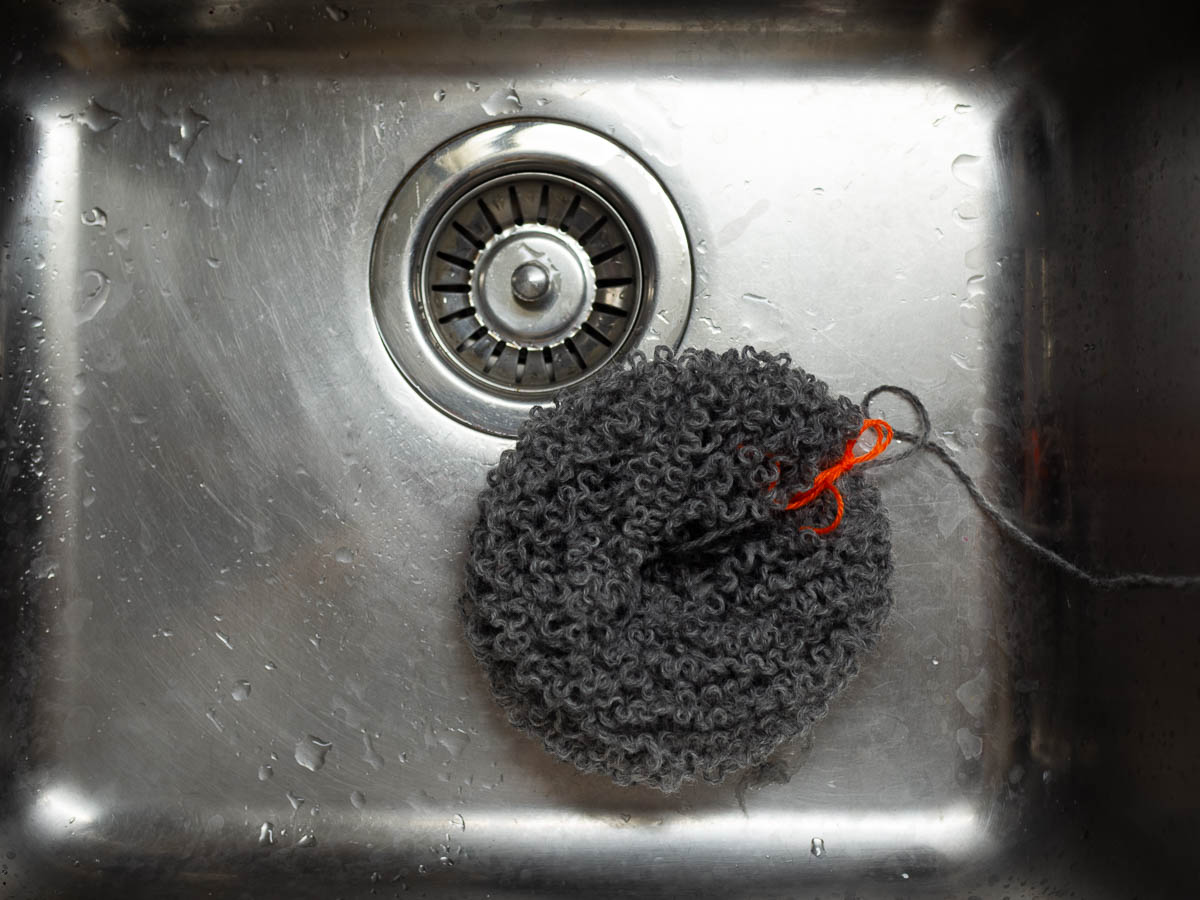
Finish one sweater, start thinking about the next one. First step: knit, block and measure a gauge swatch. I don’t much like keeping my gauge swatches – they take up space, and it’s unlikely that I’ll ever have any benefit from them – so I usually rip them up and reuse the yarn immediately.

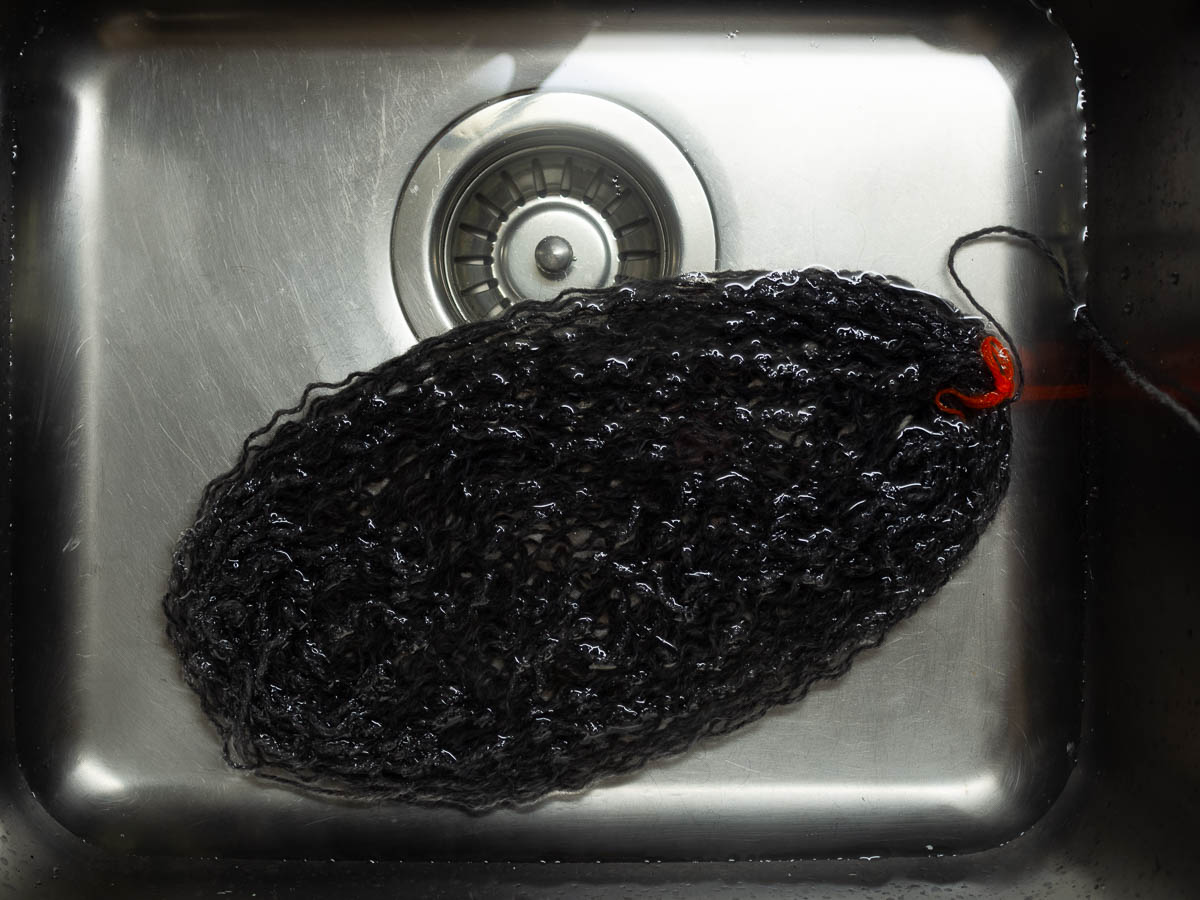
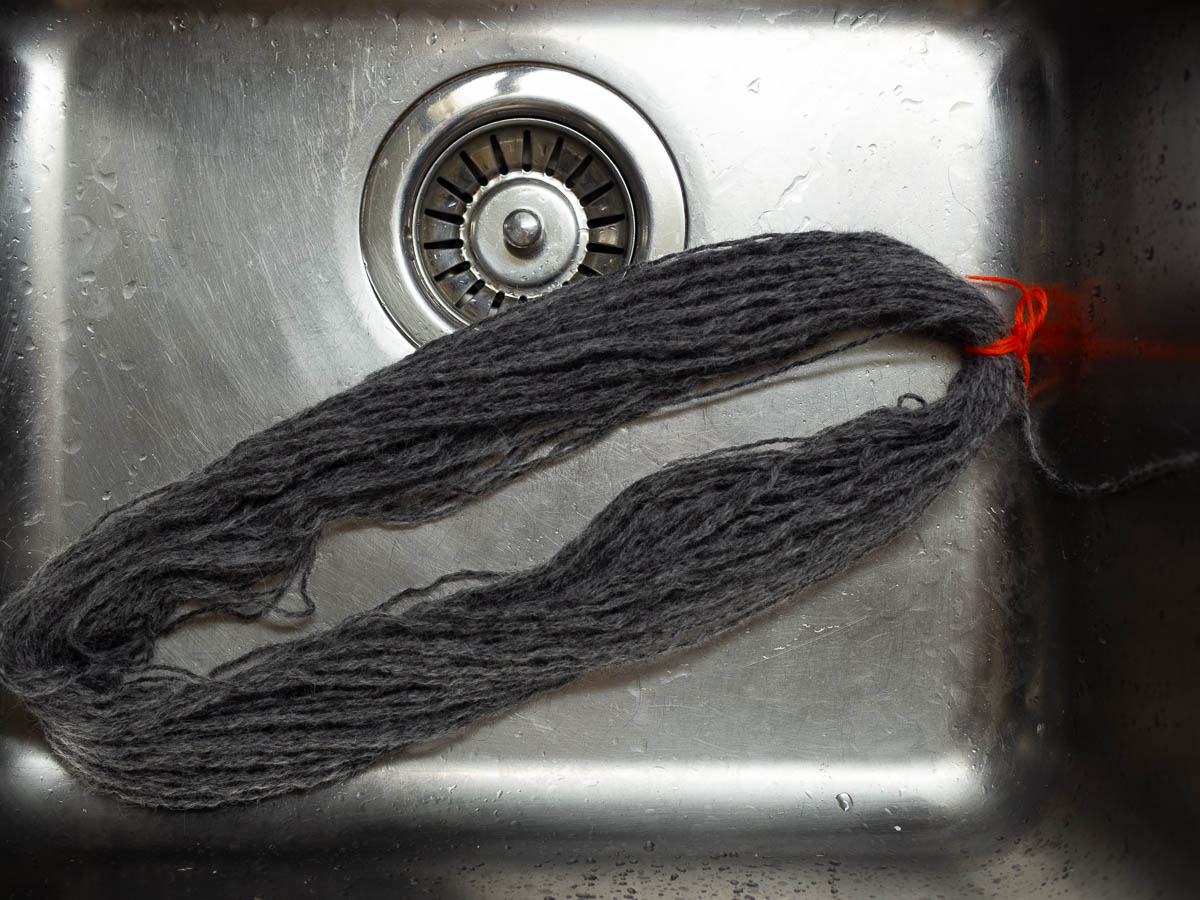
The yarn looks unusable, and mostly is unusable. Crinkly and uneven. But then I put it in lukewarm water for ten minutes, gently massage it a bit, squeeze out the water – and it looks just like new. Like magic. Except now it smells like a wet sheep, which is less magical but also kind of wonderful.


I finished the crazy sweater, and even wove in all the ends – of which there was a lot, due to both the stripes and the shaped construction.

It didn’t come out quite as I had pictured it. The stripes could have been more uneven in width and distribution. Now I just eyeballed things, and clearly ended up converging at some kind of comfortable width and comfortable distance. Also, I had imagined a more drapey look, but the garter stitch made the fabric a bit stiff.

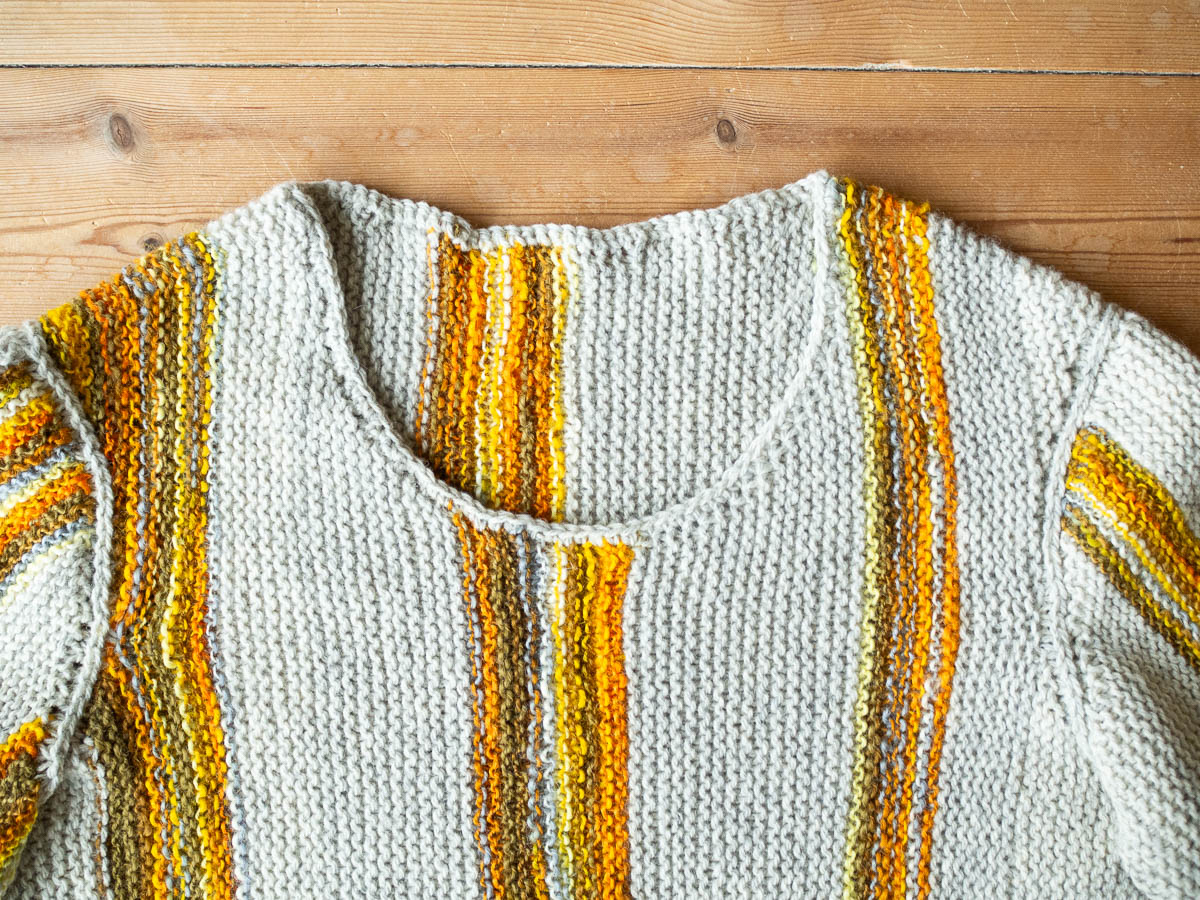
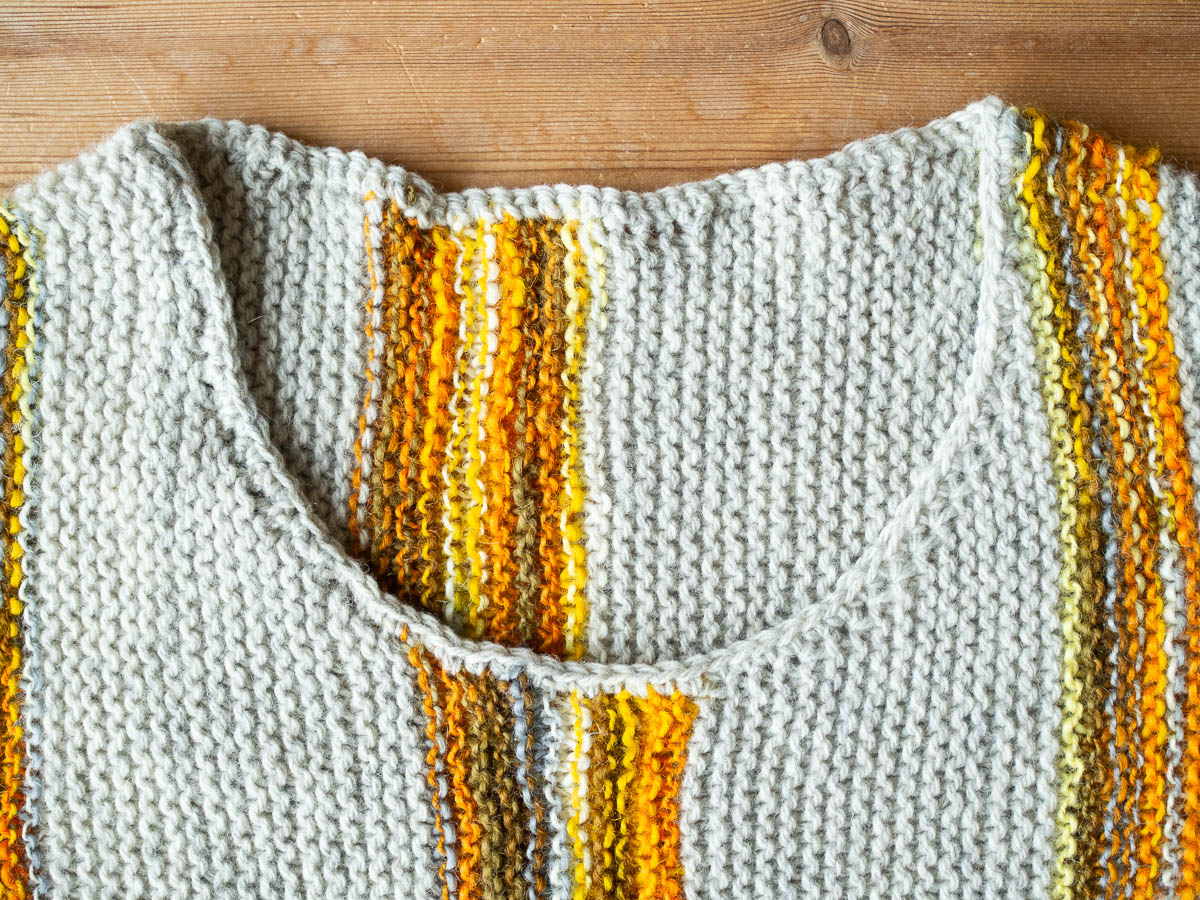
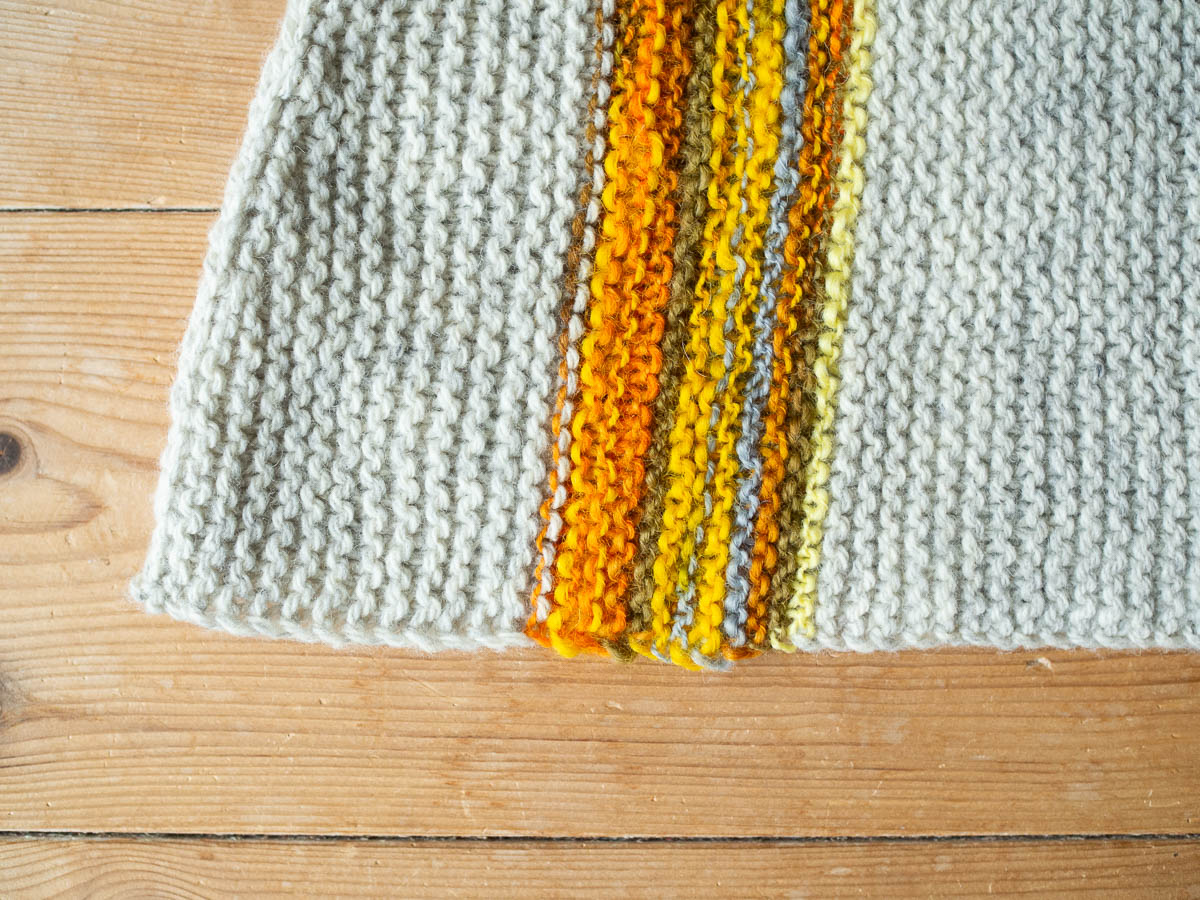
To let the stripes and the crazy yarn get most of the attention, I kept everything else as simple as possible. No ribbing or anything around the neckline, just one row of single crochet to even out and strengthen the edge, and nothing at all along the cuffs and hem. I rather like this simple, pared-down look.


Initially as I finished the sweater and looked at it, I wasn’t sure how much I liked its combination of loose fit and thick fabric. But then I put it on and it felt amazingly comfortable – soft, loose and very stretchy without being baggy. And it is kind of fun. So now I’ve been wearing it around the house in the evenings almost every day. I think it might be a perfect sweater for the in-between seasons, especially when lounging at home. It may not see much use outside the house – it’s too bulky to fit under a coat (at least under any of mine), and somewhat loosely knit so not much protection at all against the wind on its own.

Staying at Duottar for another night. Today was planned as a slack day, in case we needed to adjust our route or timing due to the weather – or to be used for a day trip. In the end it was a bit of both. The day started out very windy, continuing on from yesterday, so we mostly stayed in the huts until lunchtime.

In the middle of the day we had a couple of fine hours of beautiful sunshine, and went out on a small circuit on the nearby lake. On the other side of the lake we took off our skis and climbed to the top of the (very small) peak to get some views.
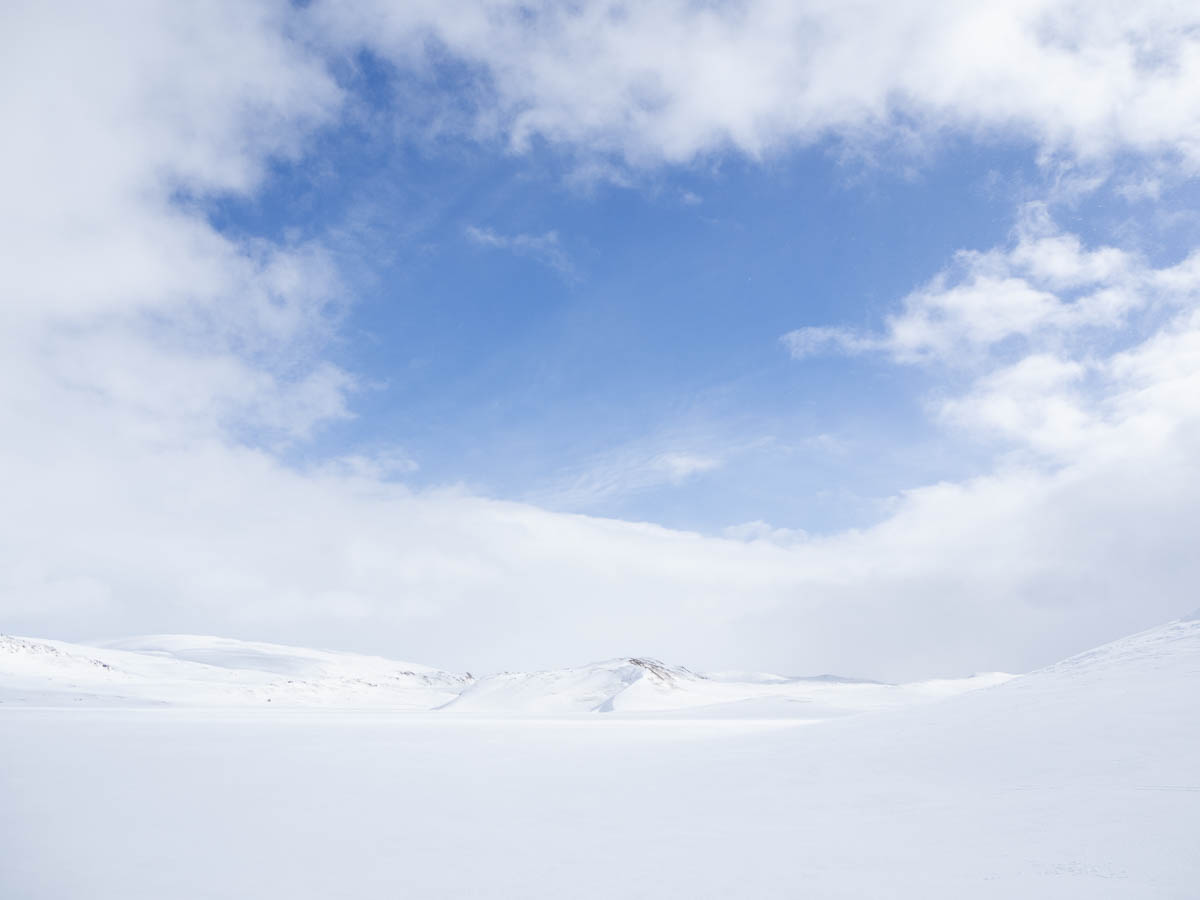
It was rather satisfying to get some good glide going. Swish, swoosh, across a flat lake, with the wind at our backs and the sun brilliant above us.
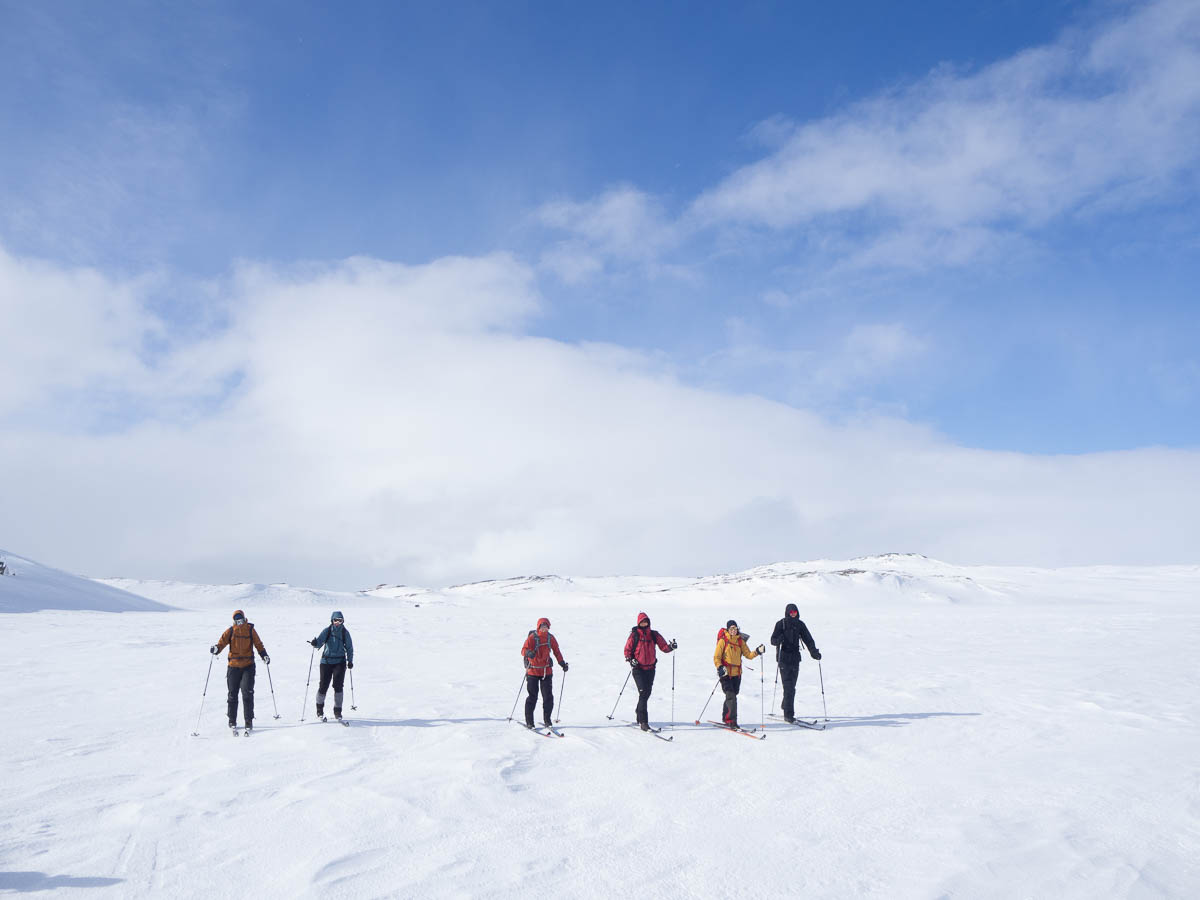
More dark clouds were piling up when we were turning back, and the wind picked up again soon after, so our outing remained short.
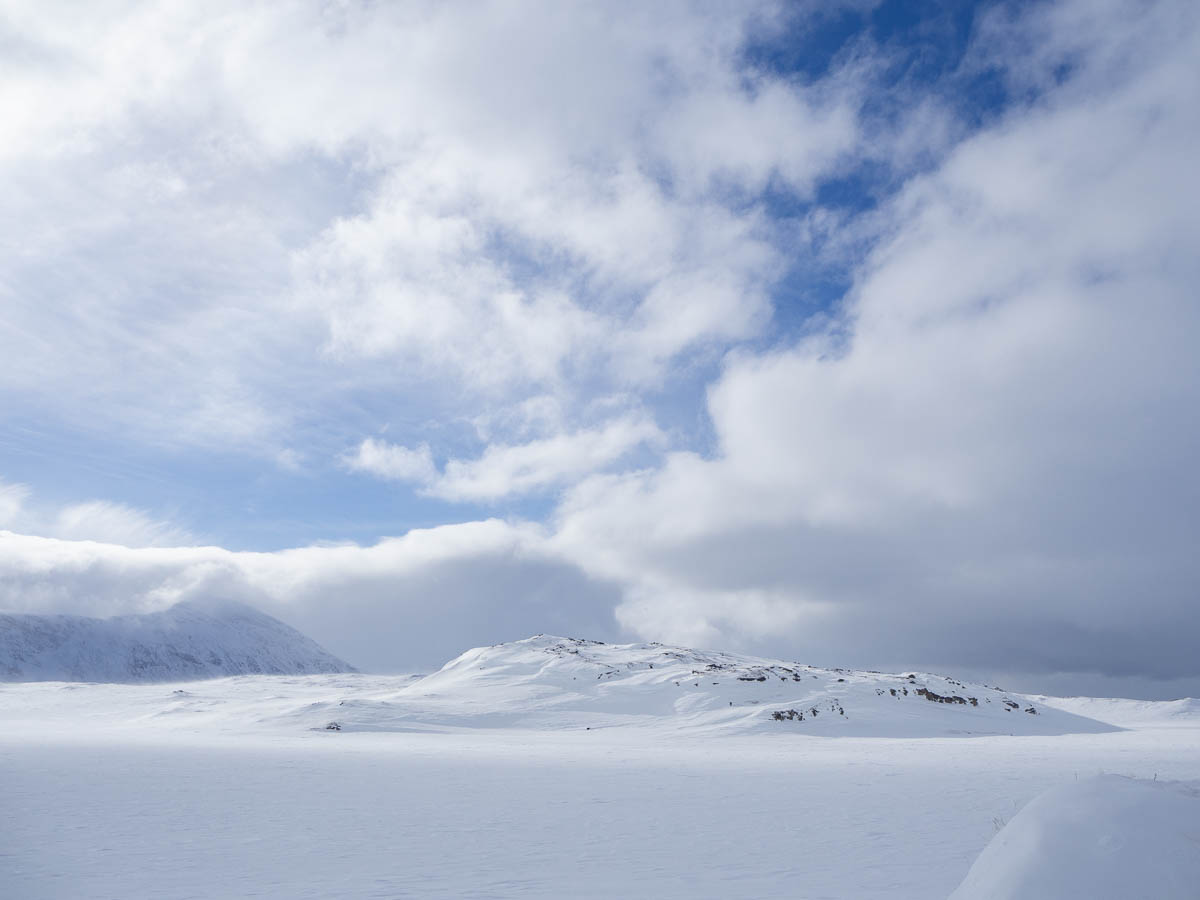
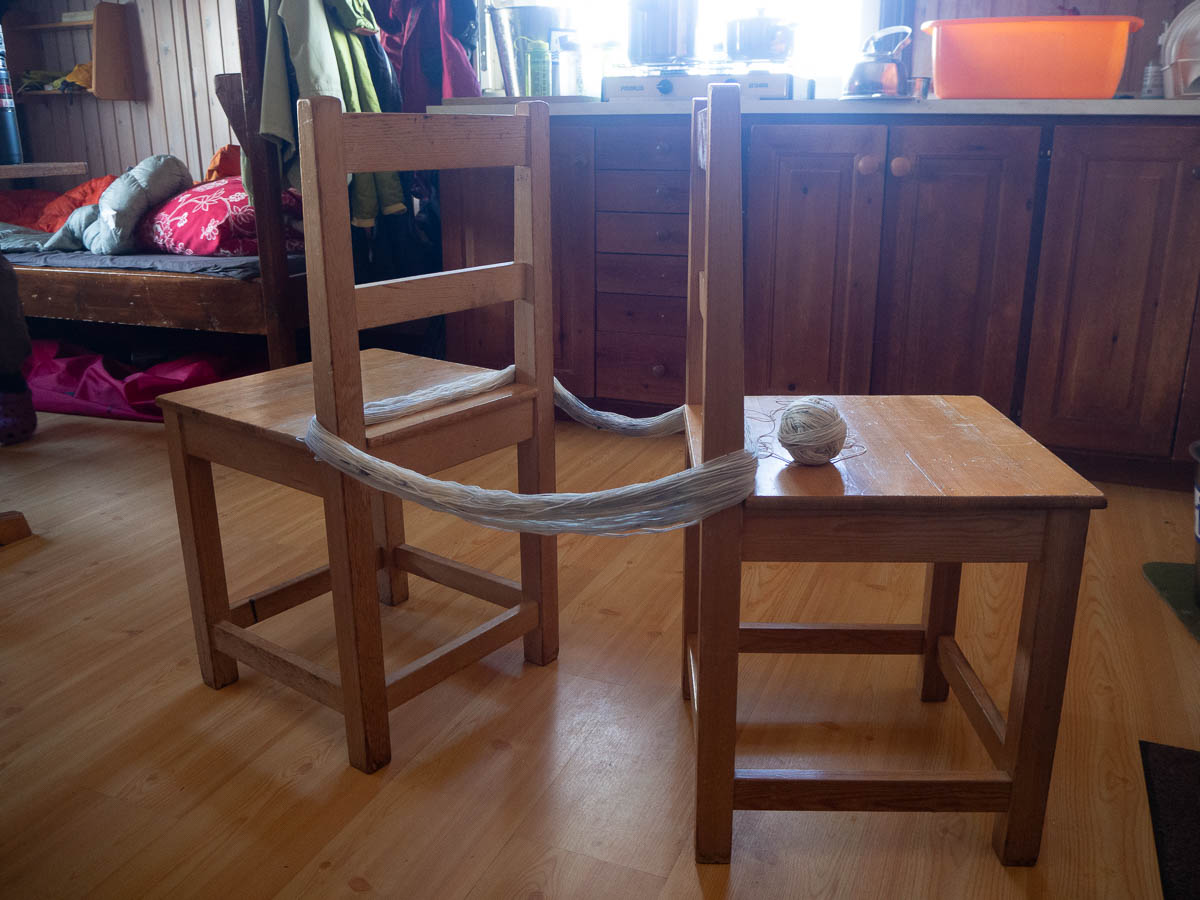
The rest of the day we just puttered around our huts. I think many in the group appreciated the rest. There isn’t much space nor comfortable furniture in the huts. You can lounge in your bed, or on one of the small, hard chairs.
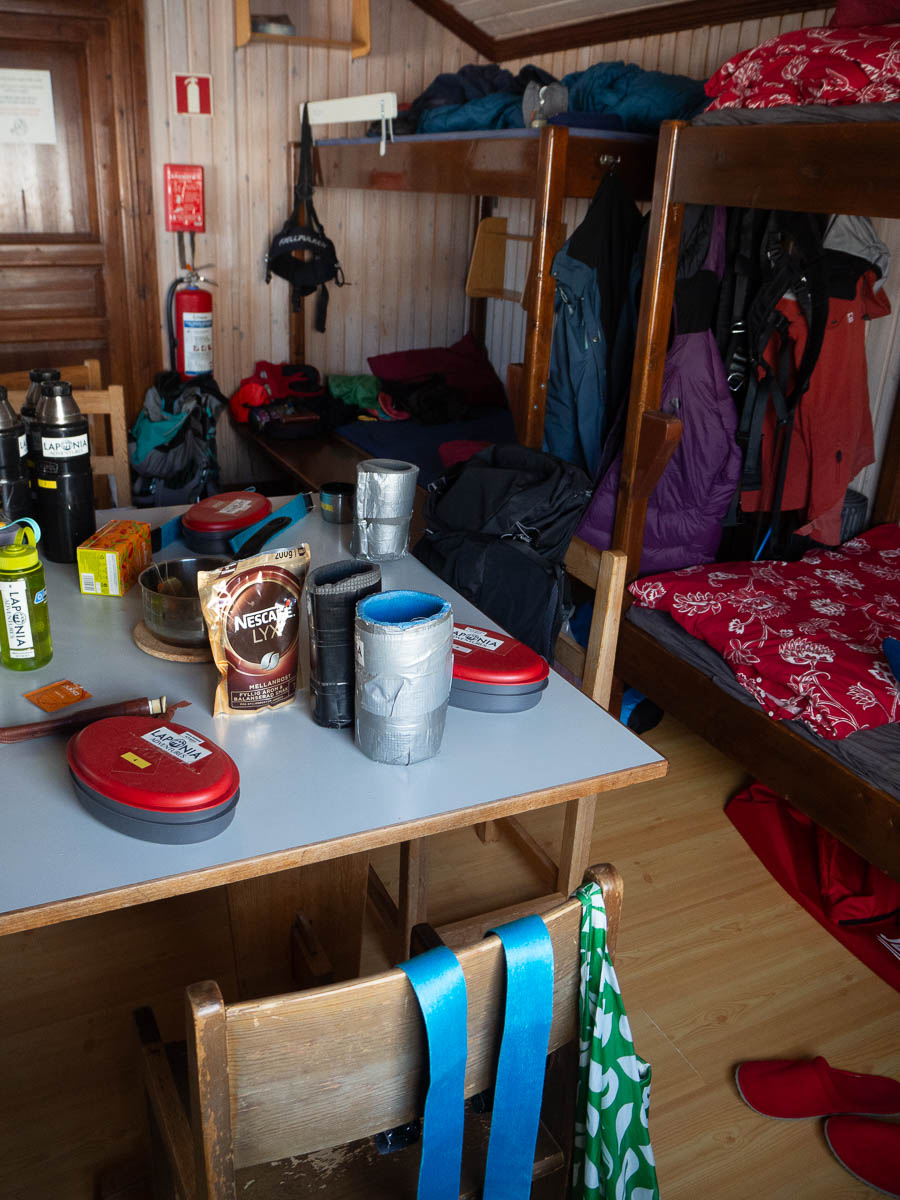
I had packed some knitting, given the more generous “luggage allowance” with the pulks. I finished a pair of socks this morning and wound the yarn for the next pair. A ball of sock yarn weighs 100 g, so the two didn’t make my bag much heavier.
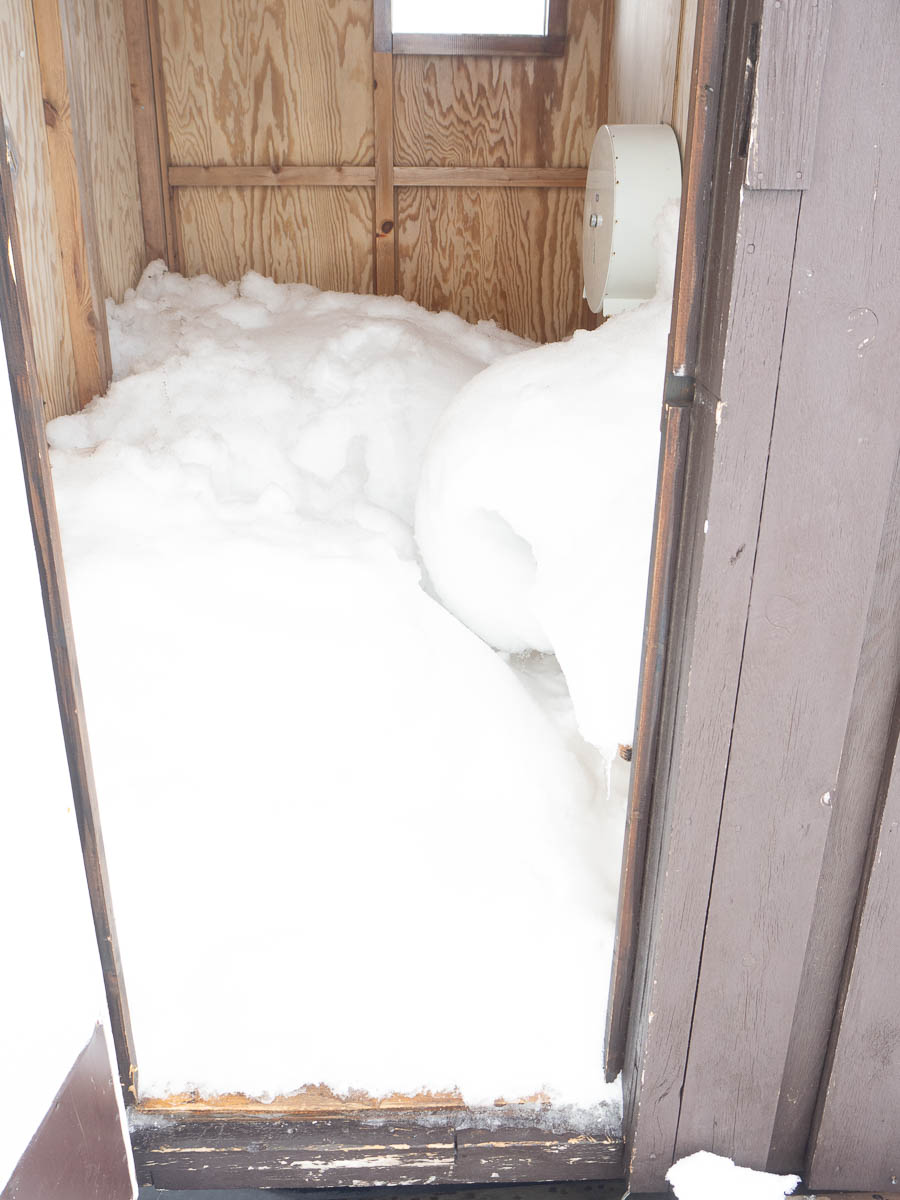
At one point we took the time to dig out another stall in the outhouse. When we got here, only one of the stalls was clear of snow. Two others were full of snow inside, and the fourth had a large drift in front of the door. But we were getting low on toilet paper in the one that we were using, so it was worth digging out a second one.
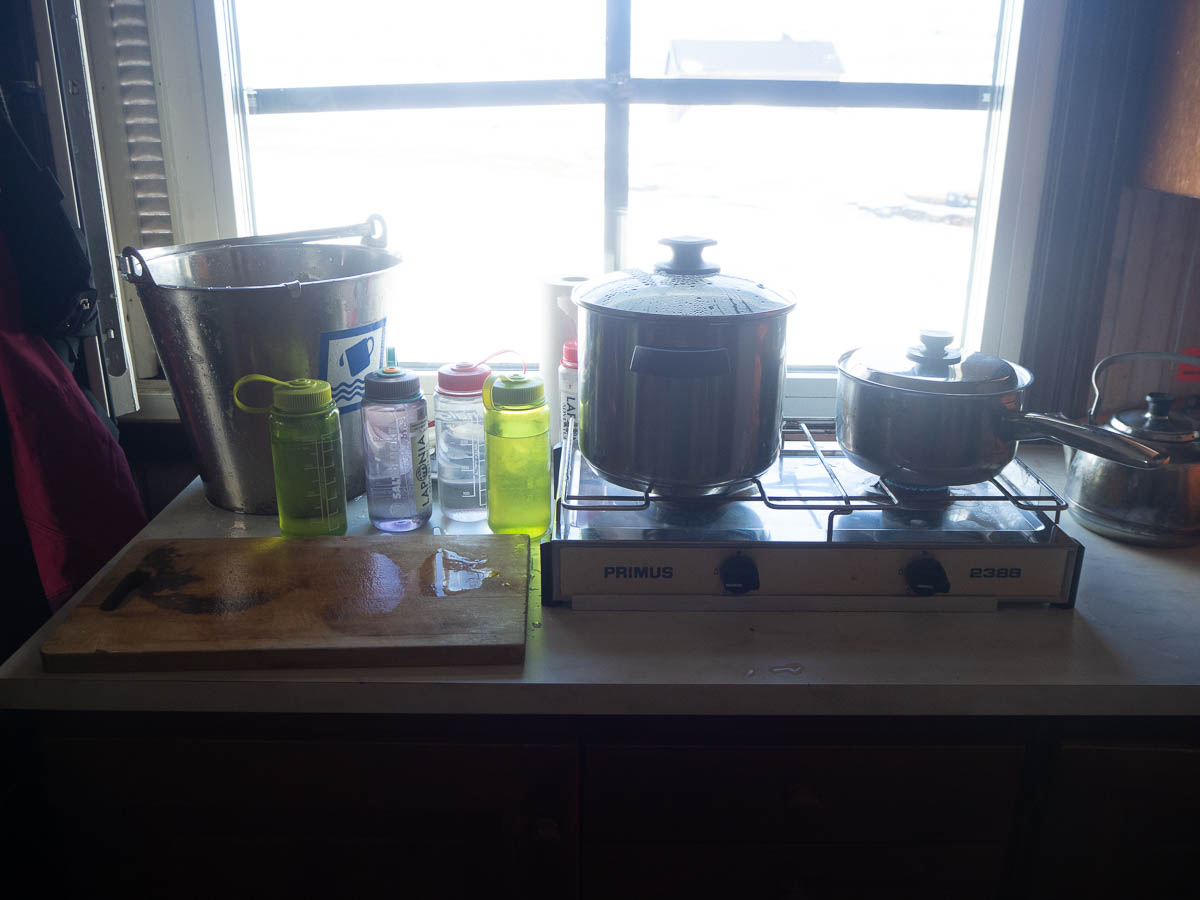
When there’s nothing else to do, there’s almost always water to melt and boil. It’s the first thing we do in the morning, and likewise the first thing we start when we get into a hut in the afternoon. There’s almost always two pots of water on the stove and a bucket of snow next to it.

Had I been on my own, I’d most likely not have bothered with the boiling. Fresh snow, freshly melted, is good enough for me. But I understand that the guides feel like they need to be more responsible with the group’s hygiene.

During this trip I’ve learned that there is technique and tricks to melting snow for drinking water. Sure, you can just shovel snow in a pot and put it on a stove, but there are ways be efficient about it.

Firstly and most importantly, don’t start with snow in an empty pot – you want some water at the bottom. Otherwise the first snow to melt will immediately boil and evaporate, which is a waste. So you prime the pot with the last dregs from your thermos.

Secondly, the first batch of ready, boiled water goes not in the thermos but in ordinary bottles, which you then put in the bucket of snow waiting to be melted next. This way you start warming up the snow while also cooling your drinking water. The thermoses you fill last.

And, of course, don’t leave any of your leftover water in the kettle, like some fool had done, because by the time the next guests get there it will be a solid chunk of ice, spiced with dead flies, which you can’t even pour out because it’s larger than the opening of the kettle.
On any normal trip we’d also spend a fair bit of time cooking. This time we had packed, frozen meals for all dinners, and the guides took care of breakfast porridge. I’ve never eaten as well on a hut-to-hut tour, with as little work.
Right sleeve of sweater. I liked the way it looked, rolled up around that little ball of yarn.


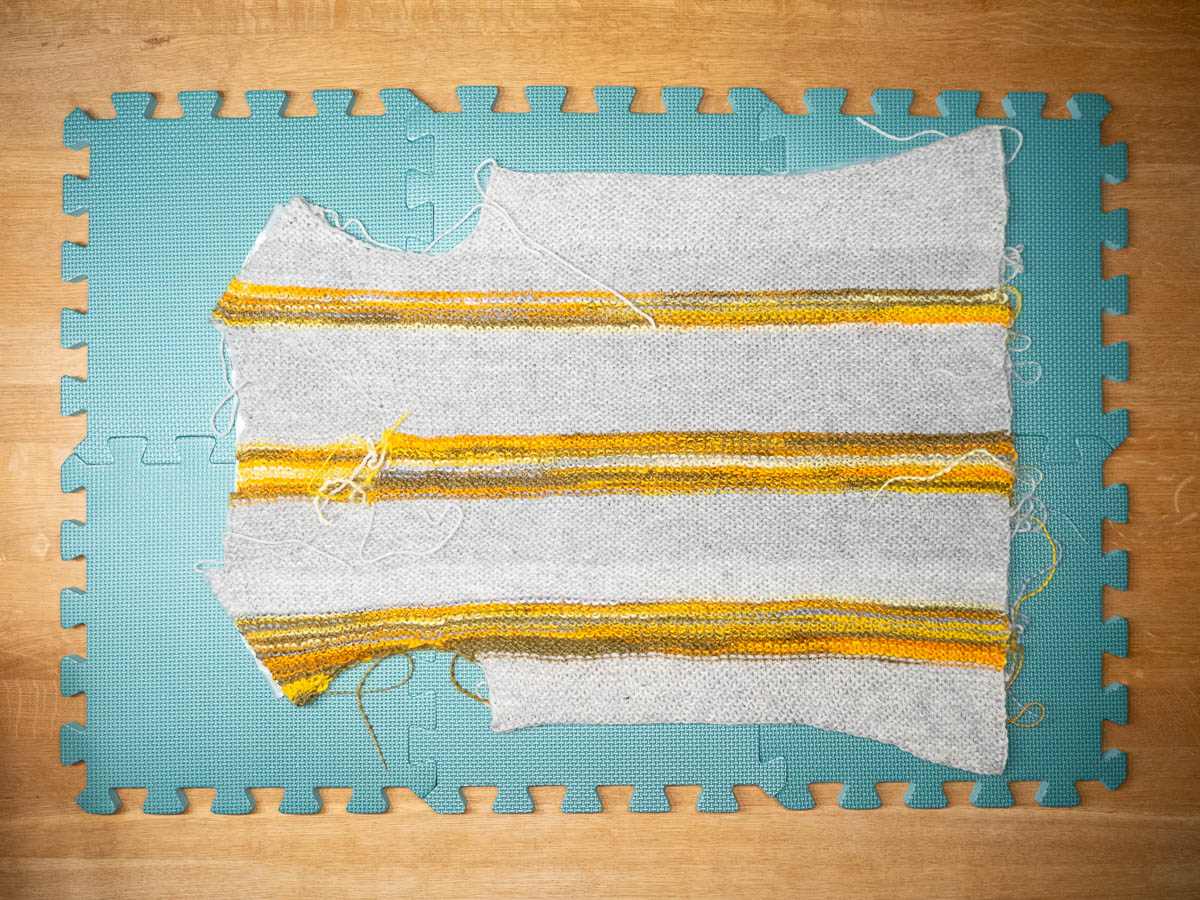
The sweater body is finished, and now drying after I wet blocked it.

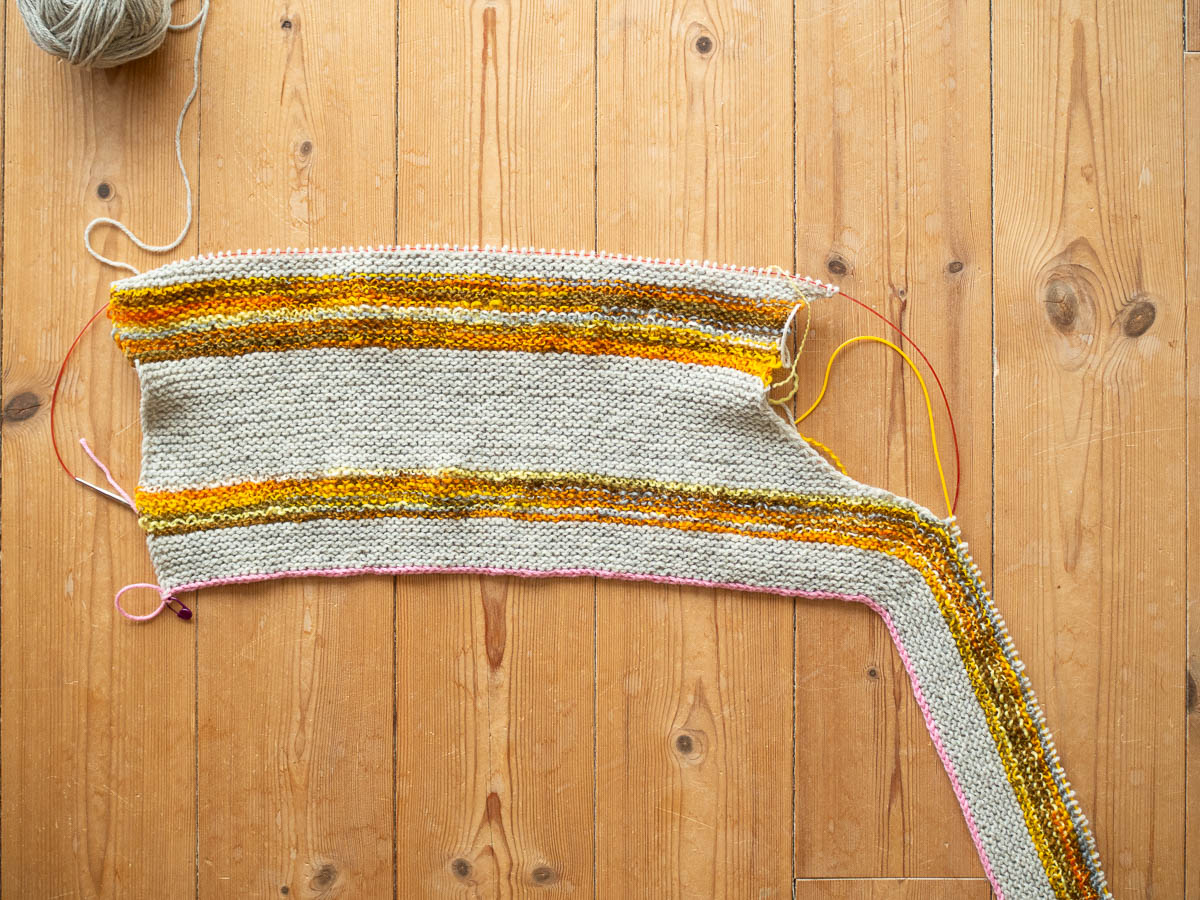
The colourful stripes are as crazy and colourful as I pictured them. The lines between the light gray and the almost-but-not-quite-the-same light gray were not planned. I guess I got two different batches of the gray yarn. Given how the sweater is constructed, I can’t even easily avoid them by alternating the two skeins. With the line at the top, for example, I actually started the knitting there, and knitted first in one direction (downwards in the photo) and then re-joined the yarn when the rest of the body was done and knitted upwards to make that shaped section.

But I guess if I’m doing stripes anyway, what’s a few extra ones?

Or, maybe, if they do end up bothering me, I could use duplicate stitch to embroider a thin line there with the crazy yarn and pretend that it’s part of the design.


I have plans, and I have a yarn – I can start knitting!

There’s a whole chunk of it done already, even though what I have doesn’t much look like a sweater. I’m knitting it sideways, and not starting either in the middle OR at the side seam, so what I have is sort of random-looking pieces. A long strip of the left side, from the front hem over the shoulder and down to the back hem, and then a big chunk of the front, with the neckline curve at the right side of it. Now to finish the front, then knit the back, and then they’ll join up again at the right shoulder and continue towards the side from there.


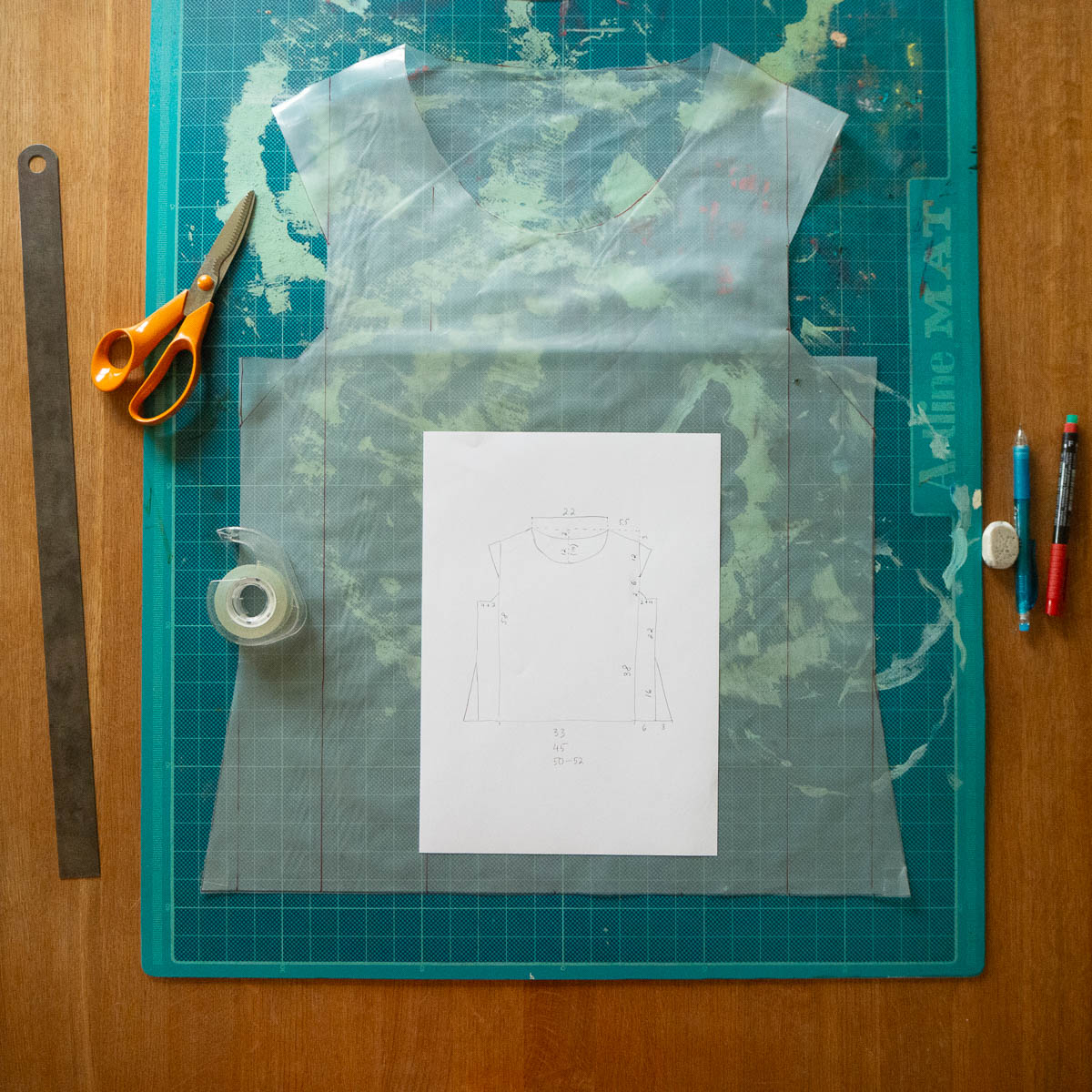
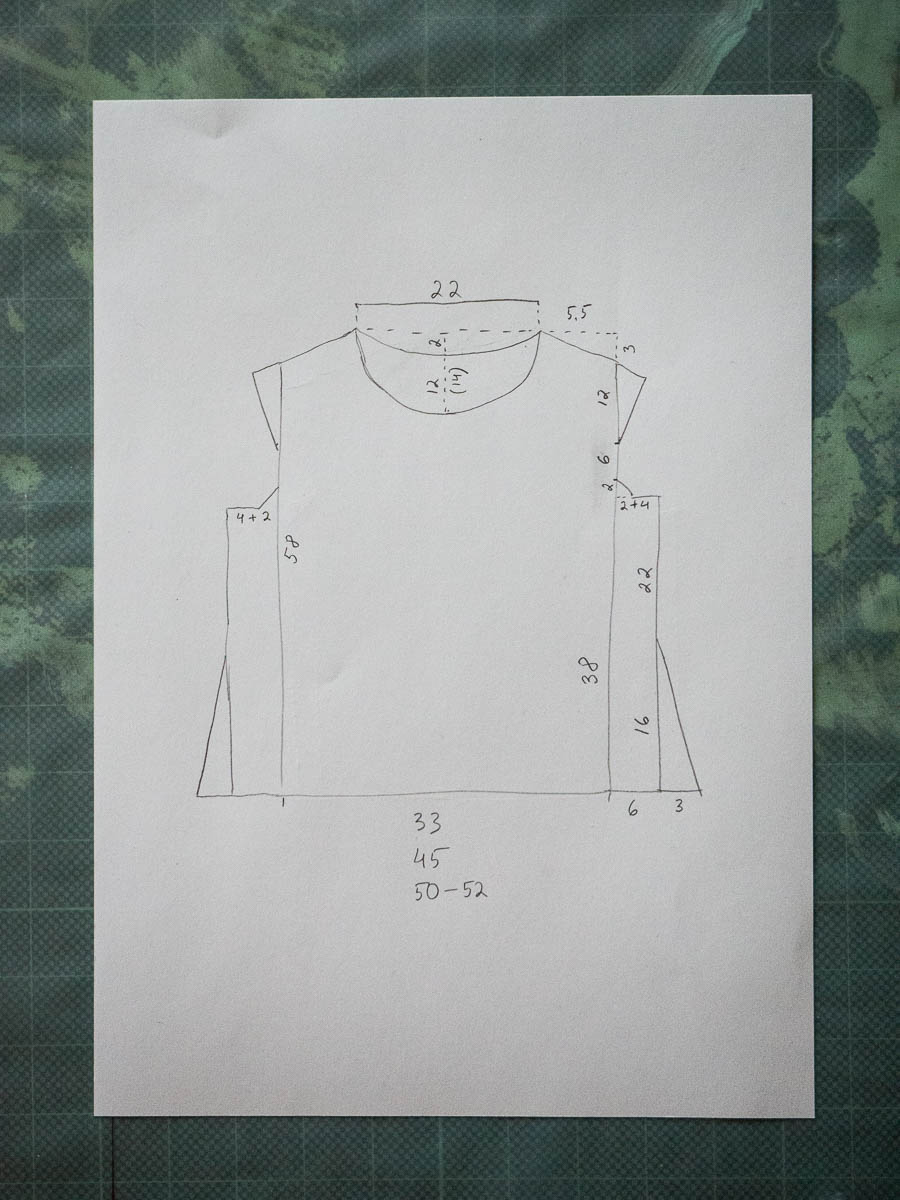
Planning the details for the “sweater with the funky yarn”. I couldn’t find a pattern that I liked, so I’m making it up myself based on bits and pieces of different patterns.

Sewing patterns can have curves all over the place, for armholes and sides and necklines and what not. But knitting patterns ultimately tends to boil down to straight lines and triangles. Making things fit is about adjusting the angles and lengths of those lines. “Decrease x stitches on every n:th row”, and you just pull those numbers up and down to fit.

For a curve, you just need many short, straight, angled lines after each other. Knitting is inherently made up of discrete stitches, after all. Even if it looks like a continuous curve, it isn’t. You want a neckline curve? It’ll still have to be broken down into “decrease 10, then decrease 7, then 4” etc. (I’m postponing thinking about the details of this neckline for now.)


Went to my favourite yarn shop and bought some undyed wool yarn to combine with the funky one. I think this combination might work out.

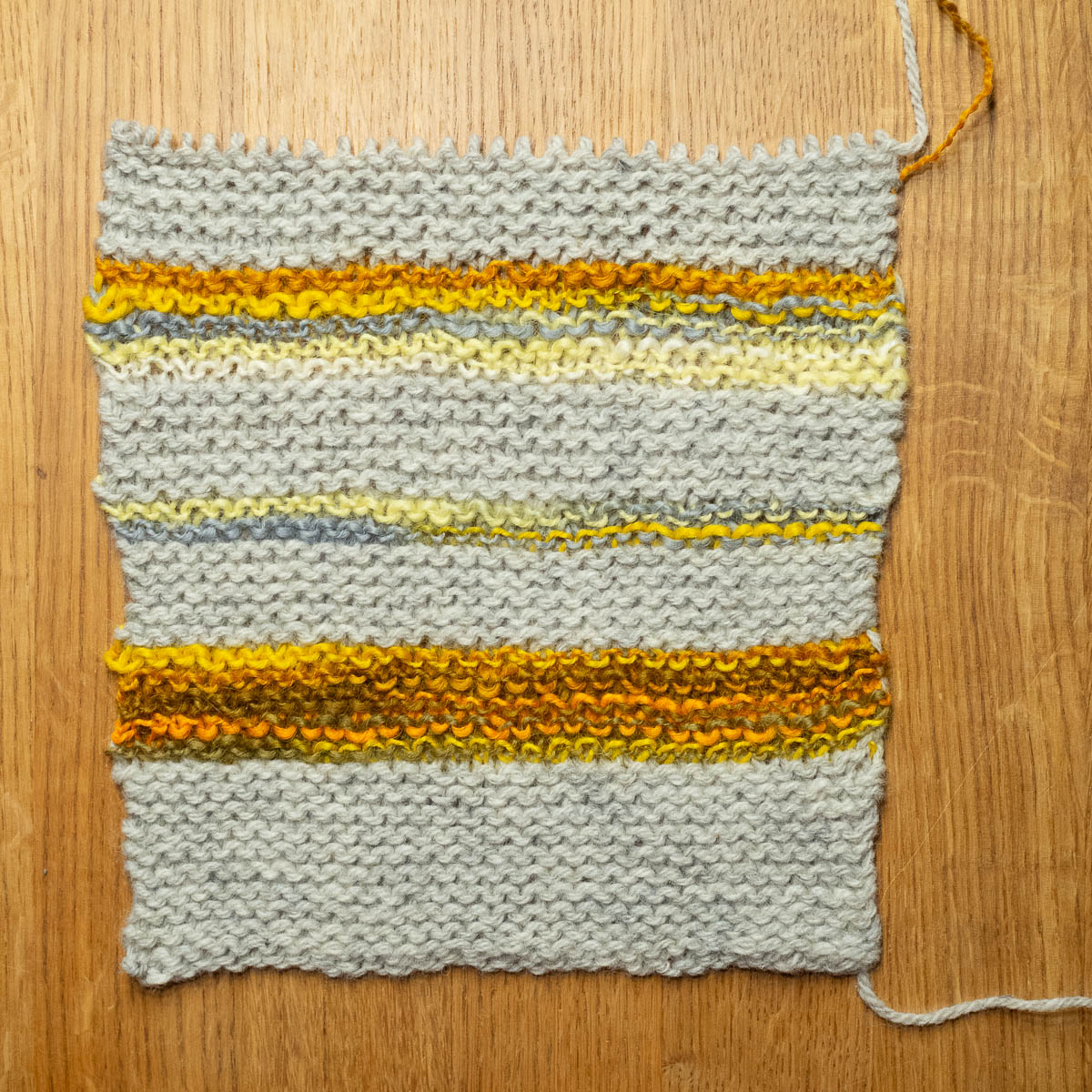
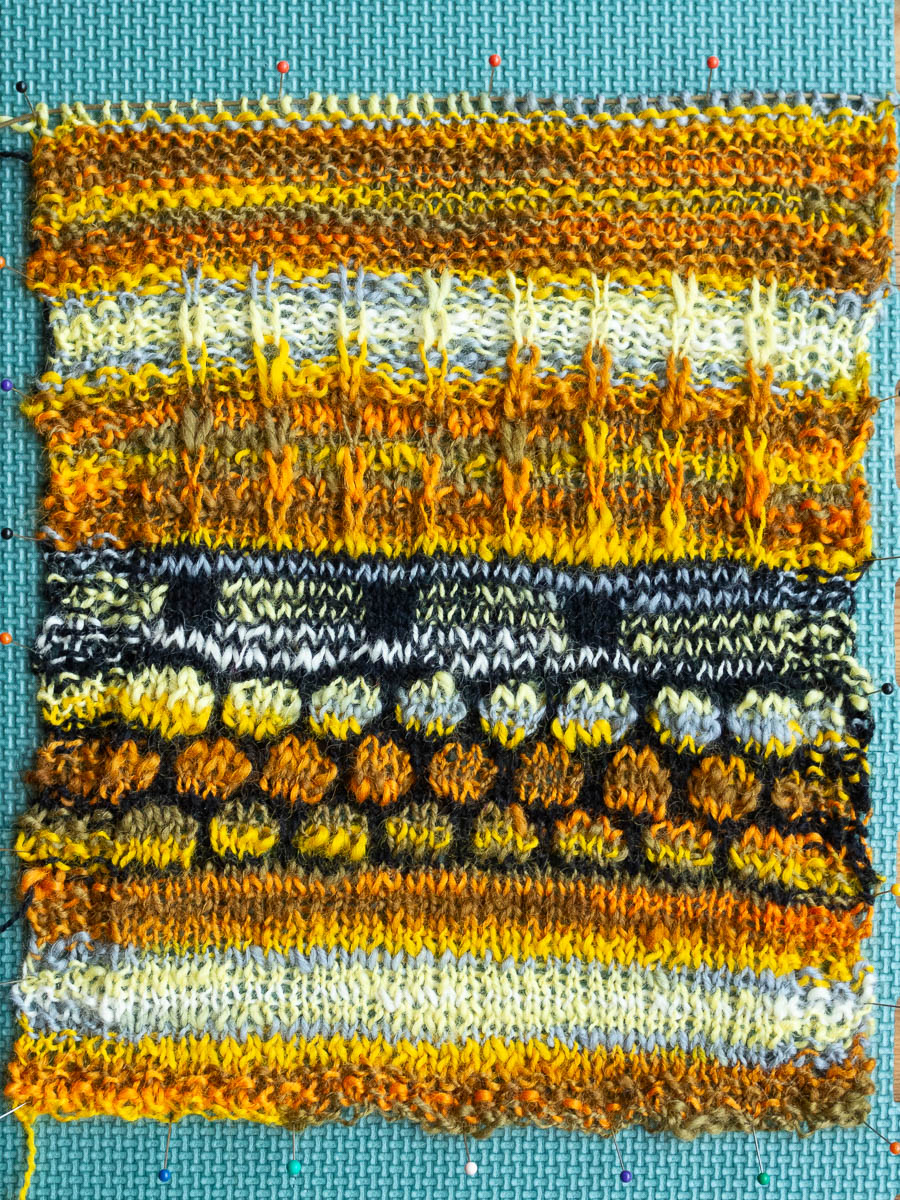
The yarn weight isn’t a perfect match – the funky one takes up more space than I expect based on its looks. With the same needles for both, the funky one bulges out a bit. I could try and buy more varieties of gray wool yarn from the internet, until I find a better match, or I can just make do. For the top half of the swatch I tried using 4 mm needles for the funky one and 4.5 mm for the gray one, and that looks pretty even.


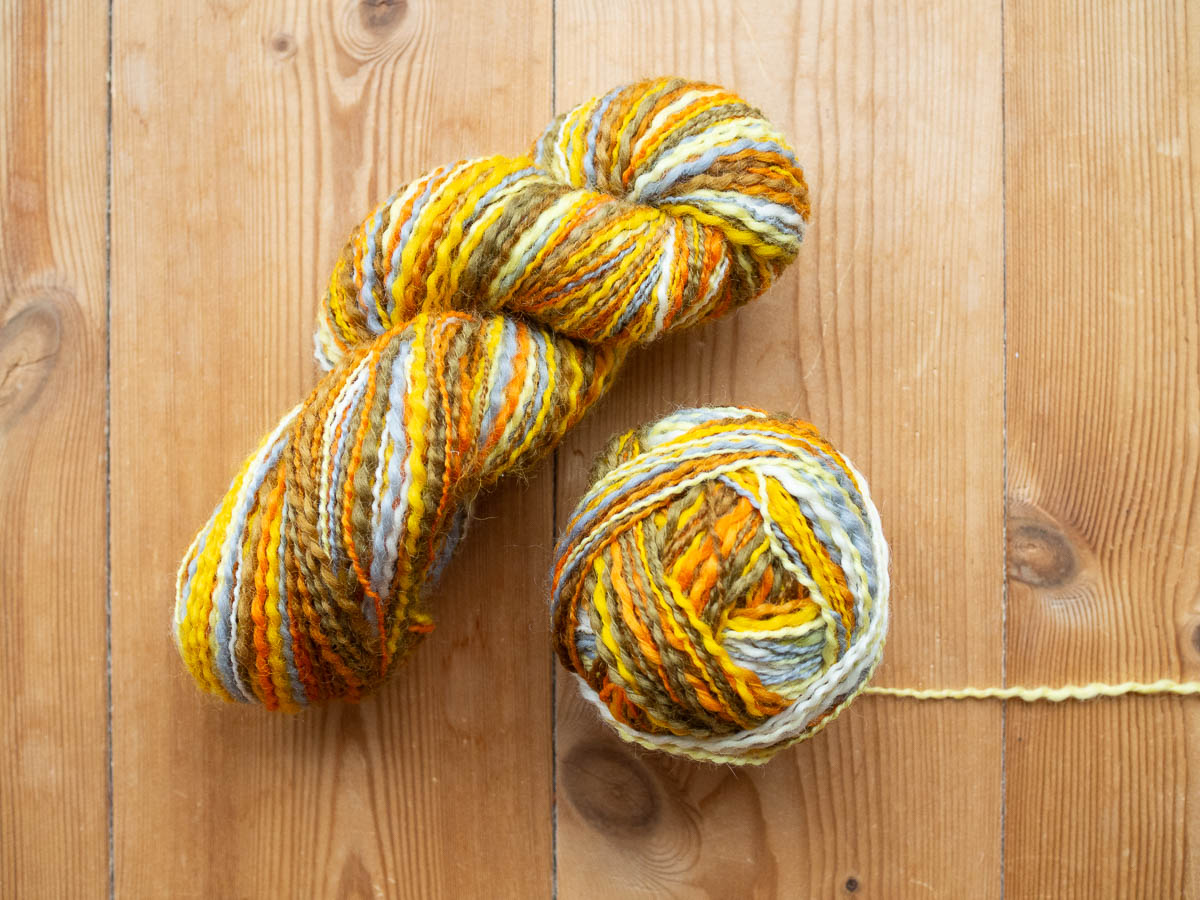
I found this funky vintage wool yarn at Tradera (Swedish ebay) and bought it because I liked the look of it. After winding it, I still like the look of it. (Which is not always the case – most of the ugliest yarn I ever bought is still in my yarn stash.)

Knitting it into something that looks good will require some more work, though. The yarn varies not just in colour but also in thickness, and it’s got a kind of a curl to it, like it’s been spun around a wire that’s later been removed. In straight up stocking stitch it just made stripes, not the variegation I had expected, and the stitches looked uneven. It really didn’t do the yarn justice.

So I tried all sorts of other things, to mix up the stripes: combining it with a solid colour in slip-stitch patterns; slip-stitch patterns with just the funky yarn, both on stocking stitch and on reverse stocking stitch. And then – just simple garter stitch, which worked better than any of the other stitches. Broke up the stripes just enough to soften the impression, but without muddling it all up (like what happened with the 2nd attempt of combining it with black).