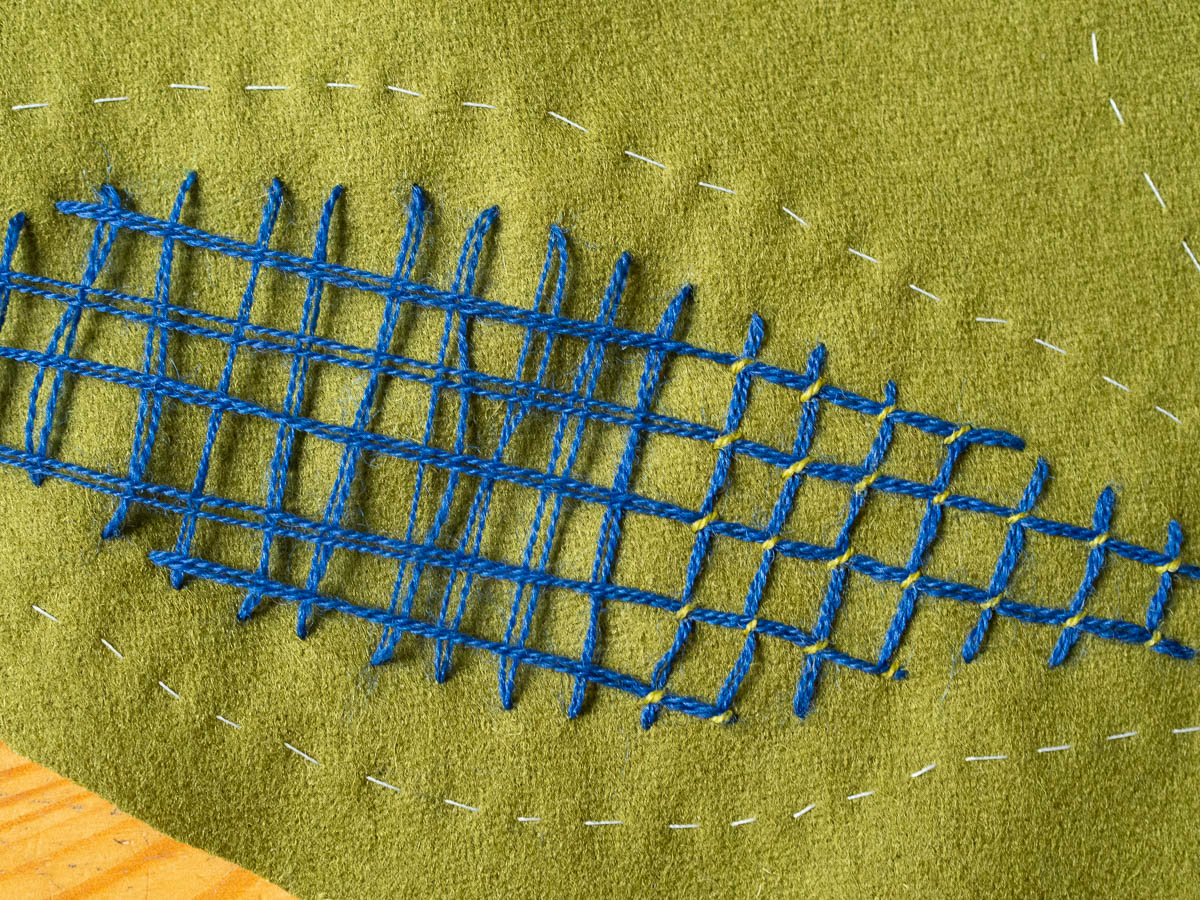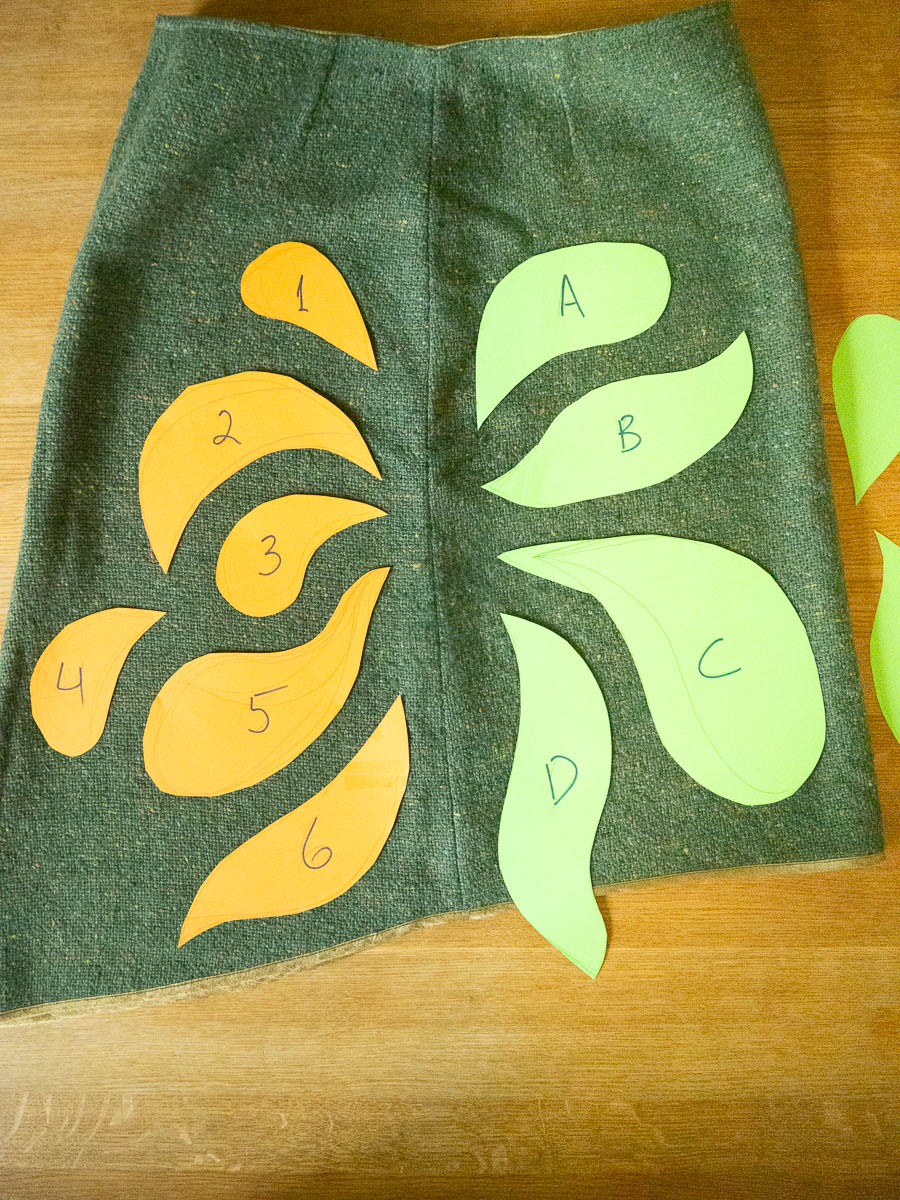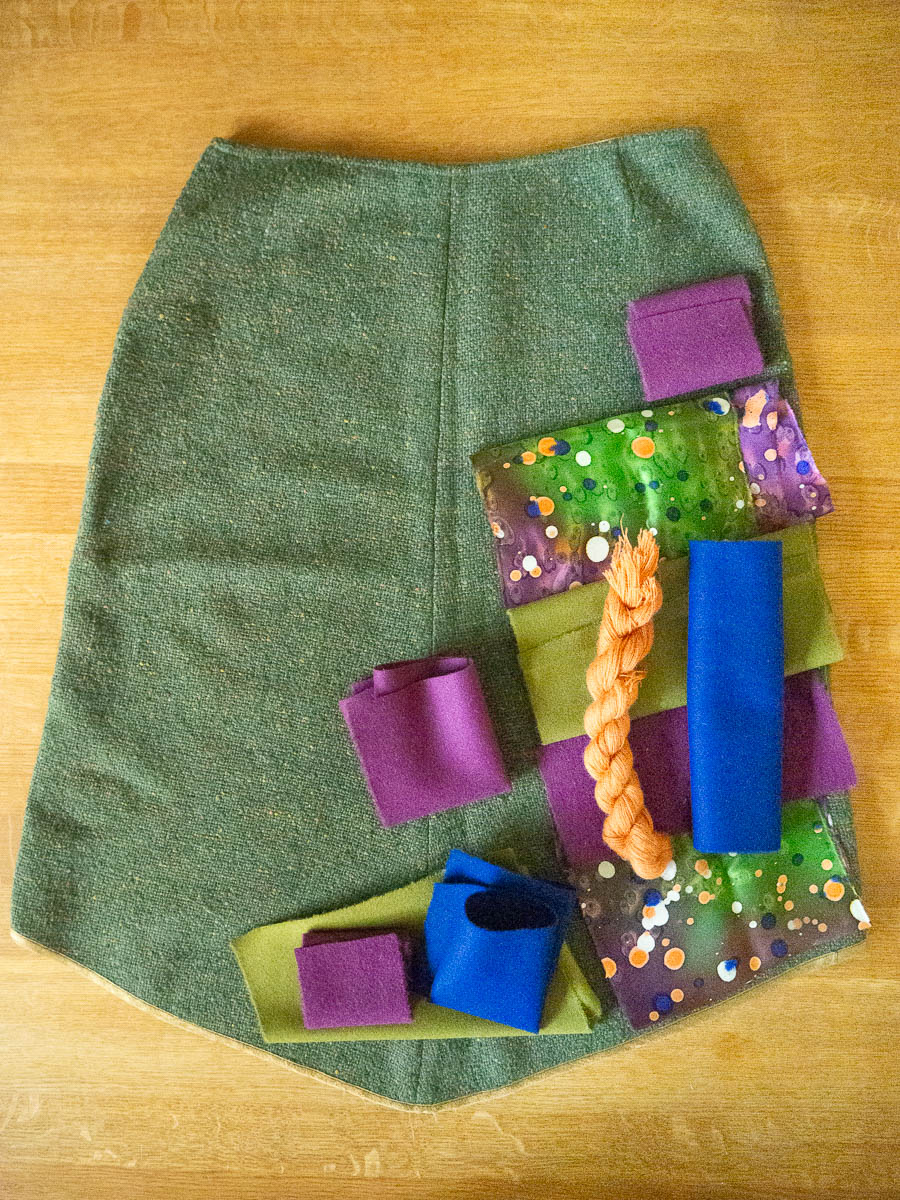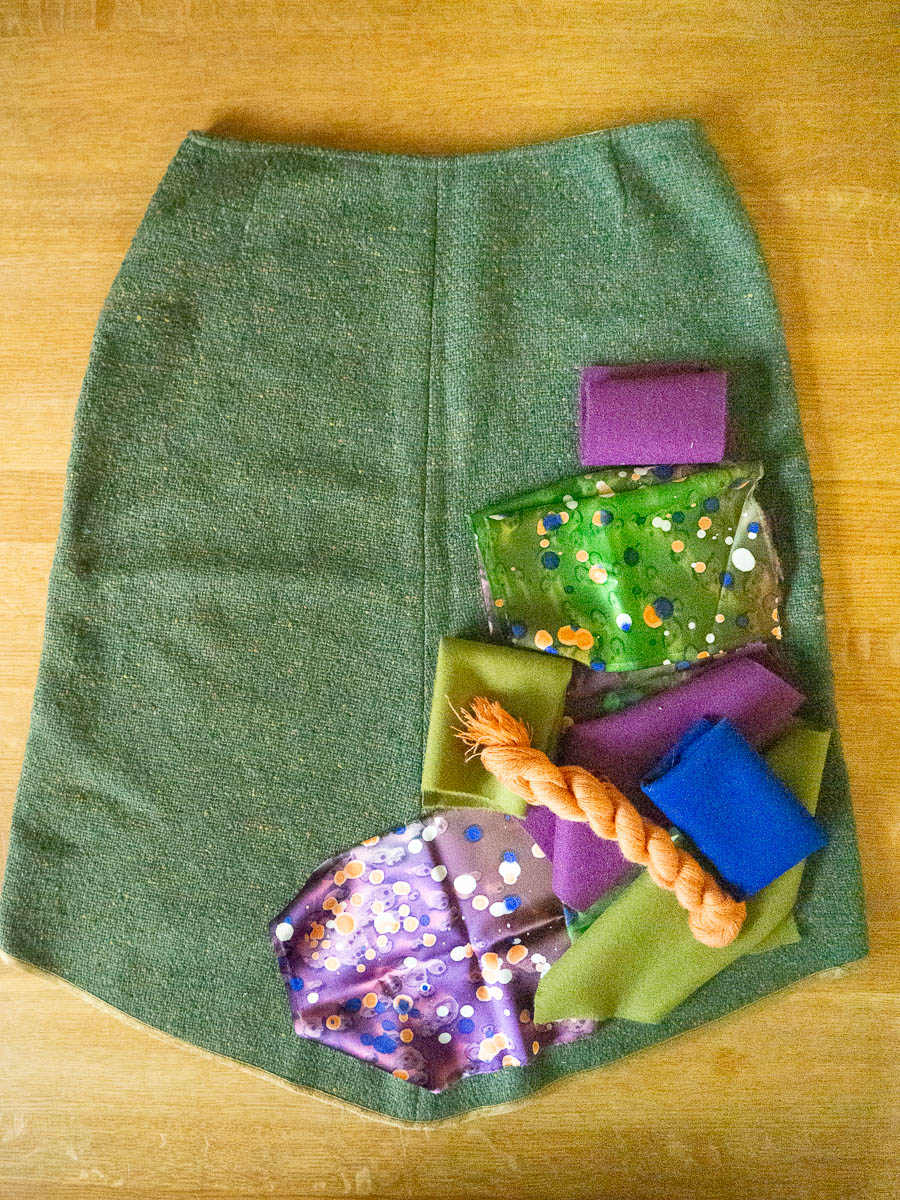
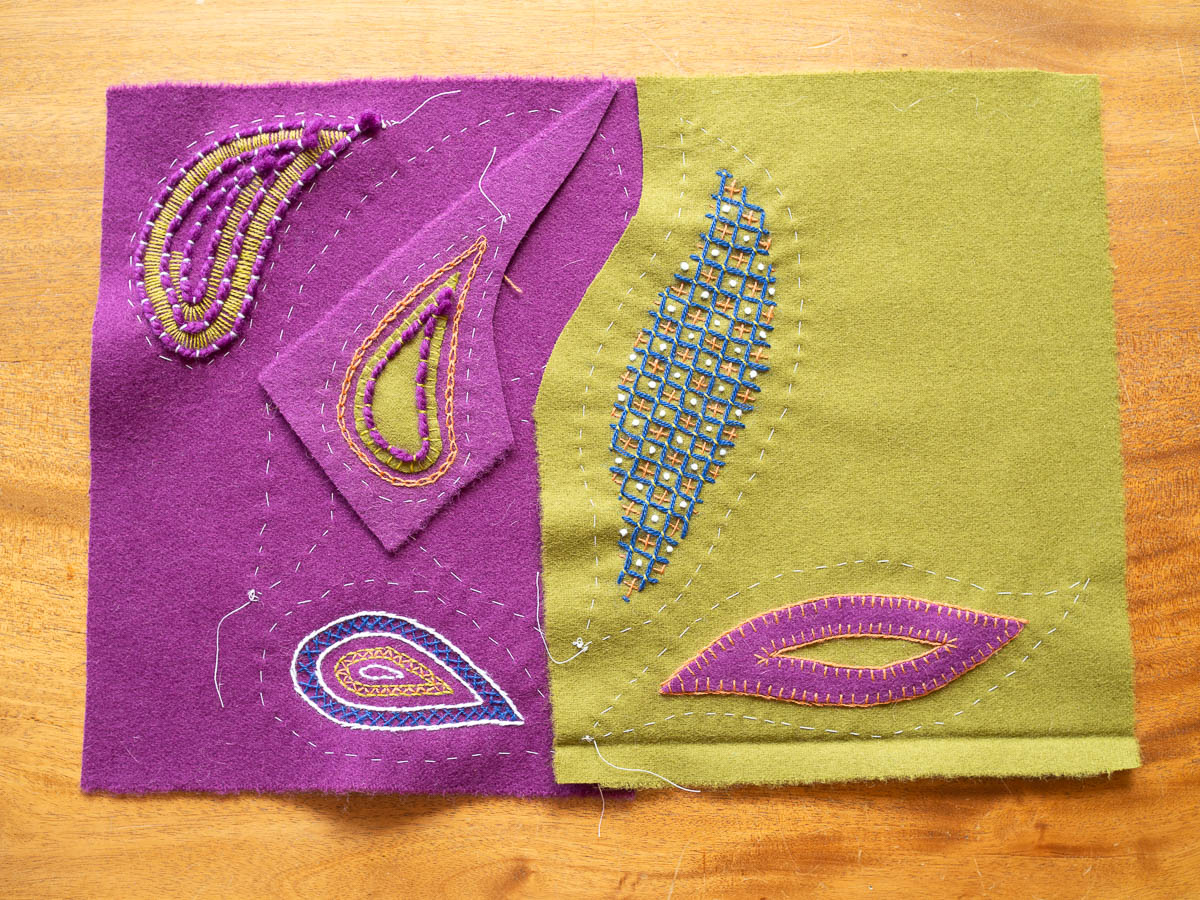
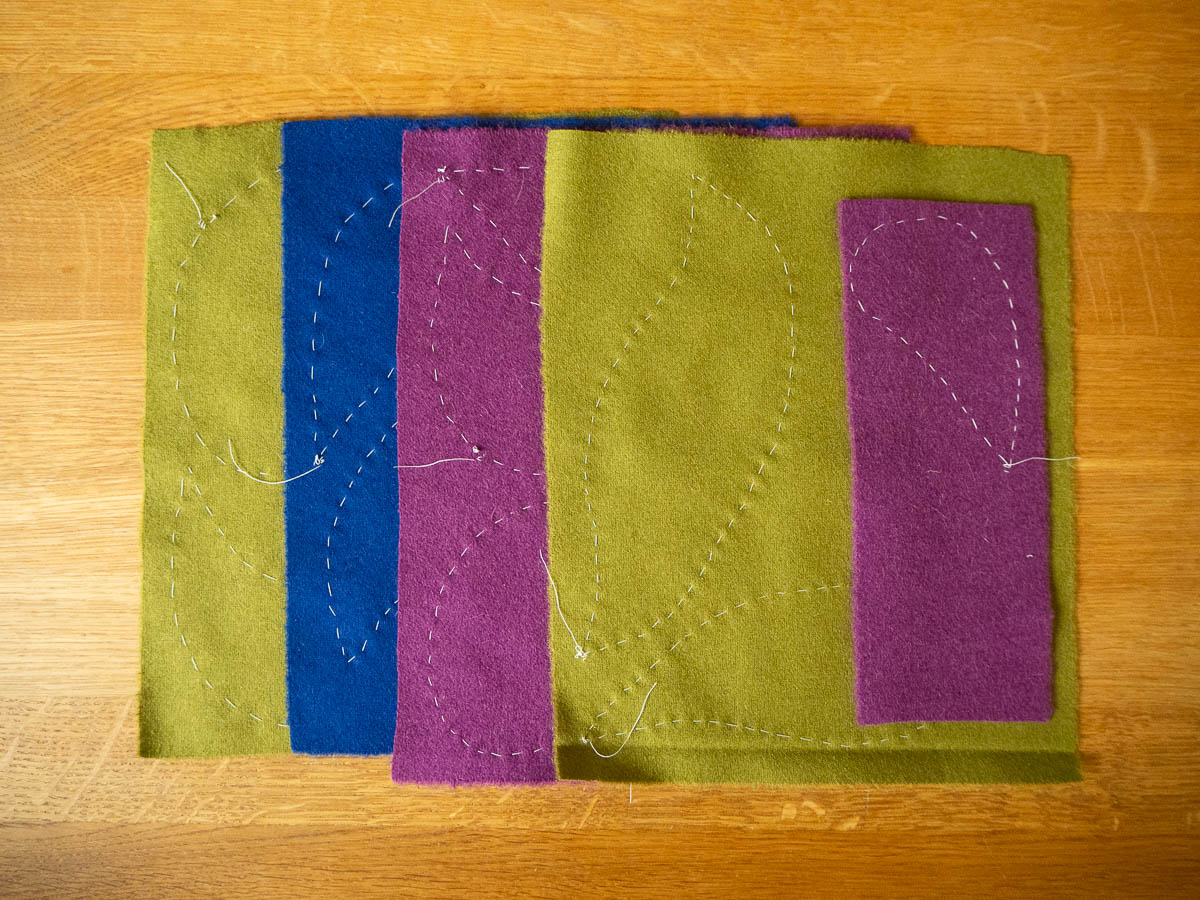
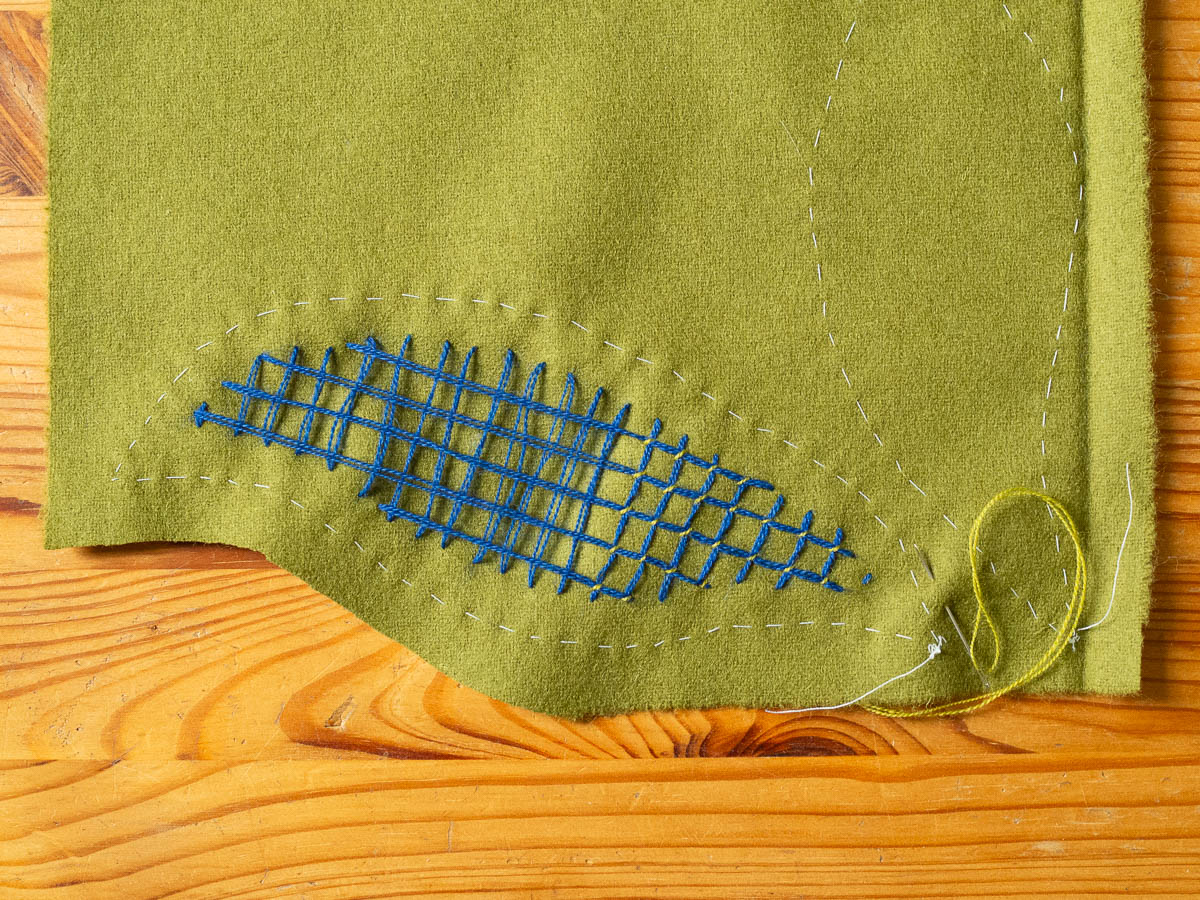
Picked up the embroidery project again after a pause due to travelling and such. It’s coming along nicely. The initial lack of plan has now gelled into at least a sense of direction. Shape-wise mostly following the contours of the shapes. Combining most if not all colours on each piece to tie them together. That one latticework piece will need a companion to make sure it doesn’t look out of place.

I like the look and feel of the couched lines with the thick purple yarn, but I don’t want it to take over. Perhaps I need another project that focuses on couching stitch.

As usual, I’m getting started without fully knowing where I want to end up.

Detailed plans are not for me. I can’t do weekly meal plans; I don’t have daily plans for our vacation trips; I don’t have a design for the garden; I don’t draw up plans for software I write. I have a direction, and ideas about what I might like, and more detailed ideas about the first few steps, and the rest will come later when I know more. Trying to make a detailed plan usually just ends up paralysing me with anxiety.

I semi-randomly assigned colours/fabrics to the shapes I had drawn, with no more thought than making sure that I didn’t get two of the same colour next to each other. Outlined them, and started embroidering on the first one with lattice stitch.


After four days of tedious, boring, fiddly mending, I need a project that is fun and creative and enjoyable.

Funnily enough this one I’ve also been thinking about and sort of procrastinating about for a long time, but for completely the opposite reason than the damn cardigan facing, but for the completely opposite reason.

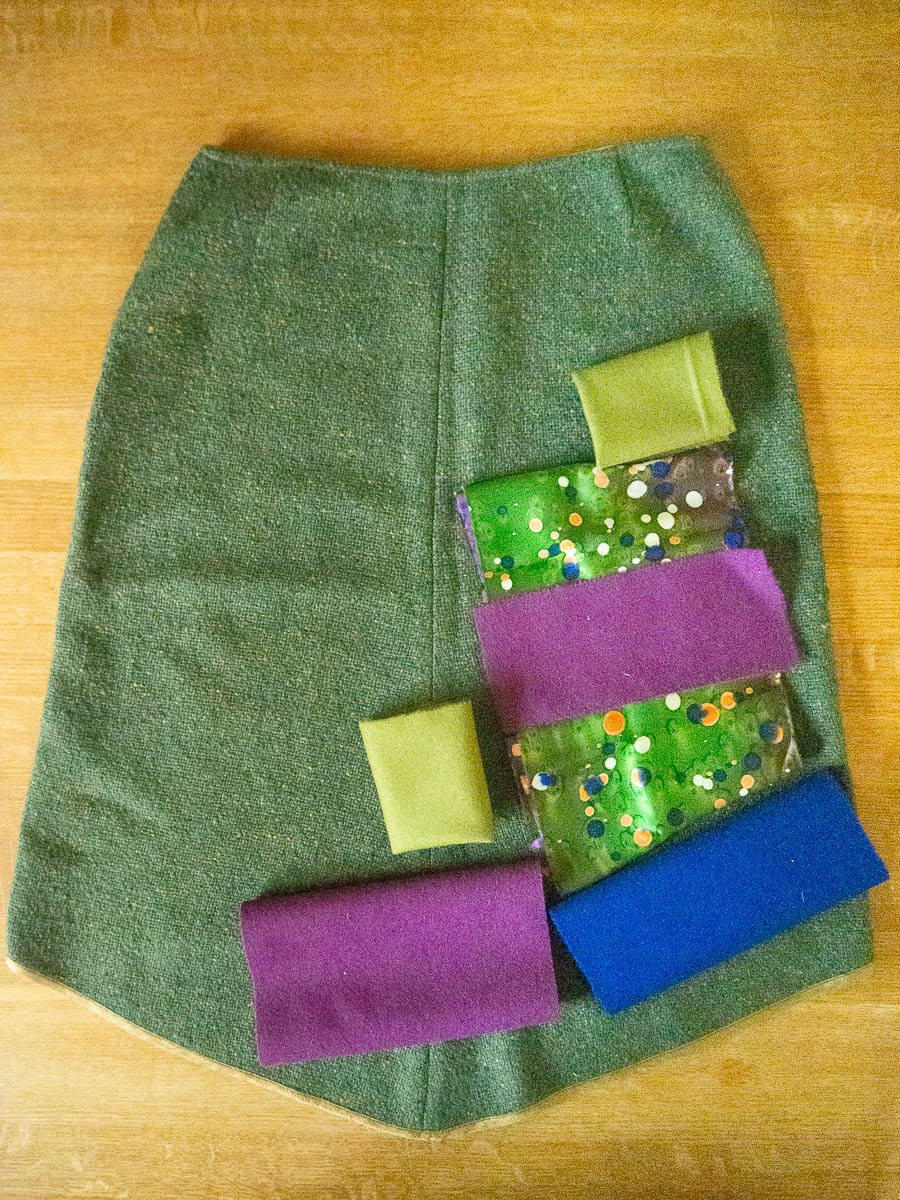
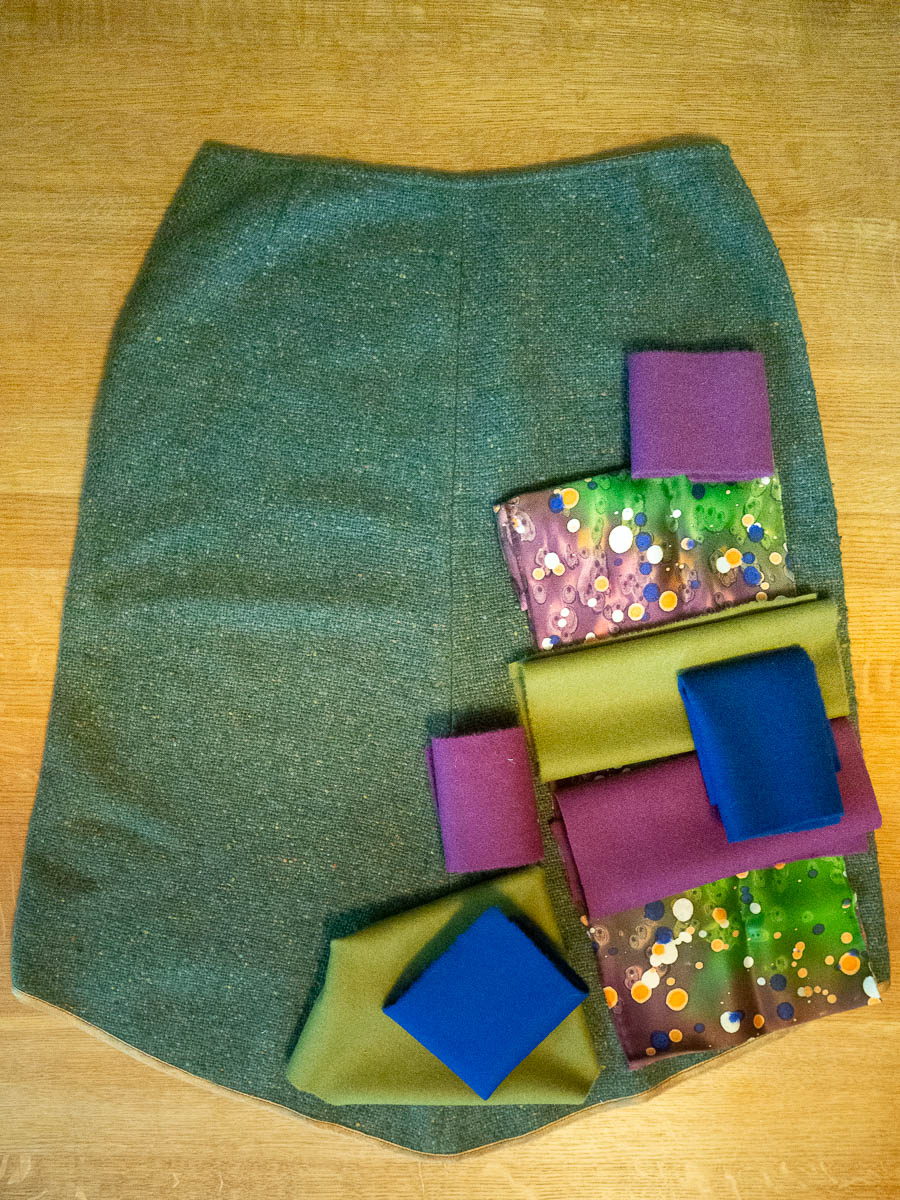
This is an old skirt in some sort of crafts-woven wool mix fabric that I bought at Spitalfields Market ages ago, from a small-scale maker. I still like it but at the same time I feel it’s getting a bit boring. Needs more bling, more pizzazz. So I’ve been thinking about decorating it somehow.

But how? Applique? Lace? Embroidery? Too much wide-open choice, too many options, so I’ve done nothing.

At one point I bought a small bit of glorious patterned silk fabric that I thought I might use for some kind of applique, but it never felt quite right, so the project has been languishing at the back of my brain.

Inspiration is never going to simply appear so I just have to get started. I’m thinking of organic shapes in a vaguely flower-like design, centred around the right side seam. (Sloppy photos today, sorry – I was focusing more on the design than on documenting it properly.)

Going all in on the patterned silk would be too much of a good thing, I think, so I bought wool in matching colours to combine it with. The silk gets to set both the colour scheme and the overall tone – blingy! – but some of the “petals” will be in wool. In a way it will make it visually noisier but also less overwhelming I hope.


Kind of nice but also not quite what I had hoped for. But an interesting experiment, and a useful thing to have, and I enjoyed making it, and now I’ve learned something.

I’m going back and forth about adding a closure. I was thinking a button, first, because hook-and-loop tape on this would clash too badly with the style. But I also don’t want a buttonhole. So either nothing, or maybe snaps.

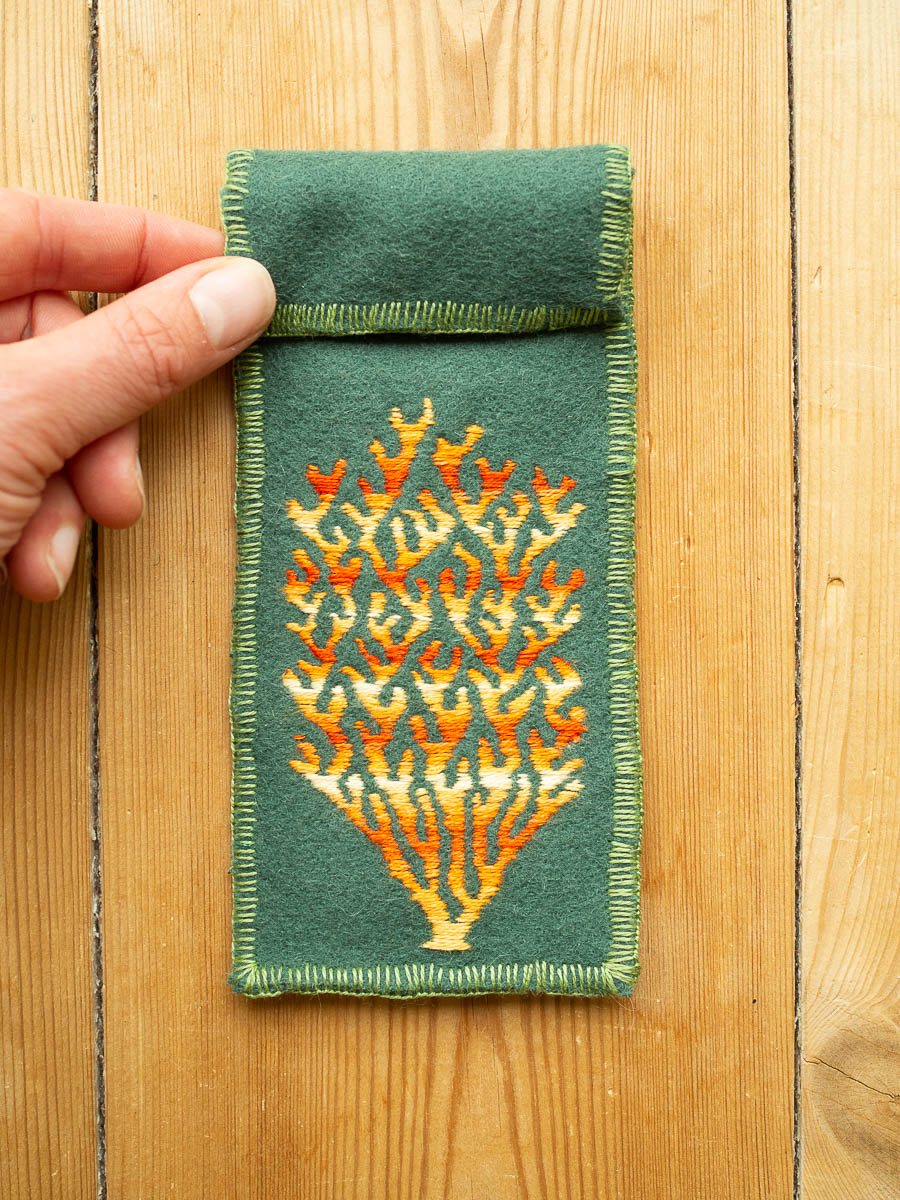
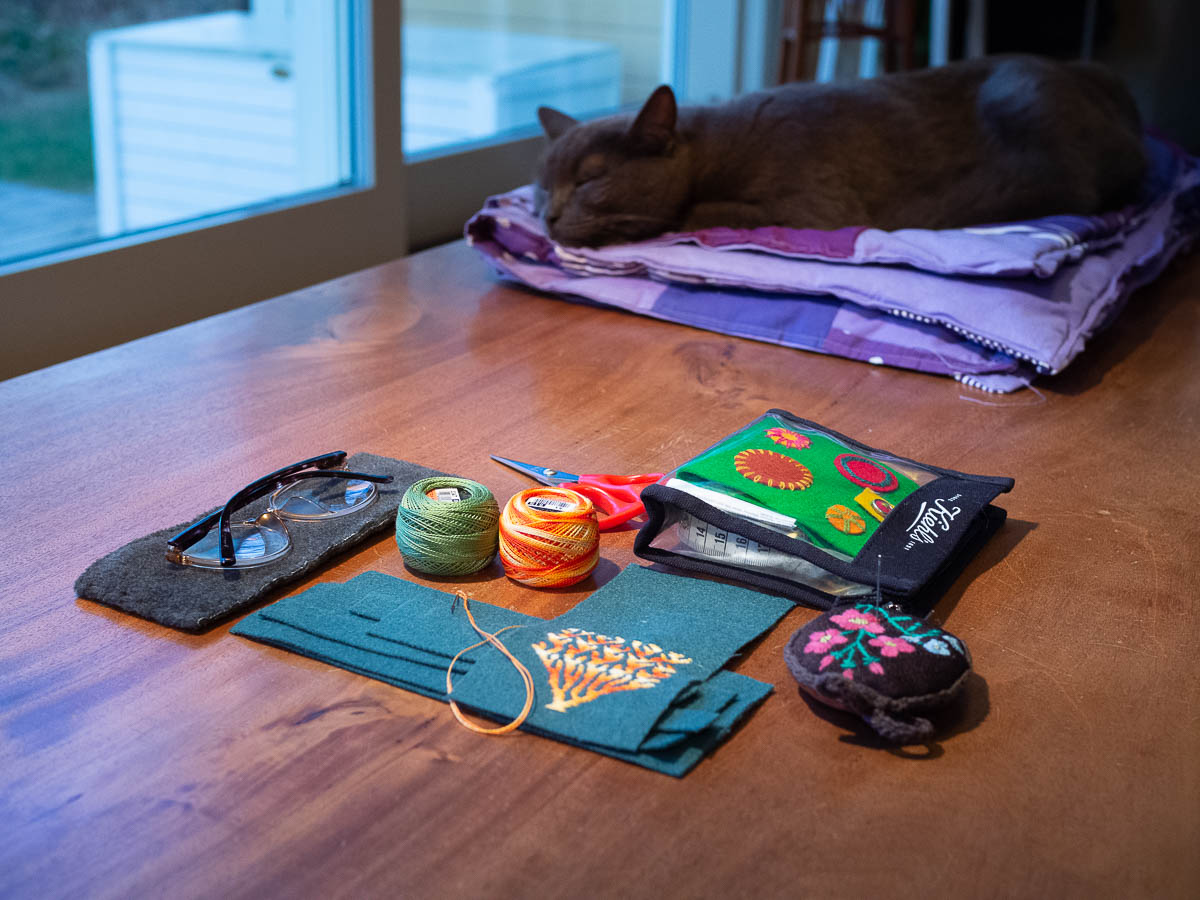
My current embroidery project is a glasses case. I don’t need my glasses often at all but they still deserve a nice case.

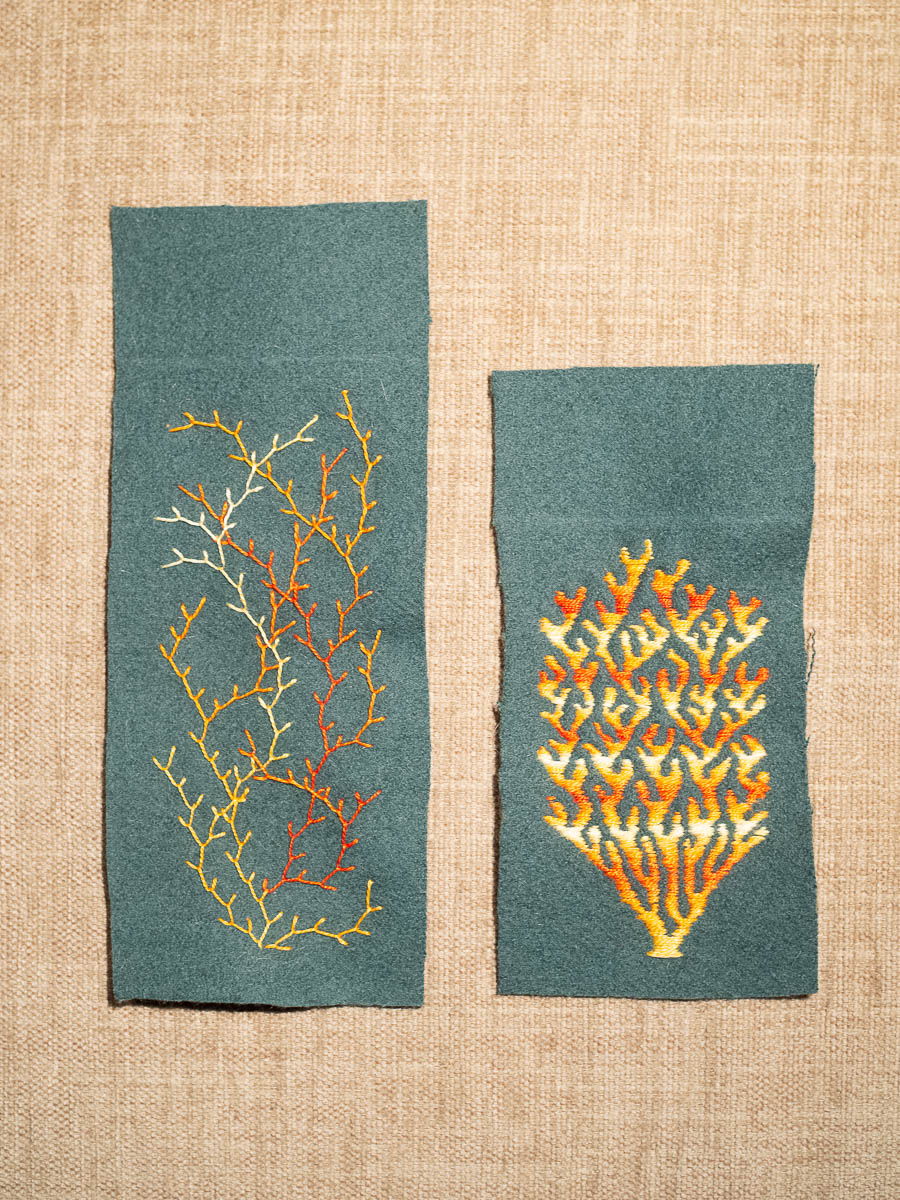
The starting point was a technique I saw posted on Instagram, called stacked running stitch. It looks like satin stitch at first glance, but builds up very differently. Instead of making one branch at a time, the yarn goes all the way across the motif, building up all the branches simultaneously, a millimetre at a time.

Instead of something purely abstract, I did the stitching in the shape of a coral.

It sounded interesting, and was definitely interesting to work with. It took a lot more concentration than I had thought. The running stitches had to be kept straight (probably easier on a fabric with visible threads) or the lines would start to lean or curve. And I also had to think about the branching all the time, to make sure they didn’t run into each other, or all end at the same time, or all split at the same time.

The end result is perhaps technically impressive rather than beautiful. It was an interesting experiment, though. I think it might have worked better for a purely abstract design after all.

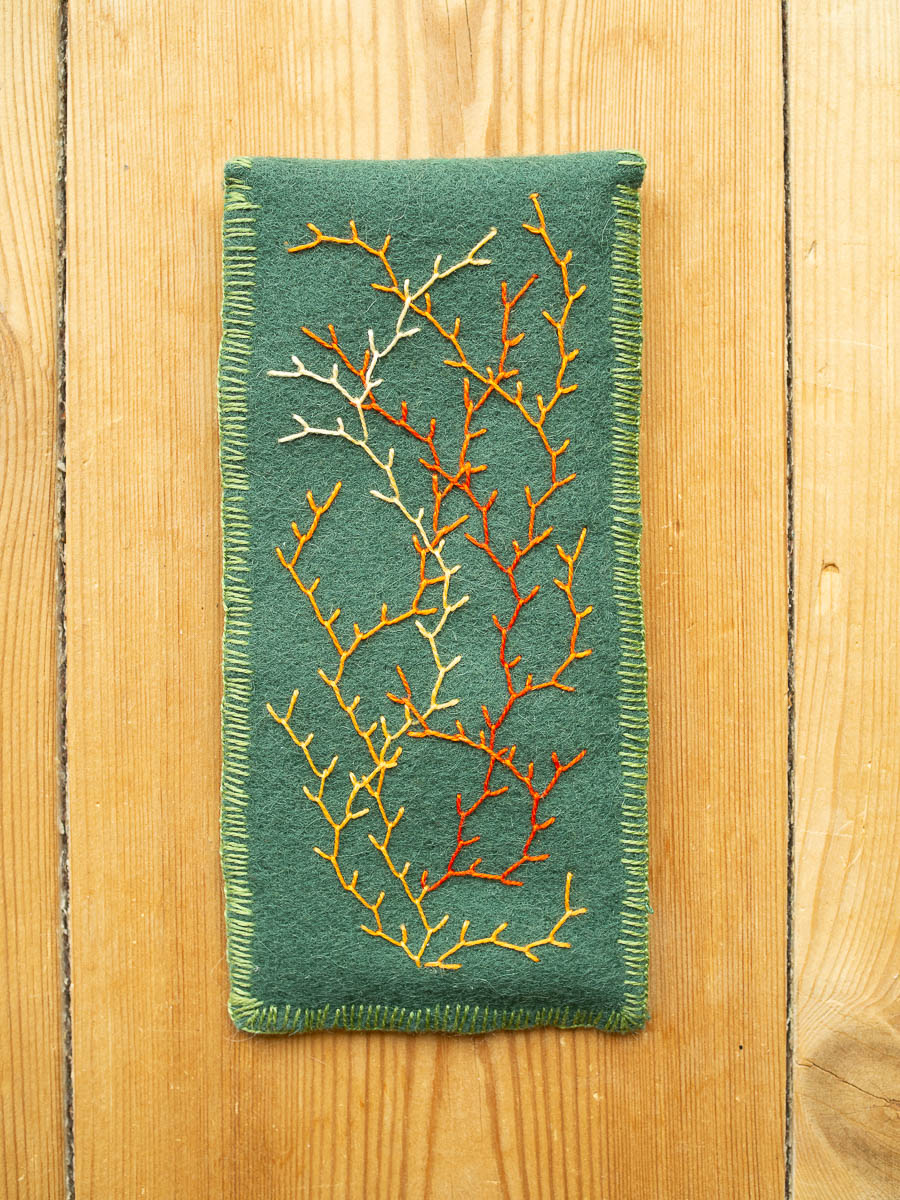
The motif on the rear is also a coral, but a quick and simple one in feather stitch. In all its simplicity I think it looks better than the laborious one on the front.


I’ve missed the last three meetups of my embroidery club. First we were away skiing during the spring break; then I was away for a different kind of skiing on my own; then I was travelling for work. And then one meetup was cancelled due to Easter. I thought the next one would be today, but when I turned up, there was nobody there. Either I mixed up the weeks, or they shifted everything by a week instead of skipping Easter Thursday. The arranger was away on vacation so I couldn’t get in touch with anyone, either.

I had been looking forward to this for many weeks. If the embroidery club isn’t happening, I’ll make it happen. So I went home and had my own one-woman embroidery meetup in the sofa. Put on some music, poured myself a glass of glögg that we still had since Christmas, and asked not to be disturbed.

I’m working on a glasses case. It seems fitting, somehow, to embroider something for the glasses that I need for embroidery.


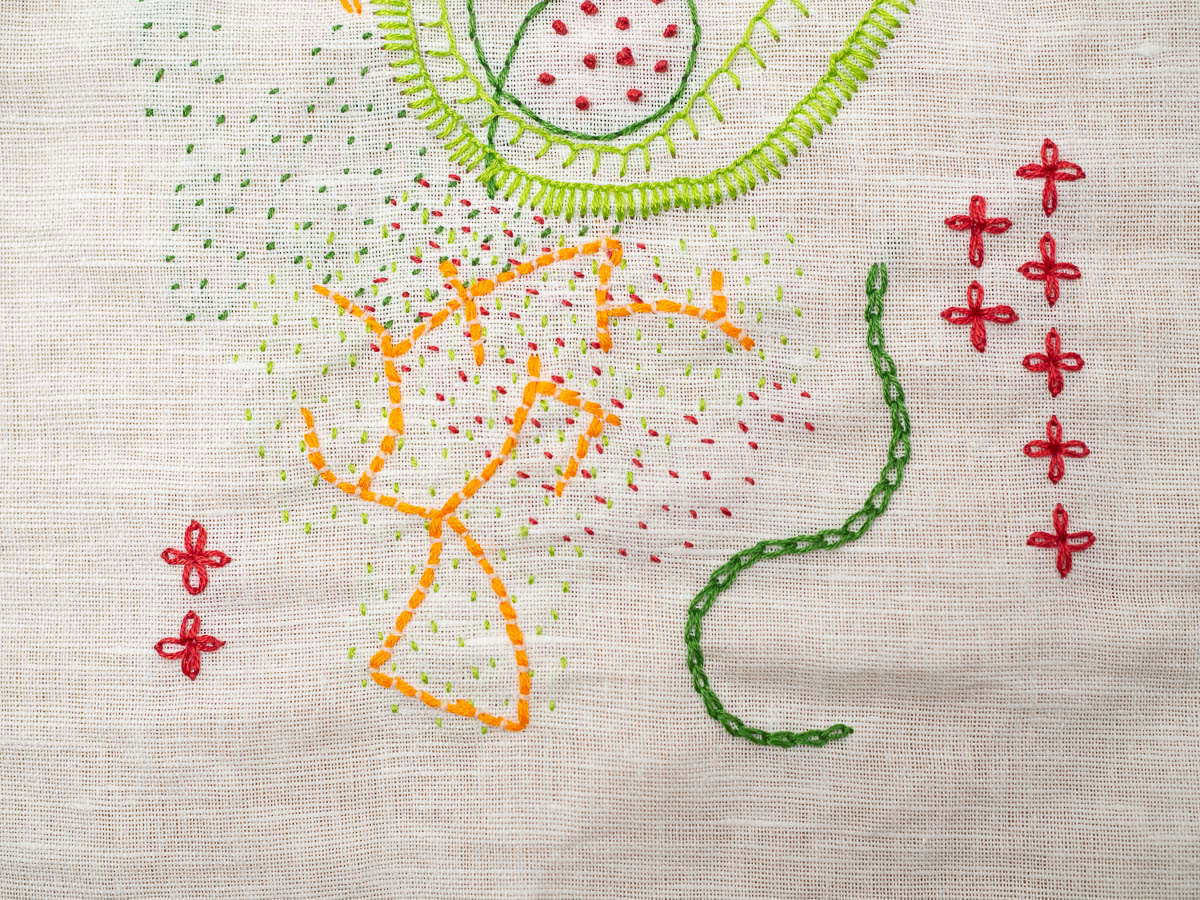
The dogma embroidery, continued. (Add chain stitch. Use a colour you don’t normally use. Add a pattern. Echo a part of your motif elsewhere. Emphasize a part of your work with a similar colour.)

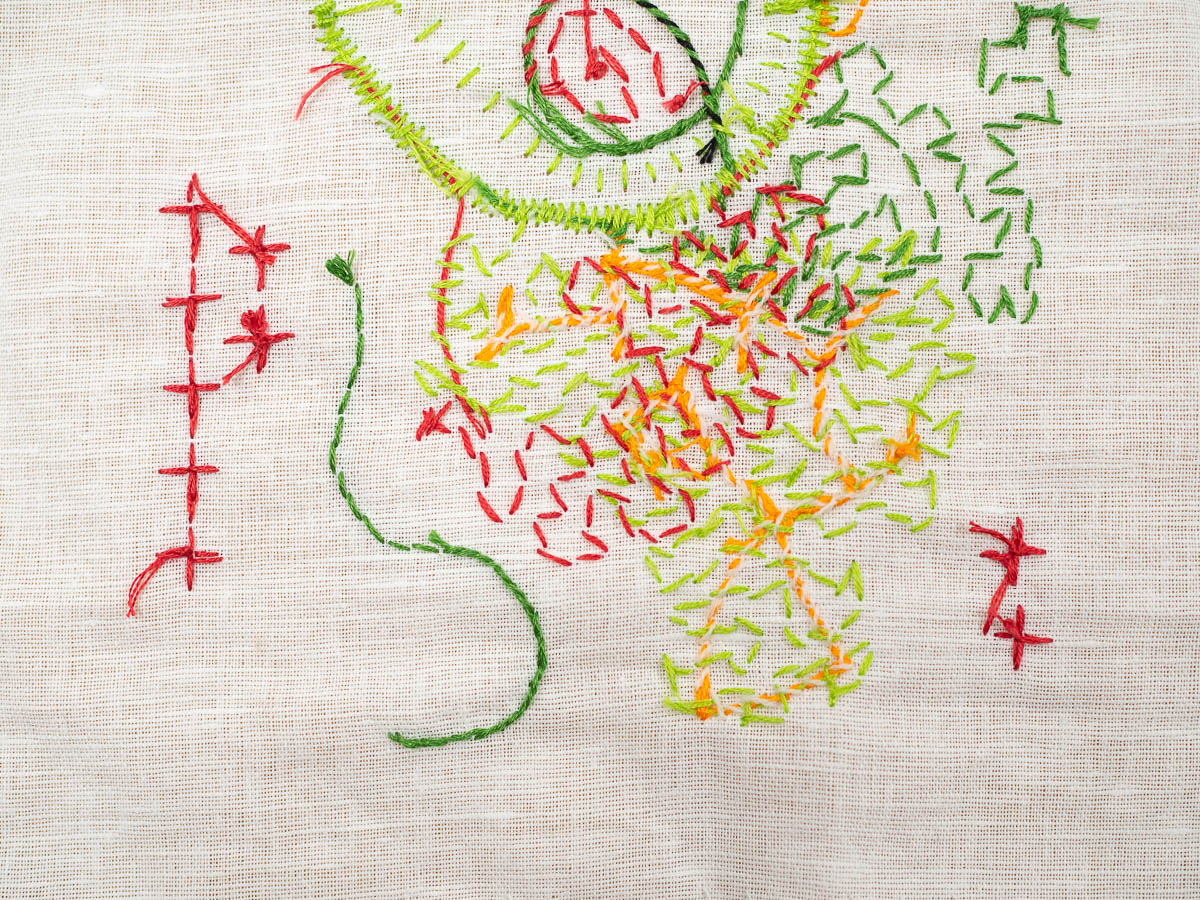
As a piece of finished embroidery, it’s junk. A jerky, unbalanced, random agglomeration of parts that don’t go well together. Some of the later steps helped pull the earlier ones together a little bit, but it’s still very obvious that there is no overall design or composition.

As a creative approach, it’s been great. Letting go of all expectations regarding the outcome and just going with the flow, fitting in whatever curveball I’m thrown as best I can. Later steps overlapping with earlier stitches. It doesn’t matter what the result looks like. This doesn’t need to be either beautiful or useful.

As a learning process, it’s been interesting. I’ve learned – again – that achieving apparent randomness is hard. The seed stitches tend to start pulling into lines and naturally distribute themselves evenly. I’m not sure how to make them uneven for real. I also learned that I like the tangle that the seed stitch makes on the rear side.


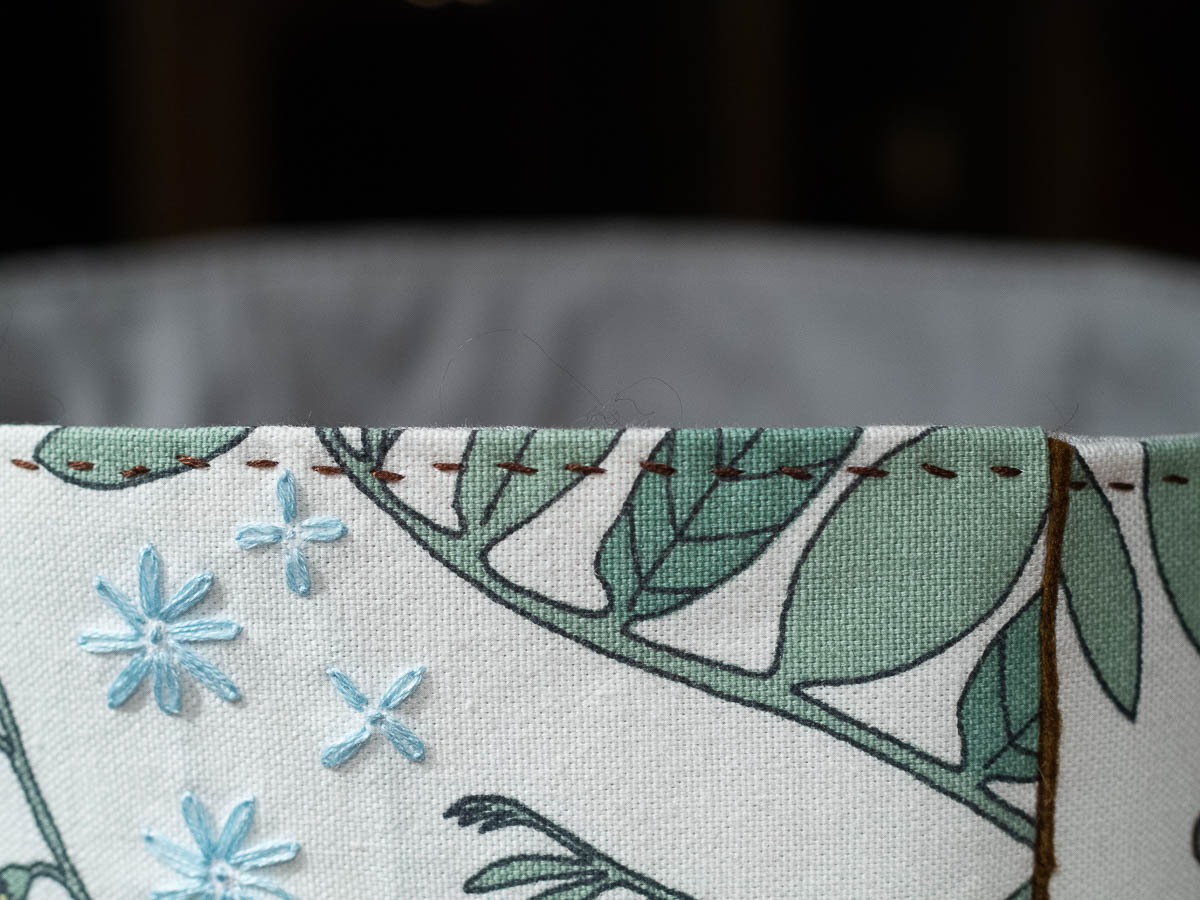
Lining attached, piping trimmed, top-stitching added.

Now I need to think of something to put inside it.

Learning point for next time: a padded lining takes up space, so for a perfect fit, it should be smaller than the outer walls.


Thursday night embroidery club, for the second time.

Last time everyone worked on their own projects. For this time the group decided to try out dogma embroidery. I’m not sure what it might be called in English, and to be honest, I’m not sure the concept even exists outside of some very narrow pockets of Scandinavian crafts circles.

There’s an e-book at the bottom of it all, and articles about it draw parallels back all the way to the ancient Greeks. Since the author is Danish, I suspect it was more likely inspired by Dogme 95, a movement in film-making, originating in Denmark, that sets strict limits on the tools and techniques allowed. The embroidery version is not quite the same, but it’s still built upon the same idea of strict rules.

Jytte Harboesgaard, as quoted in the Täcklebo Broderiakademi members’ magazine in 2015:

Vi var vana vid att broderiet var ett stygnprov eller skulle bli något bestämt. Detta menar jag är en av orsakerna till att det är så svårt att förnya broderiet, vilket jag anser att vi måste om broderiet skall ha ett berättigande i framtiden. Det var här idén till konceptet Dogmabroderi föddes. I Dogmabroderiet broderar man efter regler som man själv bestämmer… Den viktigaste regeln är att broderiet inte ska användas till något bestämt. Istället är det själva processen att brodera “fritt” efter reglerna som är den viktiga drivkraften.

We were used to embroidering either a sampler or in order to make a particular thing. In my opinion, this is one of the reasons why it is so difficult to reinvent embroidery, which I believe we have to if embroidery is to have a future. This is where the idea of the concept of dogma embroidery was born. In dogma embroidery, you embroider based on a set of rules that you set yourself. The most important rule is that the embroidery won’t be used for any predetermined thing. Instead the process of embroidering “freely” based on the rules is the driving force.

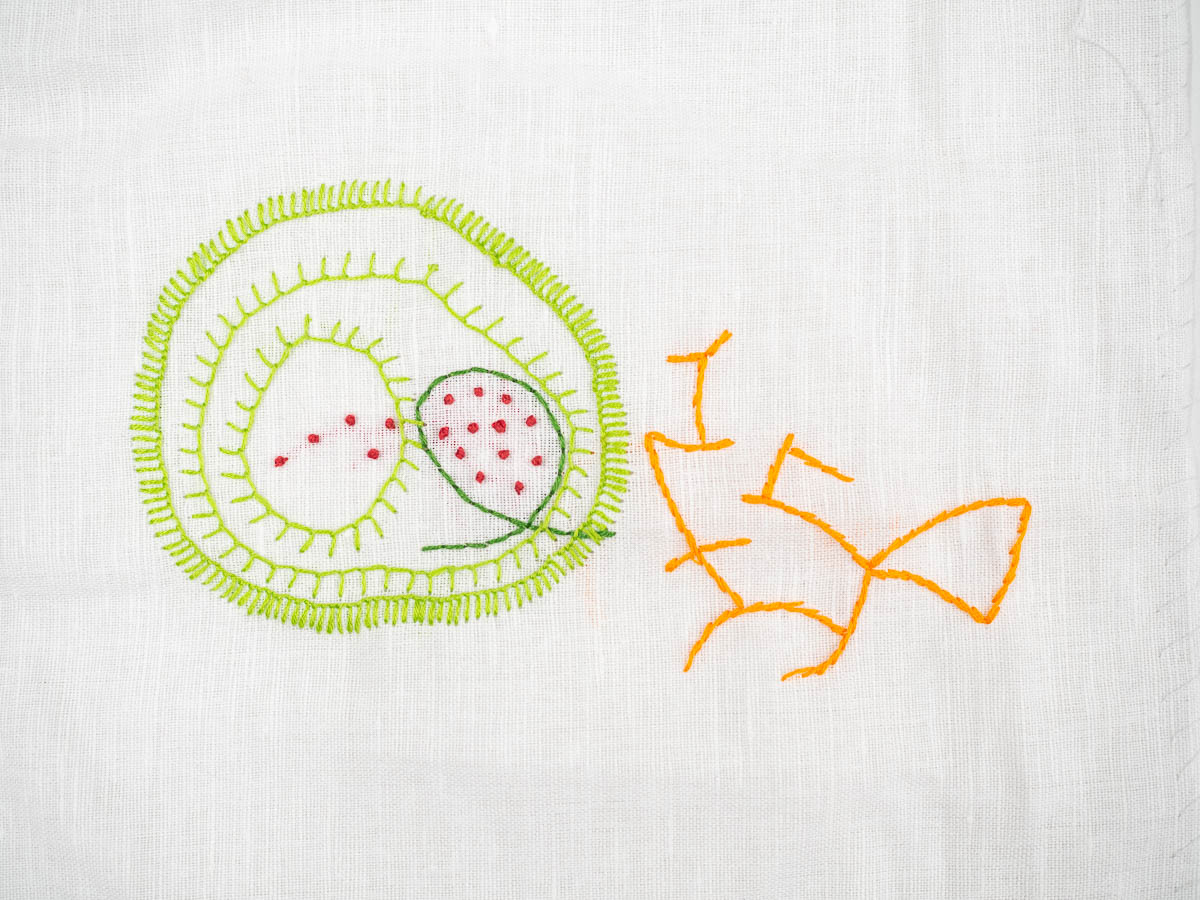
In our case, since most of us were doing it for the first time, one of the members who’d done it before provided us with rules, one by one, so we’d see what dogma rules might look like. The first rule was “a 30×30 cm piece of fabric”. Then “using the greenest thread you have, start in the middle of the fabric, and make 30 backstitches”, followed by “at least 10 French knots” and “a doodle that doesn’t look like anything”. The next step, “three circles of blanket stitch around the French knots” was a bit of a challenge because there was not much room but I just had to think bigger.

The next two steps we got with us as homework. “Find an area where your work is unbalanced, and fill it with seed stitch” (which suits me very well because the doodle is crying out for something to link it to the rest) and “using white thread, lighten up your work” (which will be interesting given that I’m using white fabric).

To really push yourself out of your comfort zone, you’d finish one dogma embroidery, then take a new piece of fabric and repeat the exact same rules on that one, for a new and different outcome. And then do it again, and again.

Reminds me of the running stitch sampler I made but never documented in its full glory. The first ten squares are easy; to complete all twenty-five takes perseverance and effort.
I looked for another embroidery course for the spring term but didn’t find anything I liked. The courses offered are all intro to this and beginning that, and “learn seven basic stitches”, and I really don’t need any of that. All the more fun, advanced courses are either full-time (for people who want to go pro) or weekend workshops, especially during the summer.

But I did find an embroidery club instead. They meet every other Thursday, and there appear to be no expectations or requirements at all for becoming a member. Just pay a small membership fee, turn up, and embroider. And even that last one seemed almost optional – some of the other ladies (because they were all ladies) turned up with an embroidery project but then barely touched it at all and spent the two hours holding it while socializing.

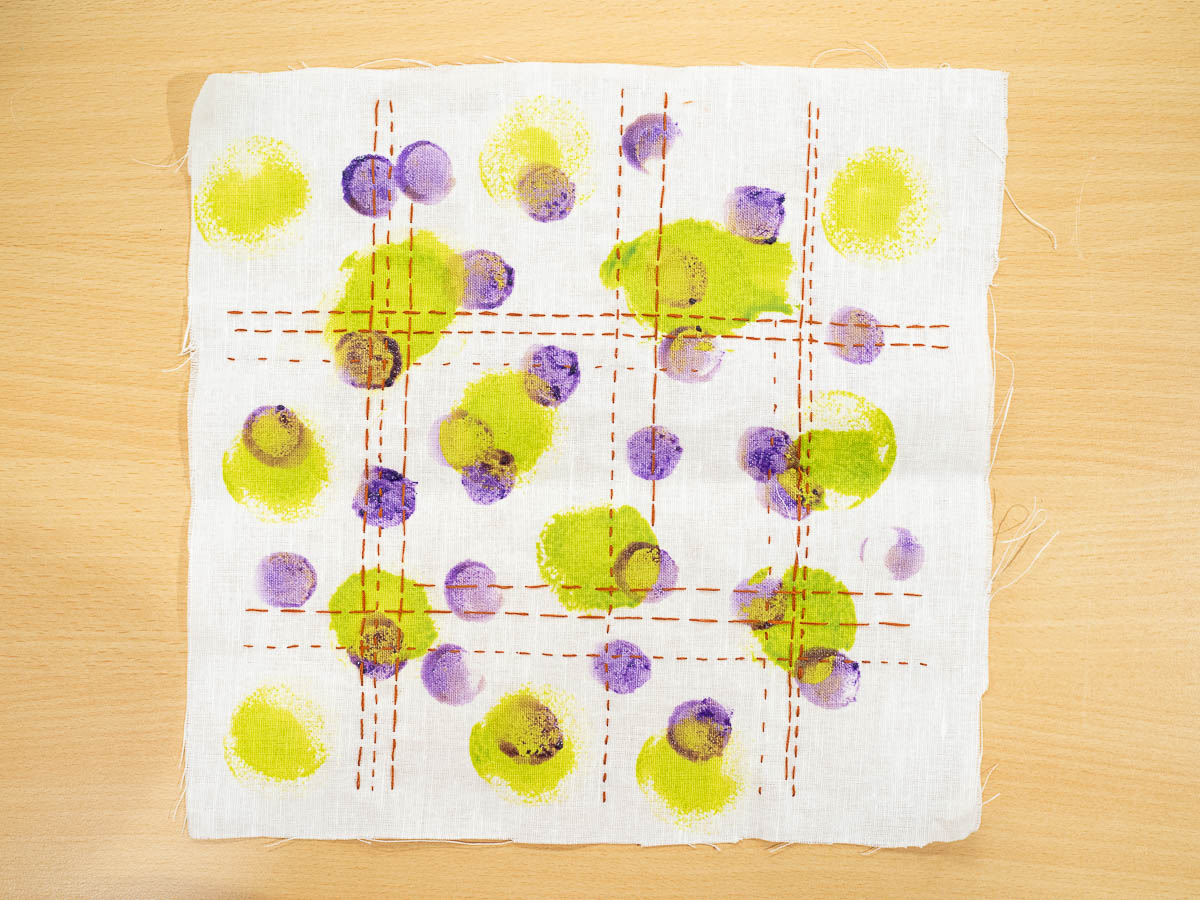
I brought something random (one of the leftovers from the freehand embroidery course this autumn, the painted fabric is getting some random stripes of running stitch) just to keep my fingers busy. Next time I’ll start a real project.