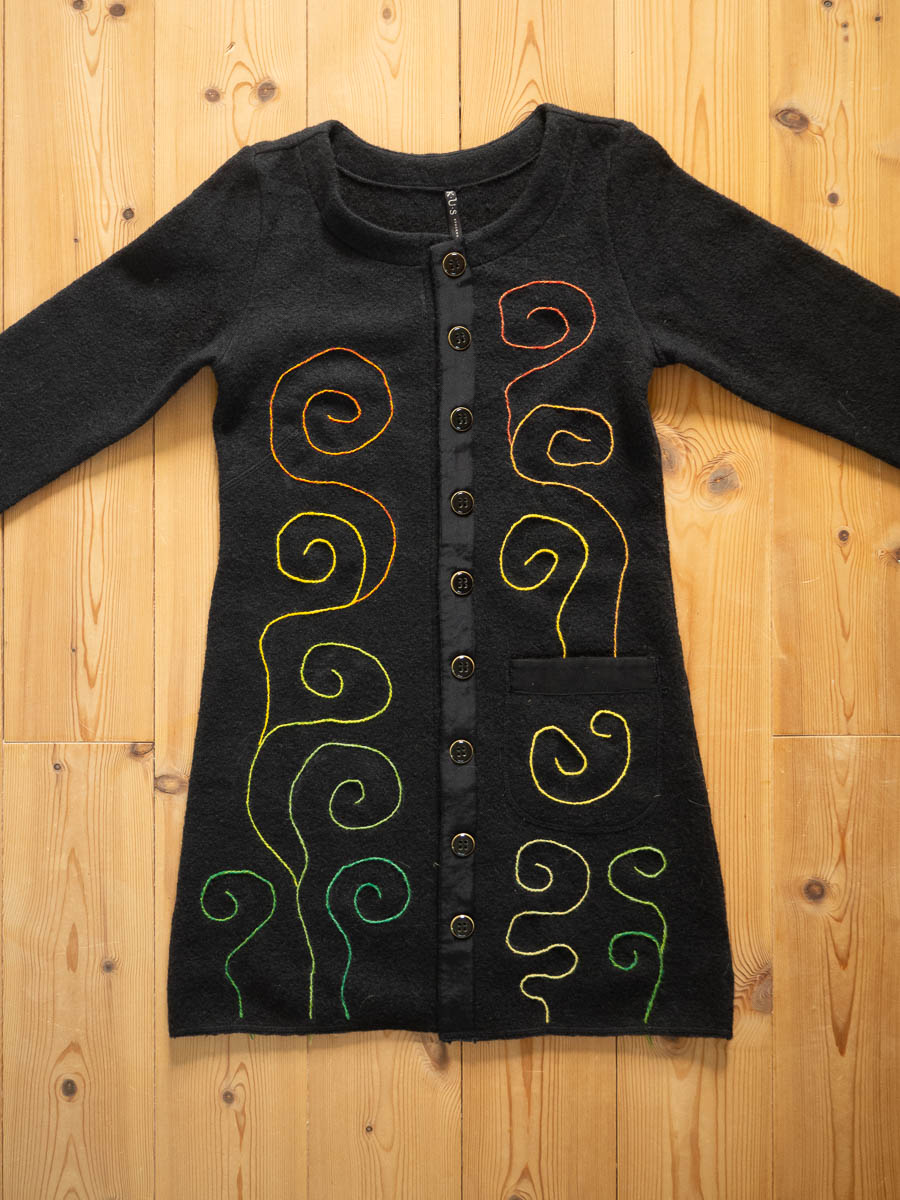
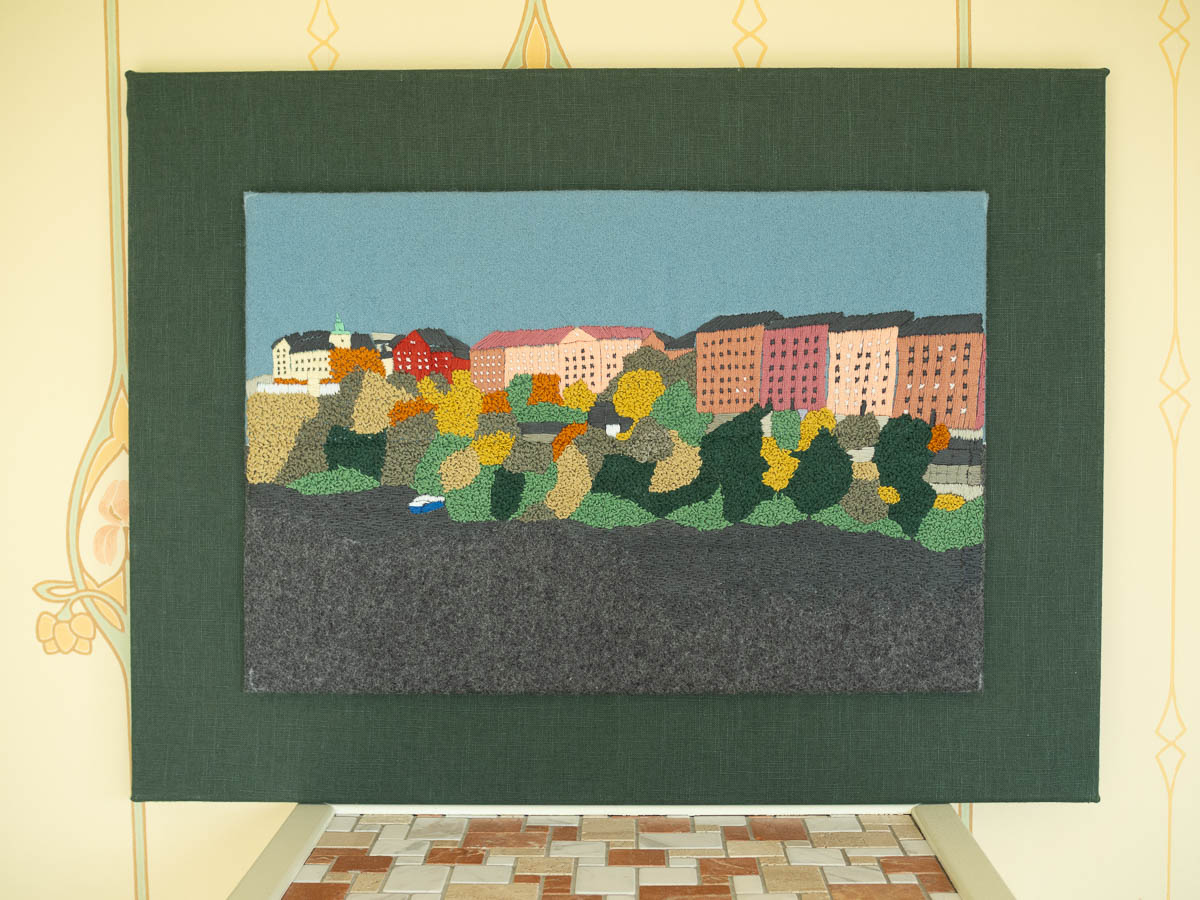
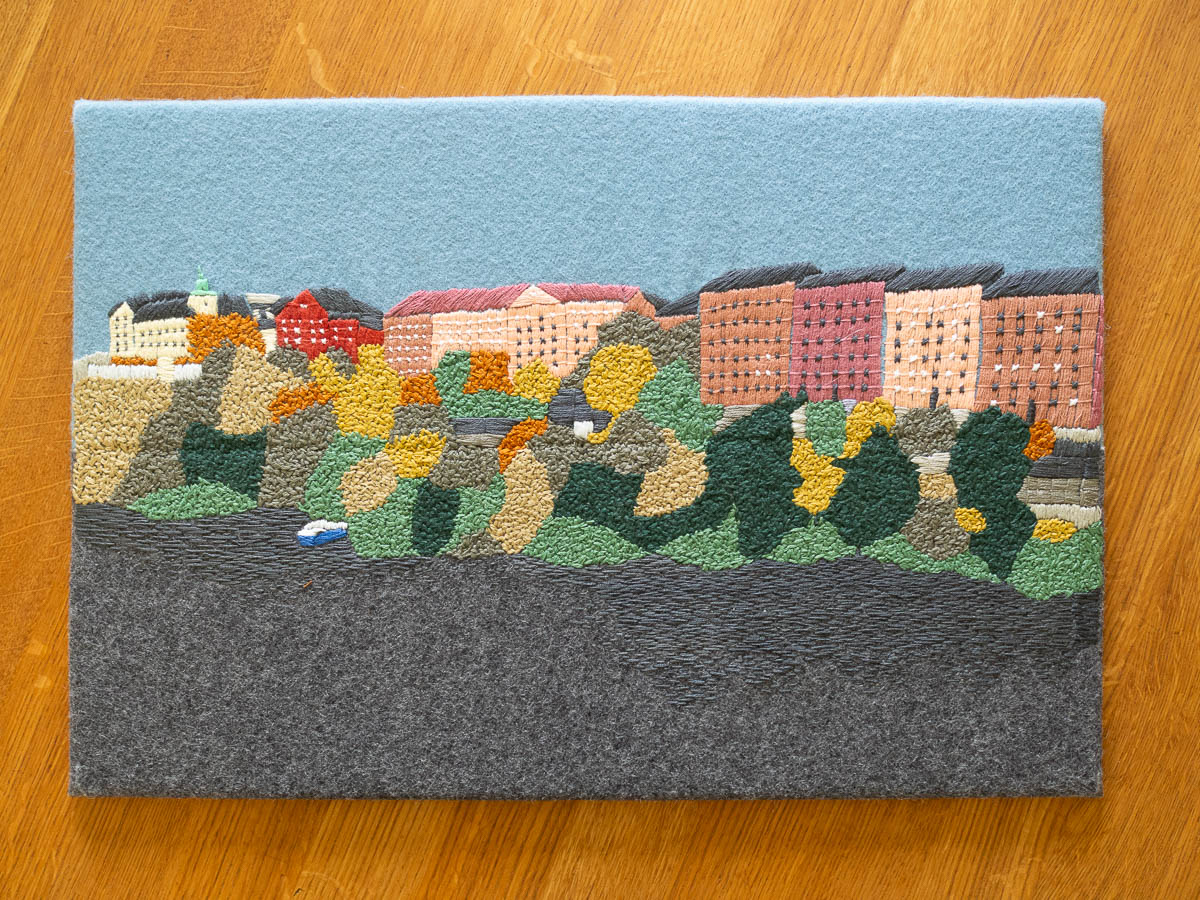
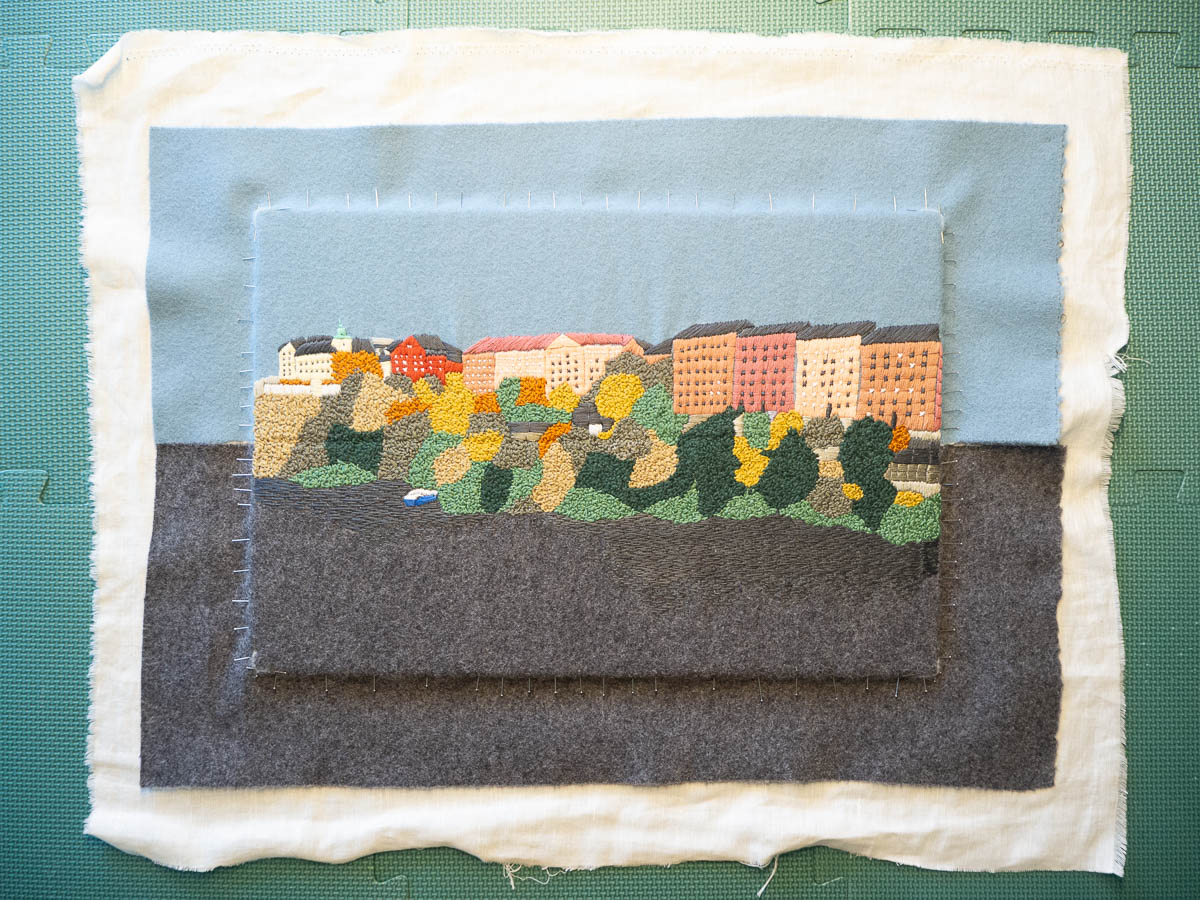
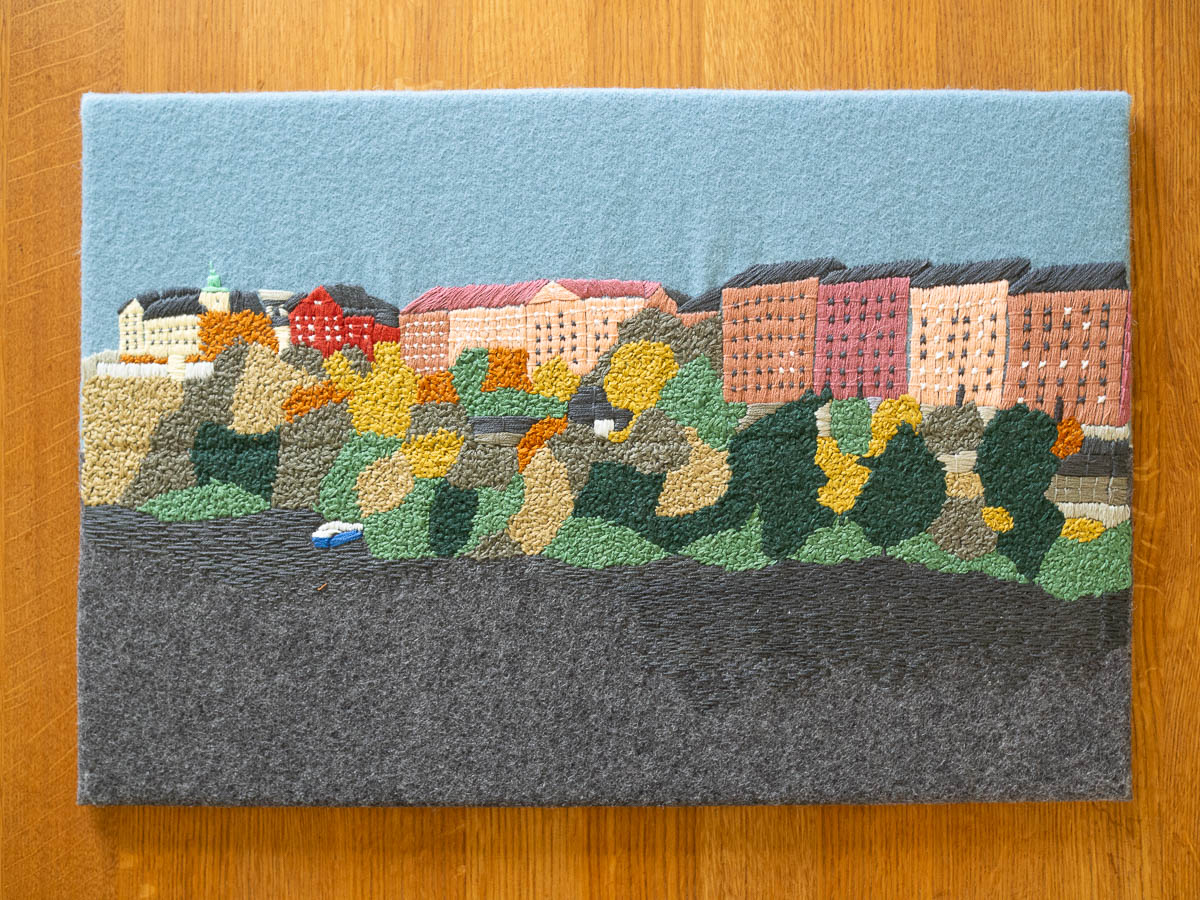
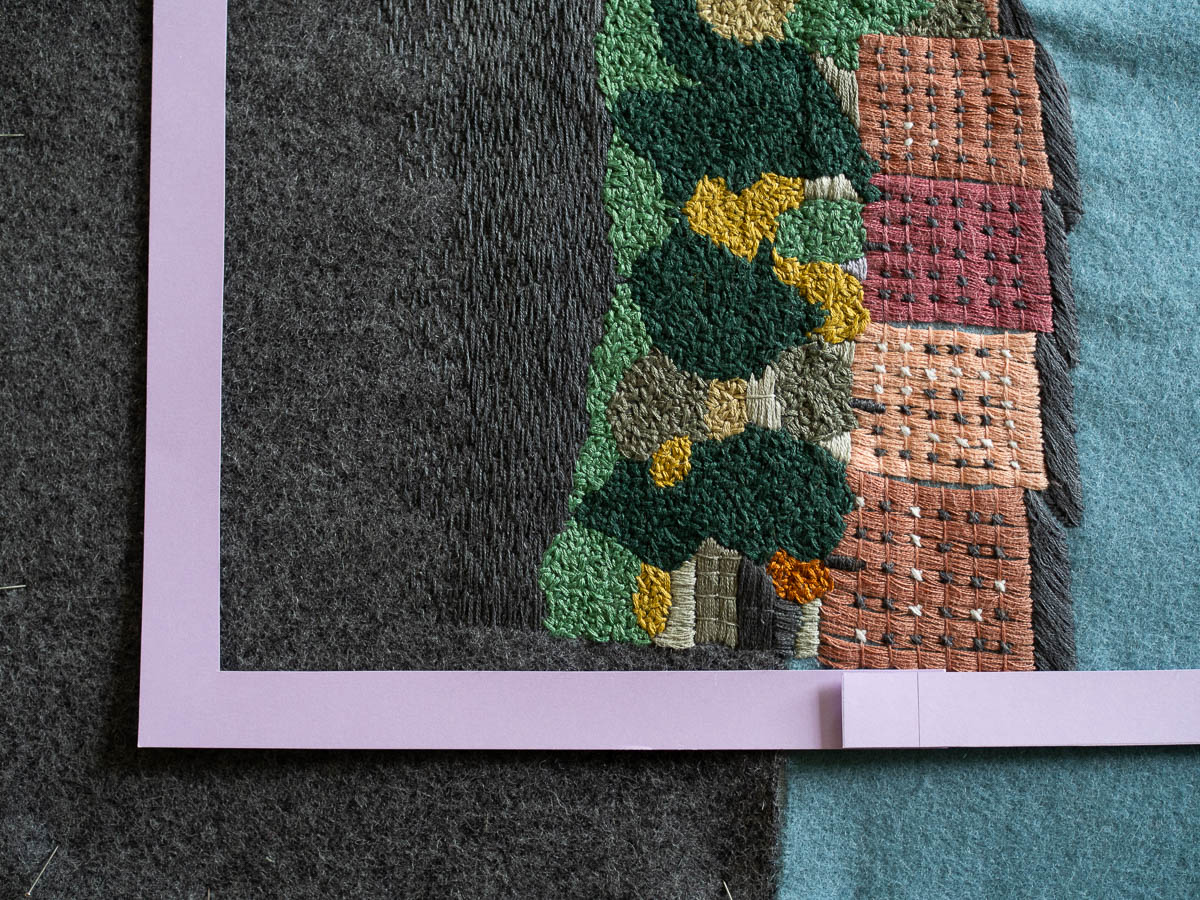
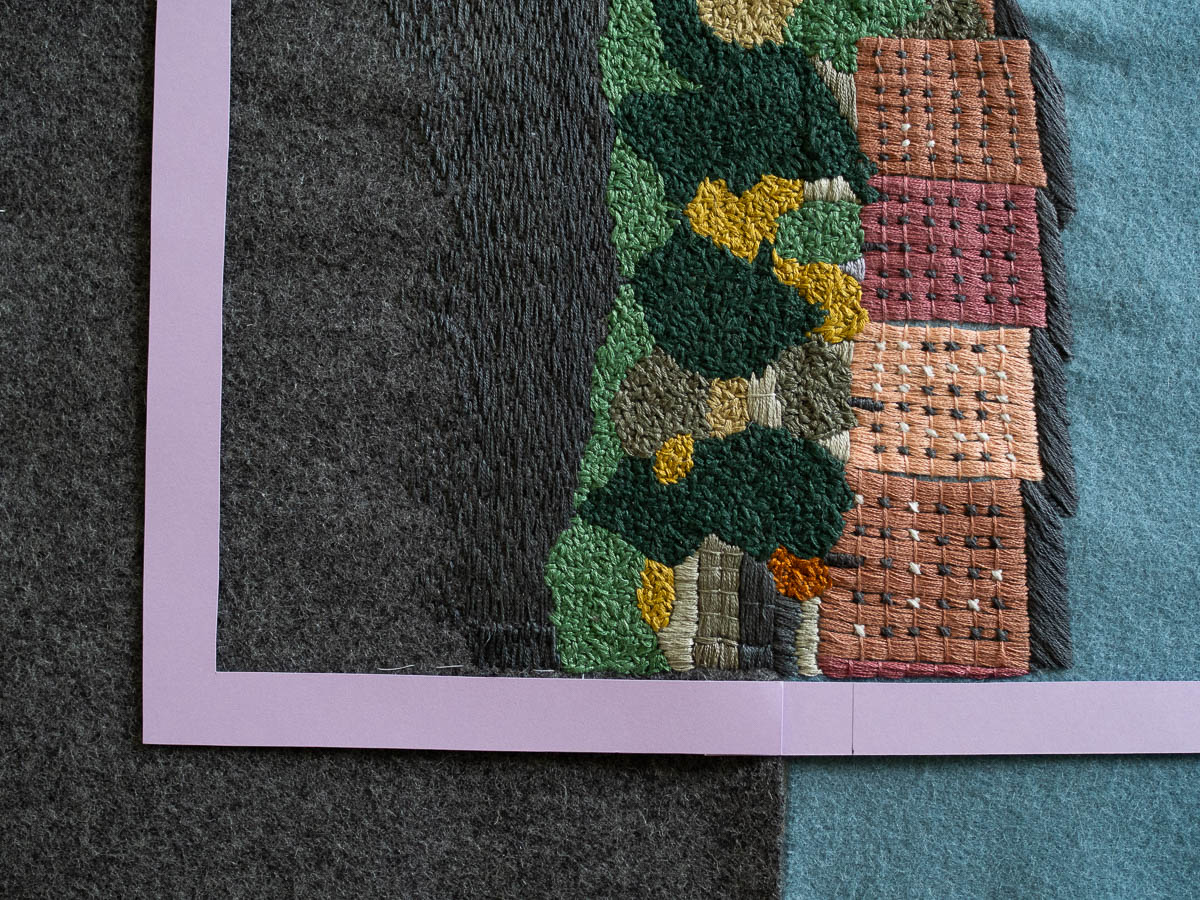
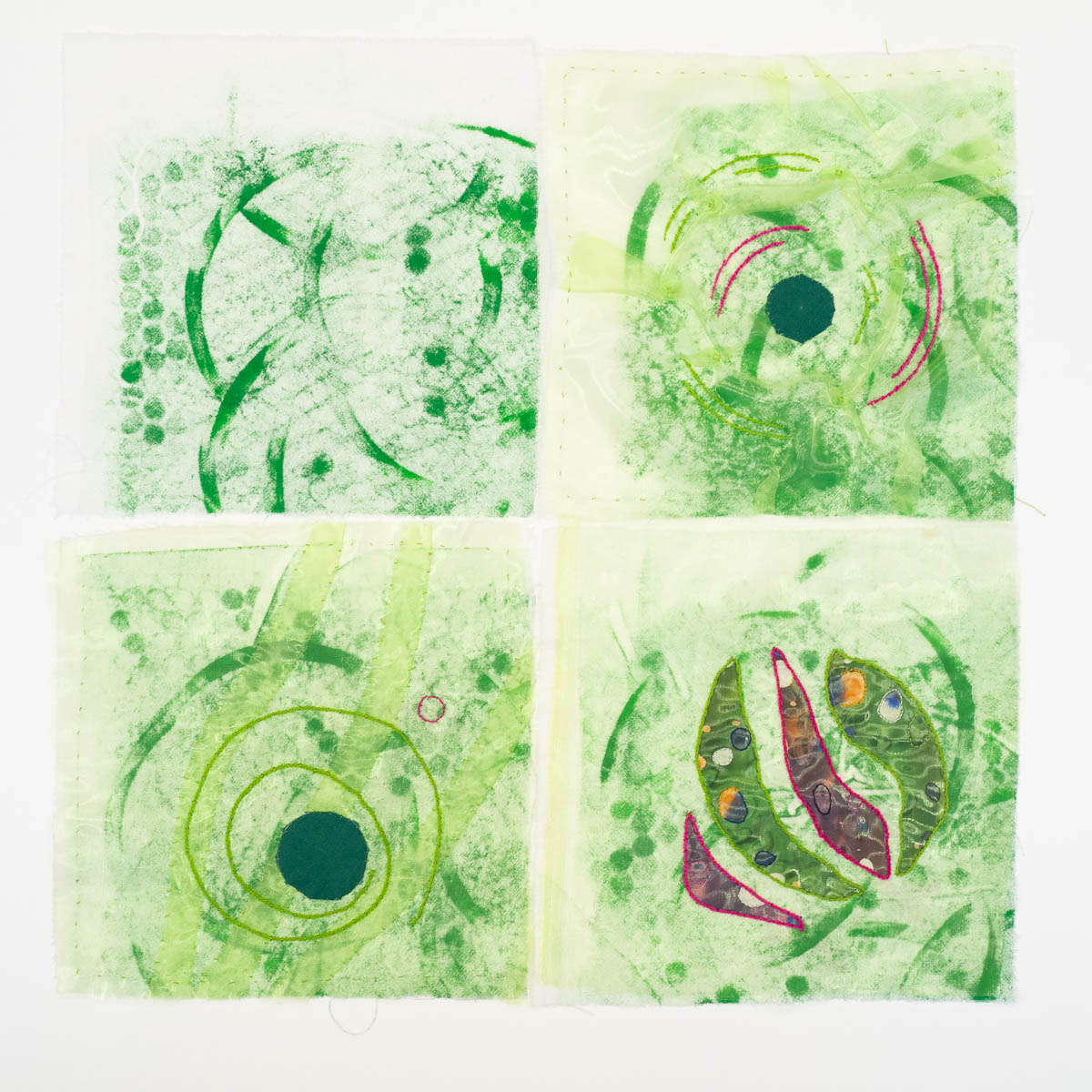
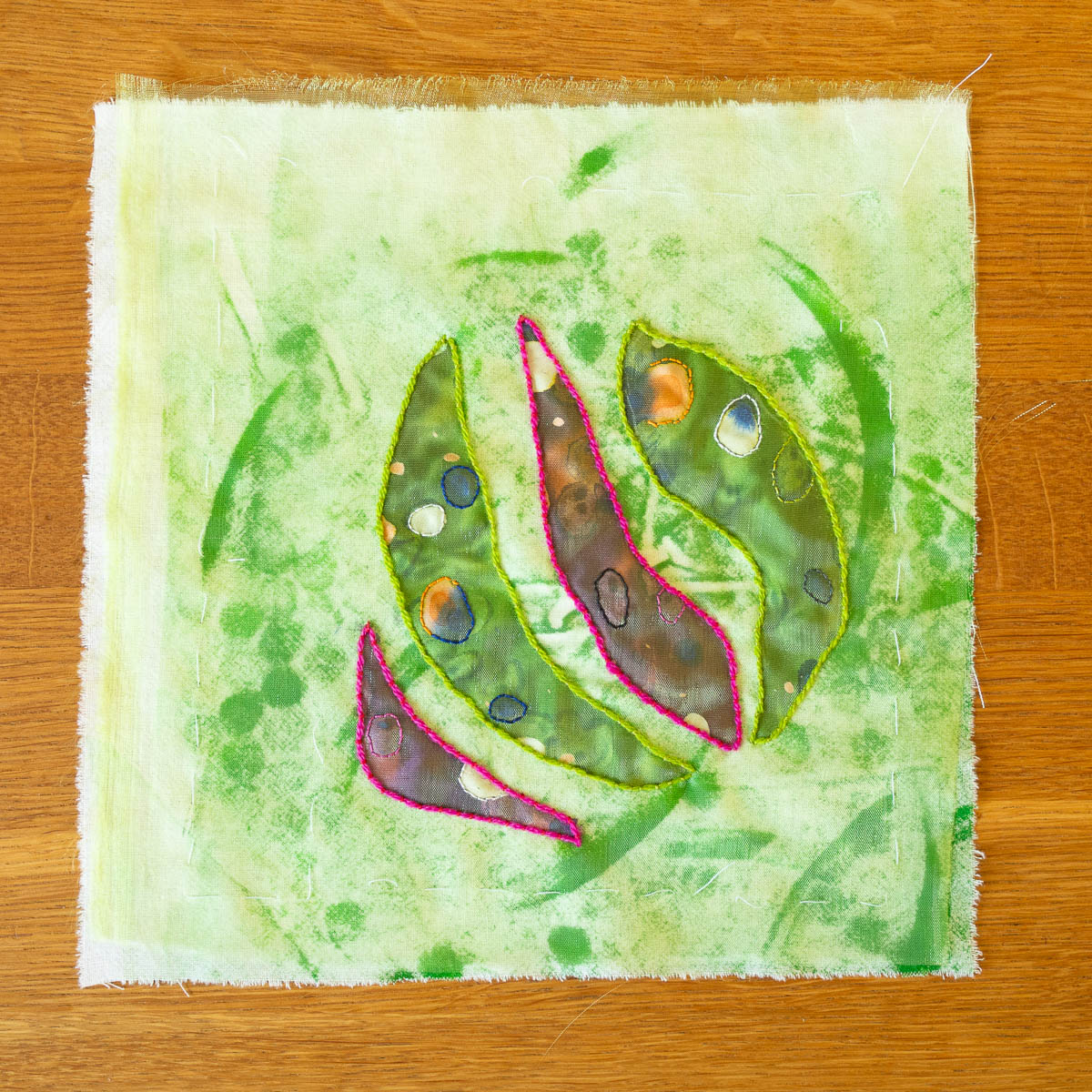
All done with the Stockholm embroidery! Needs better lighting to do it proper justice, though.

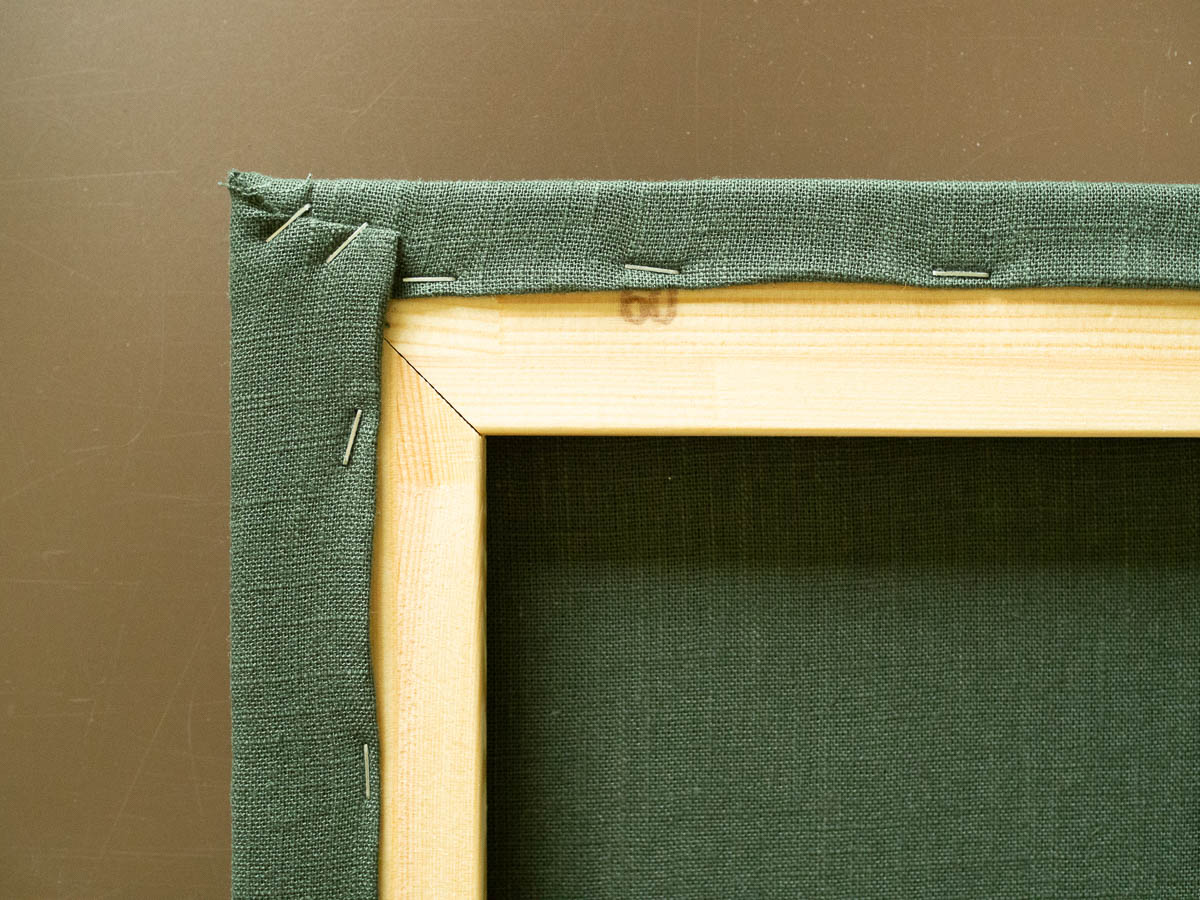
Staple guns are strangely satisfying to work with.

Working on my green organza tetraptych, hoping to get it to a presentable state in the week that’s left before our embroidery club’s last meet-up of the season. It would feel nice to have it finished. (The Stockholm embroidery will be fully finished and mounted this weekend, as soon as I get my delivery of linen backing fabric.)

I like embroidery projects where I can let the design emerge as I go. I have an overall concept or idea, but no detailed design sketches. I do a bit, let that marinate, do a bit more, look at what I have and consider what more might be needed. An incremental, intuitive approach. Sometimes I don’t even have a real plan for what I’ll do with the yarn I’ve threaded my needle with. I just know that there will be something with this yarn in roughly this area. Only when I have it in my hands and start stitching does the design coalesce.

Sometimes the yarn or the fabric decides the details. When my hank of green thread ends, then that’s where the couching ends. When I want a piece of the silk fabric, if I have an existing scrap piece with roughly the right characteristics, then I take that, instead of imagining some sort of ideal and trying to find it in a larger piece – and the scrap piece can then set the tone for its surroundings.

A deadline was exactly what was needed. I had all the materials – all I needed was a nudge, and a whole lot of patience.

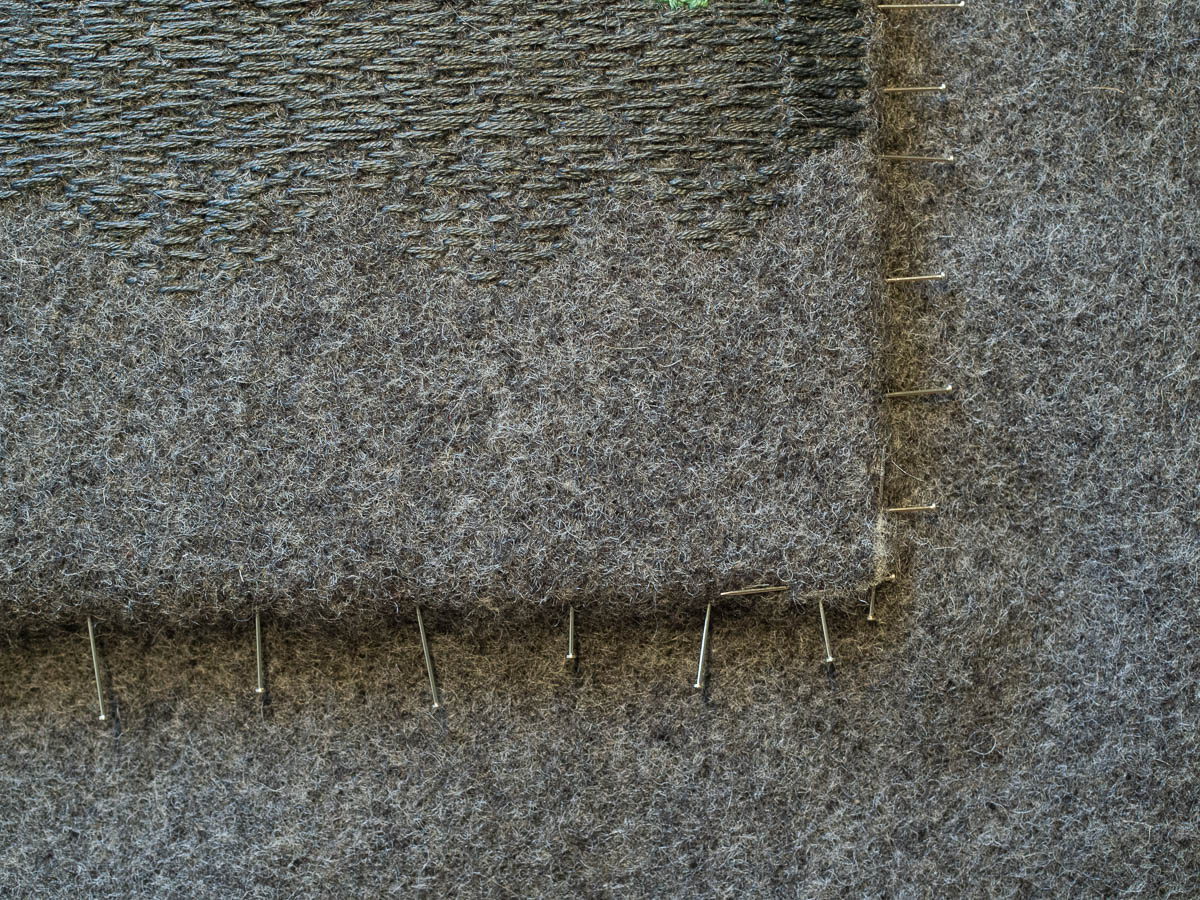
First: pinning. With lots and lots of pins. Note to self: don’t try to do this wearing a knitted sweater, because those pins catch on everything.

Stretched and pinned to a sheet of foam board, it’s already looking nice:

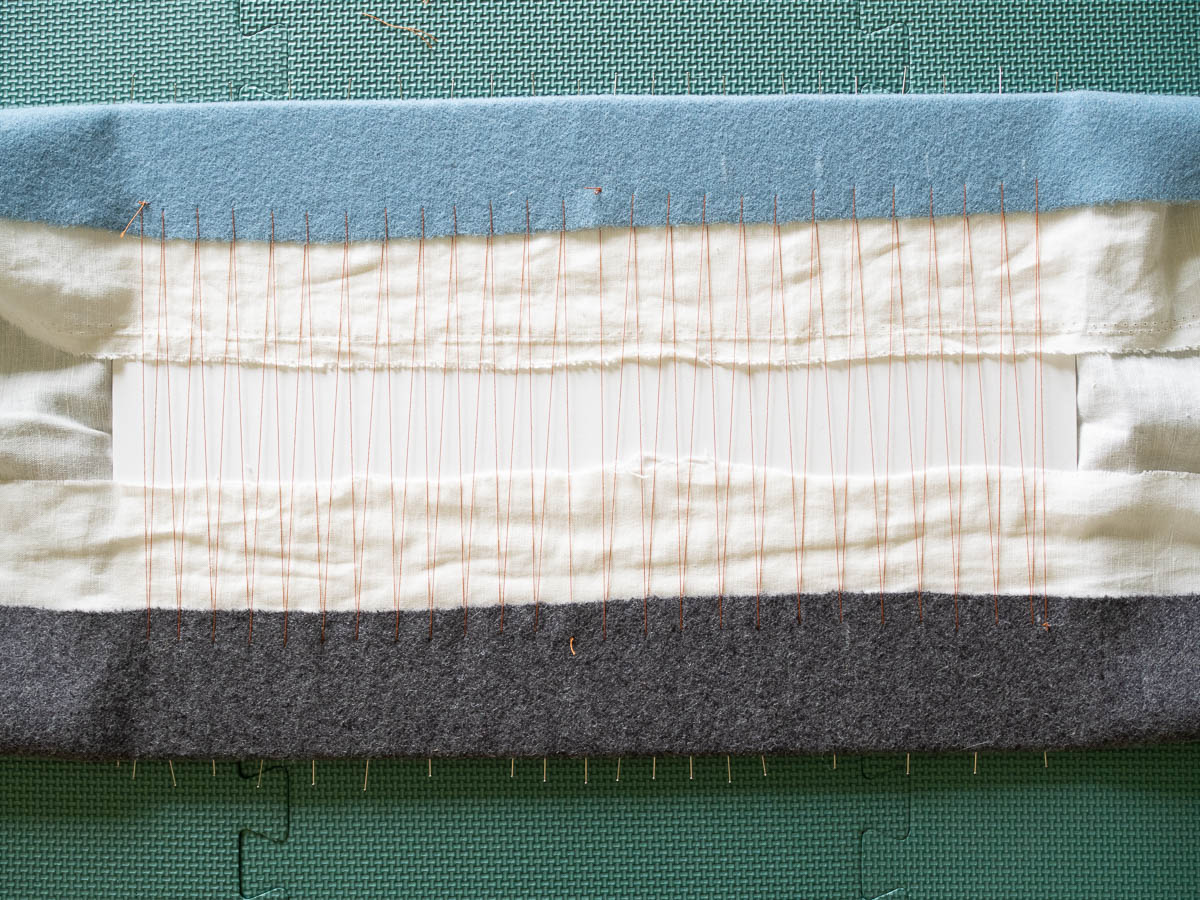
Lacing it from the reverse side.

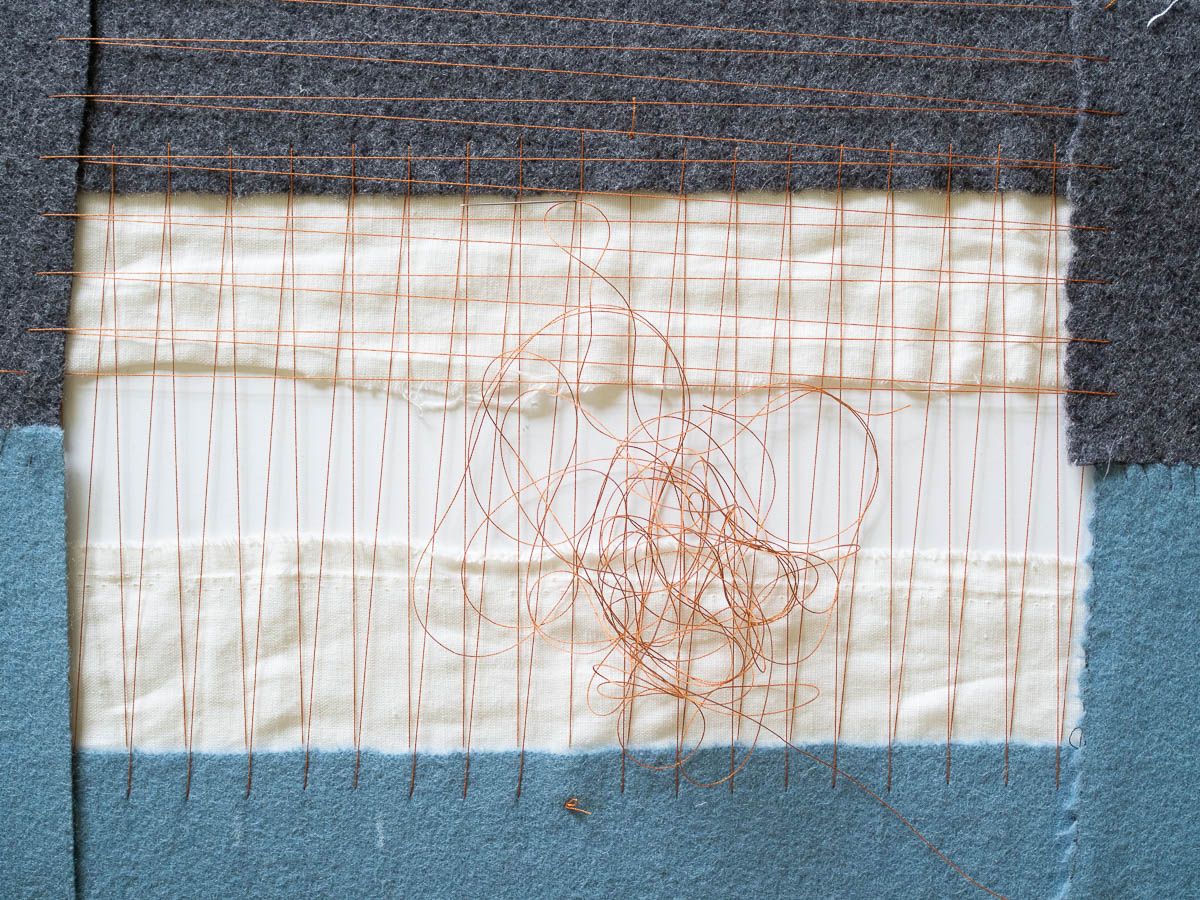
You really don’t want any knots in the lacing thread, because they make it near impossible to tighten the lacing, so I ended up working with 5-meter pieces of thread. Trying to keep them from tangling was an exercise in patience.

It reminded me of an old Estonian folk tale, where Clever Hans and Old Nick were both going to sew something. Probably Hans challenging Old Nick, as he often did. Old Nick had thick and clumsy fingers, so he asked Hans to thread a needle for him. Hans threaded his own needle with a normal length of thread. For Old Nick, he first gave a very short piece, and when he complained, gave him a very long piece so he had to run back and forth across the yard for each stitch. I felt like old dumb Nick with my long piece of thread here.

Even with all my stretching and blocking, there’s a tiny bit of puckering in the blue background fabric. It’s only noticeable with the light coming from the side and putting the puckers in relief. When it’s hanging on the wall, I’m sure it won’t even be noticeable. For the photo at the top, I turned it with the long edge towards the window, and that already made a difference.

Now I want to frame it on a green background fabric. That’ll be a project for next weekend, when the fabric has arrived.

My Stockholm-themed embroidery has been finished, more or less, since a burst of concerted effort ahead of the workshop at the end of March. Since then I’ve been working with the printed fabrics we made in that workshop, and the Stockholm piece has been languishing in a bag.

The embroidery club has its last session for the season in two weeks, and we vaguely discussed that we should bring the works we’ve finished this season, show them off a little bit.

Realizing that I haven’t actually finished anything, I set myself a new deadline. I will finish mounting the Stockholm piece, and I will make an effort to finish and mount the green prints plus organza series as well.

Step one: block and stretch the piece. It turns out that, even though I had a grid to work off, it’s somehow become slanted nevertheless. Fitting it into a rectangular frame like this would be difficult.

Thus, step zero point five: add a narrow wedge of bushes and walls and water to the edge to square it off. It doesn’t blend in 100%, especially the shadow on the water, but nobody’s going to be looking that closely at the edges.


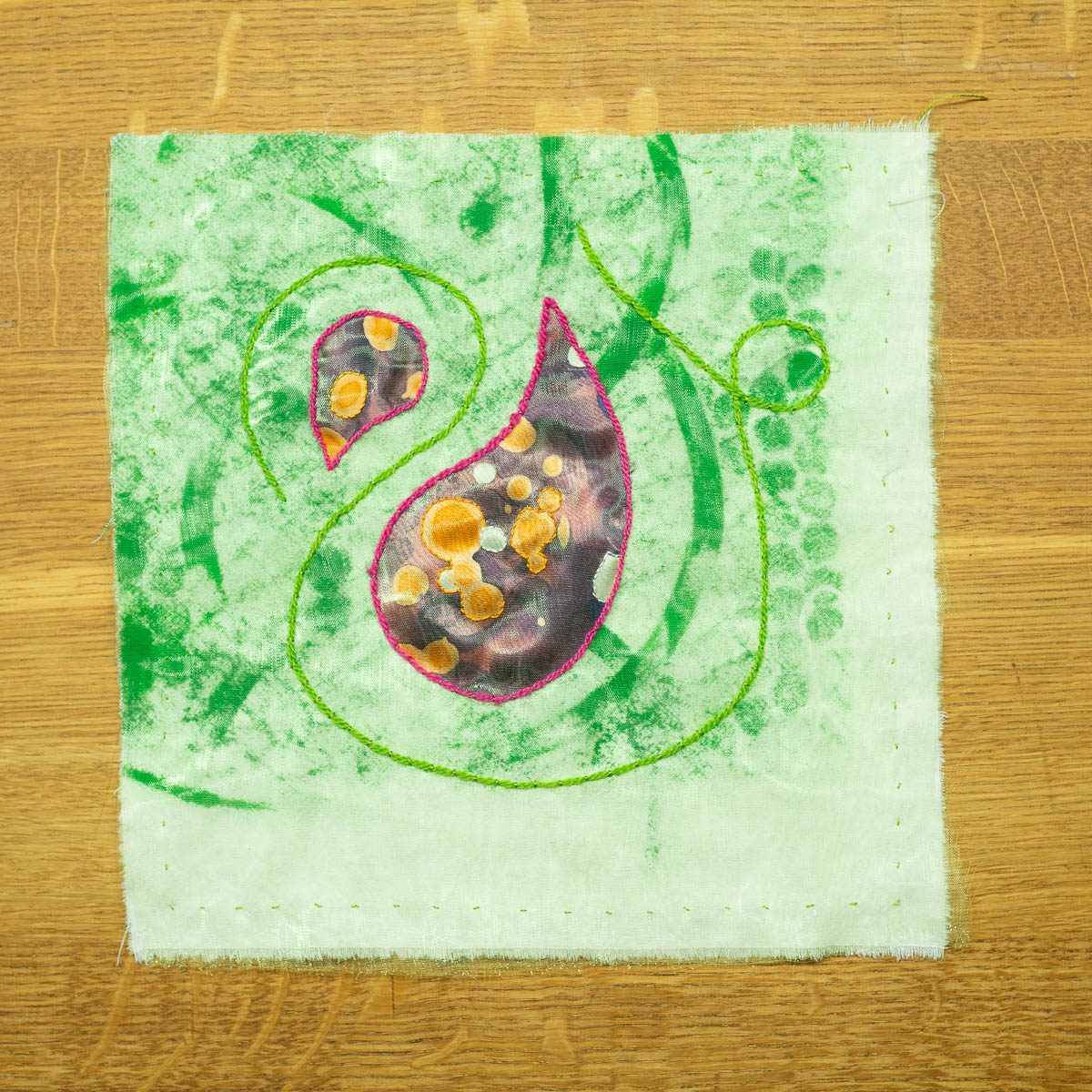
Continuing with my tetraptych of organza over hand-printed green fabric. Trying out different ways of layering the organza. The first one was a flat layer of organza over printed silk; on the second I tried folding the organza; on the third one I bunched it up and stitched it down more randomly. Photos really don’t do that one justice.

I think the silk needs to make a come-back in the fourth one, to bring it all together, and the purple could be more present in #2 and #3, for the same reason. And they all need a bit more in general (possibly with the exception of the first one).

Finished the organza-over-silk-over-print embroidery. Still not in love with it, but it’s better.

I think the original idea has promise, though, so there will be more attempts. This was one quarter of a larger square of printed fabric. I think I’ll make variations on the theme of the other three quarters, and then perhaps frame them all together.

Today I learned that tetraptych is a word.

Day two of our weekend textile workshop with Lena Larsson. Yesterday we printed on fabric; today we’re embroidering on our printed fabrics.

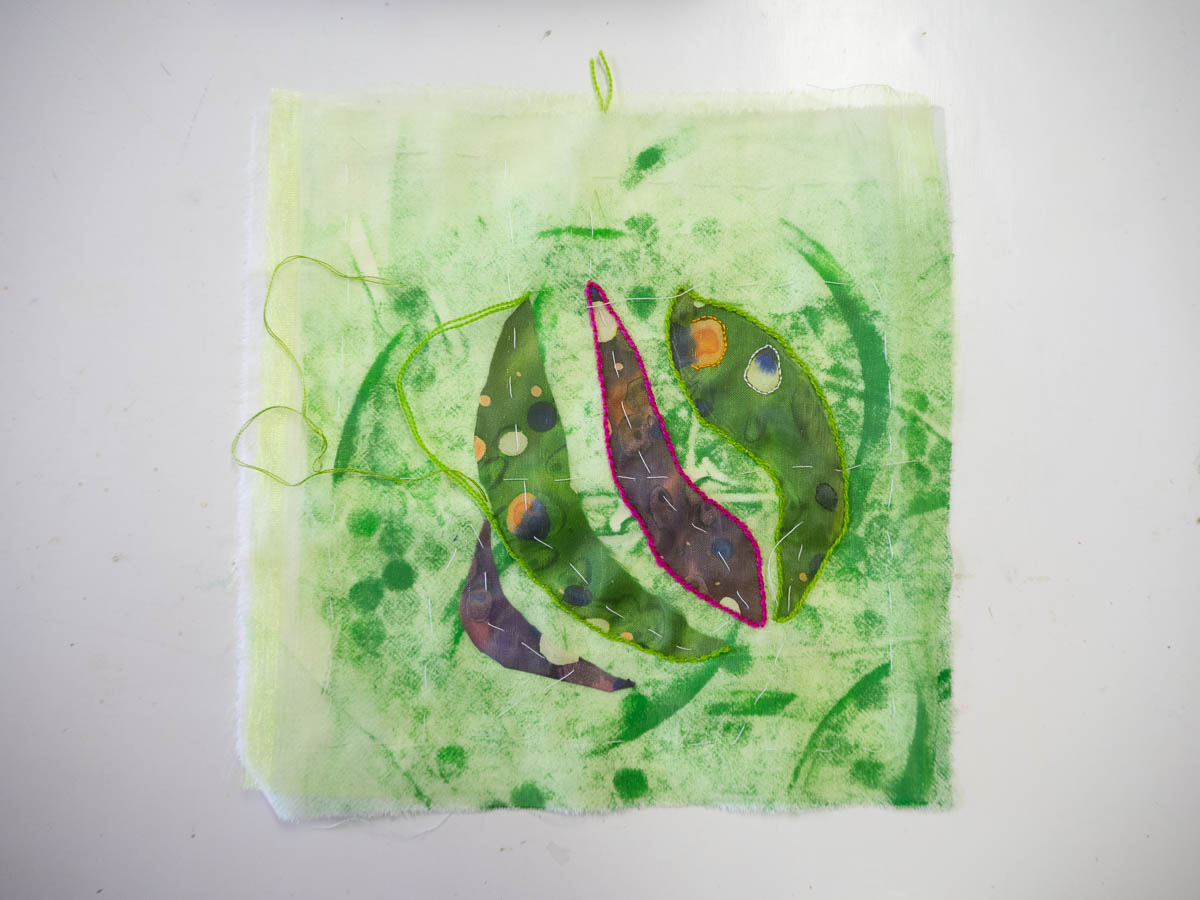
Lena uses a lot of applique in her embroidery, and she has a particular technique for this that I haven’t run across in anyone else’s work. During the first half of the day I experimented with her technique. She puts a layer of thin, translucent fabric such as organza or tulle on top of her printed fabric, and then sets applique pieces between these two layers. Then she stitches along the contours of the applique pieces. So the applique pieces are not actually sewn to the fabric – they’re only held in place by the contouring stitches. They almost hover in place.

I tried light green organza over a fabric with plenty of green, strips of patterned silk in between, and couched contours. I liked the technique, but I think my fabric choice wasn’t the best. I thought green and purple would give me vibrant contrast, and they would have, if they had been side by side – but the green organza on top of the purple silk strips just made them look washed out and muddy. I tried bringing back some of their colour with embroidery, but I still don’t like the look.

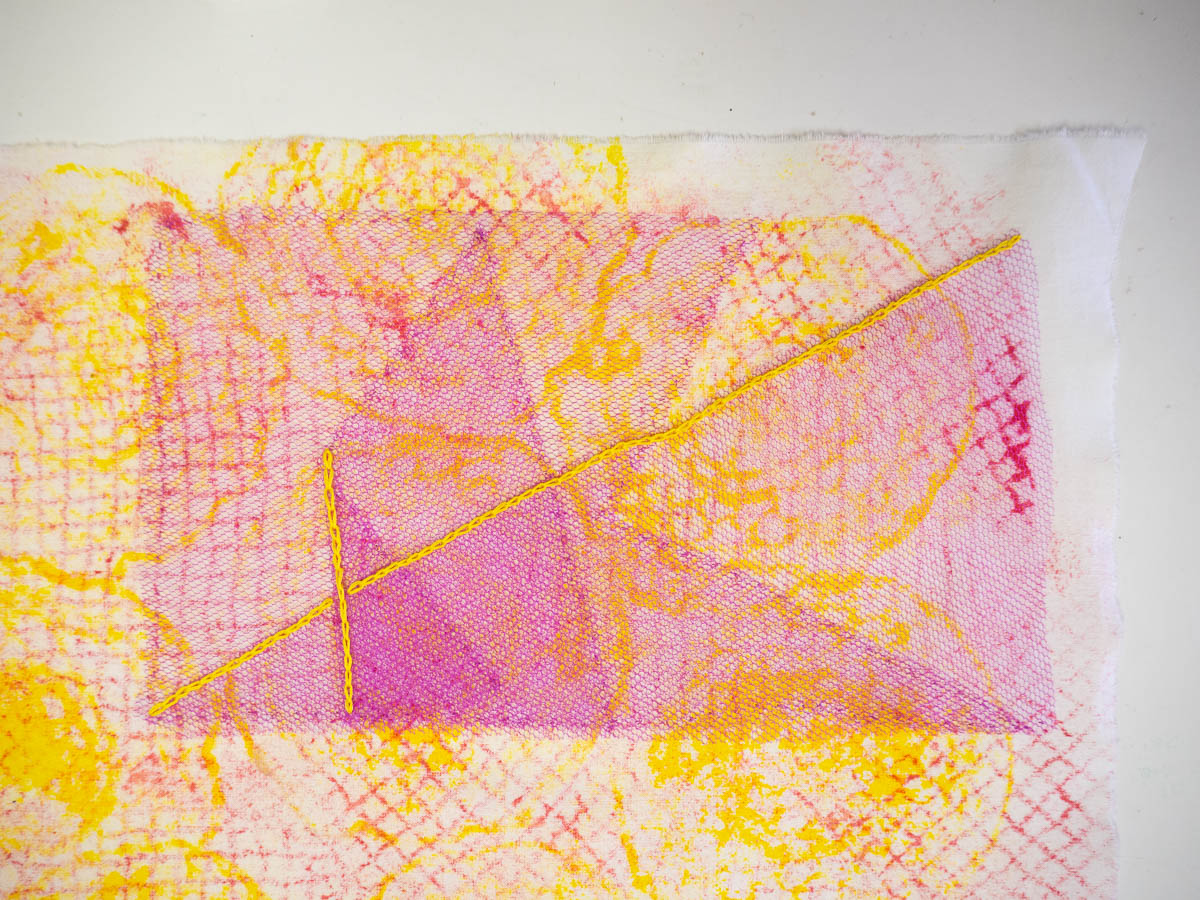
After lunch I switched techniques and experimented with stacking layers of tulle on top of each other, and embroidering on that.

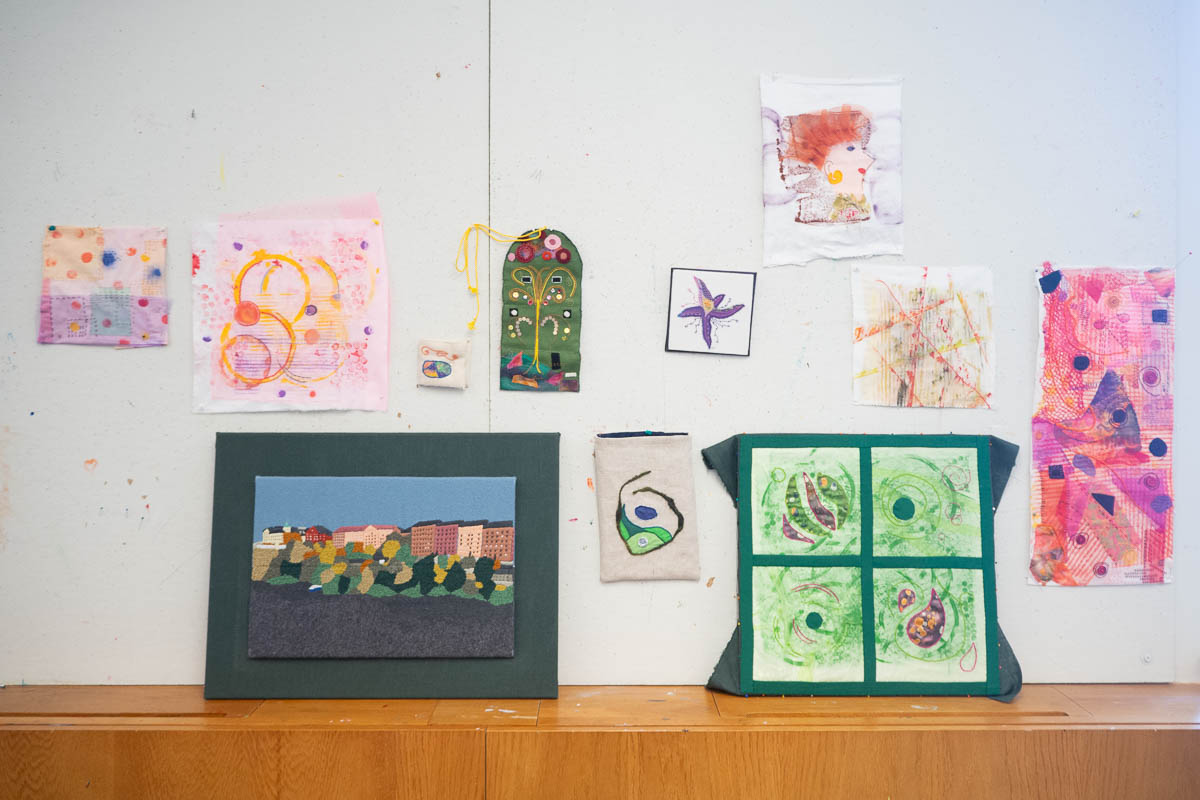
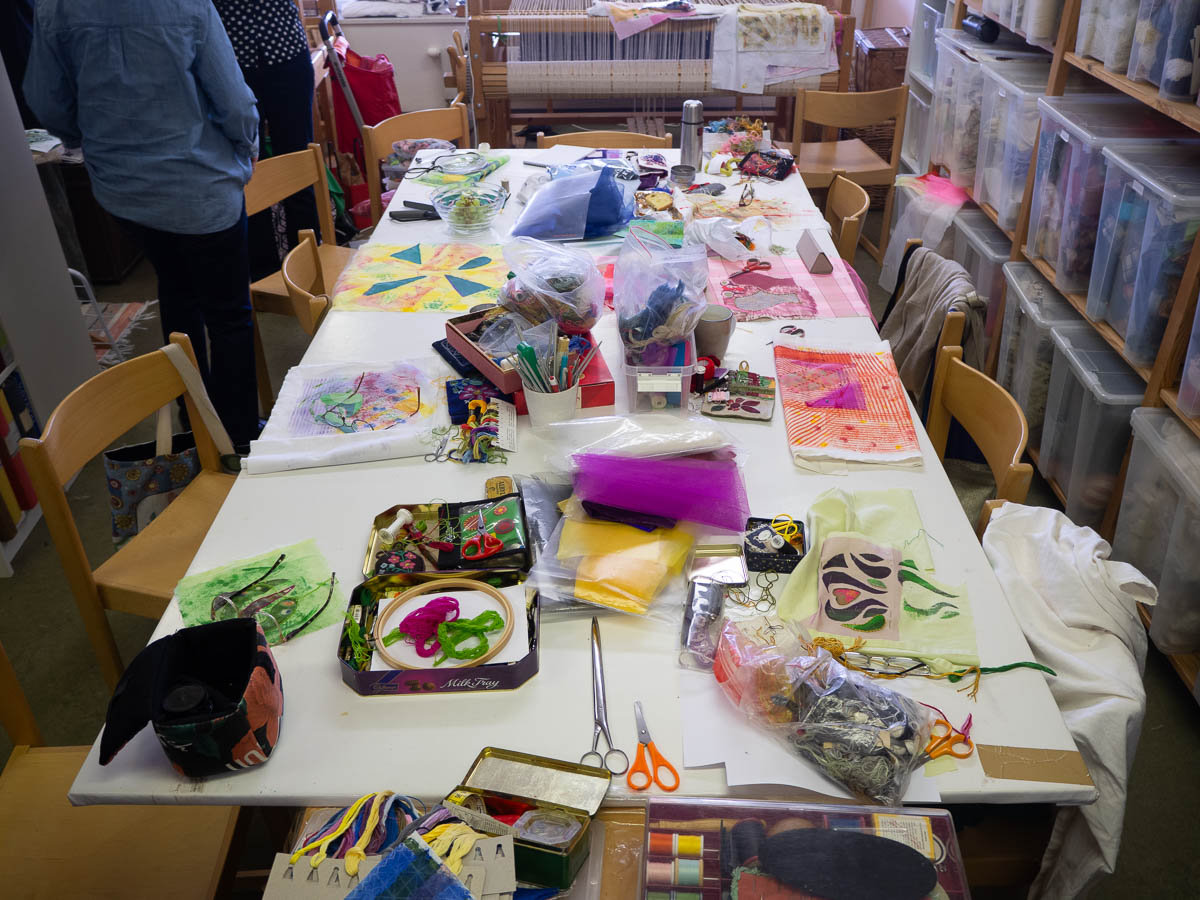
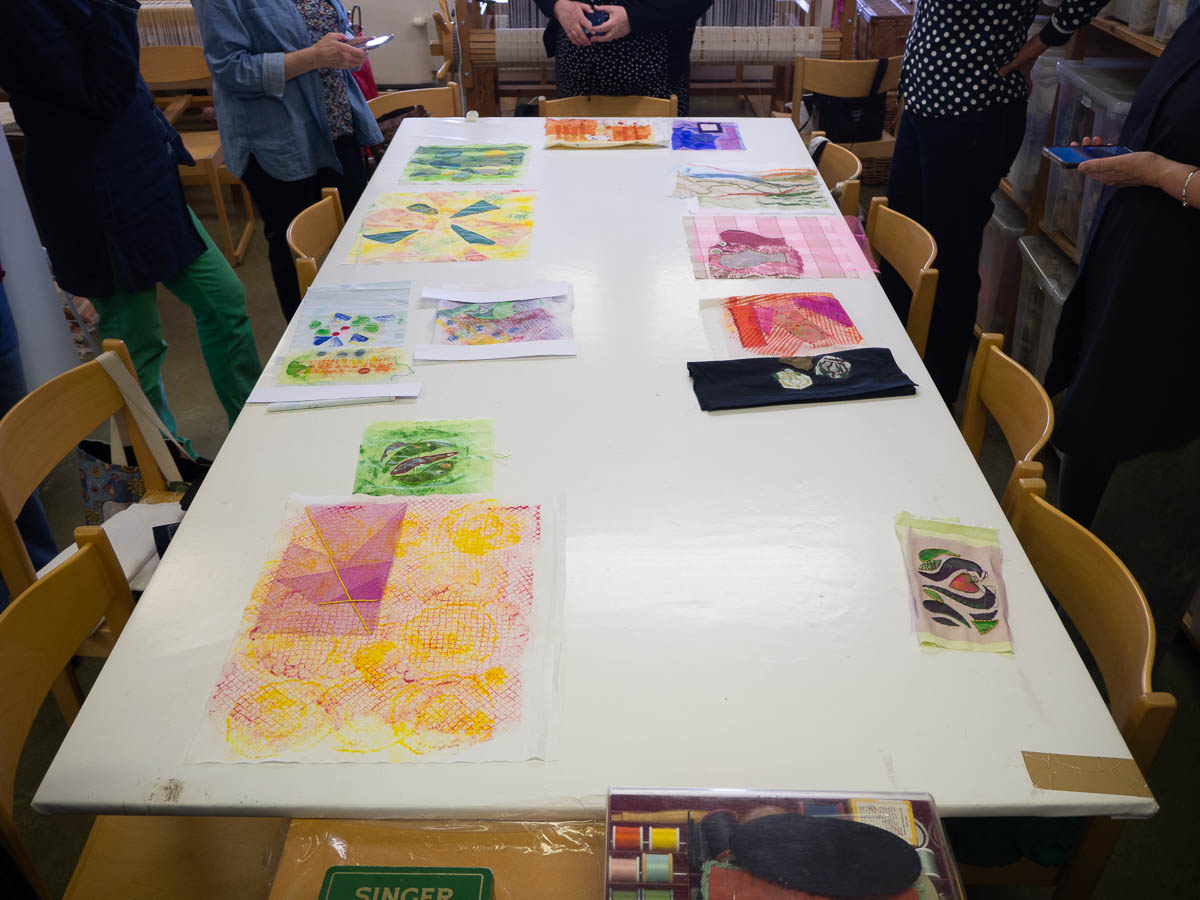
Ten people, all given the same materials and instructions, ended up with ten very different results.

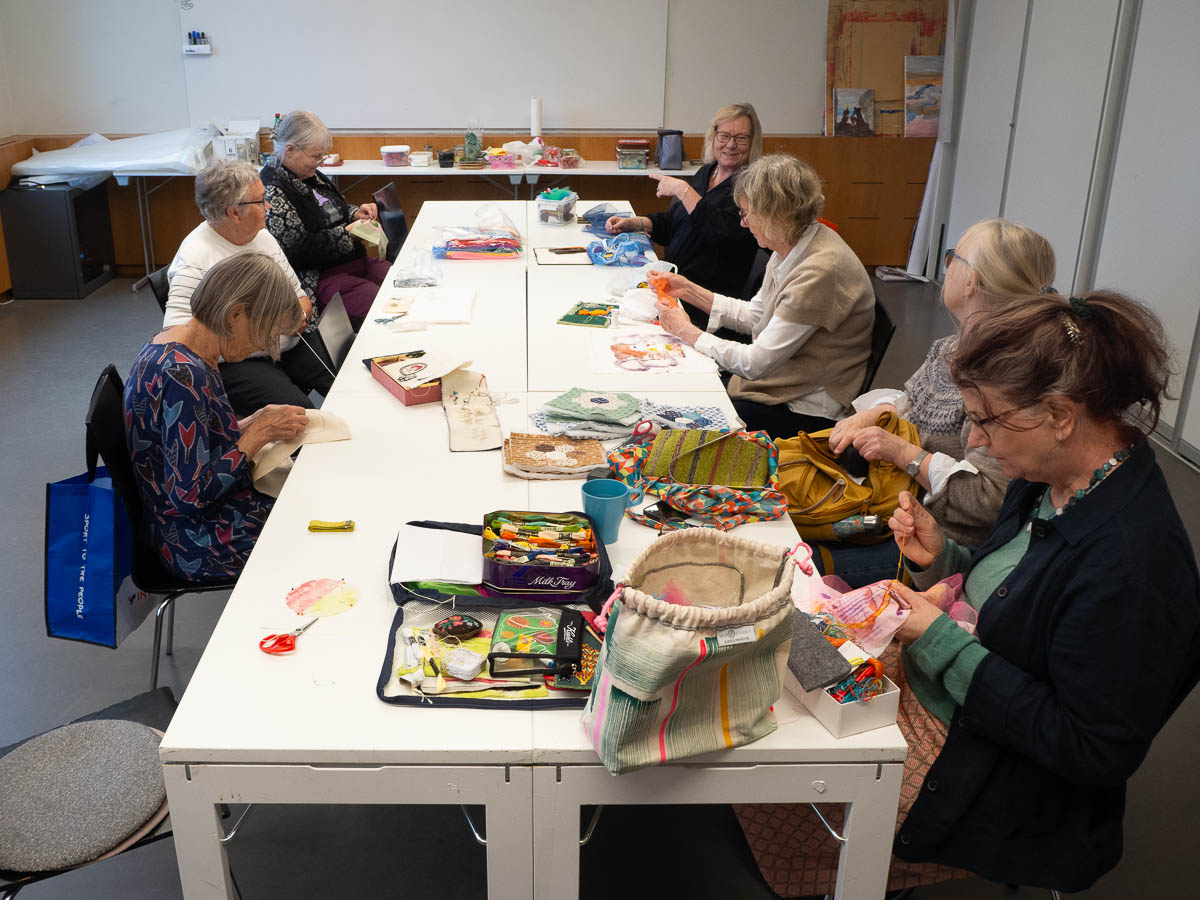
It’s embroidery club Thursday.

I think I am actually done with the Stockholm embroidery. I’ve been hesitating about adding a little bit more, but I suspect I’d end up overworking it, so I’m stopping now. I did take a photo but the lighting in our meeting room is not very good and I only had the phone camera, and the picture did not do it justice. A proper photo will be coming up when I have it mounted and ready for hanging.

This week’s dogma embroidery: use fabric in the colour of your hair. Randomly sprinkle hole punch confetti on your circle of fabric and embroider them with star stitches. I had no hole punch so I made do with other pieces of paper. Afterwards I saw that others had fastened their confetti with their stitches; I had misunderstood and just used it to mark the spots where to put the stitches.

The rules for this dogma embroidery: A light-coloured fabric. A circle, divided into five parts. Threads in the same general colour as the fabric but in different values, one for each part of the circle. Use only the hash stitch.

I used a piece of a very old fabric dying experiment by Eric, from well before we met. He was about to throw them out at some point and I said no, I’ll take them. They’re smallish pieces of fabric and mostly not in my favourite colours, so they’ve stayed in the fabric stash. A greenish-yellow piece, with a bit of a spring vibe to it, was perfect for this.

As usual, I badly underestimate how long this kind of work takes. A 12-centimetre circle, that’s nothing! But it took me two evenings.

I forgot my glasses at home today. It wasn’t too bad at work – I can see the monitor well enough, it’s just a bit tiring. What was unfortunate was that this happened on an embroidery club day, and I’m in the middle of a section of dark grey thread on dark grey fabric, which is rather hard to work on when you can’t see it well.

One of the other ladies there had an extra pair that I could borrow. I was most sceptical, because they were more than twice as strong as my own reading glasses. I tried them out anyway, and it was like wearing a pair of magnifying glasses – as long as I held the embroidery work at exactly the right distance. They were totally useless for seeing anything else, especially the rest of the room. But with their slim design, I could push them down on my nose, grandma style, and look over them for everything else.

Maybe I should buy extra strong embroidery glasses for myself as well. Or maybe I should get an actual eye exam done and not just buy off-the-shelf glasses that seem good enough. On the other hand, I have a whole list of things to buy that seem more urgent than slightly better glasses, so maybe not.