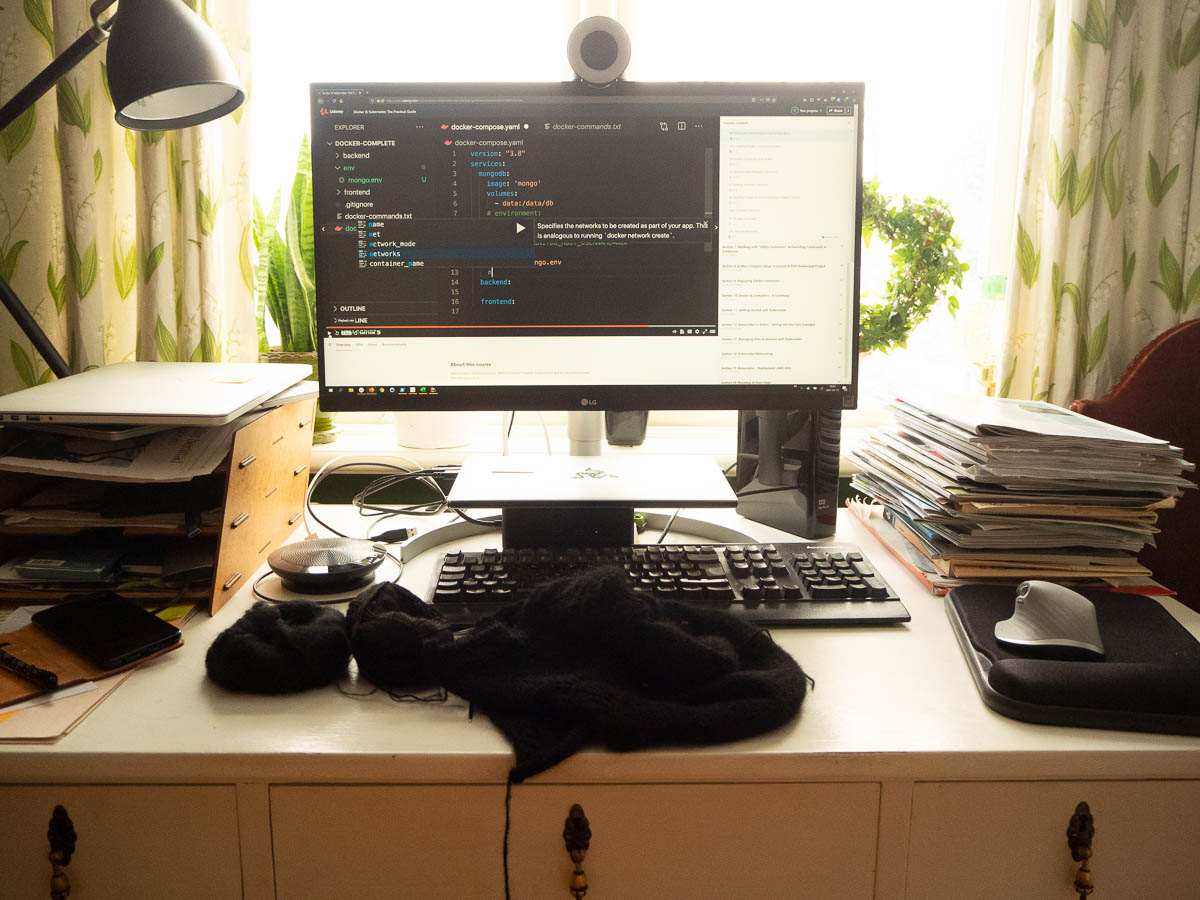
The presentation I promised to do is happening on Wednesday. I did start preparing in good time and actually have most of it figured out. As I was working on it, I came to realize that for this topic it would make most sense to just skip all the usual Powerpoint slides and just write code, live, on screen, during the session. Which I have never done before, so I can’t just wing it the way I normally tend to do with presentations. I can’t even really estimate how much coding I can fit into one hour. So here I am, spending my Sunday afternoon talking to myself while writing the same code for the third time now.

If you want to see me do this live on Wednesday, here’s the link: Massaging MongoDB data.


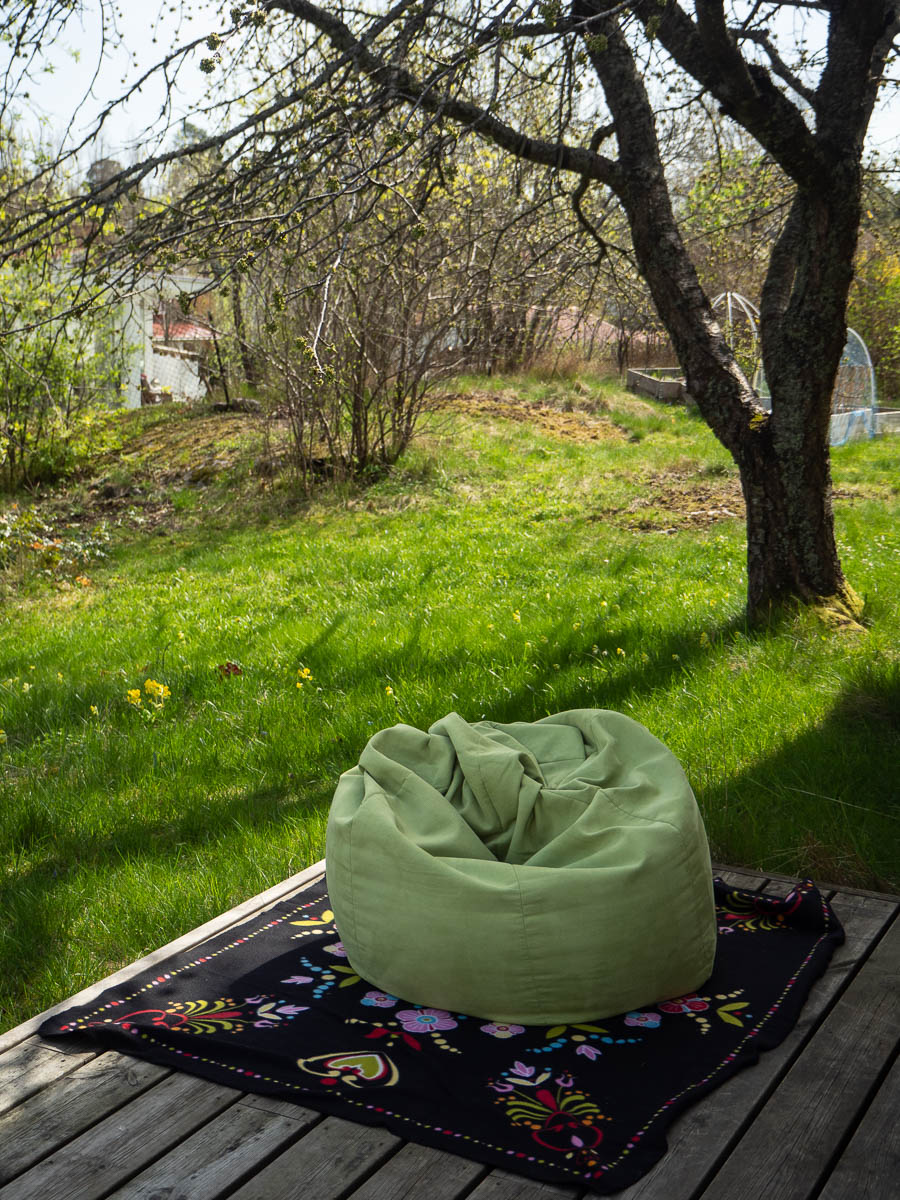
The ground is still slightly wet with dew at 9 in the morning, but the deck is dry enough for me to put down a bean bag and have my morning meeting outside.


It’s seven o’clock in the evening and I’m sitting in front of my work computer and wracking my brains. I was asked a few weeks ago if I could hold another talk for tretton37 and, eager to please people, I said yes. Now the bill is coming due. I need to actually come up with a topic, so that the talk can be scheduled and marketed and whatnot.

The talking is never the hard part. The hard part is finding something to talk about. I’m not working on anything new or exciting. It feels like everything I can think of has already been talked about. I keep second-guessing myself.


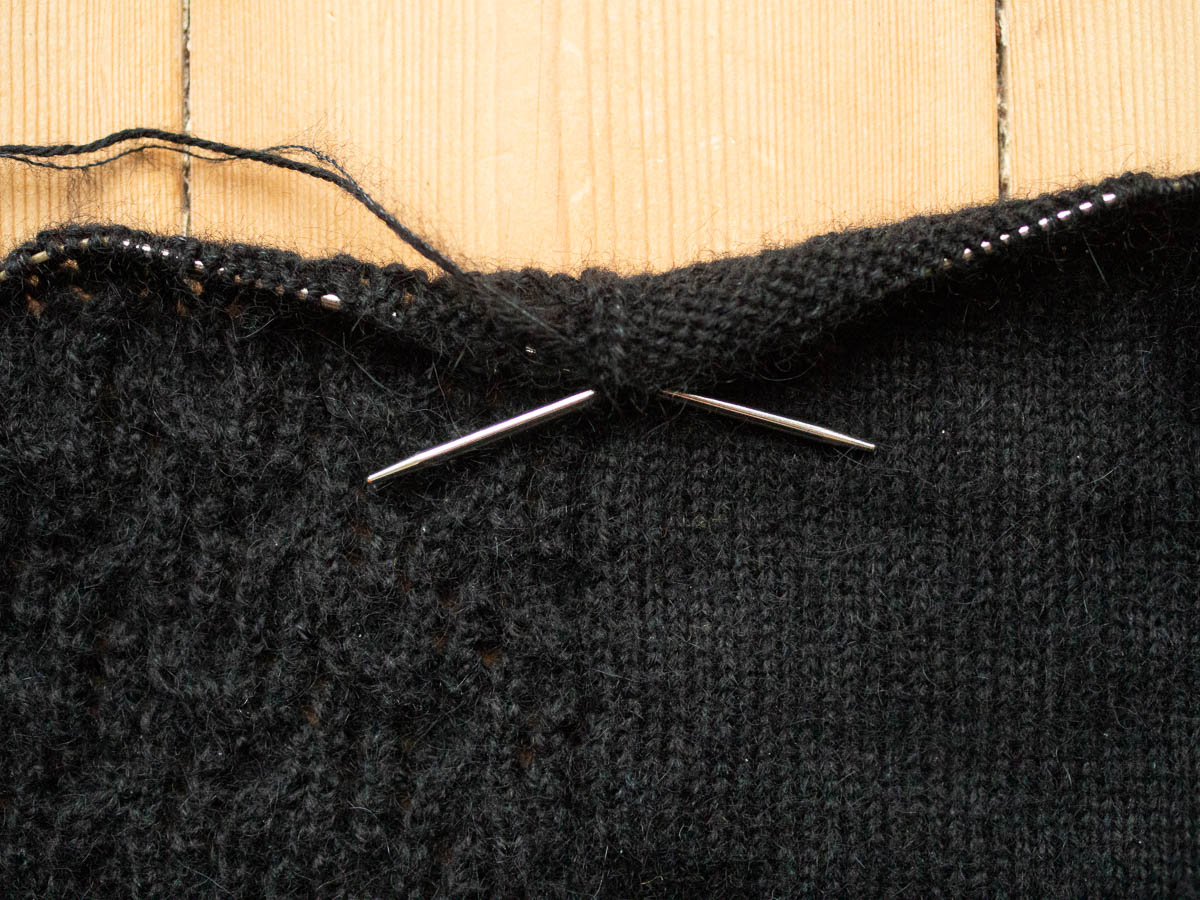
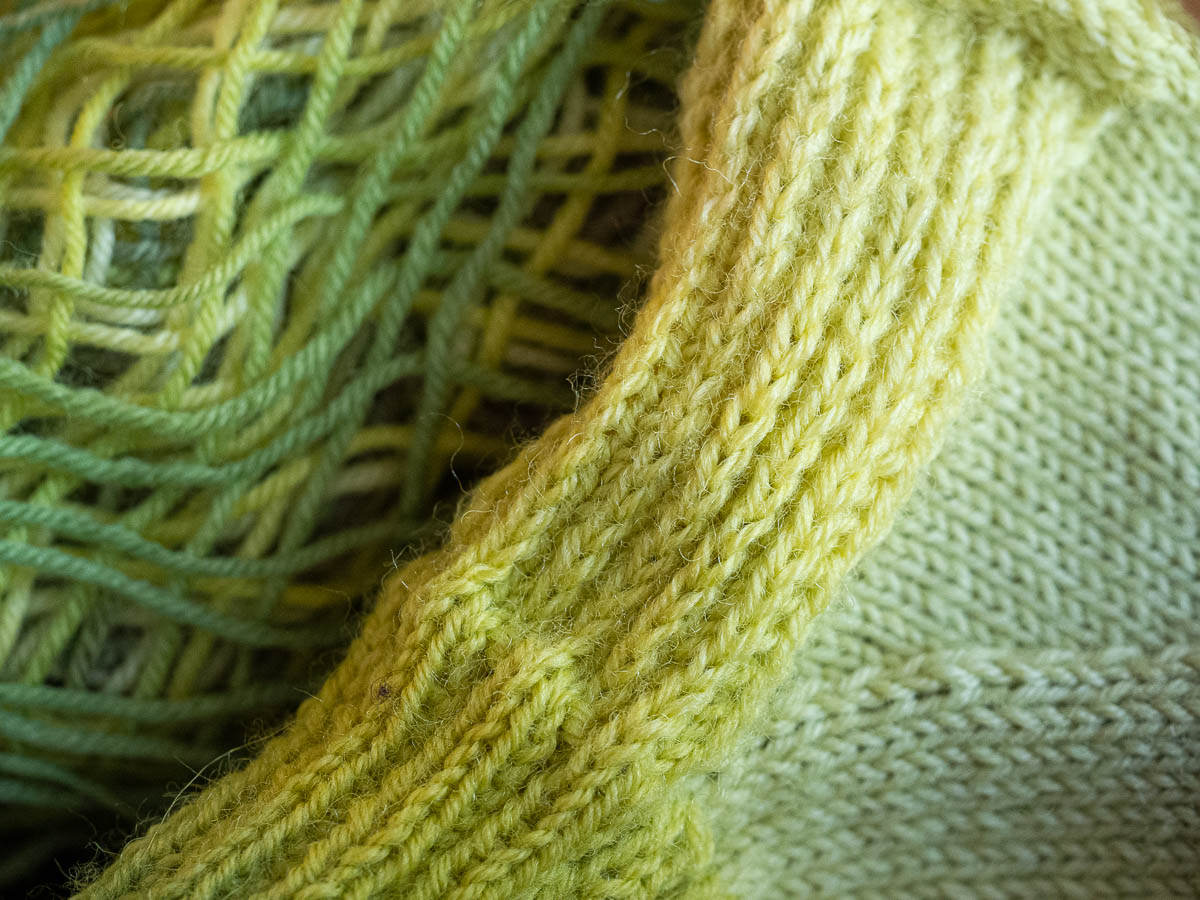
The cardigan is now at roughly the same point where I ripped it up last time. Time to try it on again soon.

I’m making good progress on it, and on the socks I’m also working on, with all the online meetings we have. Knitting is the perfect filler activity for meetings where I am mostly a passive participant.

But meetings are only good for a certain kind of knitting: the kind that I can do with half my attention. No measuring or fitting, no casting on new things, no tricky counting. I try to make sure to have at least one of my projects in a meeting-ready state by each morning. I wouldn’t want to end up in an hour-long meeting with no knitting just because I’m stuck behind the start of a heel or something like that.

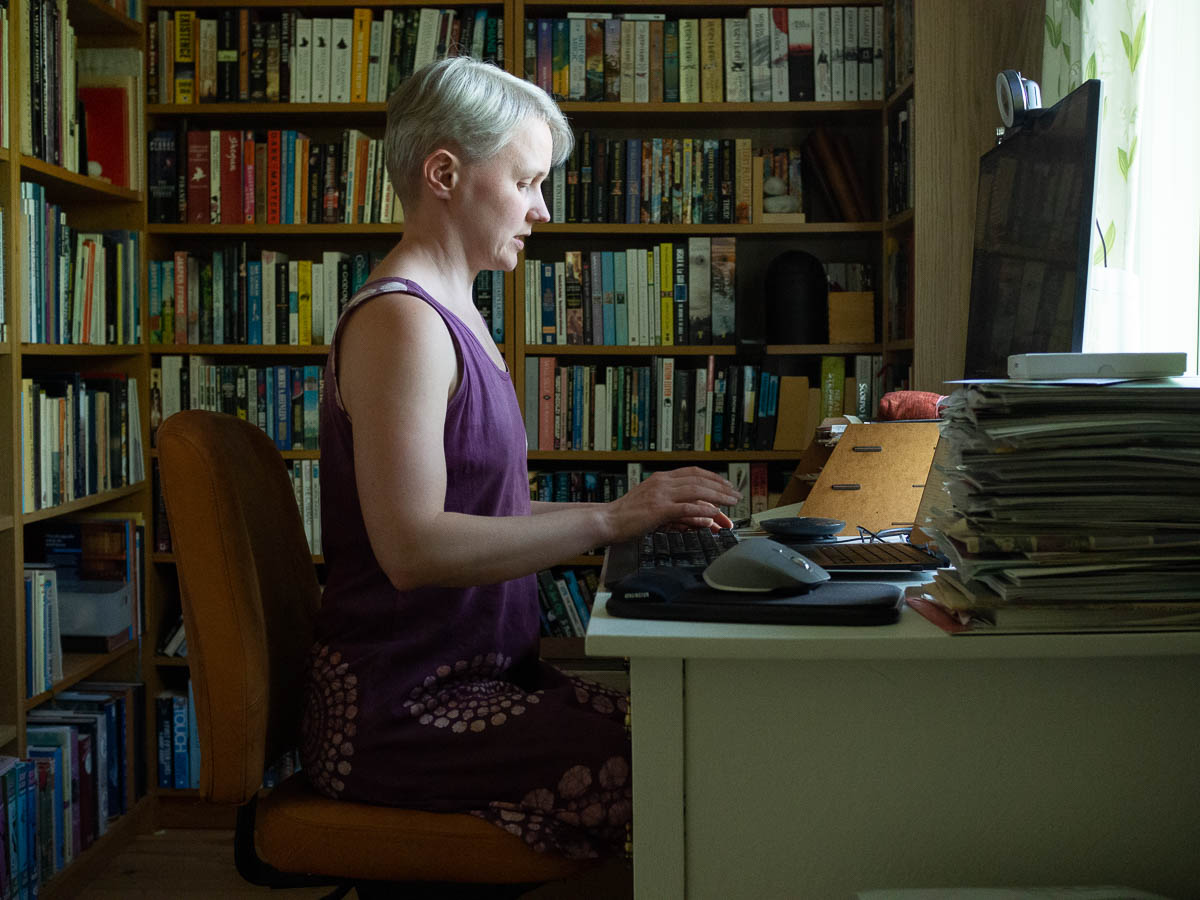
This work-from-home thing is really spoiling me.

For International Women’s Day, tretton37 interviewed me and some of my women colleagues about being a developer. Here’s a video of me talking about why I love my job.


Part of my job is doing recruitment interviews. I do them quite regularly – recently at least once a week. 1337 is growing and we want to hire more developers, and someone needs to interview them from a technical point of view. These days I do roughly one per week, and often get requests for more. It’s getting to the point where I have to say no because I can’t take that much time from my “real” work. But I enjoy them, so I do try to take the time.

We’re a large enough firm to have specialists for the early phases – finding and winnowing out suitable candidates, and having a first interview with them. I’ve never enjoyed that part of the recruitment process so I’m glad that’s already done by the time I get involved.

The second step is a technical interview, and that’s where I come in. The third and final step is a manager interview.

In a tech interview, we spend one to two hours inventorying and mapping the candidate’s skills in a wide range of topics. We don’t usually dig into any one area in great depth, but we probe enough to get a good picture of where the candidate’s skills lie, and find out where there are gaps in their knowledge.

These days we have a comprehensive template document listing all the areas to cover, each one with a set of keywords to help jog our memories. This is a relatively new “tool”. We’ve invested many laborious person-hours in internal workshops to prepare this interview guide, and then to get used to working with it, and now it’s really paying off. I’ve been doing interviews for many years and they’ve never been as focused and well-organized as what I’m doing now.

We always do the tech interviews in pairs, which I really like. Not only is it good to always have a second opinion, but it also makes the interview run better. If I can’t think of a good follow-up question, my colleague is sure to have one.

It’s easy, relatively speaking, to interview a developer who is supposed to be roughly at my own level of experience. I know what I would expect from another senior colleague. Does this person know enough to be able to deliver production-ready code? Do they have enough experience to make architecture decisions? Are they able to consider the bigger picture, the business needs, the trade-offs?

It is much harder to interview a junior developer. Experience and knowledge can be judged more or less objectively. But judging potential is so much harder. How can I know what this person will be able to do in a few years? How much of their lack of knowledge today is due to lack of exposure, and how much is due to lack of initiative?

I’m quite glad that the final decision is not mine.

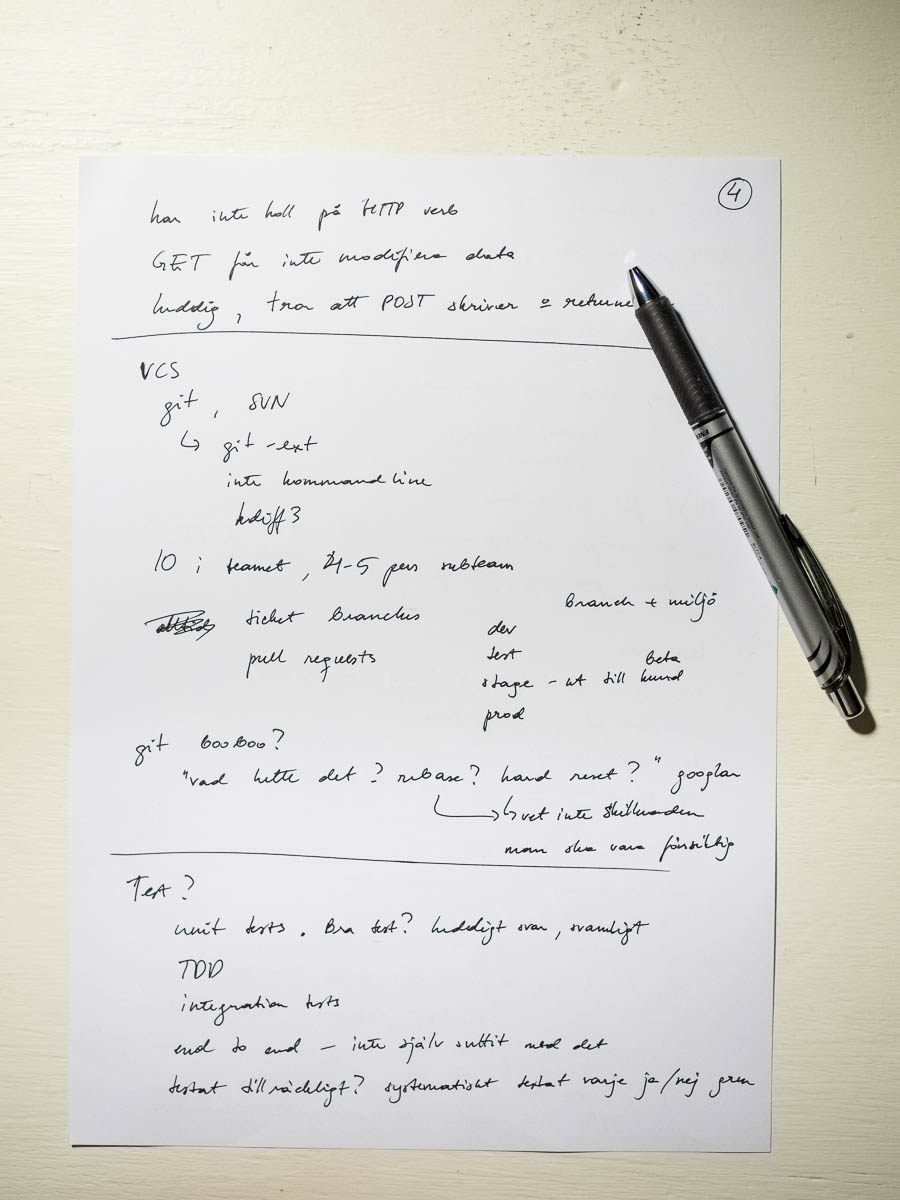
Despite all the digital tools we have, I always take notes with pen and paper. Nothing beats pen and paper when it comes to quick scribbles and unstructured comments.


I needed to go to the tretton37 office today. Last time was in September I think?

My back has occasionally been acting up still, so I didn’t dare to commit to cycling all that way, especially since cycling involves (1) bending at the waist and (2) pushing with my legs, both of which have been a bit problematic recently. So, train and tube it is.

I left home early to avoid the worst of the morning rush. I wouldn’t quite describe the train as crowded, but definitely not empty either. And those who were there didn’t seem to be thinking much about social distancing or any such thing. Less than half the passengers were wearing masks. And people were squeezing past others (and me) in the narrow aisles without any second thoughts, and likewise on the escalators.

I guess if you have to be on public transport every day because you cannot work from home then after a while maybe you simply stop worrying, because you run out of worry.


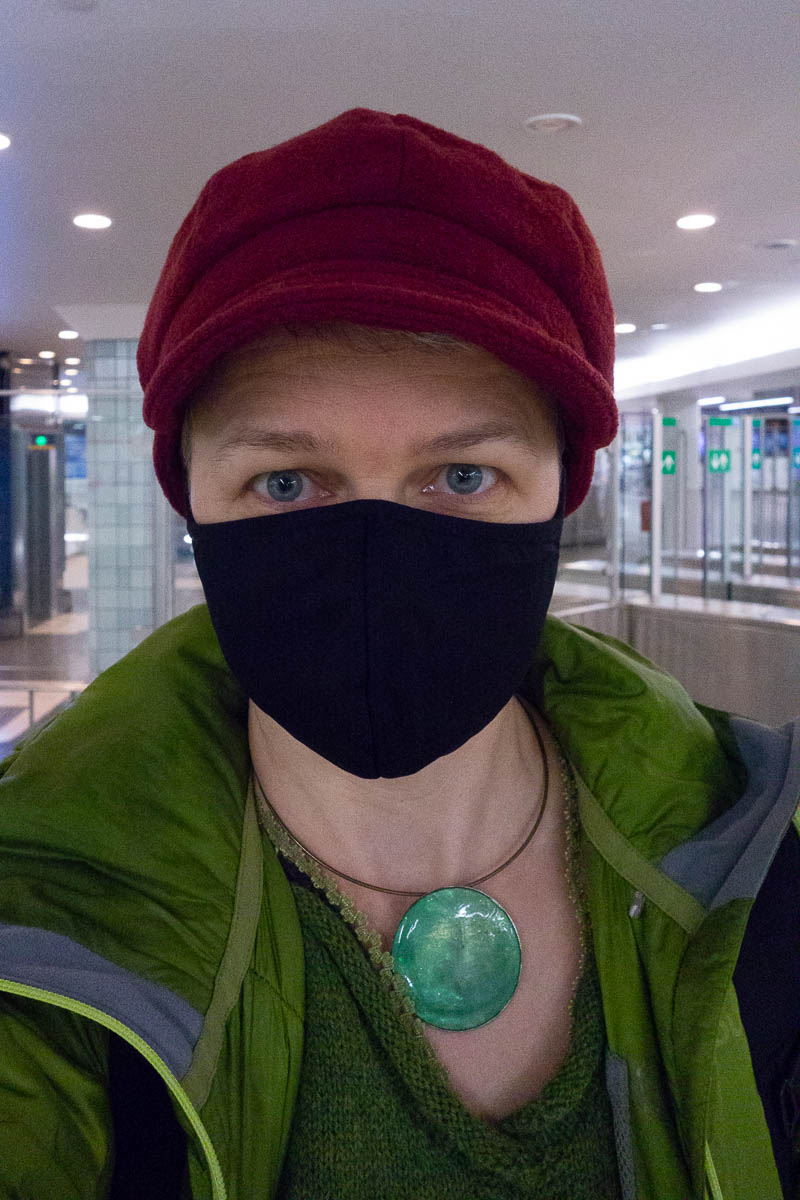
This was my first time in a crowded indoor space in months, so it was also my first time wearing a face mask for real. It didn’t feel like I had expected.

I had expected the bands around my ears to be uncomfortable. I usually hate such things. I only ever buy sunglasses with straight arms to avoid pressure behind my ears. But I didn’t even notice these.

I constantly noticed the mask itself, though. It comes up high enough under my eyes that I see it all the time. And especially when I tried to look down. When I wanted to read, I had to hold my magazine up high to see it properly past the edge of the mask. And when I tried to use my wallet to pay, and when I touched my key fob to the door pad, and so on.

If I had to do this daily, I’d probably try to find a different make that didn’t come quite as high up on the sides. But now it’s not worth the bother.

It got steamy inside the mask when I took the stairs fast.


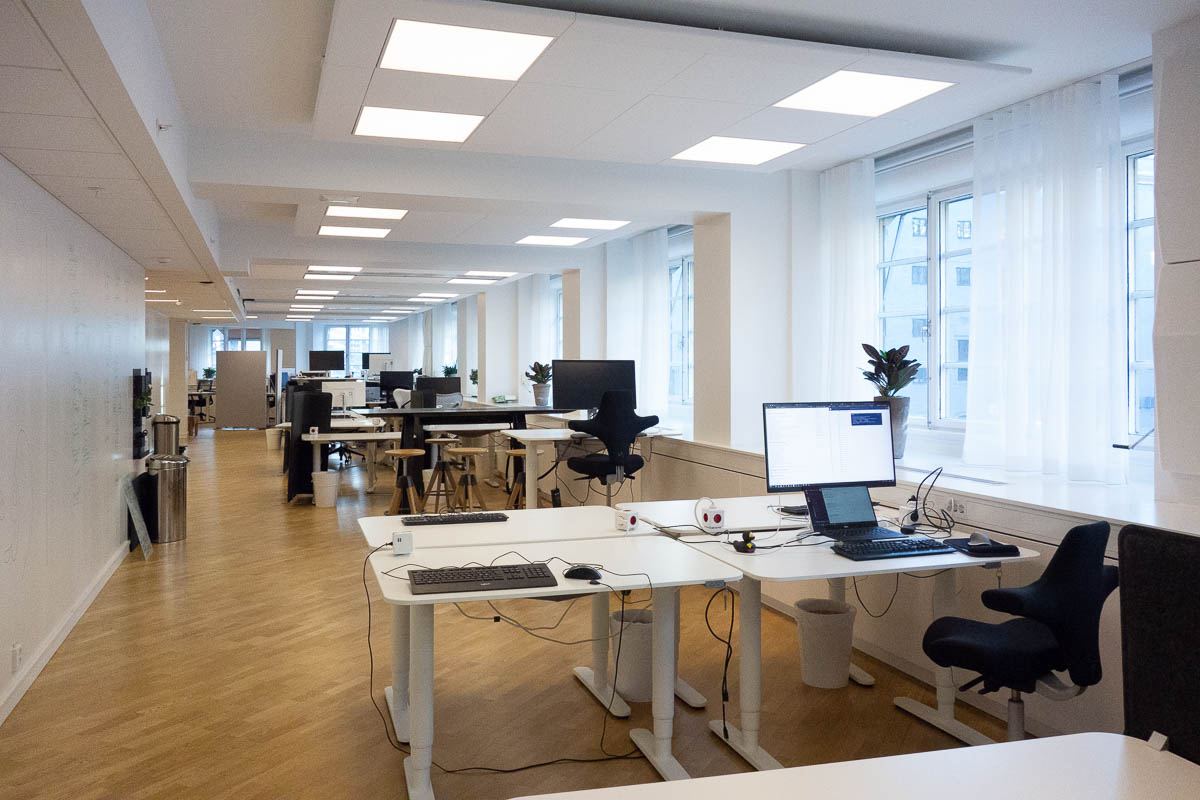
The office was mostly empty. A handful of people were there but the overall impression was of abandonment.

I left in the early afternoon to avoid the rush hour again and finished my work at home. The whole commute felt like so much wasted time. 40 minutes there, 40 back, all chopped up into little pieces so I can’t even do much with the time.


My knitting basket is near-permanently stationed at my desk during working days. Long remote meetings become so much more bearable when I can keep my hands busy.

I wonder what my colleagues think of it. It hasn’t come up in our discussions yet. The knitting is mostly out of view for the camera, but not always. And I’m sure they notice that I’m not looking towards my screen and camera. Then again, it’s not rare for people to have their camera somewhere off to one side, so those folks are never facing the camera, so perhaps my doings don’t look as odd as I imagine.


It’s my last day on my current project and I am in fact spending most of my time preparing for the next one. The new project utilizes technologies that I’ve never worked with (Docker and Kubernetes) so I’m getting familiar with them at least in theory.

I find video tutorials difficult. I get bored and lose focus. (I also never watch Youtube videos for fun, or TV series – I only do that as a mostly social activity together with Eric or the entire family.)

The biggest problem with video lectures and all other videos is that they happen at someone else’s pace. When I read, I decide how fast I go. I read fast most of the time, and slow down to re-read bits that are important or interesting.

Luckily this platform had controls for playback speed so I could do the same here. I started out at 1.25x speed, quickly moved on to 1.5 and then settled at 1.75. The speedy delivery, combined with knitting to keep my hands busy, got me through the day quite productively.

Is there even a point to writing a review for the year that ended? I thought. But what is obvious and top of mind for everybody right now, won’t be as obvious a few years from now.

2020 was the year of the coronavirus and its associated disease, covid-19. It became a topic during the last week of February in conjunction with winter break, when many people go on ski trips either in the Swedish mountains or in the Alps. (We went to Åre: day 1, day 2, day 3, day 4, day 5, day 6, day 7.)

There were plentiful reports of lots of people being hospitalized with covid-19 in Italy but the Swedish authorities still thought it unnecessary for tourists returning from the Alps to self-quarantine. Just two weeks later the situation had deteriorated enough for the authorities to recommend working from home. People were stockpiling toilet paper, fearing a full lockdown, which never came. The summer was a bit better (the virus being less active during the summer, just like other coronaviruses such as the common cold) but in autumn it all went downhill again.

Some countries managed to contain the virus and limit its spread but Sweden plainly didn’t, and the situation now is worse than ever. Hospitals are nearly full and people are dying in record amounts. 8727 deaths thus far in Sweden, which is about 870 deaths per million people – ten times more than Norway (80 per million) and Finland (100). The authorities keep trying to redirect comparisons towards the worst-hit countries instead and of course we could be up there with France, Italy, Spain and the UK (1000+ deaths per million) or even Belgium (near 1700) but given that we are closer in all ways to our neighbouring countries, this just looks like a futile effort to deflect blame.

I started working from home on March 13. While things were calmer in the spring and summer I made a handful of trips to the office for workshops and retrospectives, but I haven’t been there at all since early September.

Working from home felt unfamiliar at first. Then during summer I quite enjoyed it. It’s more flexible than working in the office: I could have lunch outside in the sun, or work in the garden. I dug and planted bushes behind the house as well as a new flowerbed. Not commuting saves me at least an hour and a half every day – I’ve never been so little stressed about times and schedules. And I am mostly more productive this way.

Now during the dark, dull half of the year I am enjoying it rather less, especially with all the extra restrictions.

Eric has been working in the office mostly (or sometimes at a customer’s office) but commuting by bicycle. Ingrid and Adrian’s daily lives have been least affected. Adrian’s least of all; Ingrid would be hanging out at the movies or McDonald’s or a gaming centre with her friends, if it wasn’t for the virus.

All trips abroad for the rest of the year were cancelled and most domestic trips as well, some before booking and some after. We were forced to cancel our annual trip to Estonia. We replaced our usual summer hiking trip with a week in Gotland, just before the larger crowds got there. (Day 1, day 2, day 3, day 4, day 5, day 6. I missed my ski tour in Norway and my autumn hike in Jämtland, but replaced it with two lowland hikes (Kinnekulleleden day 1, day 2, day 3, day 4, and Sörmlandsleden day 1, day 2, day 3.)

And of course we have been to no concerts, theatre, dance performances, museums, or other culture (apart from one movie, with two empty seats between each family group for distancing, back when the cinemas were still open) since March. No visits to gyms or swimming pools. No scout camp. No birthday parties and no Christmas celebration with the extended Bergheden family. Only a funeral.

For the past month or so I’ve started to really chafe at the restrictions. I used to get fresh air, exercise and at least a little bit of variety from cycling on small errands in the middle of the day, but since November all that is also strongly discouraged. I feel locked in, and I struggle to find ways to fill my time at home. Reading, knitting, blogging, cooking, etc… All nice activities, but I would enjoy them more if I could choose them freely, rather than doing them because I cannot do much else. Reading a new book is still just more reading. I want out.

Even though vaccines are on their way (and the first doses have arrived) covid-19 will be with us for many months still. But I’m about to start working on a new project at work in a few weeks: something new in my life! And the days will become longer, and January and February are usually colder than December, so perhaps we will get freezing weather and firm ground so that I can go walking without wading in mud.


PS: other notable events or achievements for this year include developing my Sonos companion app which I am quite proud of, and finally finishing my green cardigan.

I also made two skirts, one scarf, two pairs of socks and two pairs of mittens.

This was also the year of the wasp invasion in Ingrid’s room.