Inger Edelfeldt’s Namnbrunnen (“The Well of Names”) is a collection of modern fairy tales (in the tradition of HC Andersen and Selma Lagerlöf, the author points out) loosely connected by a framework story of storytellers meeting on a town square and telling each other their tales.

The stories have a proper fairy tale feel to them, with princes, serving maids, talking animals and such, and mostly happy endings. But they also have a more modern, psychological angle – children hoping to gain their parents’ love by living up to their expectations; jealousy killing a loving relationship, etc.

The psychological theme gives each story an anchor, while the fairy tale layer gives it wonder and magic and a sense of tradition. The combination is full of some quite unexpected turns and many of the stories ended up someplace I hadn’t foreseen at all.

Edelfeldt tries to use a fairy tale language, too, which for her means about 19th-century Swedish. I found that contrived and a bit pompous to begin with, then got used to it, only to be occasionally jarred by some modern expression. On the whole I would have preferred a simpler and more even tone.

This is one of those books that I had mixed feelings about while reading it, but the longer I let it stew in my head, the better I like it. I’m already thinking of re-reading it – and of reading HC Andersen.

AdLibris.

Tolkien’s The Lord of the Rings was first translated into Swedish in the 1950s. A fresh new translation was produced in 2004-05, coinciding with the 50th anniversary of the book, as well as the movie trilogy.

Erik Andersson, the translator of this new version, kept a diary of his thoughts around this work. This diary was published under the title Översättarens anmärkningar (“Translator’s notes”).

I’ve always been fascinated by the craft of translation, and by LOTR in particular. It was the first major book I read in English, and the book that definitely lured me into fantasy, which led on to SF, which now dominates my reading. In fact I started on a translation of LOTR into Estonian, sometime in my early teens, together with a friend. I don’t think we got further than 100 pages or so.

Översättarens anmärkningar is an interesting and entertaining little book. The entries range from Andersson’s difficulties with translating “pools of light” and all the various names in LOTR, to his back pain – and the endless flood of suggestions, corrections and objections he gets from Tolkien fans from all over Sweden. “Translating The Lord of the Rings is almost like translating the Bible,” someone notes – everybody has strong opinions. Andersson has an editor, of course, but also a reference group, a group of fact checkers, plus various engaged fans who send him their unsolicited comments, or call him, or post their views in online forums. On top of that there’s Tolkien’s own “Guide to the Names in The Lord of the Rings” – he was rather unsatisfied with a few early translations.

I haven’t read the new translation (or the old one for that matter) but I liked what I saw of Erik Andersson’s style and philosophy in Översättarens anmärkningar, and really enjoyed reading it. Several times I found myself reading slower only to make the slim book last longer. Nevertheless it ended far too soon.

AdLibris.


With excellent timing, an essay was published today, comparing the two Swedish translations of LOTR and discussing the very different philosophies that underlie them. God åkermark eller fet och fruktbar mylla? – Om Erik Anderssons och Åke Ohlmarks översättningar av J.R.R. Tolkiens The Lord of the Rings. Long and very interesting.

Sometimes I read a book and, after finishing it, wonder if I read the same book as all the other reviewers. This is the case with Gene Wolfe’s Book of the Long Sun series. The back-cover comments (not by Oprah or by some little back-country magazine but by big-name newspapers and famous SF writers) call Wolfe “the best novelist in America”, and “a national treasure”, and describe the novels as “one of the major SF series of the decade … a bona fide masterpiece”. And I read all four books, with slowly decreasing enthusiasm, and come away rather disappointed, relieved that it’s over and I can read something else.

The series was originally published as four books, but it would make no sense in reading them separately. It is really one 1200-page book, broken up for the sake of reading convenience. (I read the two-volume edition.)

The book is set in an artificial world inside a vast spaceship. Several centuries have passed since the world was created, and by now its inhabitants, both biological and robotic, have forgotten that that’s what their world is. The creators and the gods of the world have mostly withdrawn, and haven’t been seen for decades in the electronic altars of the temples of the world. Technological skills have declined, knowledge and tools partly lost – no new advanced products are manufactured, and old ones are mostly maintained by scavenging parts from totally broken ones.

In this world lives Patera Silk (Patera meaning priest). He’s in charge of a small temple & school complex in a poor part of town. The temple is bought by a crime lord, probably to be razed and replaced with more lucrative buildings. Silk decides to fight for the survival of the temple.

Silk’s story starts out personal and local, but then spirals at increasing speed, as he is enlightened by a god, gets caught up in high-level politics, becomes a prophet and inspires a civil war. All the while learning what his world really is, who the gods really are, and so on.

While I was reading this, I kept feeling that the book is picking up, is about to become interesting, is taking a new turn. But even though it took new turns, they didn’t lead to any real improvement. It was never bad enough to make me give up, but never actually enjoyable either.

The first book was slow; ploddingly so. It starts midday of day 1 and ends in the early hours of day 2, and Silk spends most of that time performing an impromptu burglary, aimed to save his temple. (Somehow that idea makes sense to him.)

At least that book was clear and made sense. The following books set a slightly faster pace, at the expense of clarity. We now see and hear the story from the viewpoints of multiple persons, not just Silk. But far too often, each thread is cut off just before something important happens, and we only hear about it through some half-informed conversation later on. This trick gets repetitive and annoying. There is way too much talk talk talk and too little direct participation in the action. I really wanted to shout at Wolfe: “Show, don’t tell!”

Even worse are all the cases where we are sort of given the facts and then some hours later Silk (or some ultra-perspicacious colleague of his) tells someone else something like “I think you were really his mother, even though no one knew, weren’t you? Here are the clever observations and connections I made. Was I right?” Oh please can you stop showing off your smarts!

The fourth book was probably the weakest of them all. There were more and more unexpected turns, making me feel like I was lost on the sea in a storm. Rushed and confusing. Then suddenly the book was over, and most of the questions he raised were still unanswered.

There are occasional great scenes, but the series as a whole just felt contrived, rambling and lifeless, full of complications for the sake of complications. I don’t understand the point of this series, nor why Wolfe wrote it.

One Amazon reviewer said “If you’re already a Gene Wolfe fan, you may like this series. If this is your first Gene Wolfe series, you may never read his work again after this series.” I guess I might give him another chance, but only after this experience has had a few years to fade in my memory.

Amazon US – parts 1 and 2, parts 3 and 4. Amazon UK – parts 1 and 2, parts 3 and 4.
Whenever I write a book review here, I always browse other people’s reviews, too. Mostly I do it after writing my own but sometimes before. They don’t change my opinion, and I don’t lift content from them, but sometimes they help me clarify my own thoughts: things that I feel vaguely but can’t quite put my finger on. It’s also useful and interesting to read opinions that differ from my own.

Often I also read reviews before I buy books. In London I could go to a bookshop and find new interesting books just by browsing, but here that’s not so easy – the shops carry very limited ranges of English books. So I have to resort to the internet, which means no browsing, which means I have to have some idea of what I’m looking for. Mostly I find them via SF Site or other blogs, and then I go to Amazon and/or to Google to get a second, third, and fourth opinion.

This has been one of the reasons why it’s been so hard for me to find Swedish books to read (or Estonian, which is even harder): almost nobody reviews these books. There are only reviews for the absolute top of the bestseller list, and even then they’re often very few – all I find with Google is dozens of copies of the publisher’s blurb and maybe one or two reviews by the major newspapers. Anything older or less mainstream, and I find nothing at all. Same for Estonian books.

Just as I was about to give up on modern Swedish fiction (and read only foreign books and Selma Lagerlöf in the future) I found a book really worth reading. Given my abysmal hit rate thus far, I expect I will find another readable one some time next summer.

Människohamn (“Human harbour”) begins on a beautiful, crisp winter day. On a small island in Stockholm’s archipelago, Anders, Cecilia and their six-year-old daughter Maja decide to take a walk over the ice, out to the lighthouse. But once they’re there, Maja disappears, even though there’s nowhere to go. Her tracks stop in the middle of the snow.

Two years later, Anders returns to the island, alone and alcoholized, and still obsessed with Maja’s disappearance. Out in their cabin, he sees things that seem to tell him that somehow Maja is still around.

Here the story starts to grow and spread, both backwards and forwards in time, and pulls in more people. At various points the main story thread pauses for a digression into the past, which then wraps up and smoothly directs us back into the main story. It turns into a family saga and a local history. (There’s an old Swedish tradition of skärgårdsroman, “archipelago novels”, dating back to Strindberg in the 1800s.)

It appears that Maja is far from the first person to disappear like that, and that some of them may indeed still be present even though they’re gone. And some of them are not entirely benevolent towards the living.

Just like Låt den rätte komma in, Människohamn makes for a great horror book because it blends the supernatural into the everyday so discreetly that it barely stands out and seems to belong there. His undead drive mopeds and quote 1970s pop music. As a result it seems quite believable that an evil force might be in residence somewhere out there in the sea. Only the ending is a bit too turgid, too much Lovecraftian “nameless evil from the abyss”.

I’d recommend this book to you even if you wouldn’t normally choose to read a horror story. Lindqvist is a great writer and Människohamn is a joy to read. The phrases flow effortlessly, the descriptions are evocative, the moods are wonderfully moody, the dialogue is lively and unforced.

I read the book when it was first published, back in 2002. This year it was republished as a graphic novel, illustrated by Craig Russell.

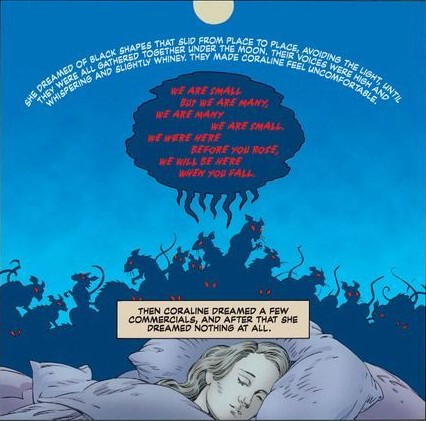
Coraline and her parents have recently moved into a big old house. One rainy day, when it’s raining too hard for Coraline to explore the grounds, she decides to explore the inside of the house. She finds a door that goes to the other side of the house, where everything is fun. She finds her “other mother” and “other father” there, who are just like her parents except they are always happy to see her – and they have black buttons for eyes. They’d love to have her stay there forever. There’s only one catch: she would have to get black button eyes, too.

A child’s dream come true – “why couldn’t my parents always be nice and always have time for me?”. But as always in fairy tales, everything has a cost.

Coraline decides she doesn’t want black button eyes and comes back to her own side of the house, where discovers that the other mother has somehow stolen her real parents. So she returns to the other side in order to find them and bring them back.

It’s funny and spooky-scary and very well written, as all of Gaiman’s books. And Coraline is a great character, an unusually sensible and brave child protagonist, despite the lack of magical powers or grand quests.

The illustrated version is nice, but as often happens, it has lost a good part of its horror compared to the original. When reading a book, my imagination provides its own versions of the scary possibilities and spooky places and situations. Inevitably someone else’s pictures of the same thing are less frightening. Words are for me more powerful than pictures – I’d rather have a thousand words than one picture.

But I am looking forward to the stop-motion film coming out next year (trailer).

See a preview of the book at HarperCollins.

Amazon UK, Amazon US.

I have read One Day before, in Estonian, I think, but couldn’t get hold of an Estonian copy this time, so I ended up reading it in English.

One Day describes one day in the life of a prisoner in a Siberian forced labour camp in the 1950s. It’s important and worth reading mostly for its historical value. It’s in the same league as Anne Frank’s diary: a matter-of-fact inside report of a horrible life that affected millions.

The gulag is cold, depressing and hardscrabble. All of life is reduced to acquiring food, staying warm, and avoiding punishment. But the human spirit endures and adapts, rejoices over warm mittens and an extra piece of bread, and even finds happiness in a job well done. And that’s the brilliance of this book: that it is not a day of tragedy, nor even a day of depressing misfortunes, but a fundamentally happy day.

It is simply and straightforwardly written – Ivan Denisovich is a simple peasant – and thus makes for easy reading, so the horror almost slips past you. But then I stop and think, and try to imagine 3653 such days. Or the rest of one’s life. For millions of people.

The translation (I read Ralph Parker’s 1962 translation) was OK but definitely clunky in places. Some parts were translated too literally, ignoring the cultural “baggage” that the readers have. Expressions which would be colloquial in Russian come across as contrived and formal in English, and some similes felt very unnatural in English.

Amazon UK, Amazon US.

A semi-autobiographical novel about a childhood with no mother and a “crazy” father. (Autobiographically inspired novels about difficult childhoods seem to occupy about a quarter of the shelf space in Swedish bookshops nowadays – half is filled with detective stories and a quarter is left over for other odds and ends.)

Connie grows up with her aunt and uncle, who take care of her out of duty and with not much love. The rest of the people in her life are not much different. She finds them boring and intolerant, and no one understands her. She has trouble at school (difficulty sitting still and concentrating, and often she falls asleep) and only one friend.

All this bleak dullness around her makes it all the more understandable that she loves her father Ted – because he is fun. Ted enjoys defying all social conventions and expectations, telling tall stories and making mischief. He steals garden gnomes from his neighbour’s garden, takes Connie to a porn movie, and sneaks them into a circus tent by crawling under its edge. Connie looks up to him, and takes after him: she hides a forbidden hamster in her room, rides without a ticket on her weekend trips to her dad, and leaves turds in front of neighbours’ doors.

Connie spends every other weekend with her father. Or rather, she is supposed to, but sometimes her father forgets. The more you read, the more you realise that Ted confuses unconventionality with selfishness: what he likes to think of as his rebellion isn’t anything high-minded like an effort to change the world or to show people what is possible, but simple disregard for others’ lives. Connie herself sees this only after many years of disappointment.

The story initially seems fun, but is sad inside: the almost infinite love and loyalty of a child is ignored by her father, and no one else in her life cares much for her, either. She is seen as trouble, and perhaps pitied. Today (or perhaps even in the 1970s, if she had caring parents?) she would probably be diagnosed with some kind of letter combination and get help at school. Or maybe not. And even with that help she would still not fit in anywhere in a conservative small town.

As semi-autobiographies go, this one wasn’t too bad, but not too good either. Connie was well written, but Ted’s character doesn’t quite work. He’s described as a womanizer, always introducing Connie to new girlfriends, but he comes across as ridiculous rather than charismatic, and it’s hard to understand how he’d attract all those women. A greater weakness is the book’s repetitive nature. Not much changes or develops over time, and it all becomes an endless list of Ted’s escapades. No matter how wild they all are, it becomes boring after a while.

You can buy it on Bokus.

As the back cover says, “you will go on a journey with a nine-year-old boy called Bruno.” Bruno lives in Nazi Germany during the war. His family moves to a house in the country, due to his father’s job, next to an odd place with lots of people wearing striped pyjamas. Bruno is puzzled by the whole thing.

Thanks to his powerful father the family is sheltered from most of the troubles that come with the war, but even so Bruno is not a credible 9-year-old. A boy of that age could not possibly miss that there is a war going on around him, or not know who the Führer is, or not have heard of Jews. (Come on, the word Führer is a normal German word meaning leader – how could a German boy NOT understand the word?) He would have to be incredibly stupid, or to live with his eyes shut and his ears covered, singing “la la la I cannot hear you”. This makes it rather hard to get engaged in Bruno’s view of life.

There’s not much else in the book to be engaged in, either. Everything except Bruno’s thoughts are very sketchily described, including his relationship and conversations with the one friend he finds. Perhaps Boyne does this to keep the book simple enough for children, but the end result is patronising and superficial.

The book is marketed as a child’s view of the Holocaust, but I wouldn’t give it to a child to teach them about the Holocaust. Firstly the book is sufficiently coy and indirect about what is actually happening, that a child reading it wouldn’t learn much unless they already knew a lot – and if they knew it already, they wouldn’t get anything new from this one. And secondly Boyne takes great liberties with various facts in order to make his plot work, so the reader would get a seriously misleading and sentimentalised picture of what it was like.

Very disappointing.

Amazon UK, Amazon US.

“Caipirinha med Döden” / “Caipirinha with Death”.

Erica is a successful copywriter, in a happy relationship with her partner Tom. One night Tom tells her that he wants to take a break from their relationship. She goes home and tries to drown her despair in alcohol. Then someone knocks on her door. She opens and meets a man who says he’s Death. (He was supposed to visit the man upstairs, he says, but went to the wrong door.) Erica is by now so drunk that she isn’t even scared.

A few days later (after Erica finds out that the man upstairs has died from a cerebral hemorrhage) Death comes back to visit Erica. They talk. He turns out to be charming and funny, and not at all scary. He sleeps in her sofa, and makes her a luxurious breakfast the morning after. Soon he’s sort of moved in with her, cooks her gourmet dinners and even does the dishes. He asks Erica to accompany him to a few jobs, and after a while asks her to take care of some souls herself. Without thinking twice, Erica uses the opportunity to “solve some problems” among her acquaintances.

It’s weird combination of thriller and chick lit. Mostly chick lit, though: after all, the book is mostly about the love life of a hip young woman, plus some sprinklings of her work life, told in an irreverent tone and with lots light humour. I don’t know if it’s a chick lit thing or not, but I found Erica annoyingly stupid and really couldn’t sympathize with her when things started to go wrong for her.

I like reading about natural forces presented as people, because there are often interesting angles to those stories. Here this plot device isn’t used too well: Death gets to deliver too many philosophical lectures. And Erica herself gets involved in a project about genetic testing, so we get those debates as well. Because of the setting the discussion cannot be anything but superficial and banal. And when Death is joined by the Devil, and later it turns out that Jesus is still alive as well, it all becomes too much.

The story also spirals somewhat out of hand, but the final twist is a good one.

The book isn’t badly written, but it’s like all the other Swedish books I’ve read in the past 6 months: the language is that of a journalist. There are facts and descriptions, but there is no beauty in it. The author has no voice of her own. Disappointing, really.

Bokus. No Amazon links because the book hasn’t been translated into English.