This summer has been relatively culture-poor for us. No particularly interesting theatre or musical events in London have caught our attention, and we’ve both been working too much to see any spontaneous, unplanned culture.

Looking forward, now that summer is over, all sorts of interesting events are cropping up. But now we’re not really sure whether it will be possible for us to get out at all, so we’re not booking anything.

Between these two lulls, we managed to get in one excellent evening of dance to music by Steve Reich.

Part 1

The first of the three parts was set to Piano Phase and Violin Phase. In both of these a short phrase of music is played over and over again by two musicians (pianists or violinists). They start out in phase. Then one of them speeds up marginally so they get out of phase, and slows down again when he is exactly one beat ahead of the other. They repeat that until they’ve gone full circle and are in phase again. Wikipedia’s article on Piano Phase explains it in more detail.

The full description actually sounds boring and technical to me – an experiment, a gimmick, “see how clever I can be” – but the music was anything but. It was absolutely mesmerising. The melody itself was beautiful in its utter simplicity, and even though this was taped music, it sounded very good through the Barbican’s sound system. I imagine it must be rather challenging to play, so live performances of this are probably rare. The phasing in/out kept a constant subtle tension, so despite the simplicity the music never got boring. (While listening I didn’t actually realise fully what they were doing – I just heard the repeating music and shifting in/out of phase.)

Violin Phase was similar in setup, but because the rhythm wasn’t as distinct, I felt it lost some of that magic.

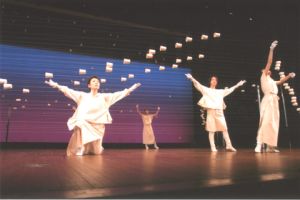
The dance element matched the music. Two dancers performed a simple, short sequence of movements over and over again, shifting in and out of phase with each other. The two dancers look almost identical, and are far back on the stage so details aren’t visible. Instead the focus is on the shape of the movements – pendulum-like with long arm swings and rhythmical 180-degree turns – and the phase, the similarity. Two strong lights cast two shadows of each of them, and the ones in the middle overlap, so the dancers melt into one. Like the music, this was almost hypnotic.

Part 2

Part 2 also consisted of two pieces of music – Perotin’s Viderunt Omnes, a medieval polyphonic piece for four singers, followed by Reich’s Proverb for five singers plus vibraphones and electric organs. Both are, again, very minimalistic, and beautiful in their simplicity. They are far less technical than the Phases, and really got their strength from bringing out the best from human voices: clear, graceful, melodious. (Performed live by Theatre of Voices.) Reminded me of Tehillim, which I saw/heard a year ago or so, and which I also loved a lot.

The dance part by Richard Alston Dance Company, on the other hand, was completely uninteresting to me. It didn’t suit the music in style or temperament, and wasn’t particularly interesting on its own, either. I found it a distraction, and simply closed my eyes to shut them out. Therefore I don’t really have much more to say about that.

Part 3

The last part was Variations for Vibes, Pianos & Strings. Nice enough, but not as interesting or engrossing as the previous two parts – relatively tame and neutral compared to his best pieces.

Yet this part was most popular with the rest of the audience. I guess that was mostly due to the dance, performed by three very vigourous male dancers (Akram Khan Dance Company). It had some interesting aspects. For example, even when the three were doing the same thing, they retained quite individual styles, reflecting their different backgrounds (one African, one Middle Eastern, one Asian). But I found the choreography itself a bit simplistic. Much of it was very close to the music, almost acting it out: long sweeps of violins were accompanied by long arm sweeps, etc. At times the dancers were mock-conducting the orchestra in the way a child would: not providing direction but following the music exactly. It was the kind of choreography that might emerge if a very talented someone, with no education or experience in choreography, tried to just dance to the music. I guess this immediacy and closeness to the music may have been what the audience liked about it.


The more I hear of Steve Reich’s music, the more I like it. And every time I run into Theatre of Voices, I like what they do. Both deserve more of my attention, I think.
This was a concert that Eric bought tickets to, and I would join him mostly because… well, why not?… just because he was going. In the end, Eric got sent off to Manchester for the week, and I went on my own.

They turned out to be talented musicians, but the music (much of it from their latest CD “Day is Done”) was not really to my taste. It was the sort of refined and elegant jazz that makes experts nod knowingly at each other and comment on how skilled the bassist is. And that may be entirely true, but isn’t enough to carry a whole concert, unless you’re one of those experts, which I am not. The kind of jazz where every song sounds much like every other song, at least to an untrained ear. They could have played any one of them again, and I wouldn’t have been able to say whether I had already heard it or not. (Even reviewers at The Guardian who gave it 4 stars described it as “absentmindedly drifting”.) I like music to have some sense direction, not just aimlessly wandering improvisation.

A few of the songs had more character, more groove and melody. Their rendition of “The very thought of you” was quite nice. But most of it was pleasant but rather boring, in my opinion.

Japanese drums. A very special art form, and very intensive experience.

O-daiko

Kodo seems to be the Japanese Taiko group that most often visits Europe. We’ve seen/heard them once before, but that was several years ago. This time their programme was more modern: the leaflet named individual composers for all songs of the first half. The last of them (“Monochrome”, on 7 small drums) had a particularly modern feel, with enormous variation in volume. It gave the impression of a large swarm of potentially aggressive insects – a storm of locusts, or a nest of hornets. First quiet humming, then sharp and furious.

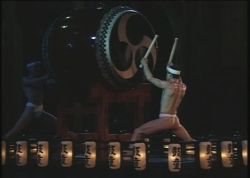
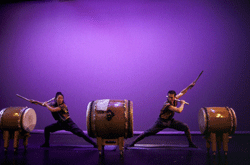
The second half shifted towards a more traditional style, with more primal rhythms – purer and more focused in my opinion. And it’s got more of the really large drums – the ones that make the entire hall vibrate, the ones you can feel not just in your belly but in your bones. Miyake style taiko (with two drummers playing on one large drum, placed horizontally between them) in particular is very vital and intensive. Then of course there’s o-daiko which is the largest one. It’s odd that something so large and loud can at the same time be so tranquil and meditative. To listen to, that is – playing it appears very physical.

Miyake

Taiko is also a very visual show. (I found reasonably good pictures of a Kodo show here.) Taiko concerts are not ones to listen to with closed eyes – possibly with the exception of o-daiko. It’s fascinating to see the drummers move: focused and purposeful, economic, full of power but also very graceful. It looks like as much thought lies behind the shape of each movement as the sound it is to produce. (More likely, they’ve realised that cleaner, stronger movements lead to cleaner, stronger sound.) This is another reason I like more traditional taiko music better – the larger kinds of drums make the physical aspect more visible. I also get the impression that movement patterns are more important in traditional pieces.

The experience was somewhat marred by the audience. I think I must be growing old – I’m starting to think that people have no manners nowadays. Arriving half an hour late and then standing up to take off their coats, and walking out partway through the concert when their wine glass runs dry… And far too many enjoy their own applause more than the music itself, and applaud as soon as there’s a quieter moment. If they just glanded at the players they would see that it’s nowhere near done! I guess concerts have become a social event rather than a cultural one – the music is just entertainment, and not the main event.

I learned today that the drum sticks, Bachi, are not only of different sizes for different drums, but also of different materials. Softer woods give a clearer sound on small drums, where harder woods would sound “dead”, while hard woods bring out the sound better in larger drums.

(Yesterday.)
Dave Brubeck’s jazz quartet (4 white-haired old men) and the London Symphony Orchestra. Pleasant enough to listen to, and all well played, but ultimately just not very interesting. I was on the verge of falling asleep during the second half of the concert.

I don’t understand the point of adding a symphony orchestra to a jazz band… It took away most of the raw energy of jazz and smoothed it out to mellow “easy listening” music. And it feels like a bit of an insult to the orchestra. If you’ve got 25 violins, it’s a waste to have them all play the exact same (and rather simple) score – which is also the same as the score for the trombones and the cellos.

The only piece where the orchestra sounded really good was one that had originally been written for symphony orchestra & jazz band.
And the only piece that felt really alive was the encore, totally free from symphony. At least it ended well!

There’s good music, there’s great music, and then there’s music that transcends all attempts to describe it.
This was one of the latter kind.

I think that’s all I’m going to say about that.

Not only did the music sound fabulous; we also got to see Yo-Yo Ma play it. We had good seats (row 2) so we could see his face and hands really well. Some of the music was technically very demanding and it was a pleasure to see him work.

According to the programme leaflet, he plays “a 1733 Montagnana cello from Venice and the 1712 Davidoff Stradivarius”. Whichever one it was, it was a beautiful instrument to look at, with a red glow, and had a wonderful sound: melodious, soft, deep. I could have just listened to the sound of the cello, ignoring the music, and enjoyed that.

One man, one cello, up close – very intimate performance, despite the size of the hall.

He also turned out to be a very friendly, humble and good-humoured man. He appeared to be as grateful to the audience as we were to him. We managed to applaud three extra pieces out of him (which led to very pleased and humble gestures from him) and those were even better than Bach’s cello suites. One sounded decidedly Oriental (therefore probably from his Silk Road project). Another may have been a modern arrangement of some folk tune – it sounded modern but I thought it had some elements of old dance music in it. I have no idea what the third one was, but it was the best moment of the whole concert. I’ll need to keep an eye out for reviews of this concert, they might mention what it was.

Stringraphy is a room-size harp, made of silk threads stretched across the room. The installation we saw and heard had 4 sets of about 15–20 strings each, reaching from one end of the stage to the other. Two cups interrupted each string and amplified the sounds, like a string telephone. Different locations for the cups gave each string a different pitch.

5 women walked and danced between the strings and made music by rubbing and plucking the strings. They managed to produce an amazing variety of sounds – like traditional string instruments (violin / viola / cello), both “bowed” and plucked; something like an accordeon; sounds of wind and birds; croaks and squeaks; eerie whines. The cups were far apart from each other so that sound was coming from many places, filling the room – even though we sat in the front row and had a very good view of the musicians, the sound often felt disembodied.

The programme had something for all tastes, ranging from Twinkle twinkle little star and Greensleeves to Japanese children’s songs and original works by Kazue Mizushima, who’s the leader of the ensemble. While the popular tunes were pleasant enough, and well performed, the original pieces were far more interesting. When the instrument was used to play Greensleeves, it was just a very odd-looking violin (or rather like 5 very odd-looking violins with only two strings each, because each player could only rub two strings at a time). In the pieces written specifically for Stringraphy, its strengths and peculiarities were used much better – they had many more interesting sounds and combinations: varying the pitch by pulling the string away from its flat/straight position; playing long chords by rubbing two strings at the same time, etc.

I would gladly have skipped the crowd-pleasers, but I guess a purely experimental concert wouldn’t get much of an audience. Kazue says on the group’s web site:

When they asked me to play a familiar tune, I refused at first, feeling that there was no point in playing conventional music on a newly created instrument. But every single person who interviewed me made the same request, until eventually I thought I should at least try it. […] I was keen for a broad range of people to hear my music, and when I asked for feedback after performances, most people said that the part they most enjoyed is when I played their favourite songs.

Due to the size of Stringraphy, the concert was a very physical performance. The strings were around 10 metres long, with the lowest one below knee height and the highest well above their heads, so the musicians had to move and stretch to reach the strings. The concept of high and low tones was also made very visible, as their hands and arms moved up and down between every note.

Unfortunately the audience wasn’t allowed to touch the instrument, as they had two more concerts to come. I was really itching to try it myself.

The group’s web site is small and simple. Kazue’s notes from a workshop held in London in 1999 was the most informative page I found, but there are also “trip reports” from previous concerts.

Today we saw and heard the 3rd and final of this weekend’s concerts of Islamic music (the previous two were Sheikh Habboush and Khaled). All three were part of a “Ramadan Nights” programme organised by the Barbican to celebrate Eid al-Fitr, the end of Ramadan. East London’s Muslim population is sizeable, and these 3 nights offered something for everybody: “classical” Arabic music and modern groovy North African rai for the Arabian Muslims, and today Sufi music for the Pakistani Muslims (and there are a lot of them around where we live).

This night’s concert was a triple act. The first, Sain Zahoor, was a bizarre fellow… described as a “dervish minstrel”, he resembled a fairy-tale evil wizard: golden clothes, golden shoes with curled-up toes, bright red turban, and so many strings of garish tassels hanging off his string instrument that they swung like a blanket when he was dancing. The music was OK to good; the sound again far too high (although not as extreme as yesterday’s).

He was followed by two brothers, Goonga and Mithu Sain, playing large drums, one each. These two looked like Punjabi rock stars: tall and skinny like scarecrows, long hair, bright red shalwar kameez with fair amounts of glitter, and big bling-bling gold necklaces. Plus when they really got going, one of them actually started headbanging. The only thing missing from true rock star style would have been smashing his instrument when he was done.
The drumming itself was quite varied, ranging from intricate to fast and furious. They could get surprisingly different tones out of a single drum each, using two different-shaped drumsticks + their hands, and each end and edge of the drum had a distinct sound. Very focused – they didn’t say a word to the audience nor look our way – and therefore very engaging. (And completely unamplified! Yea!)

The last and main act was Rahat Fateh Ali Khan’s qawwali music. The sound technician was again making every effort to make the music hard to enjoy – gradually turning up the volume as the evening progressed, cranking up the higher tones to piercing sharpness until they were starting to sound distorted even to my untrained ears; loud drums which everything else had to compete with, and the backing chorus turned up to a point where they became an indistinct din. Would have been intolerable without earplugs.

Despite this, the music was so good that all of that could be overlooked. The programme included several excellent songs that I recognised from Nusrat Fateh Ali Khan’s CDs. Qawwali is always great, and live qawwali even more so. Melodious, with dramatic singing, swaying and throbbing rhythms, it builds from a slow start to an ecstatic finish. Even though I don’t understand a word of it – or perhaps because I don’t understand a word of it – it swallows me completely, given enough time, and I ignore everything else around me. A great finale for the weekend.


PS:
From reading my recent posts in the Music category, one could get the impression that Asian music is all we listen to. Actually I listen to gipsy music, klezmer and tango too. No, seriously, while we do listen to a lot of so-called “world music”, we go to other sorts of concerts as well. It’s just that there has been a concentration of Asian music recently. We did hear Thea Gilmore last week, but her concert was disappointing (due to the venue and sound quality) but in such an uninteresting way that it wasn’t even worth writing about.

We’ve got several CDs of Khaled. I like them for his voice, and the swing and rhythm of the music. Much of it is very “dancable”, but at the same time the rhythms are more than the simple ONE-two-THREE-four of western pop.

So I thought I’d really enjoy him in concert this evening. I enjoyed it so little that it made me wonder about things.

#1: The setup.
On the CDs he’s often accompanied by only two or three instruments – acoustic guitar + accordeon for example, or drums + violin + piano. His voice gets a lot of space, and has a lot of depth.
Today, he was backed by lute, base guitar, 2 electric guitars, one whole rock-style drum set, one hand drum, two keyboards, and a 3-man brass section. His voice had two layers of effects (vibratos and echo) and during some songs, one of the keyboard players was doing more singing than Khaled himself. The net effect was that his singing got blended into a general mass of sound and didn’t stand out, and it all sounded more like a standard rock concert than rai.

Does his voice no longer work on its own – has he lost it? Or is this an attempt to capture larger Western audiences by adapting the style to what the average European is used to?

#2: The lighting.
A floodlight of pure white, aimed at the faces of the audience, and about 4 times larger and stronger than anything aimed at the stage. Not just a little spotlight, this was so bright that it made my eyes water even when I closed them; I had to block it with my hand. What does a lighting designer think when doing something like this? “Let’s weed out the weak ones?”

#3: The volume.
Start out somewhat loud-ish. Turn it up. (We don earplugs.) Turn it up some more. And then a little bit more. Until it got to the point where it we found it physically painful, couldn’t stand it any more, and walked out.

This was even more of a surprise because the Barbican can usually be relied on to provide good (or at least reasonable) sound quality – unlike the South Bank Centre (Royal Festival Hall / Queen Elizabeth Hall) that we’ve stopped going to for concerts, because their sound been bad far more often than good.

This is not the first time we leave a concert because it actually hurts, so we’ve asked ourselves the same questions before.
How can everybody stay there and seem to enjoy it? Are they all half deaf, since they’ve been hearing music at this volume for years? Do they hear but don’t mind?

And more importantly, why is it done this way? Do people like it? Are the sound engineers deaf themselves? Or does everybody in the audience have tiny tinny speakers at home, so that they don’t know what music sounds like when it’s good – when the sound is well balanced and the volume is appropriately loud?

So I Googled for a bit (“concert too loud”). The most informative page I found was Edward Tufte commenting on the same issue on his web site (which has a whole lot of other interesting stuff too). Here are some of the responses:

The stage foldback (or monitor) system is independent of the main sound system and creates an intentionally different mix (often a separate one for each member of the band). The level is often extremely high to get control of the mix (eg if you have a double Marshall stack right next to you, the vocals in the foldback have to be loud enough to get above the guitar level). This does mean the house system (the audience’s) has to be loud enough to get above any ‘spill’ from the foldback system.

I had an interaction with a sound engineer setting up a performance. I expressed my concern over the high sound levels. He reassured me that his group had found that if the levels started low and then gradually increased, the congregation is not aware of the high levels of exposure.

In my rock club experiences, the sound engineer is typically the deafest person in the room. The engineers have subjected themselves to more loud music over the years than even the band members since many of them are “house” engineers or, if touring with bands, are out in front of the band night after night, soaking up the decibels. The ubiquity of “treble creep” is overcompensation caused by hearing that is literally notched out by damage in the higher tonal ranges. This explains the excruciating sharpness so common in live rock audio mixes these days.

I think another factor here is key, the specious practice of amplifying the drum kit. I think this got started when rock bands began playing arenas, but it then became fashionable to do this in even the most intimate of clubs. For anything but the most expansive club, the typical rock drummer is already playing at ear-splitting levels without any amplification whatsoever. Amping it just makes it worse, and a byproduct is that all the other instruments have to turn up to compete.

And a related comment regarding sound quality (from a standup comedian):

It is harder to be funny in a room with a very high ceiling – because the all-important start-up laughter from a small part of the audience has little contagion effect with the rest of the audience. The start-up laughter at a remark takes several seconds to go up to the high ceiling and come back down, too faint and too late to reach the yet-to-be amused members of the audience. The Comedy Connection has a low ceiling for good reason.

All quite interesting. I think the only conclusion from this is that in the future I will think twice before buying tickets for a concert by one of the big-name artists. The less mass-market ones are likely to care more about sound quality.

Today, we went home and enjoyed Khaled on CD instead.

We went to a concert earlier this evening – Syrian Sufi music with whirling dervishes. One lead singer, a flute, a zither, a percussionist, two whirlers, and 3 background vocalists. The lead singer was good and had a pleasant voice, and the zither player was very skilled. Some parts of the show were a bit coarse and rough – there was a tendency for the sounds to become indistinct, as the group gravitated towards the “more! louder! faster!” school of music, where a more subtle and nuanced style would have suited better. (They played some taped sufi music after the show, as people were leaving the venue, and the difference in quality was clear: the taped music had a heartbeat-like natural pulse, where this evening’s performers had a harsher feel.) Even so, the concert as a whole was pleasing.

I enjoy many sorts of religious music – gospel, hymns, Russian and Greek orthodox and Gregorian chants, qawwali etc. Music has a different quality when it has a soul, and musicians sound slightly different when they sing/play for their belief and not for money – their commitment and devotion shine through. And I like the calm and weighty feel of chanting.

(The concert venue was, quite fittingly, a converted church: LSO St. Luke’s, in Old Street. It’s a nice space, simple and open. The nave has been opened up completely, and a balcony built along the north and south sides; the stage is towards the East. The walls are bare, and all the large windows with many small panes have been left in place, although they’ve been covered up for some concerts. It should look great from the outside at night.)

I wonder what an Arabic-speaking Muslim would experience in a concert like this. I do not understand any of the content (calling it “lyrics” doesn’t seem entirely appropriate) and I only know purely factually that these are devotional chants. I cannot be part of it the same way as the dervishes are.

And I also wonder what music sounds and feels like in Eric’s head. I know it must be an experience that’s very different from mine. For me, the percussion-backed song / chanting was the best part of the performance – immersive, meditative, passionate. Eric on the other hand enjoyed the zither most, and I could see others in the audience agreeing with him. I found the zither too alien: even though I’ve heard fair amounts of non-Western music, it was too different from what I’m used to hearing, and its music kept slipping out of my grasp. There was nothing that I could recognise as melody or rhythm, and while it made a pleasant sound, I was unable to really appreciate it. Sort of like a babbling brook – pleasant but ultimately not interesting.

Interestingly, about a dozen people left early, at various points during the concert. Did they buy tickets without knowing what Middle Eastern Sufi music sounds like, and find it too strange?

Following from yesterday’s post: I’ve now found the Tom Waits “song” that I was looking for. It was “Russian Dance” from The Black Rider.

I wonder what the theatre show looks like. I’m imagining something dark and bizarre and twisted.

It took me years, literally, to get used to Tom Waits. It’s an acquired taste, sort of like whiskey or spicy food. Give any of those to a child and they’ll spit it out.

In the beginning I really disliked his music, but Eric liked it, so I kept hearing it again and again. With time, I got used to it, and after a while grew to really enjoy it. It grows on you. By now, some of his songs are among my absolute favourites – and I like them even more because in my head they are inextricably linked to Eric. To me, Tom Waits is Eric’s music (not that Eric’s dark and bizarre and twisted!) and listening to them always makes me think of him.