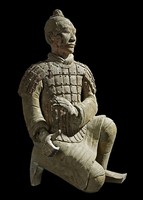
This Saturday we went to see the First Emperor exhibition at the British Museum. Advance tickets are all sold out but they release 500 same-day tickets every morning. I was there when the ticket desk opened and had no trouble getting tickets – if you haven’t seen it yet you still have a chance. (By the way they now keep the exhibition open until midnight Thursday to Saturday – the demand for tickets must be enormous.)
The exhibition space was rather crowded. One has the choice of queueing and moving at a snail’s pace, or standing outside the queues and therefore viewing some of the exhibits over other people’s shoulders. We chose the latter.
This First Emperor of China is the man who united various warring states into a Chinese empire, and who built a 7000-man terracotta army to stand guard over his tomb. I’m not going to write even a short overview of all the other things he did and achieved; you can find all of that elsewhere on the Internet (starting with Wikipedia for example). Instead I’ll just focus on what I saw and what I thought about it.
The focus and main draw of the exhibition was a small fraction of the terracotta army. There were archers, warriors, horses and chariots and charioteers, and more unexpectedly, acrobats, musicians and civil officials. Before seeing the exhibition I thought the army existed to guard the tomb, but I understand that it was really to provide the emperor with all he might need in his afterlife. And of course, for a good life one needs much more than just warriors.
The statues were surprisingly realistic and also surprisingly individual. I imagined that they would be stylized and mass produced – because there were so many of them! The main body parts were indeed mass produced but from multiple moulds, and faces, hair, mustaches etc were added by hand, making each one different. The emperor must have been something of a perfectionist given how detailed the statues were, all the way down to individual rivets on plates of armour, and hobnails on the soles of their shoes.
As with antique statues from other cultures (ancient Greece for example) the statues were originally coloured but have now lost all colour. So photos of 7000 clay-coloured statues give a somewhat misleading impression of what the ranks of the army would have looked like originally. Based on traces of paint found on the statues, one was reproduced in an approximation of its original state – and just as with ancient Greek statues, the result looked garish and loud compared to the stylish dignity of terracotta (or white marble).
While the statues were fine and interesting, I was a bit disappointed to see so few of them. They were far too few to really convey the sensation of grandeur and immensity that 7000 of them would do. So in a way, the Terracotta Army can be more impressive on picture. But on the other hand, seeing the statues up close, you can see and appreciate the details. The statues were very nicely exhibited in such a way that we could see them from all angles, and reasonably close up as well. It made a big difference to have no glass between us and the statues.
The rest of the exhibition was really there to provide a background to the army. There was a brief intro to the emperor’s life and works, explanations of how the army and the emperor’s tomb were built (by conscripted workers and convicts), and how they fit into the general fabric of his society. For example, the legs and bodies of the terracotta warriors were built much like the water pipes in the emperor’s new palaces. And the manufacturing process was highly standardised, just as the emperor standardised many other things (including coinage, weights, writing and the manufacture of weapons). One of the more interesting exhibits was a miniature panorama sculpture showing a team of workers making one statue of a warrior and one of a horse.
Emperor Qin must have been an extraordinary man. It is one thing to conquer your neighbours (other warrior kings have done that, too). But this emperor obviously had a grander plan. He was not just a great general but must also have been a great administrator, in order to successfully rule an empire. And he certainly achieved immortality, just as he wanted.
The BBC has some photos (not good but the best I could find).

It’s good to hear that tickets can be bought on the day. I thought I’d have to go and queue up from 6 a.m. We’ll definitely head over this Saturday to have a look.