Diving is like visiting another world. You’re floating around almost weightlessly, drifting slowly, hovering. You can hold yourself in place with a single finger (if there’s no current) and move up and down just by breathing in and out.
The best part, and the main joy of diving, is the fish. On dry ground you can’t get very close to anything more exciting than a beetle – as soon as you approach, all wildlife flees. Fish don’t. Perhaps they’ve learned that divers are harmless, or maybe they just don’t care. You can float through a school of goatfish, and they just let you pass. Or you can be nose to nose with a damselfish and they take no more notice of you than of a lump of stone. (Unless you get too close to their anemone, at which point they turn towards you and try to scare you away by determined posturing – which is quite funny when the fish is smaller than your hand.)
This part of the Red Sea, around Marsa Alam, had somewhat less fish than the reefs we saw near Hurghada and Sharm-el-Sheikh. Less in terms of density, that is, not in terms of variety. We bought a thorough guide to Red Sea fish last time and this time I tried to write down all the different species we spotted and were able to identify. All in all my list for this trip had over 80 species.
 |
| Clownfish |
The range of species was slightly different, and different species dominated. Lionfish were more common than in Northern Red Sea: seeing a lionfish was a big thing on previous trips, whereas here we might see half a dozen on a single dive. The same with masked puffers and picassofish. Butterflyfish, bannerfish, groupers and damselfish were everywhere, as usual, and various surgeonfish and wrasse were common.
One difference compared to previous trips was that we saw more juvenile fish, probably due to the season. Adult clownfish / anemonefish (like Nemo) are the size of my palm, roughly, so baby anemonefish are really tiny! The smallest ones were barely larger than the tip of my thumb. They were also pale and semitransparent.
Some fish (especially some wrasses) change their markings completely when they grow up, so a juvenile doesn’t look anything like an adult version. The most extreme example I saw was the clown sand wrasse. Adults are large, greenish/black with a lighter vertical band, with a slightly ragged tail and a humped head. Juveniles on the other hand are white with black spots on the front half, and two large orange/black eyelike spots on the back. I wouldn’t even have recognised them as the same fish, if it hadn’t been for our book, and the help of one of the experienced divers in our group.
 |
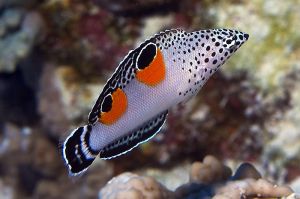 |
| Clown sand wrasse – adult | Clown sand wrasse – juvenile |
Among the more interesting creatures we met were turtles. On one of the early dives on our first trip three years ago we saw one turtle pass in the distance. This time I saw two of them, up close. They turned out to be mostly like cows – placid and mostly interested in eating. One of them was, in fact, feeding on seagrass on a flat bit of sea bottom. Impressively large creatures, though, and it would be interesting to follow them for a longer while.
Stingrays were a dime a dozen in Marsa Alam – we saw them almost every day, mostly lying in the sand, not doing much. They are beautiful creatures, though. The manta ray we saw was a more impressive sight as it slowly “flew” past us: huge (at least 2 metres across), a very distinctive shape, and very majestic movements.
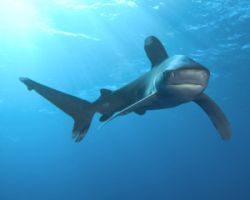 |
| Oceanic white tip shark |
Yet the absolute highlight, for me, was swimming with sharks. We went out to Elphinstone reef, which is further from the shore and in deeper waters. After 30-40 minutes diving along the reef we swum out “into the blue”, away from the reef, to see some larger fish. We didn’t have to wait long at all until the sharks turned up. To me they just looked like ordinary shark-shaped sharks, so to say, but I was later told that they were oceanic white-tip sharks. They looked every inch like predators and behaved accordingly, moving much faster and more alertly than the large fish we’d seen nearer the reefs. At first I found their closeness a bit unnerving, but as they just continued to circle around us, most of the time keeping a few metres’ distance between us and them, I got used to them and even felt a temptation to get closer (which I resisted). We had been told that the sharks don’t like to come too close to large groups, so we kept the group fairly tight. We also went up one by one, because a whole bunch of fluttering fins might otherwise attract the sharks’ curiosity and get us some bite marks on our fins.
The pictures in this post are not mine.

Leave a comment