The great nappy experiment is now well past its experimental stage and I’m using cloth nappies all the time now.
We have about 20 Tots Bots Bamboozles, 5 MotherEase AirFlow wraps, a few cotton terry boosters, and a roll of paper liners. I chose this setup based on expert advice from The Nappy Lady. It’s a lazy parent’s nappy solution, selected entirely for convenience and ease of use rather than price or environmentality.
The nappy is the part that absorbs water. The wrap goes on top of the nappy and provides a waterproof barrier between the nappy and the rest of the world. The liner (optional) goes inside the nappy and its task is to catch most of the poo, so the nappy itself stays cleaner. Finally, the boosters are like an extra nappy layer, making the whole package more absorbent, and we use it to get through the night without a middle-of-the-night nappy change.
This all works really well, I think. We no longer produce mountains of rubbish, and I find the nappies easy to use. Bamboozles are shaped and fasten with poppers, so there is no folding or pinning – they are as simple to put on as disposable nappies. And while they cost quite a lot of money, I will be able to use them on the next baby as well, or sell them – there’s a good second-hand market for cloth nappies.
Most of the things I was concerned about turned out to be no problem at all:
- No leaks! I was constantly struggling with poo leaks from disposable nappies, especially early in the morning. Fresh, dry nappies only leaked every now and again. But when the nappy was already holding a lot of water, poo just slid right along the inner surface and leaked out through the nearest opening – within minutes, if left alone. It got to the point where I rushed to pick Ingrid up as soon as I heard a poo, to save her clothes and the area around her. Terribly annoying. But with cloth nappies I only had one tiny leak, and it really was tiny.
- They really are easy to use. A nappy change now takes a bit longer than with disposables, because there are more parts, but not so much longer that it would get annoying.
- Poo-covered nappies. But liners are a great idea, and they work well.
- Storage. Dirty or wet nappies go in a lidded bucket lined with a mesh bag. When I have a day’s worth of nappies left, I lift the whole bag in the washer. The bin smells slightly when I open it, of course. But as long as it’s closed, there’s hardly any smell at all.
I am still a bit concerned about two things:
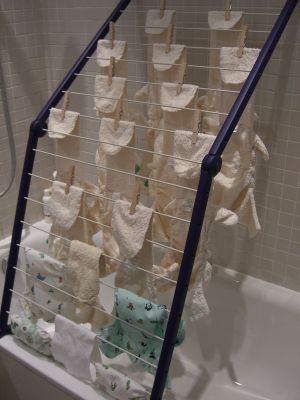
- Drying time. Bamboozles are very absorbent, more so than cotton terry, but the flip side is that it takes a long time for all that water to evaporate. When I hang them indoors, it takes around 36 hours for them to dry completely. Outside on the balcony, around 24 hours is enough. It’s all right as long as I wash them every other day and hang them out straight away – but if it’s raining or I don’t wash on time, we will run out of nappies. This may well become more of a problem when I’m back at work. I’ve ordered a few more, and we’re keeping a stash of disposables in reserve as well, just in case.
- Wetness. Cloth nappies cannot feel as dry as disposables, because the materials are different. I’ve noticed some redness of the skin, which didn’t use to happen. I’ve started changing a bit more often now, and if that doesn’t help I might switch to fleece liners instead of paper.
Things I hadn’t considered before:
- Cloth nappies are quite a bit bulkier than disposables. They add about one clothes size, but not proportionately. A body that fits well lengthwise and around the bum will generally hang a bit too loose around the upper body, and sleeves have to be rolled up twice or they will dangle past her fingertips. However I found Cut4Cloth which sells baby clothes adapted for cloth nappies.
And finally, I actually enjoy using the Bamboozles. I like the way they feel, and I think cloth nappies are even kind of cool. I’m glad I switched.

Leave a comment