A movie by Miyazaki Hayao / Studio Ghibli, based on a book by Diana Wynne Jones.
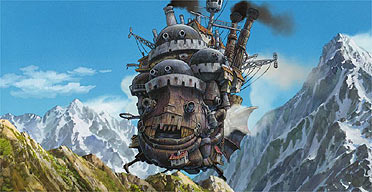
This is a fantasy story or fairy tale for teenagers. (Interestingly a lot of good fantasy writing is labelled “young adult” these days.) It’s got everything from wizardry and dastardly deeds to romance and perilous battles. An evil witch puts a curse on young Sophie, making her appear an old woman. She makes her way to the flying castle of Wizard Howl (who’s rumoured to devour the hearts of young girls) hoping to find a way to remove the curse. There is a complication, though: part of the curse is that Sophie cannot talk about it. And so she becomes a part of the wizard’s household, together with his apprentice and his tame fire demon.
While the story contains a number of fairy tale clichés, Wynne Jones makes obvious fun of them, without trying to be clever about it. Thus, for example, Sophie reflects early on in the book that she is unlikely to achieve much in life, because she is the eldest of three daughters, and only the youngest has any chance in a fairy tale. And despite the consciously clichéd components, the story itself is far from predictable, and kept surprising me to the very end. In fact it is quite a weird story, where people keep doing weird things. Wizard Howl in particular seems rather irrational at times. But then he is a wizard, after all.
The writing is focused, humourous and action-oriented, with hardly a word spent on peripheral details. Places, things and people are described only to the minimum extent necessary, conveying only their essence – often from Sophie’s subjective point of view. Here is how Sophie first sees Howl’s castle, for example:
Wizard Howl’s castle was rumbling and bumping towards her across the moorland. Black smoke was blowing up in clouds from behind its black battlements. It looked tall and thin and heavy and ugly and very sinister indeed.
There’s nothing about the colour or material of the castle, or whether it is square or round, has towers or not: only how Sophie experiences it.
Seeing the world and following the story through Sophie’s eyes adds some spice to the book, since her experience is sometimes very obviously coloured by her expectations and moods – and her often immature and impulsive teenage thinking.
In general I found this a funny, lively and enjoyable book, and would definitely read more of Wynne Jones.
The movie, while visually impressive, was less satisfying than the book. (Luckily I saw the movie first.) Since the book spends little attention on visual detail, this leaves Miyazaki a lot of freedom to invent the looks of the people and the world. And as with all his movies, it really looks like a fairy tale world: beautiful and colourful.
But the movie has a big problem: its failure to tell the story. The plot comes across as barely coherent, and I was completely confused by some turns. To be honest, this is not that uncommon with Miyazaki’s movies: Spirited Away, for example, is similarly beautiful but does not exactly make much sense.
The movie is really only a loose adaptation of the book – Miyazaki has taken some liberties with the story, and that’s putting it mildly. Some side plots have been excluded because they would make the movie too long. Fine. But then for some reason he finds time for other things that do not exist in the original story, and in no way make his version of the story clearer. He makes up a war between Ingary (the kingdom where the story takes place) and a neighbouring country, which lets Howl spend a lot of time fighting for the kingdom. I couldn’t see how this contributed anything but a sinister mood to the story (and some spectacular fighting scenes of course). And for some equally unclear reason, he introduces some sort of weird flying machines (he seems very fond of flying machines; I think all his movies have got some), changes the gender and role of one character, etc.
Since the movie is necessarily shorter than the book, all the characters get less attention, and come across as more superficial in the movie. This is especially true of Sophie, whose thoughts and wonderings get a fair amount of space in the book. And if Howl is somewhat irrational in the book, then in the movie he makes no sense at all as a person.
While the movie isn’t bad, it doesn’t measure up to the book at all. But on the other hand, without the movie I wouldn’t have read the book, either!
(PS: The movie should definitely be seen with the original Japanese voices and English subtitles.)
PPS: I have started adding links to Amazon for the books I write about. Not because I want to encourage you to buy the book, or if you do, to encourage the use of Amazon. I’ve simply noticed that whenever I read an interesting book review elsewhere, the first thing I want to do is check it out on Amazon, and it annoys me when there is no link so I have to copy & paste.

Leave a comment