I want to thank everybody who sent us Christmas cards this year, even though I forgot.
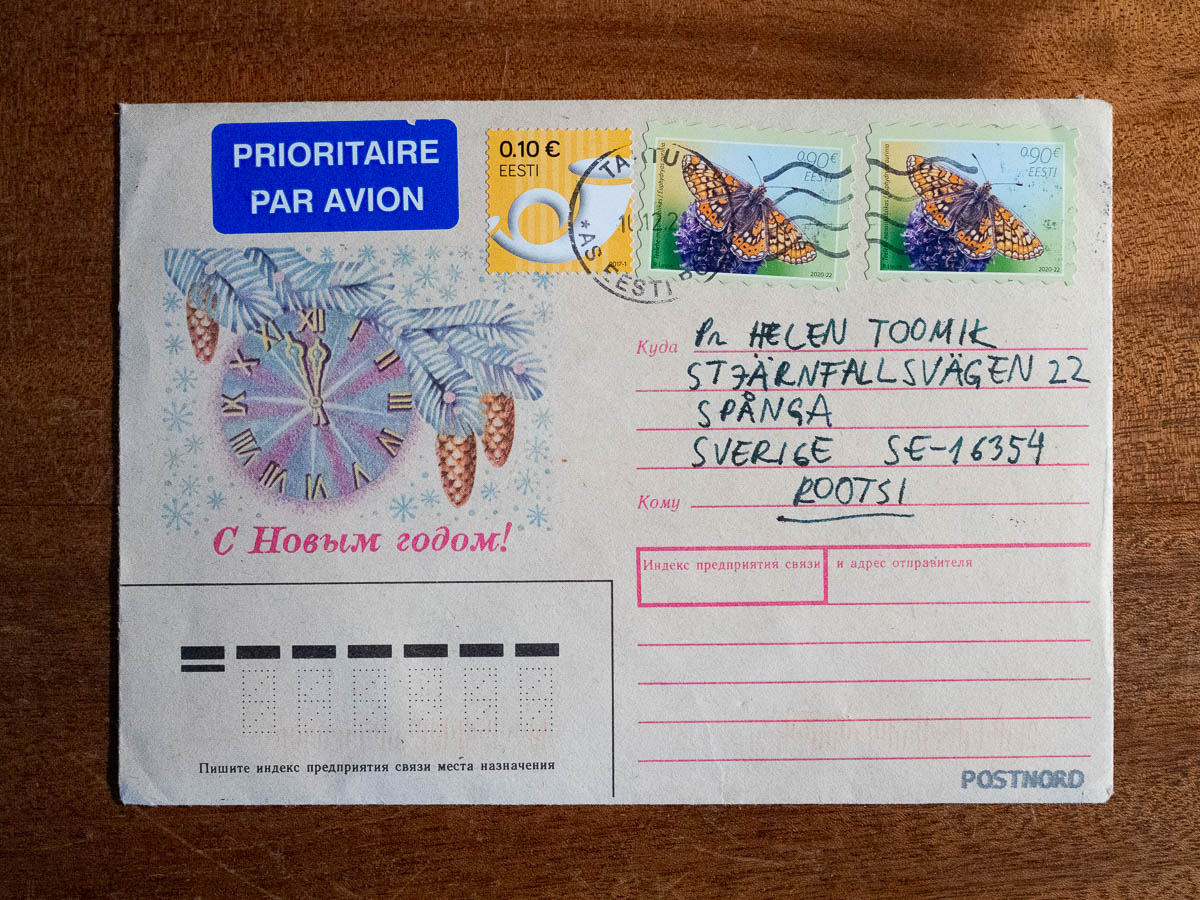
One card stood out because of the envelope it arrived in – a Soviet-era envelope from 1987, with a New Year’s Eve celebratory design. Complete with boxes for filling in the postal code in a standard way, down at the bottom left. (The flap of the envelope has examples of all ten digits, so that the boxes get filled in correctly.) The boxes for postal code have existed for as long as I can remember, and clearly at least since 1987, so I guess they had OCR for sorting mail already back then?
There was officially no Christmas in Soviet Estonia, since Christmas and everything else with Christian roots was a despicable remnant of bourgeois mores and thus Not Done. We nevertheless celebrated Christmas in our home, on the quiet, and so did many other households.
Official midwinter celebrations were all for the New Year. Apart from the name and the date, it was very similar to Christmas, though… with decorated trees with baubles and lights, gingerbread cookies, and a bearded man bringing gifts. The bearded man was Ded Moroz, Father Frost, who was usually clothed in blue rather than red, and whose sled was pulled by three horses rather than a bunch of reindeer, but who otherwise functioned very much like Santa Claus. (TIL that even Ded Moroz was too bourgeois and was banned after the Bolshevik revolution in 1917, but brought back a few decades later.)
In Estonian, Ded Moroz was not called Father Frost or külmataat, but näärivana, because he fused with not only Christmas but also the old Estonian New Year’s traditions, called näärid. Fun fact for you: näärid have their roots in Scandinavian traditions, and the word itself comes from the Swedish nyår, “new year”.

Leave a comment