Many of Iceland’s best-known tourist sites are either waterfalls or otherwise “watery”. The waterfalls are due to the mountainous and craggy terrain, and the numerous glaciers that send their melting waters down towards the coast. In fact it looked like most rivers had a waterfall somewhere along its course.
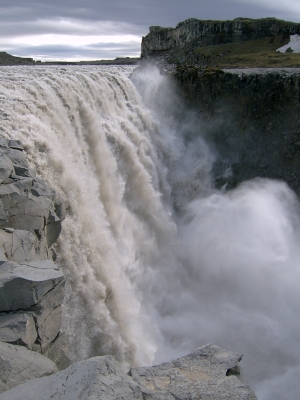 |
| Dettifoss |
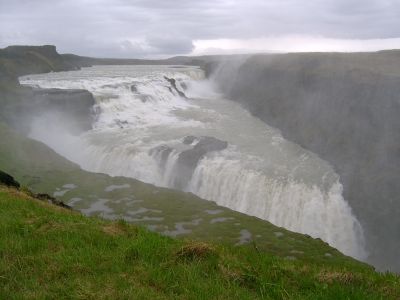 |
| Gullfoss |
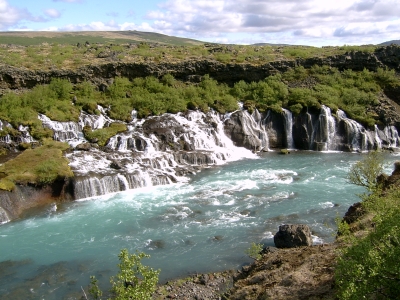 |
| Hraunfossar |
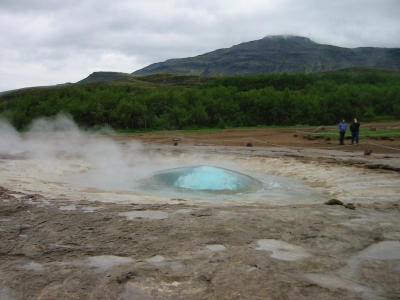 |
| Strokkur about to erupt |
Iceland has what’s claimed to be Europe’s most powerful waterfall – Dettifoss, with 200–400 cubic metres per second, depending on season. It doesn’t have Europe’s highest, a title claimed by several waterfalls ranging from Norway to Switzerland. (Height can be measured in different ways – is it the longest free fall that matters, or do consecutive cascades count as one?)
Not as powerful, but definitely more spectacular was Gullfoss (“Golden falls”). Gullfoss has two stages, and the second one dives straight into the opposing wall, throwing spray and mist high up in the air. That’s why my photo looks foggy, and that’s also what creates the small pools in the foreground. It also explains why the grass there is so much greener than on the other side of the river.
Dettifoss does the same, and because the river is in a deep gorge in an otherwise flat and empty region, you can see the clouds of spray well before the waterfall itself becomes visible.
Hraunfossar (“Lava field falls”) is a completely different set of waterfalls. There is one narrow and flashy waterfall, and adjacent to it is a broad picturesque waterfall that comes seemingly out of nowhere, as water trickles out from a lava field and from under layers of moss. Again the area just around the waterfalls was lush and green (on a relative scale) – even small birch shrub! – whereas just 100m further away there was only moss and brown grass.
Other watery sites include, of course, the world famous geysers. The original Geysir (“Gusher”) is no longer active, but the neighbouring Strokkur (“The Churn”) performs admirably, spouting hot water every 5 minutes or so. Our photos don’t look too impressive, since the grey and foggy pillar of water was barely distinguishable from the grey and foggy sky, unfortunately. If you want to see what it can look like in good weather, look at photos tagged “geysir” at flickr.
Between eruptions, the water level in the pool fluctuates significantly, and the moment before an eruption the surface balloons up into a very distinct mound. It takes a fast camera (or very lucky timing) to catch this. The shutter lag on my camera was way too long, but Eric caught this great picture of it.
Various smaller pools of boiling water are scattered around the same site – just as with waterfalls, you can spot the area from some distance away because of the steam rising from the ground.
Then there is Europe’s largest hot spring at Deildartunguhver, where 180 litres of almost-boiling water well out of the ground. This mostly has a curiosity value, as there isn’t much to see, apart from huge clouds of steam – large and dense enough to hide everything including the path, so finding your way out is a matter of turning back 180 degrees and walking in a straight line until you emerge at the other side of the cloud. Water from this spring is piped 60 km to two neighbouring villages, where it is used for heating.

Leave a comment