A non-walking day today. Instead we visited the archaeological excavation/museum at Akrotiri. Like the site at the top of the hill near Kamari, this town dates back to the Bronze age. It was destroyed by the volcanic eruption in 1600-something BC and the excavation has been in progress for some fifty-odd years.
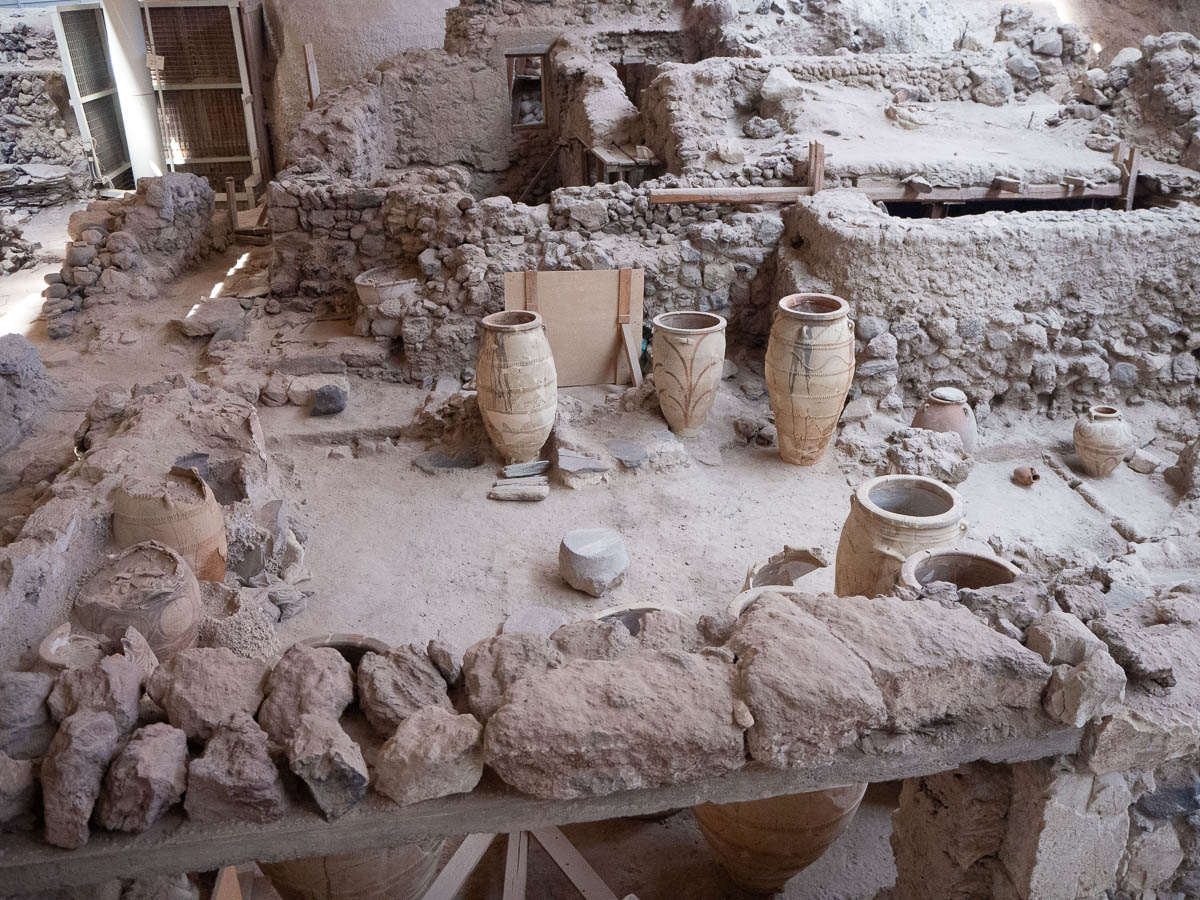
The site was interesting to see, but I was disappointed to find out that absolutely everything they’ve found – tools, household objects, frescoes – has been carted off to museums in either Fira or all the way to Athens. Only the walls and stairs and streets themselves are left here, as well as a few token clay vases, and castings of bed frames, for some reason. (Wooden objects rotted over the centuries, and left behind hollow spaces in the volcanic ash, so when any hollows were found, the archaeologists made casts of them all.) They haven’t even put up replicas or projections or even posters with images.
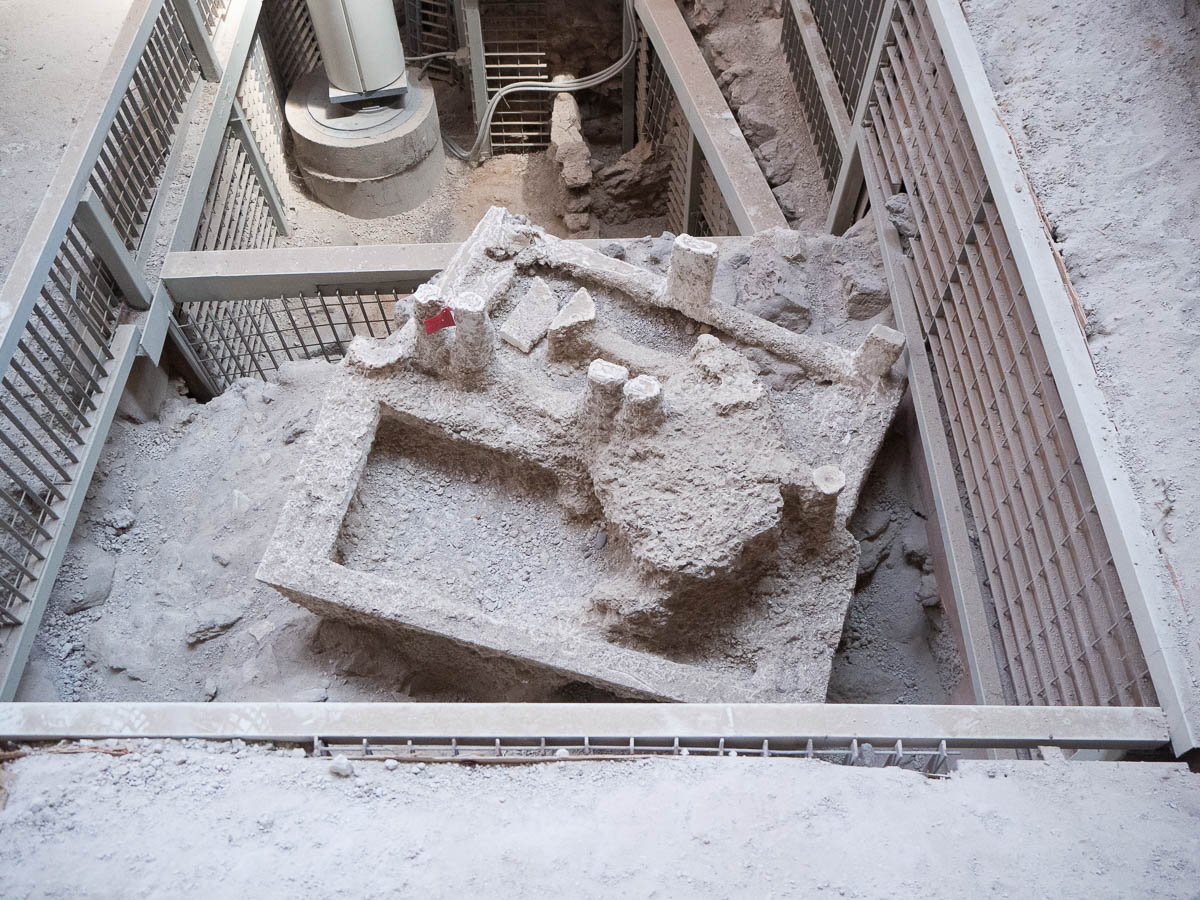
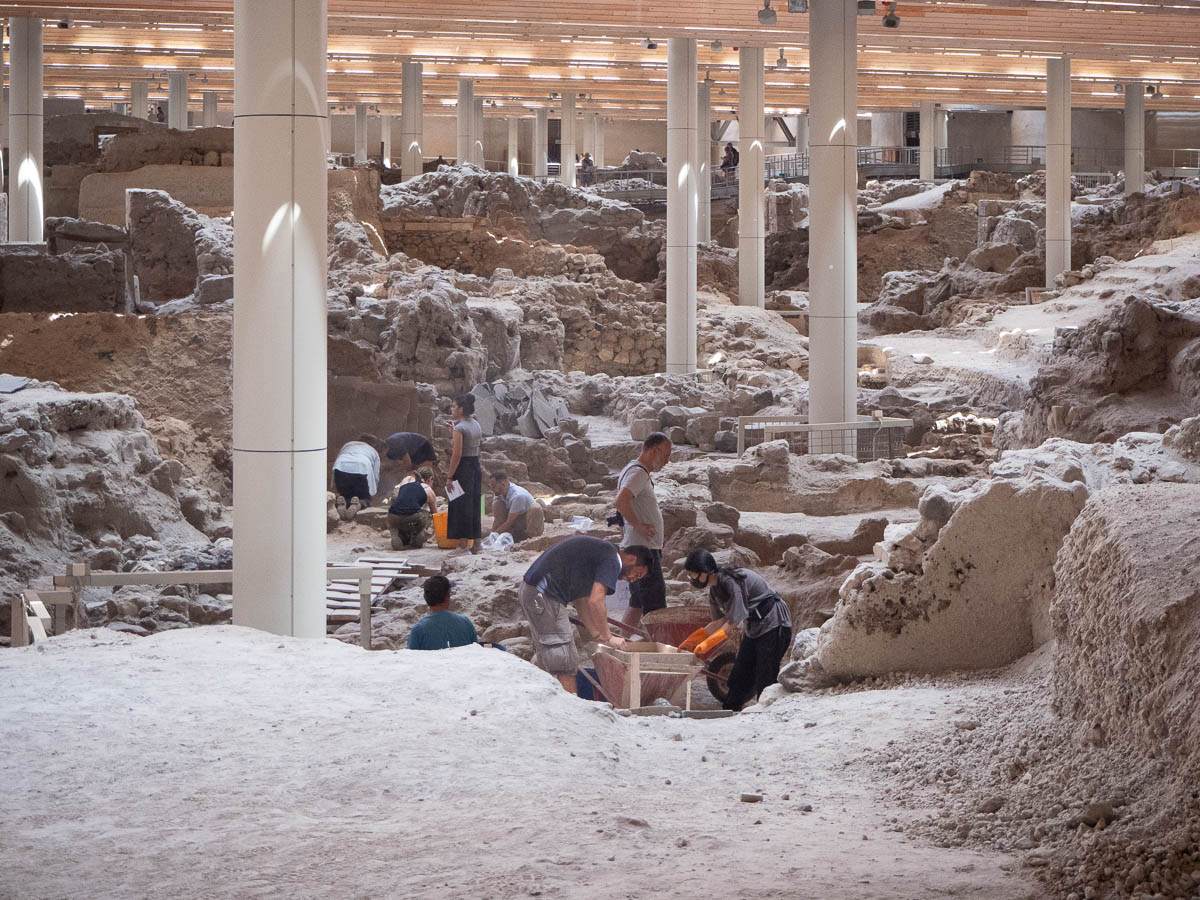
On the other hand, it was interesting to see archaeologists actually at work, with their brushes and sieves and wheelbarrows.
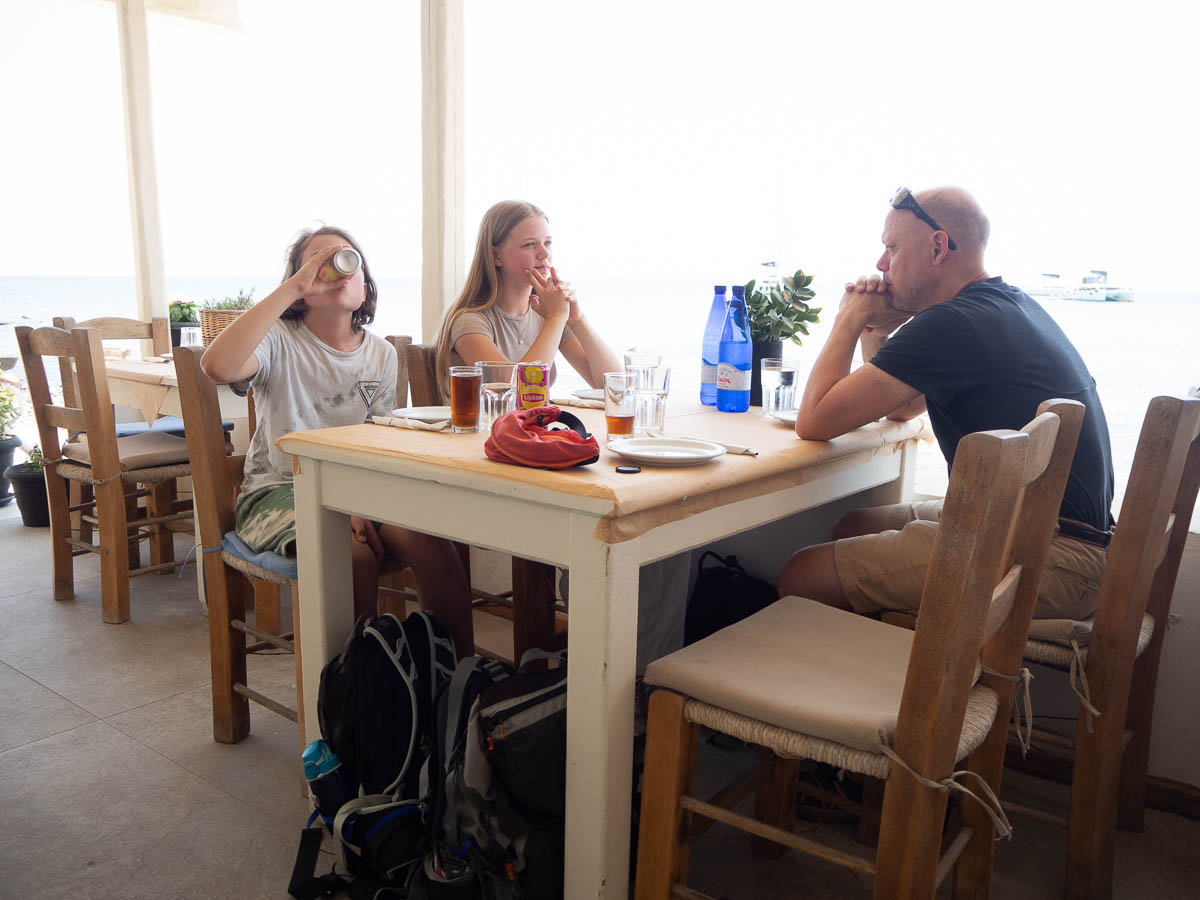
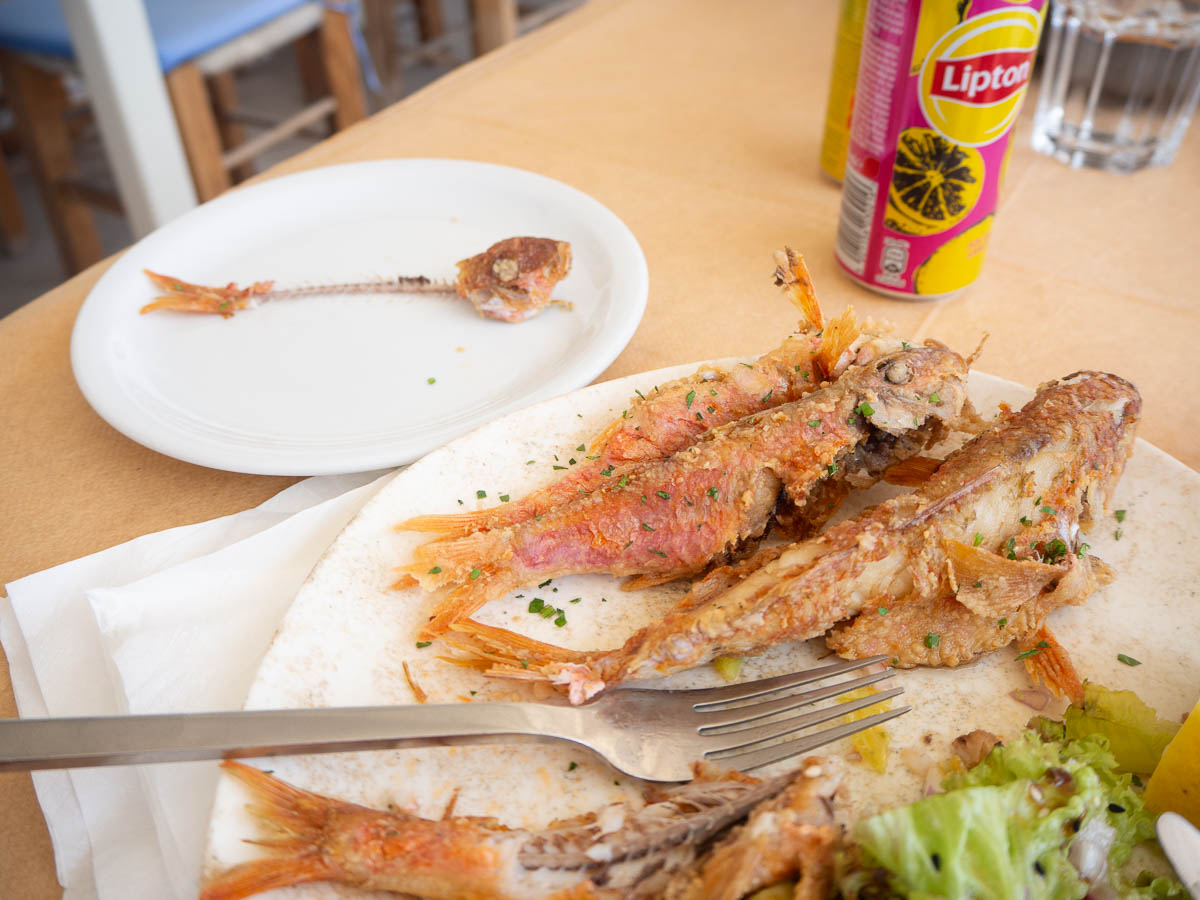
We had lunch at the beach in Akrotiri, which was a much calmer experience than the crowds in Kamari. I wanted to try something local so I ordered red mullet. My plate did indeed contain a bunch of red fish. I was informed that even the fins were usually eaten and would taste like chips/crisps, which indeed they did.
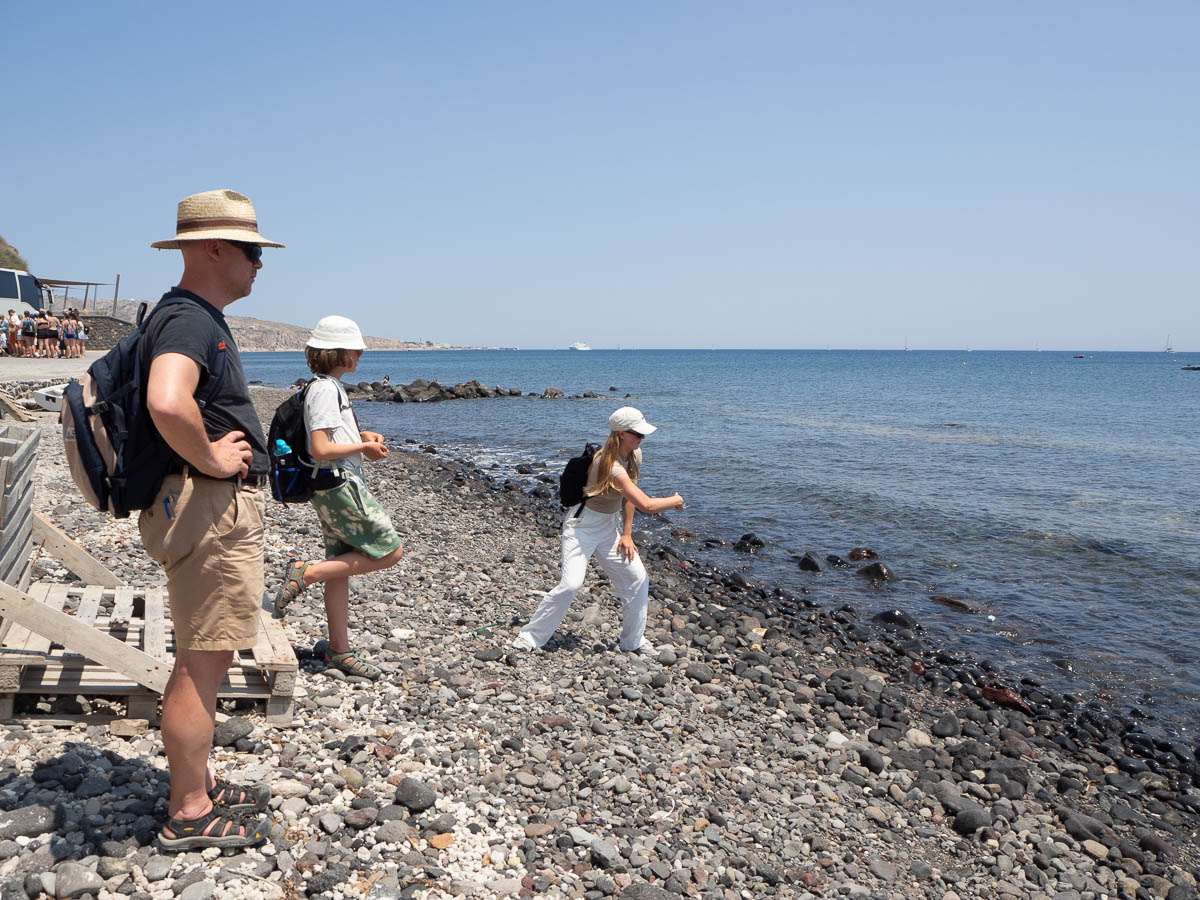
Then we looked at pretty black rocks on the beach, and threw some into the sea.
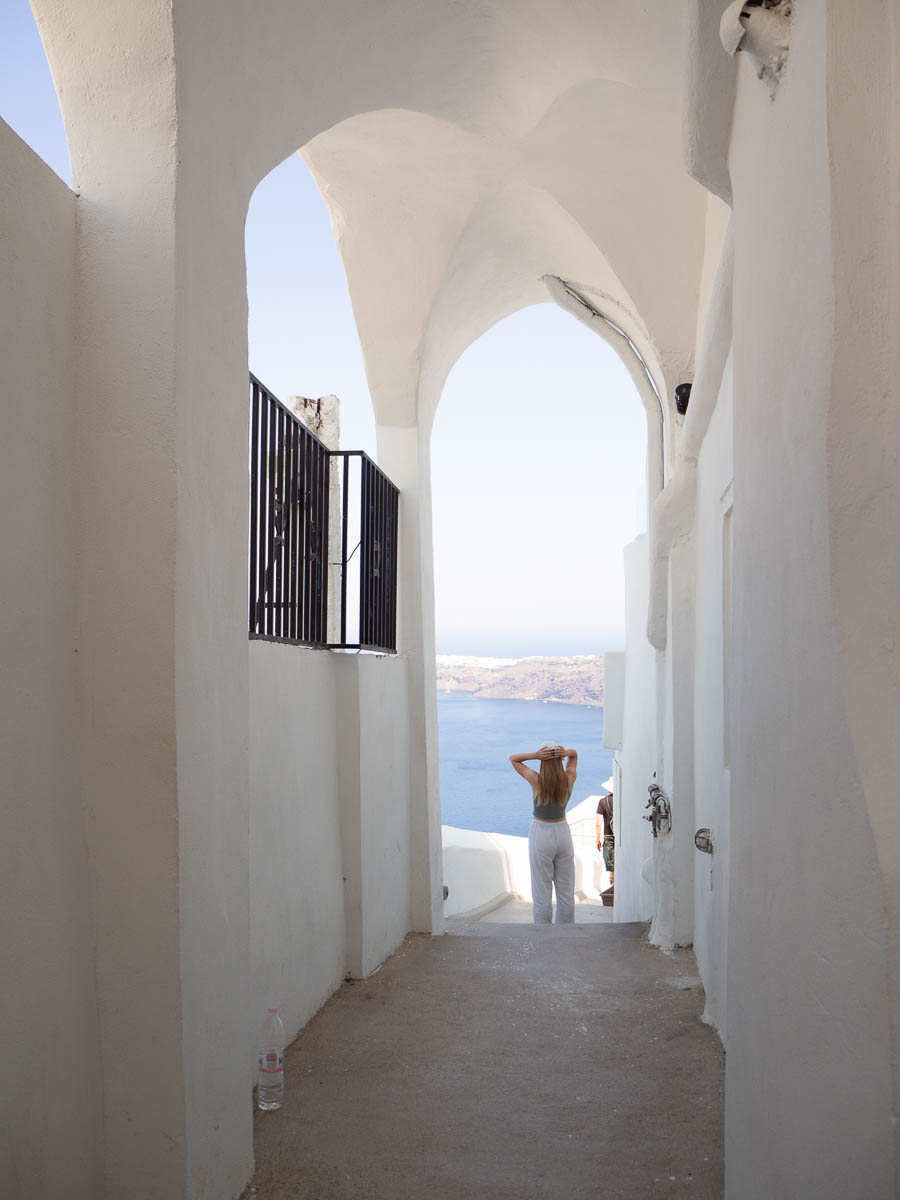
Fira to Oia is the top item on all “walking on Santorini” lists and articles. So that’s what we did today.
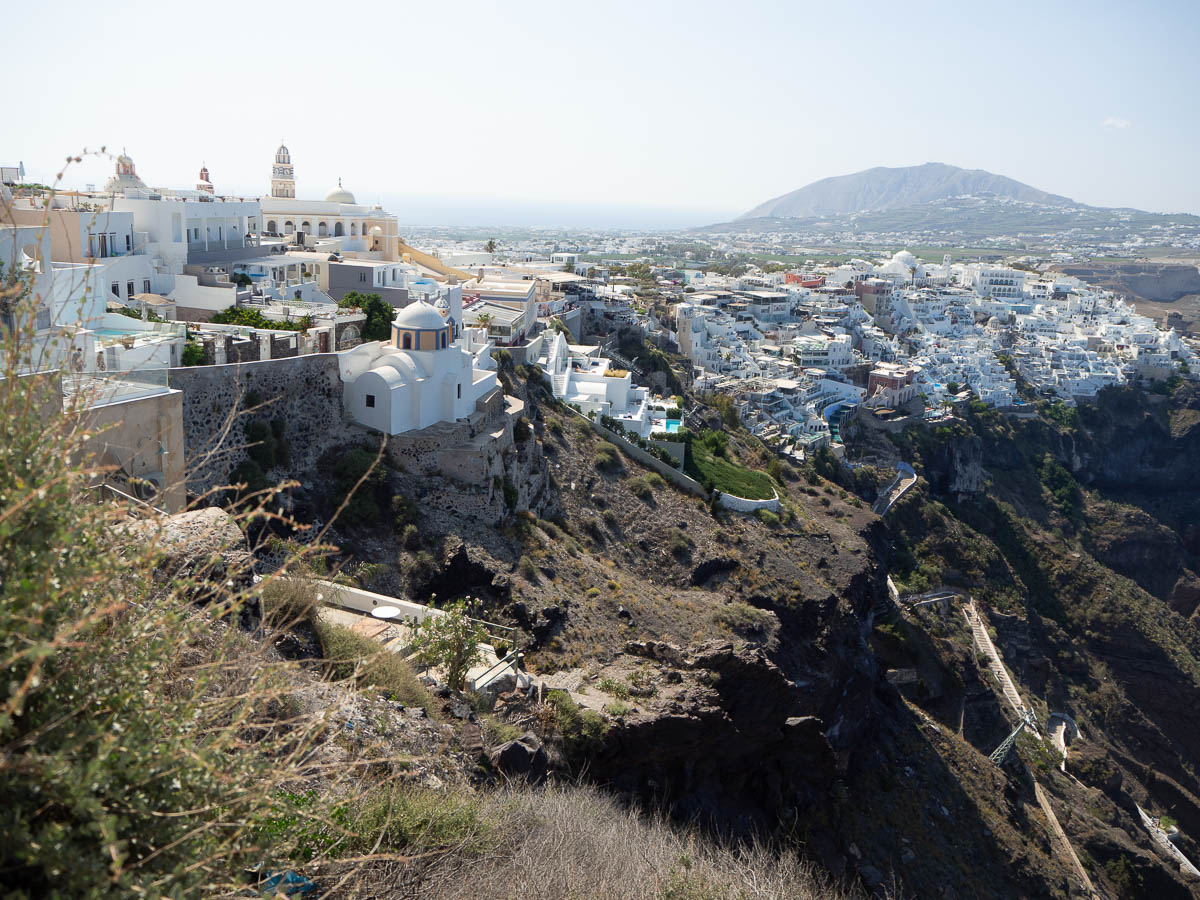
Fira is the main town on Santorini, and also shares its name with the island. Santorini used to be called Thera or Thira, which after a while became Fira. Like many other towns on the island, it’s a cluster of small, white buildings clinging on to the cliff top.
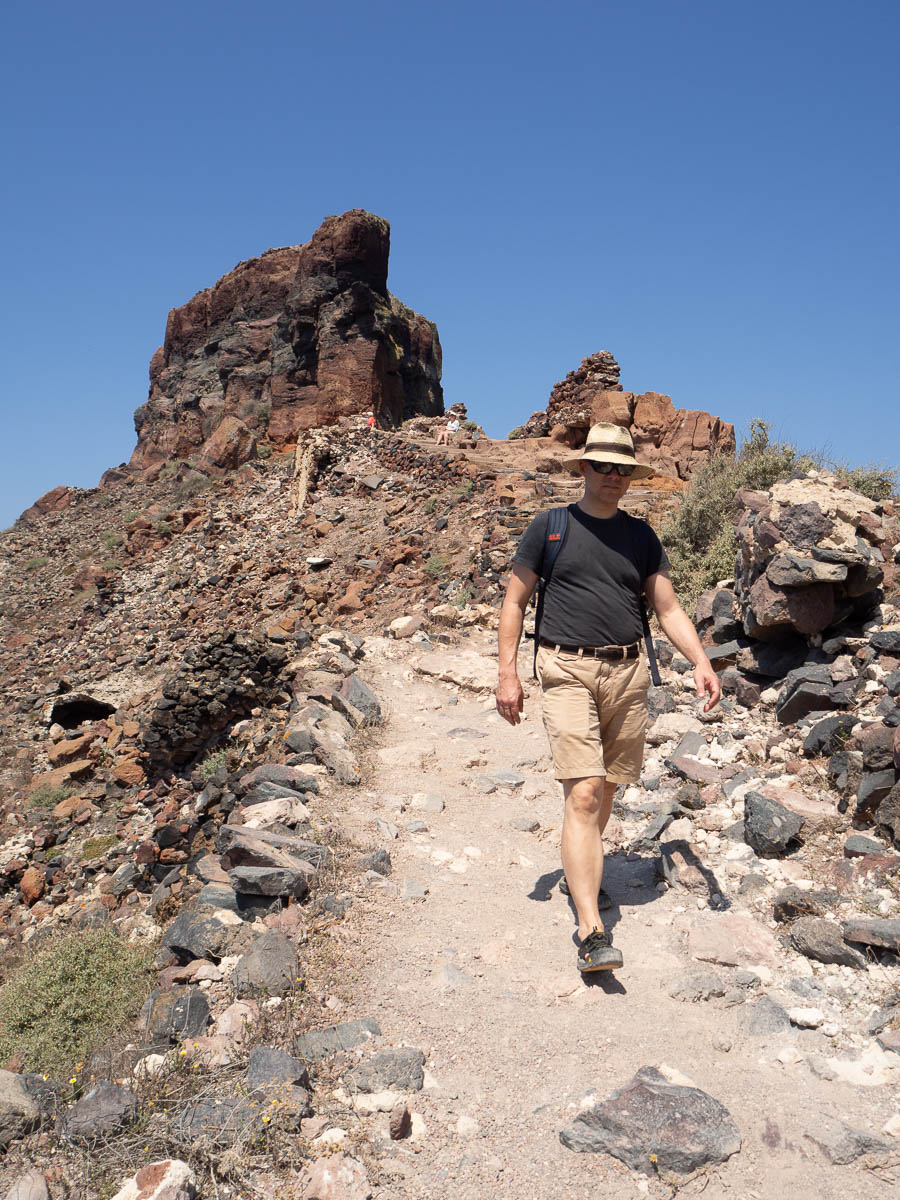
A few kilometres from Fira we came to Skaros Rock, which looks like nothing but a strange rock outcropping from the distance, but turns out to hold the ruins of a Venetian fortification.
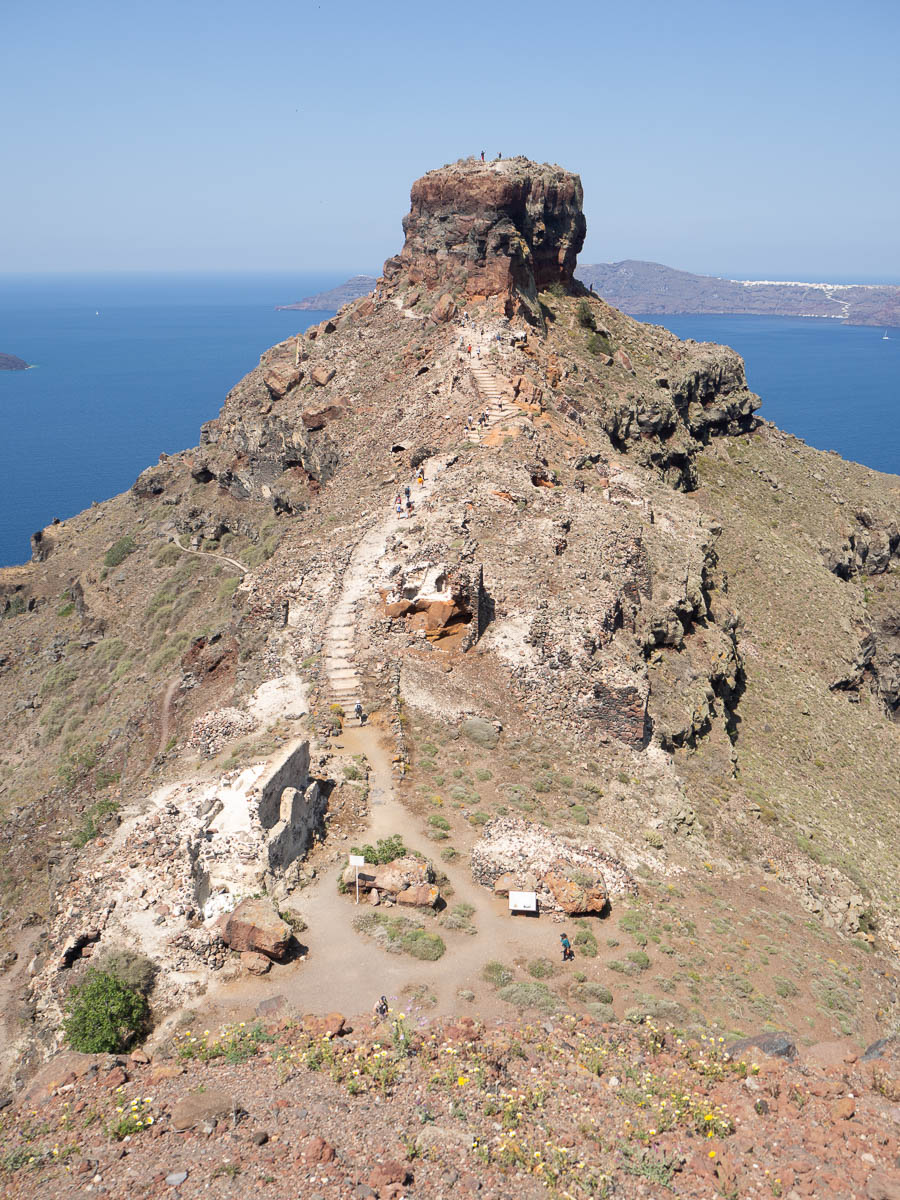
Right next to the ruins there was a loud sign proclaiming the area to be dangerous and forbidden and off-limits, even while there were paths and stairs leading into them. I’m guessing the paths weren’t up to some safety standard so the local authorities were forced to put up a sign to comply with regulations, but clearly they’d realized that actually trying to keep tourists out would lead to more danger of serious accidents than giving them safe paths to walk on.
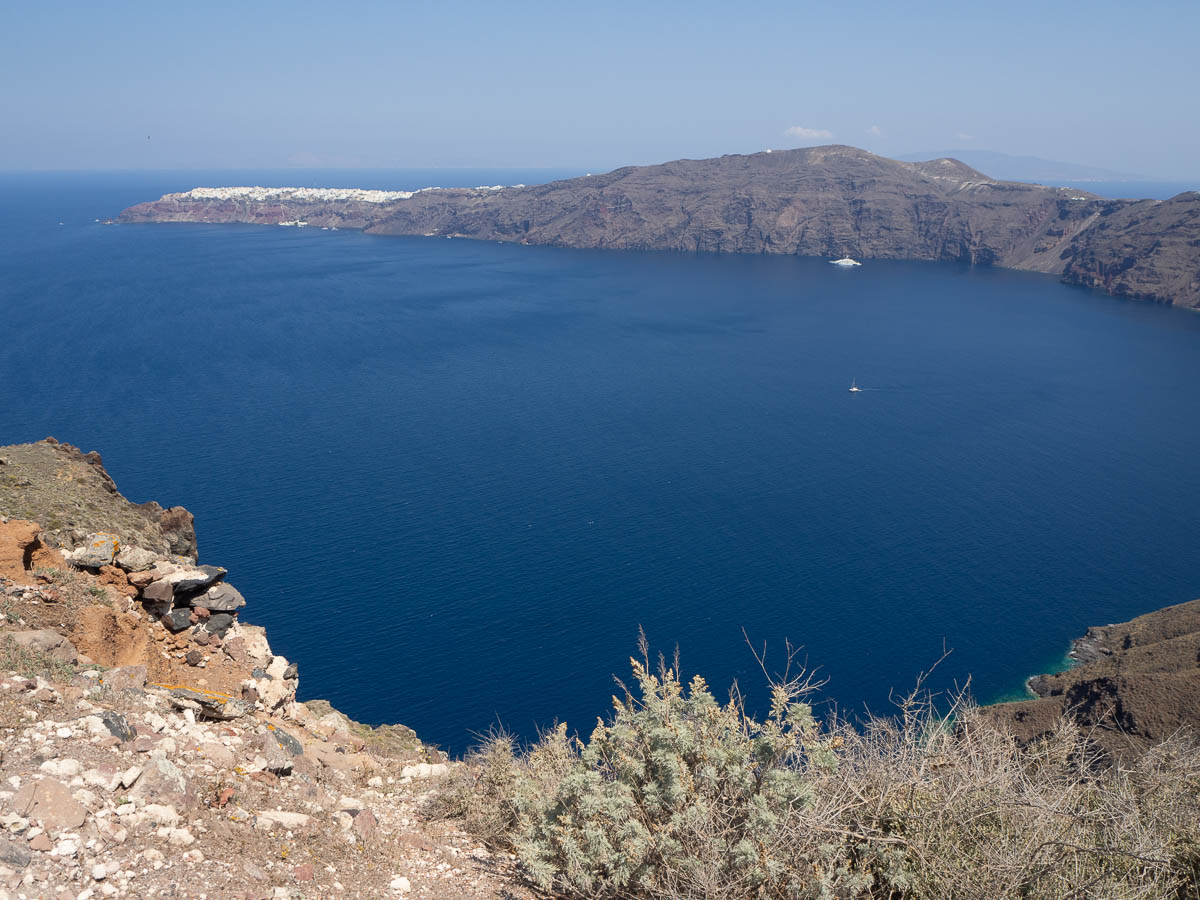
The views from here made the crescent shape of the island and its volcanic origin very obvious.
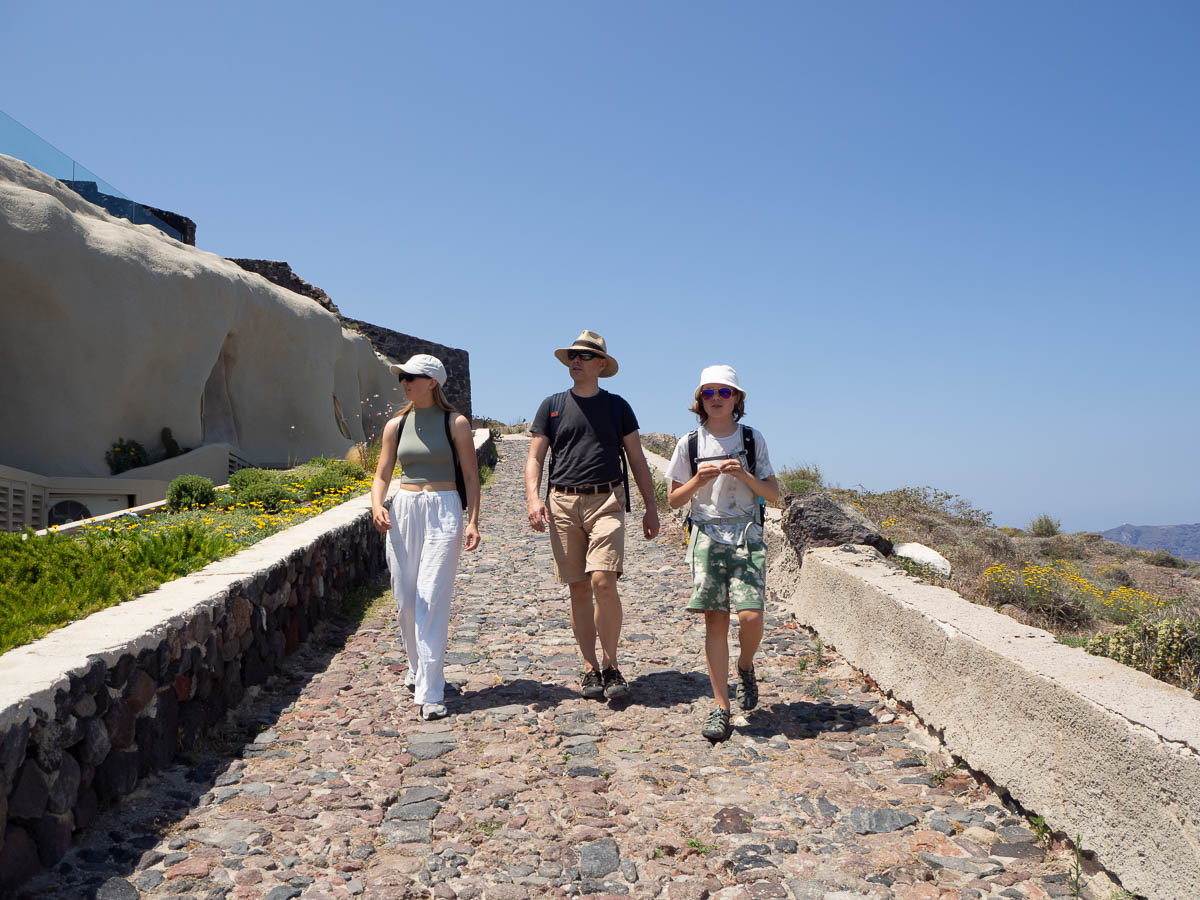
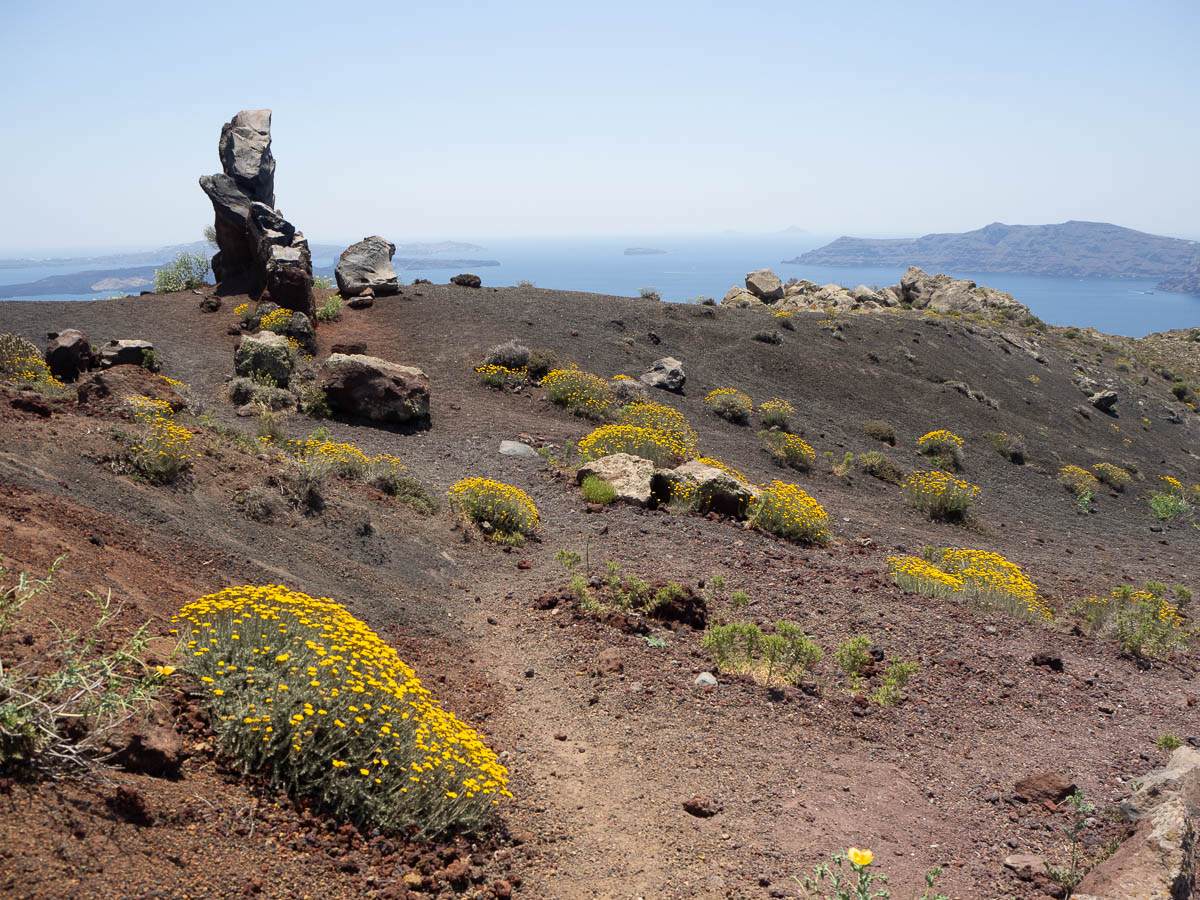
The landscape between Fira and Oia was mostly volcanic semi-desert, occasionally interrupted by tourist accommodation in one shape or another. This island truly has a lot of hotels. Then again, I can’t think of anything else they could do if they didn’t have any tourists, because it’s not like you could grow anything much here.
Tufts of this one plant with yellow flowers seem to be the first ones to take root in the dry volcanic ground.
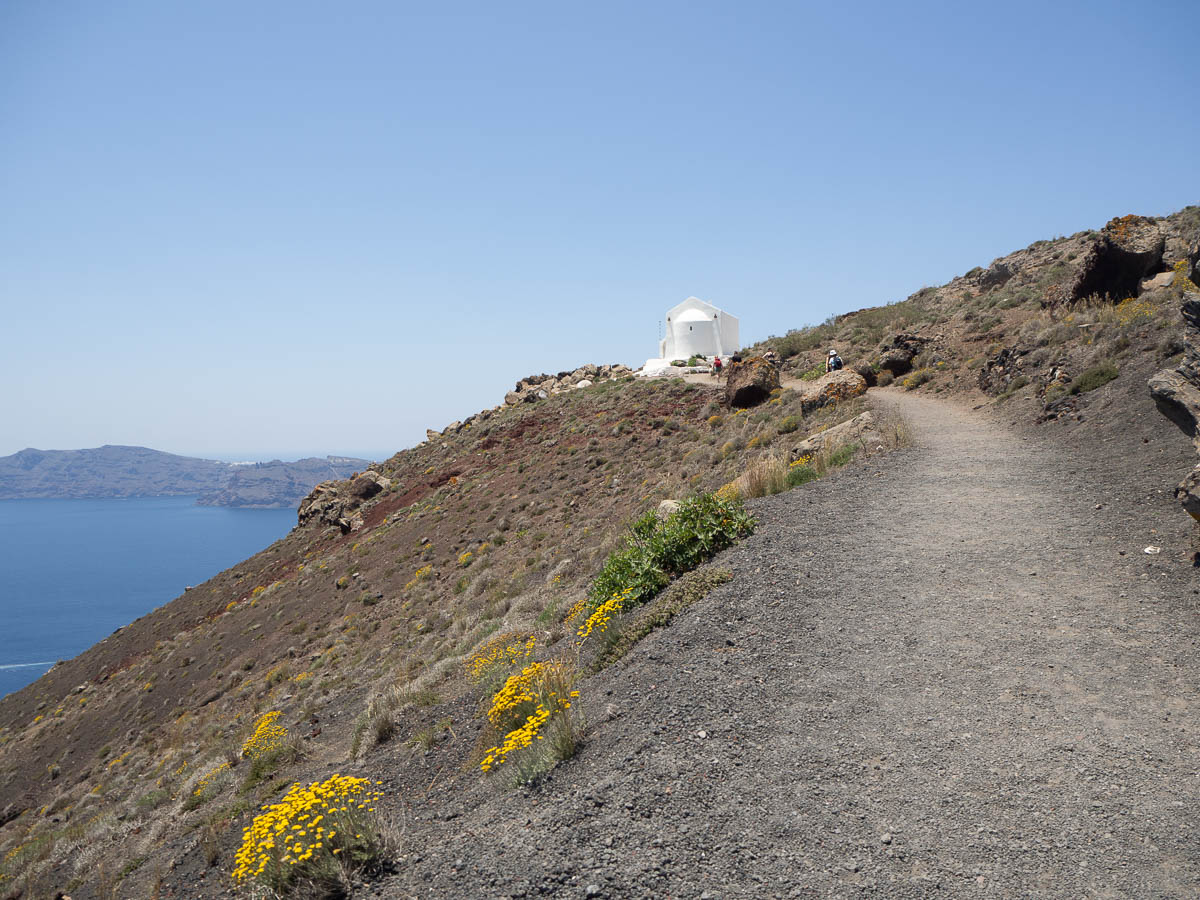
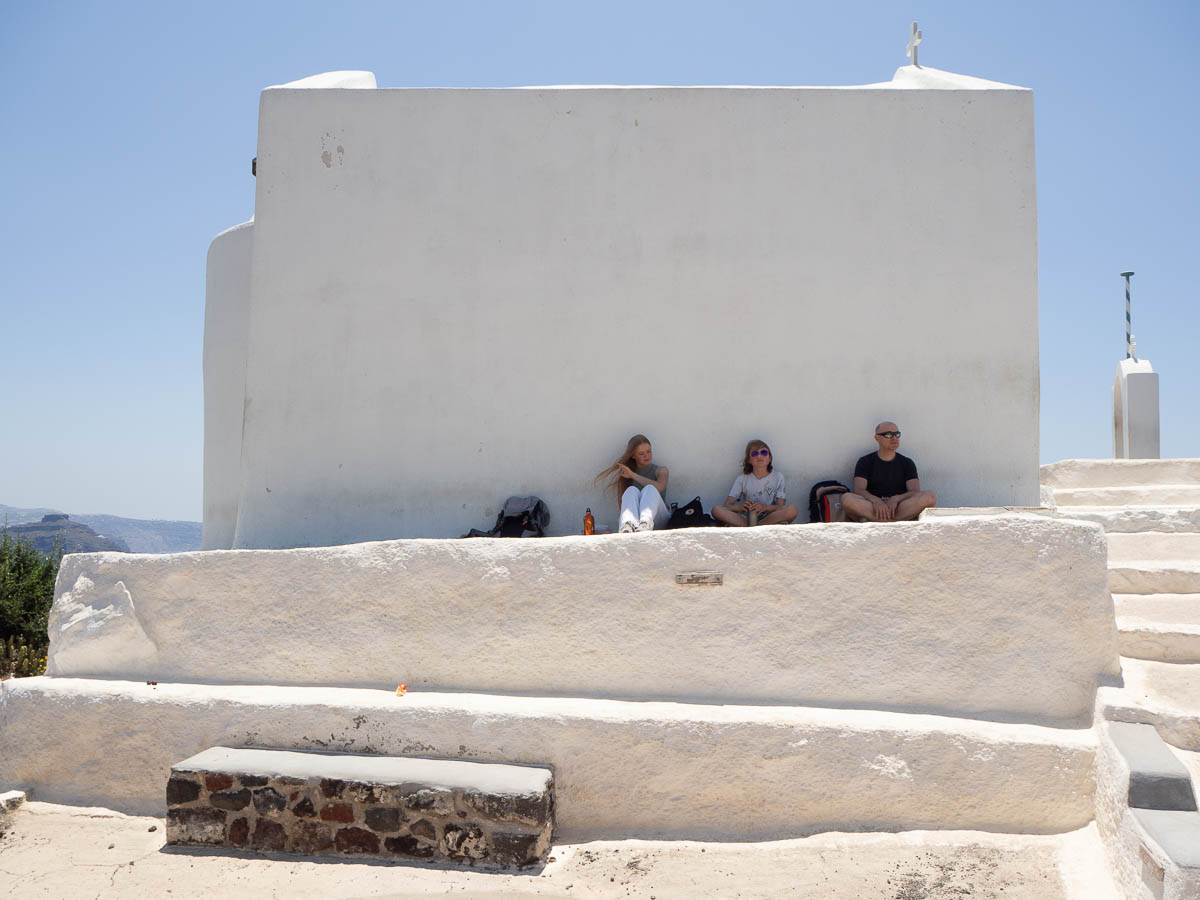
Today there were no clouds and no real shade anywhere. When we finally spotted a sliver of shade along a small chapel in the middle of nowhere, we could finally take a longer break without feeling like we were melting. When we made ourselves small and pulled our legs in close, we could all fit into the shade.
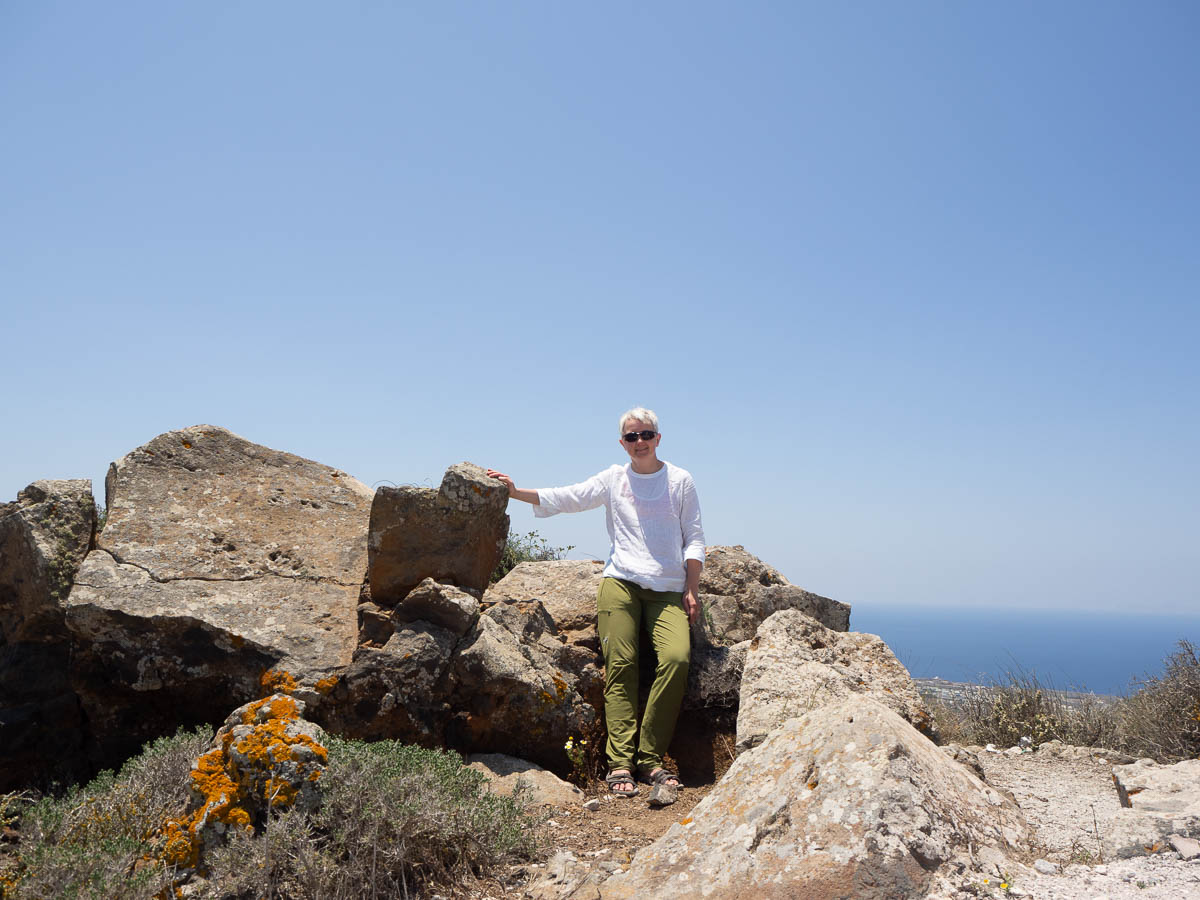
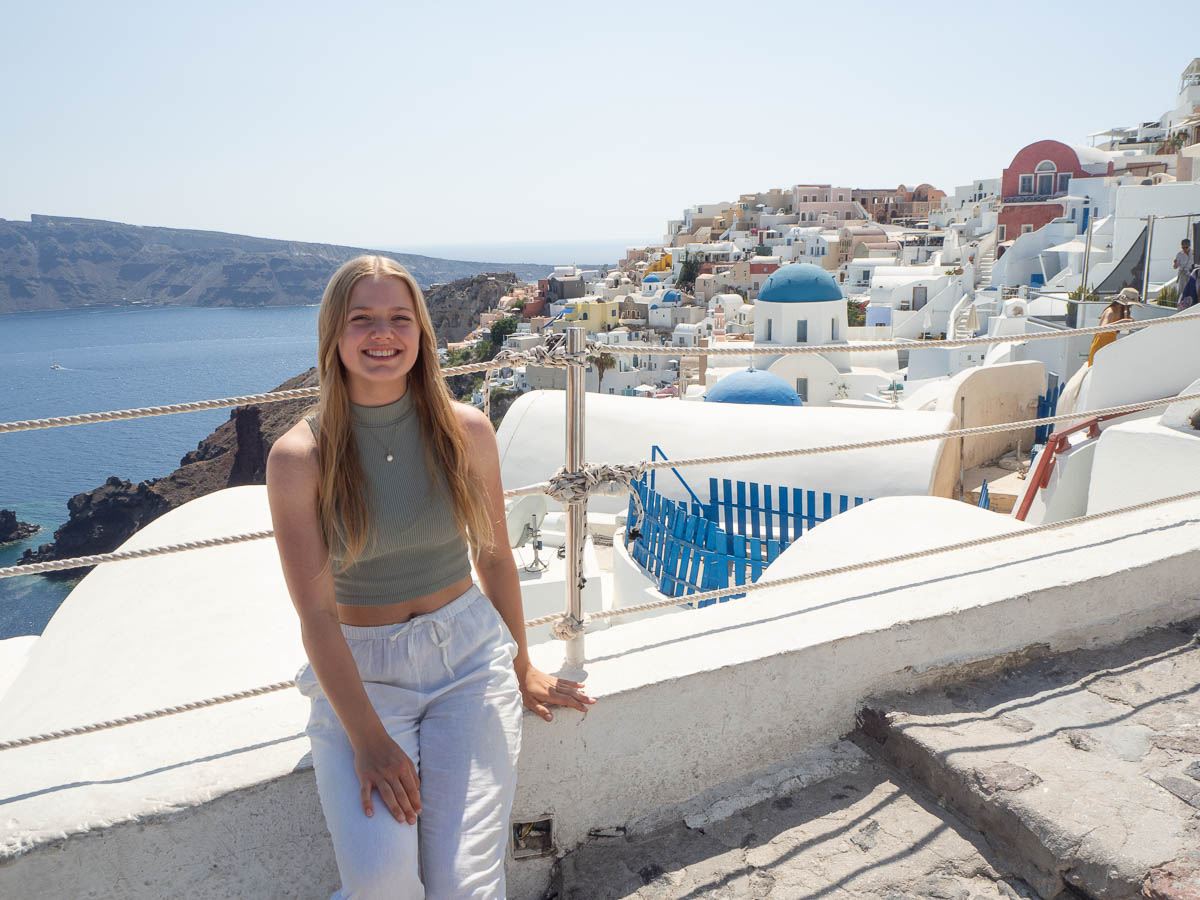
Ingrid kindly took photos of me today again.
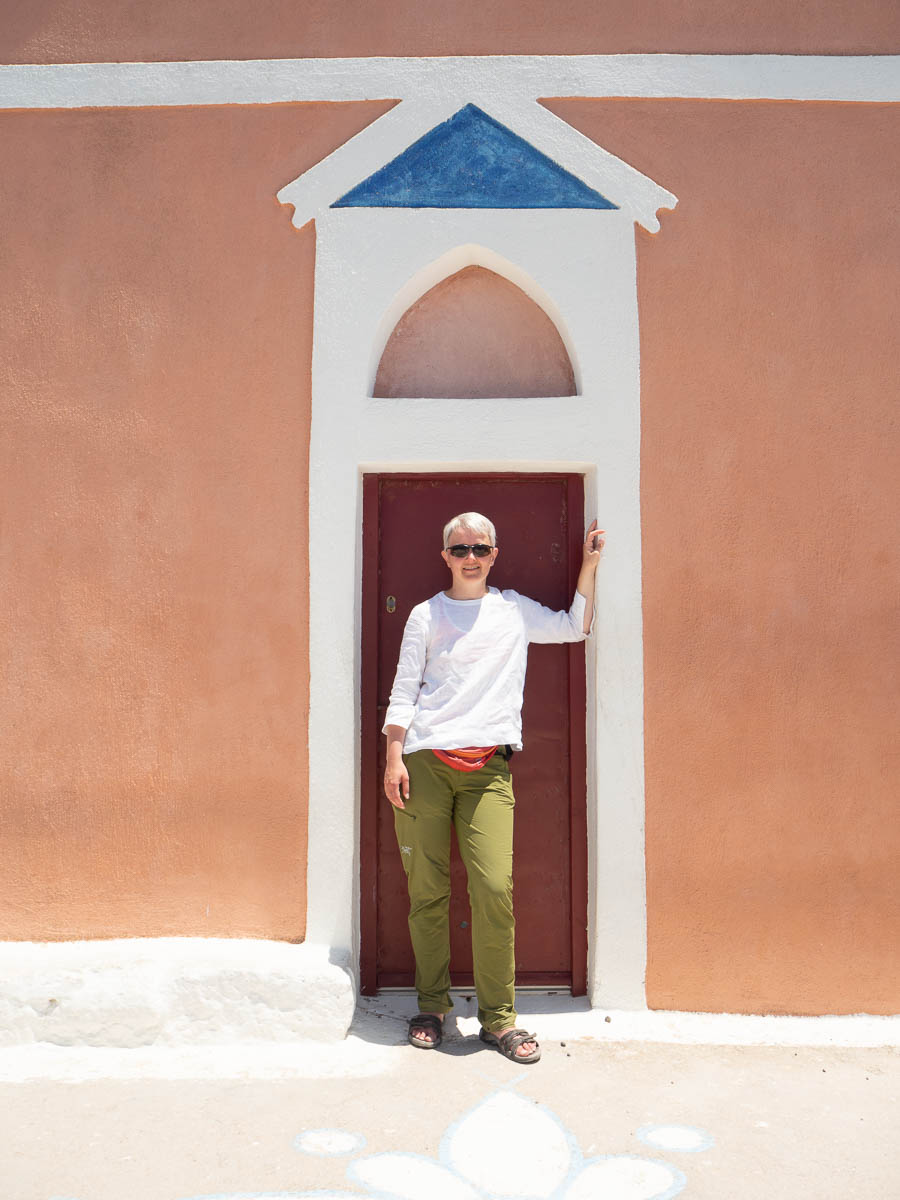
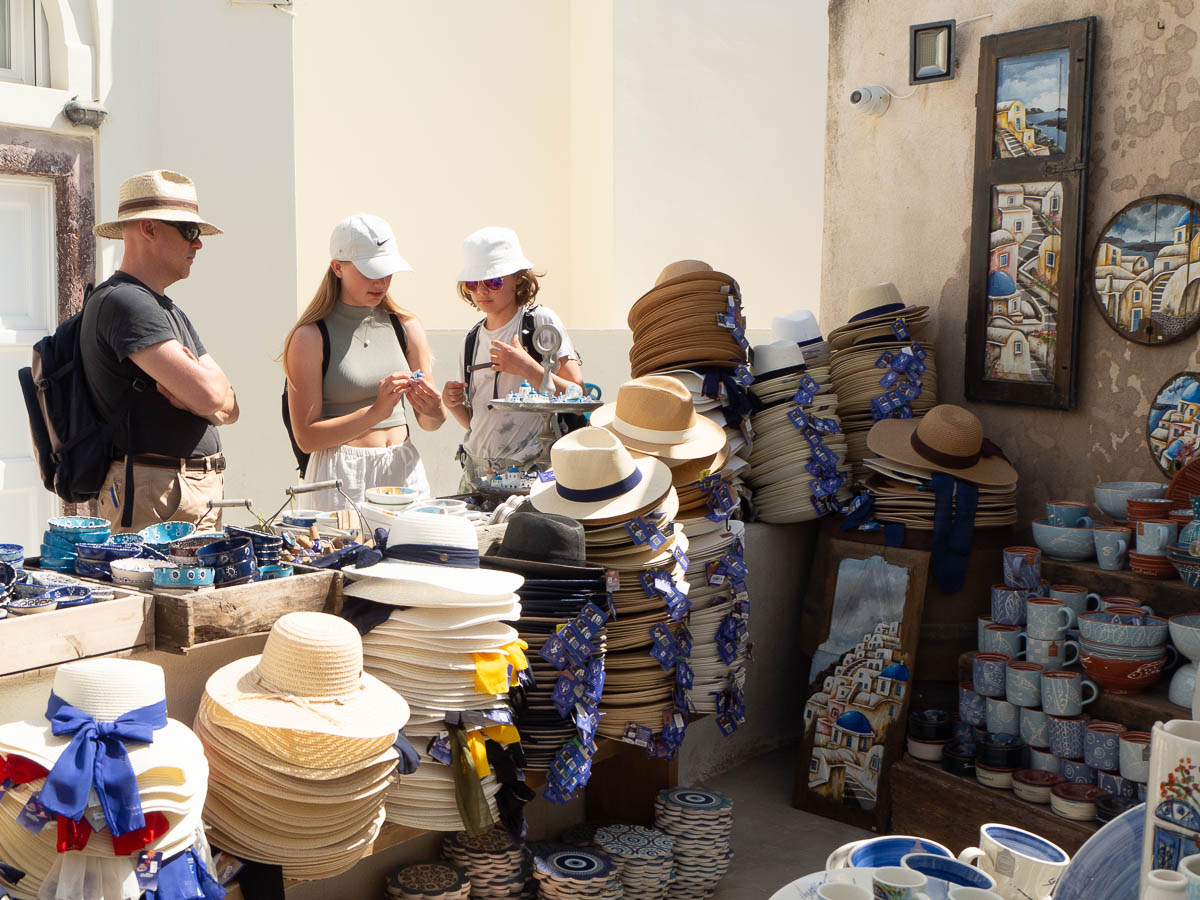
Oia was even more tourist-focused than Fira. Everything was either a hotel, a restaurant, or a tourist shop.
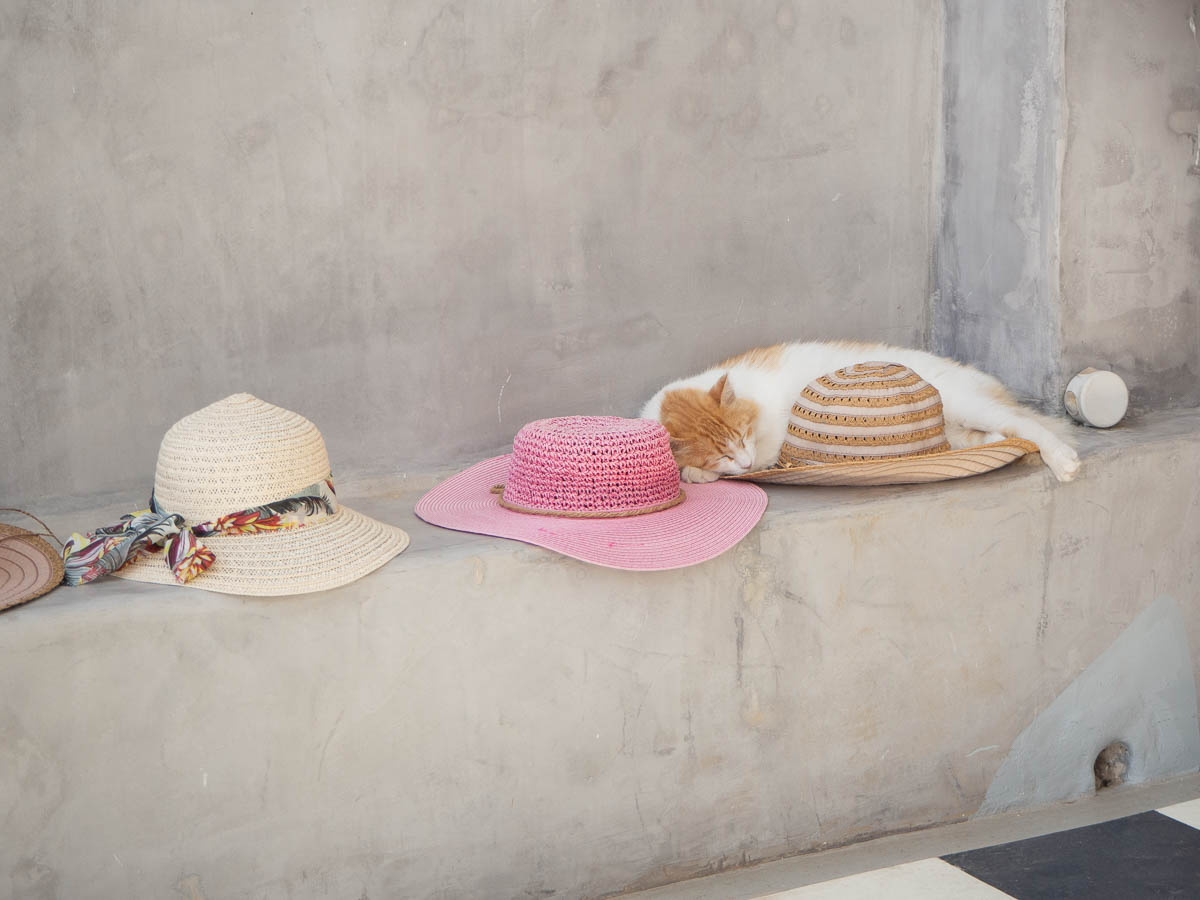
Santorini has a fair number of stray cats, that seem to be tolerated most everywhere. There is one who visits our hotel every morning at breakfast time, whom we already recognize, and we’ve seen others feel at home at cafés and restaurants.
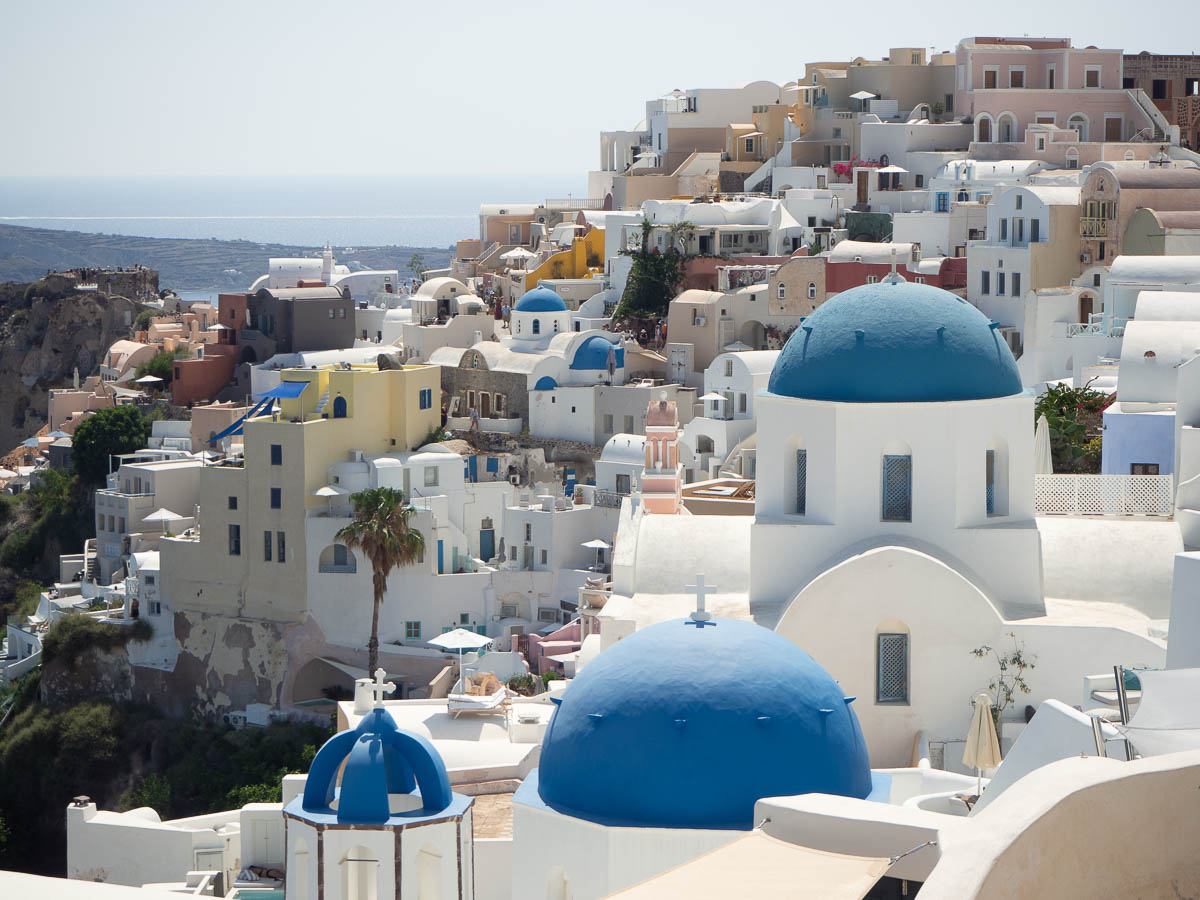
Oia is the town where the most famous photos of Santorini tend to be taken, with its blue-domed white buildings.
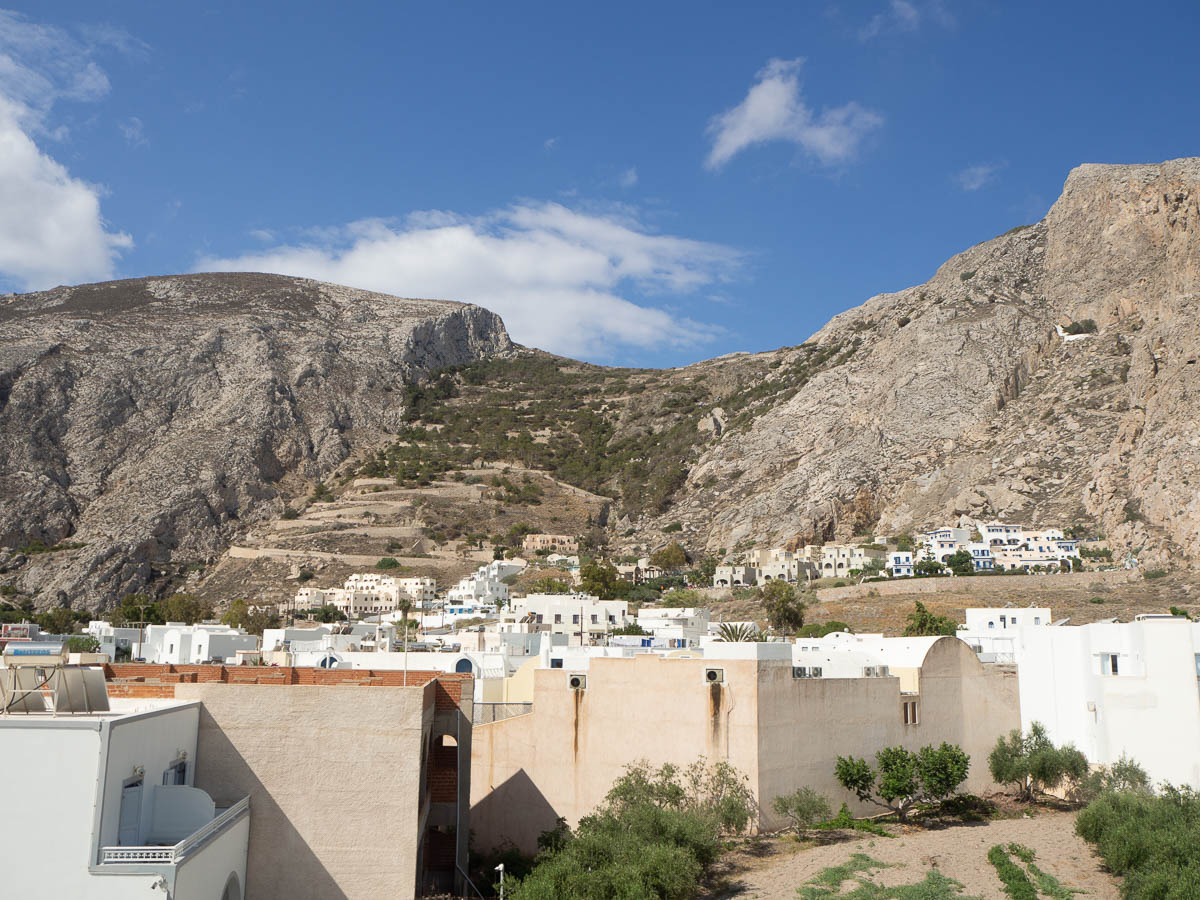
Today was the only day of this week for which the weather forecast promised a splash of rain in the morning. It seemed reasonable, looking at the sky, so we hung around at the hotel for a couple of hours before going out. This is our view from the hotel towards our planned walk for the day – that somewhat wooded area on the hills, between the two peaks.
But the rain kept not happening and we kept getting more and more restless, so in the end we just left anyway. Some rain won’t kill us.
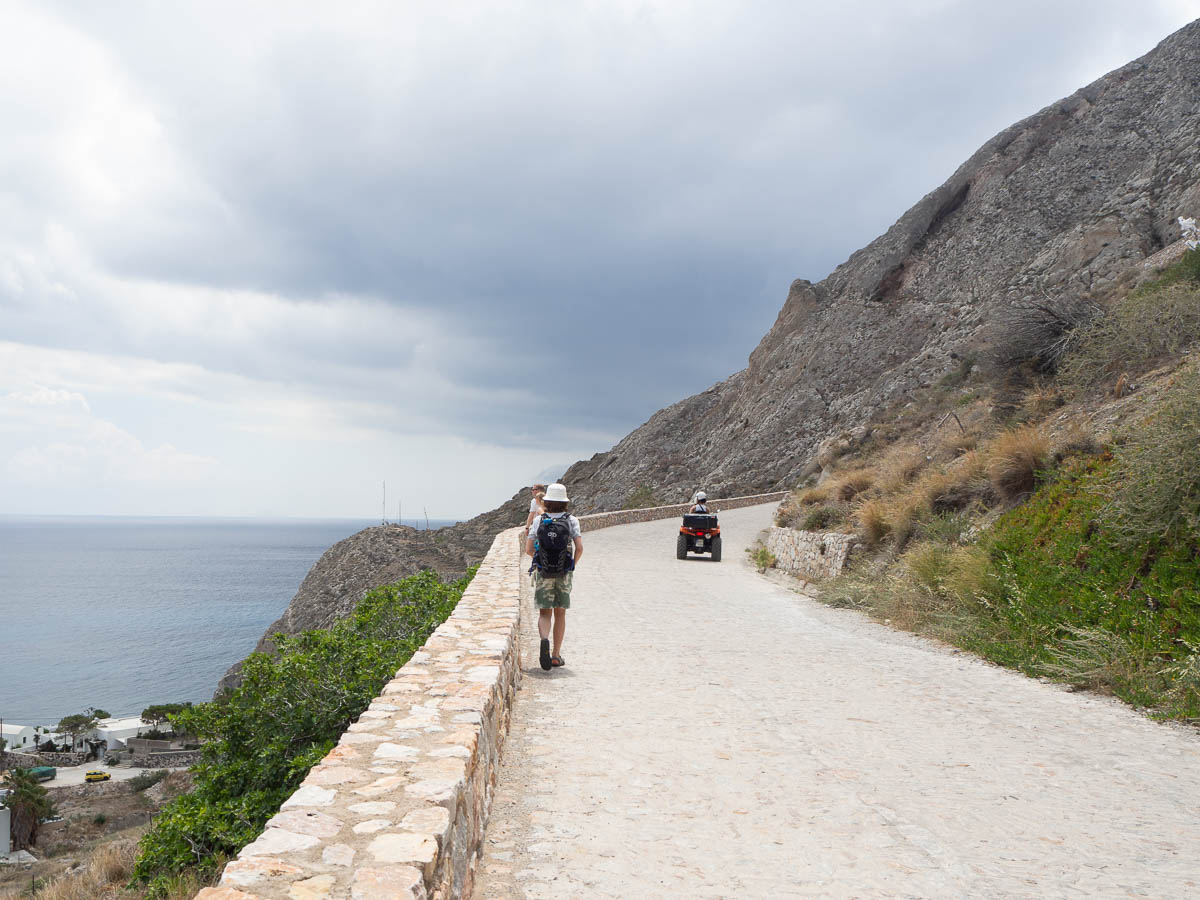
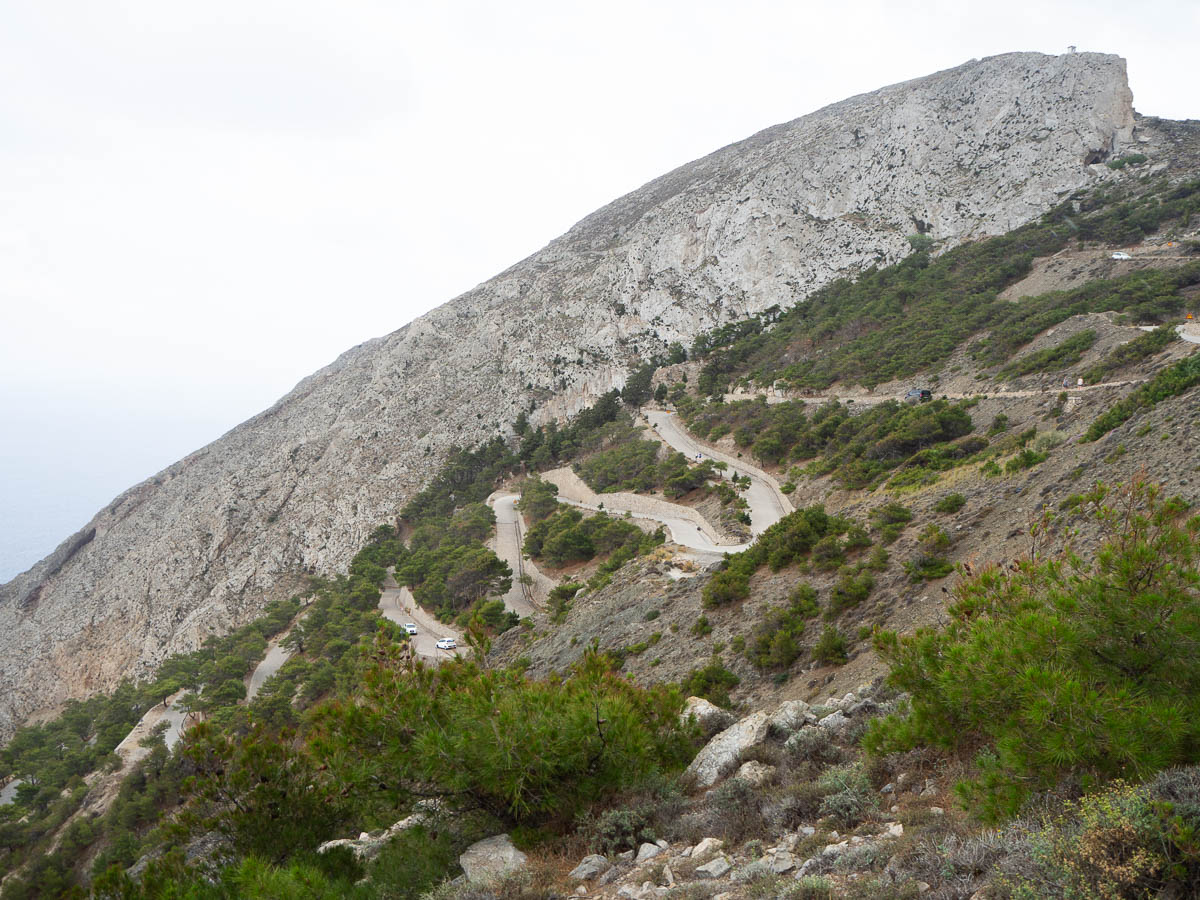
The walking took us up, and up, and up some more. First in zigzags along the road, and, after the pass, along paths and stairs.
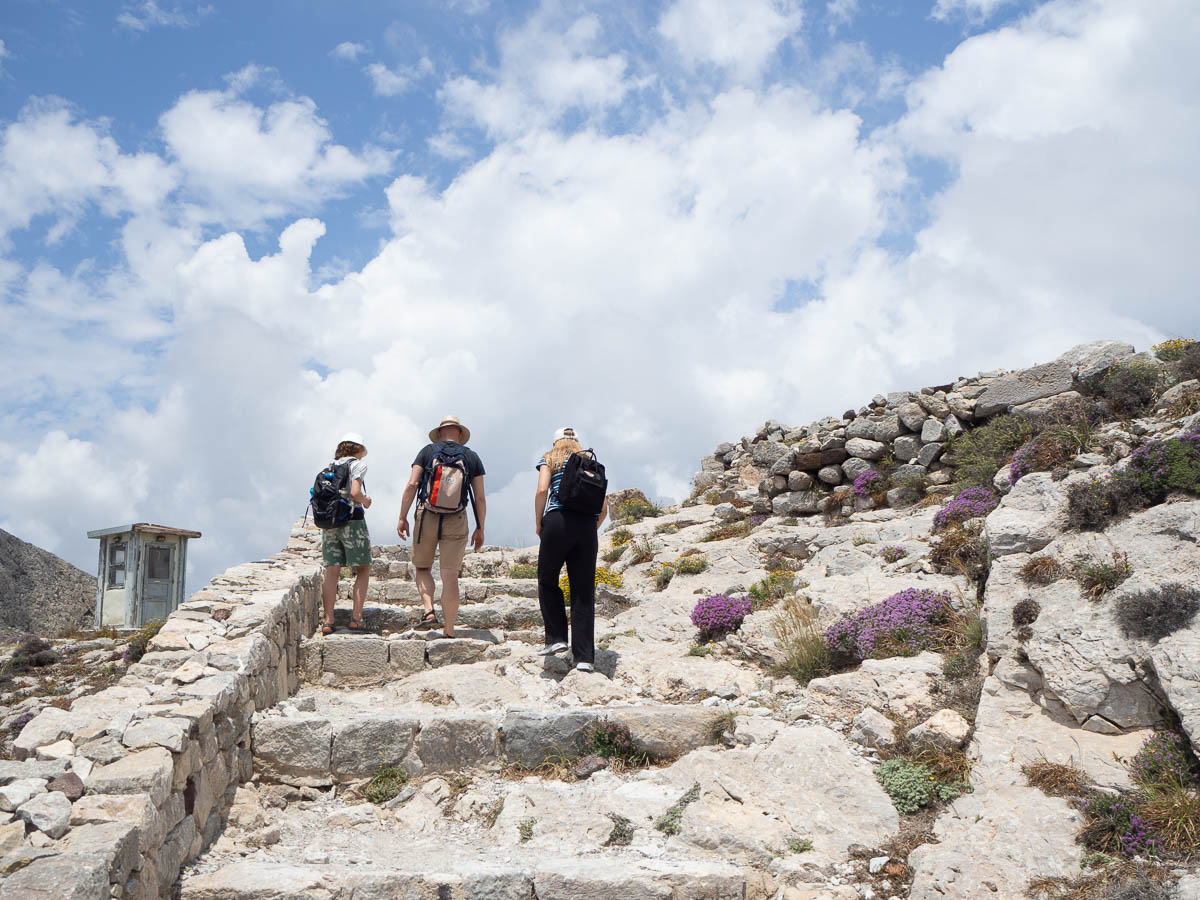
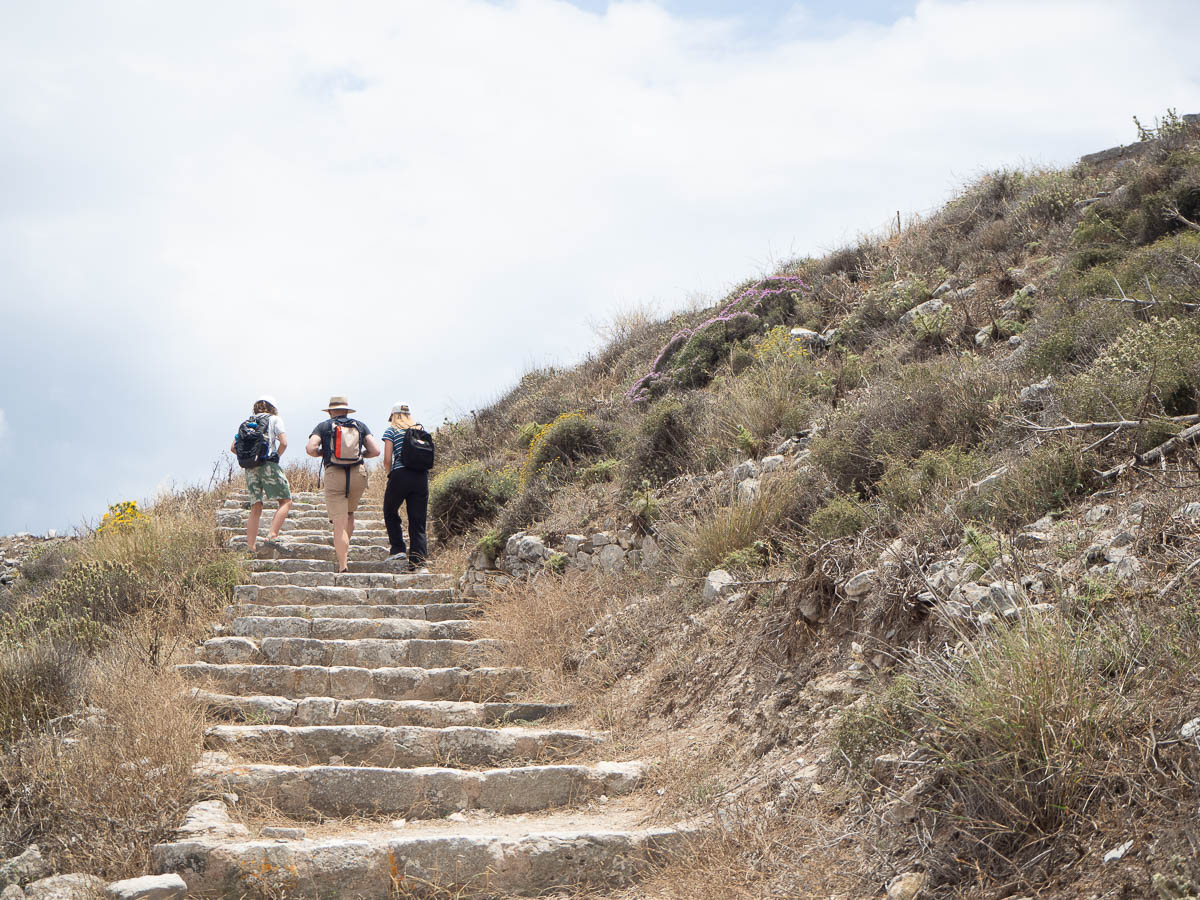
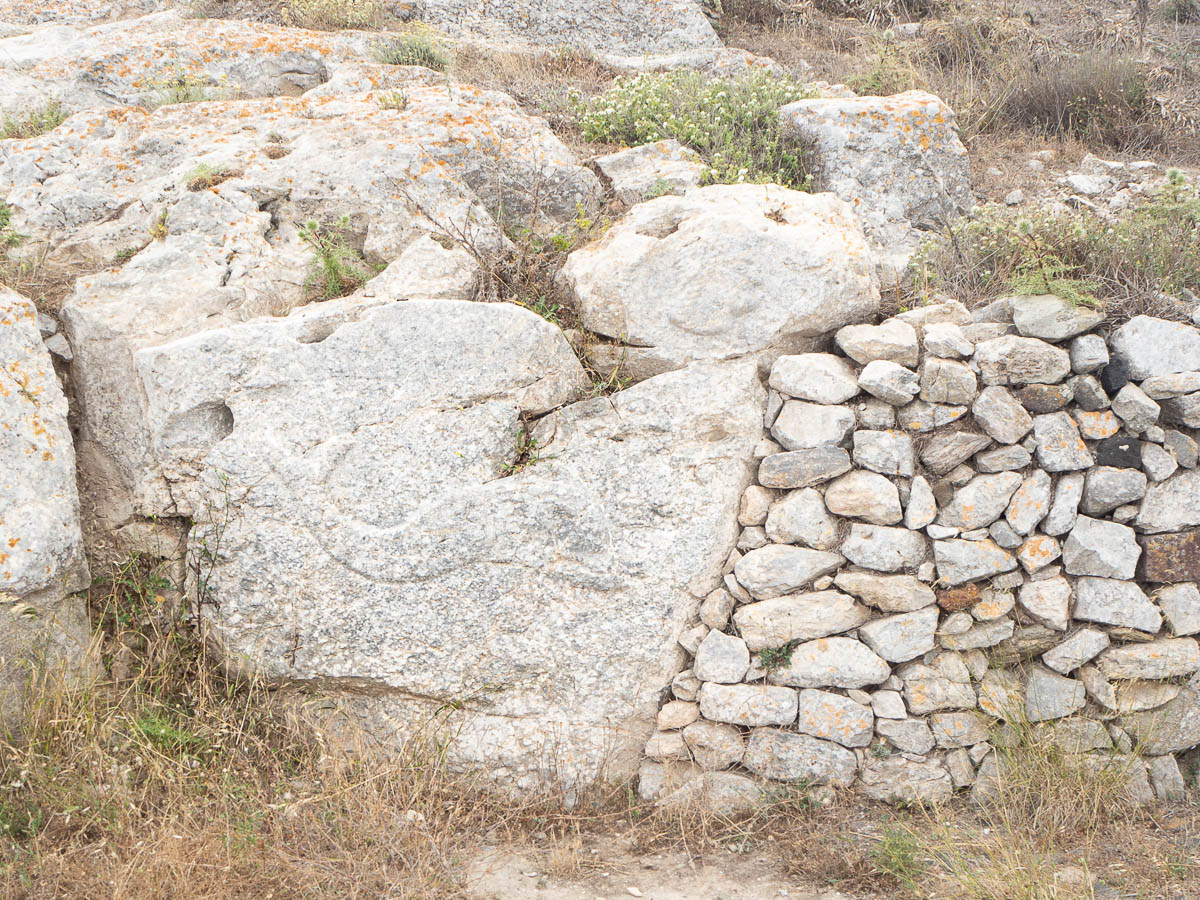
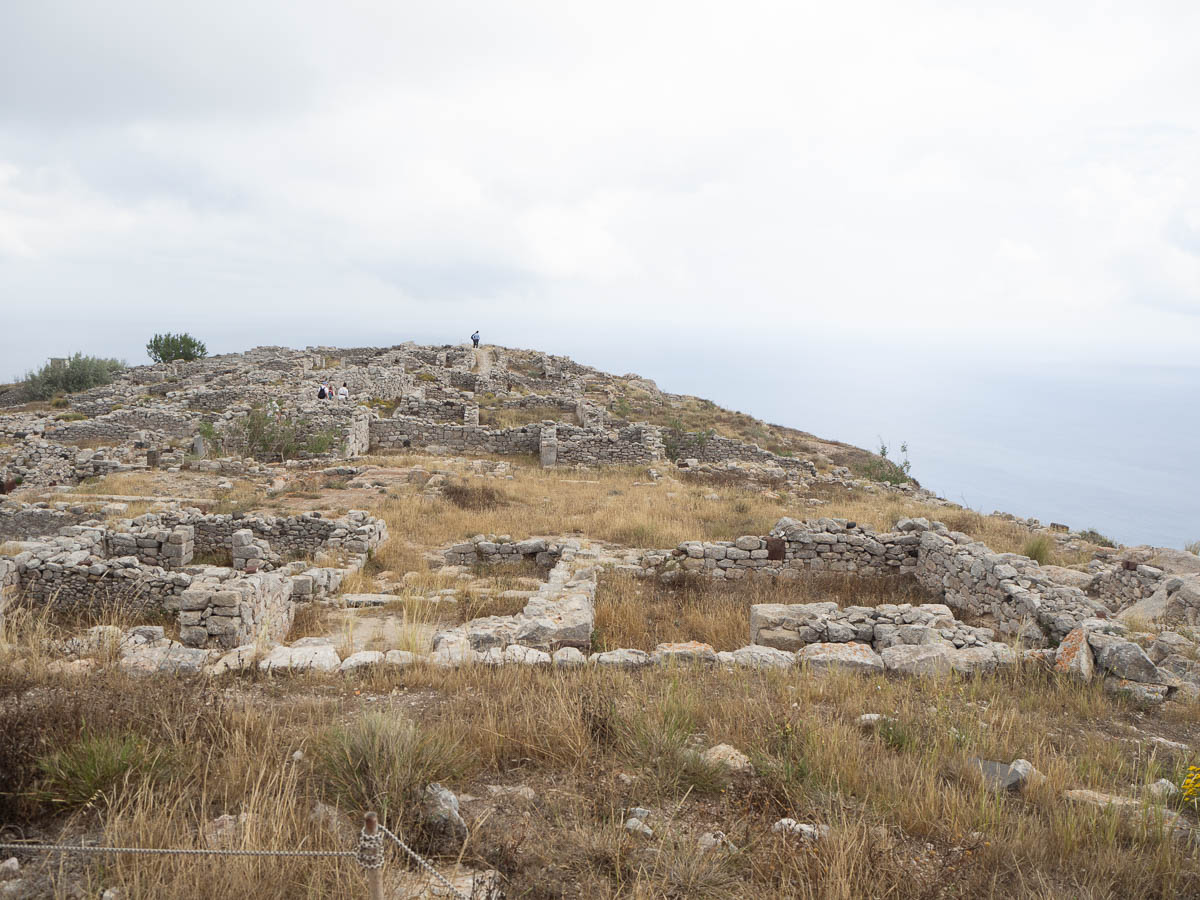
At the top of the hills, we came to the site of ancient Thera, a Bronze Age town destroyed in the volcanic eruption that destroyed most of Santorini and ended the Minoan civilization. It was amazingly well preserved – paths, walls, pillared halls, carved reliefs still fully visible.
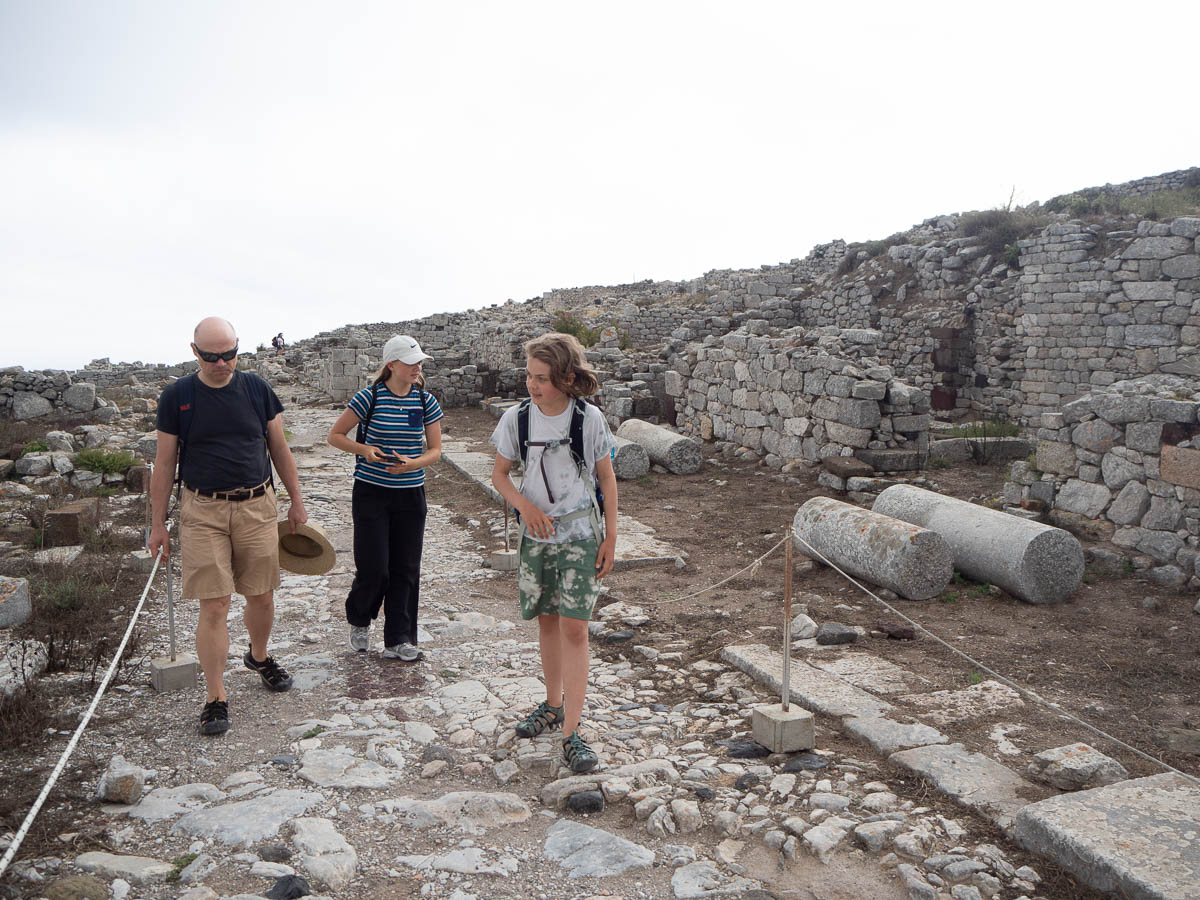
Ingrid kindly took some photos of me. I was there, too! (Holding hard on to my hat because it was very windy up at the top.)
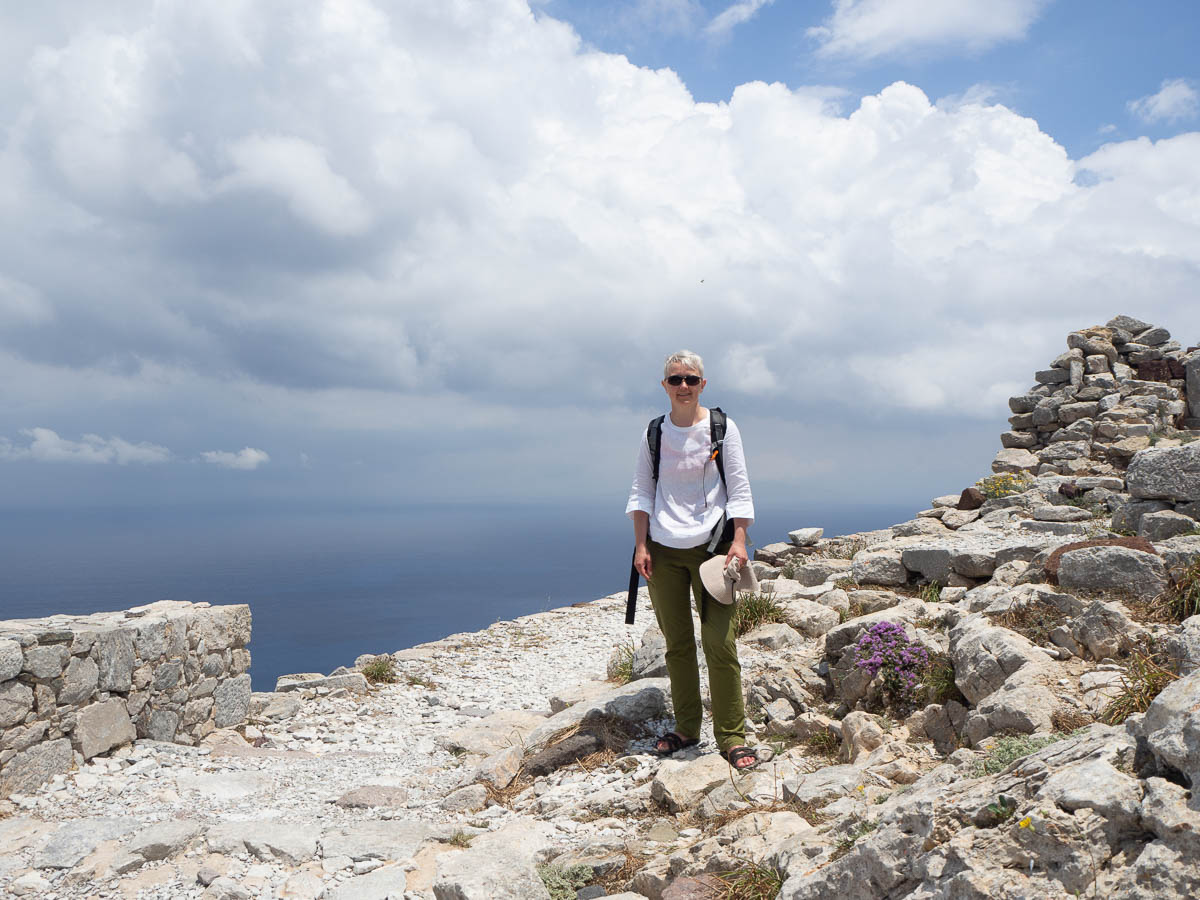
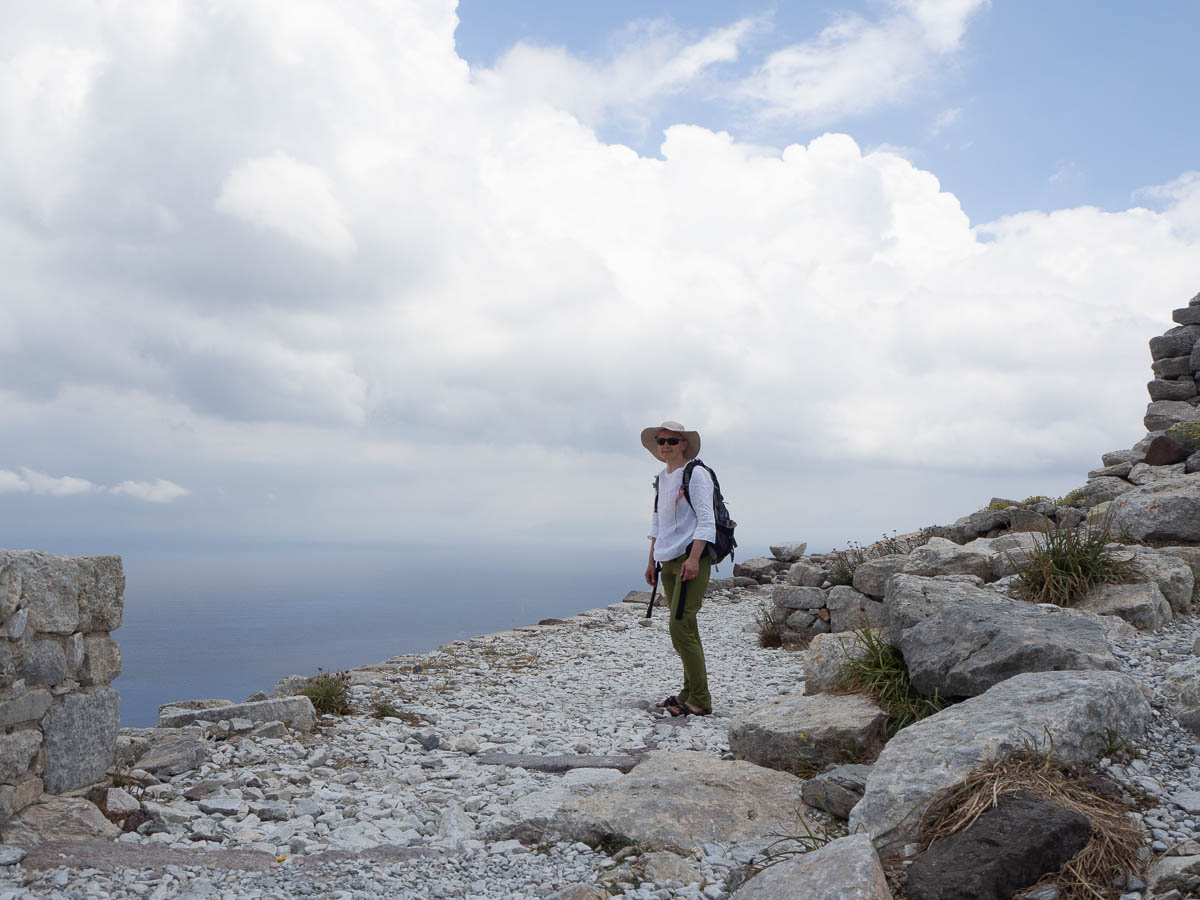
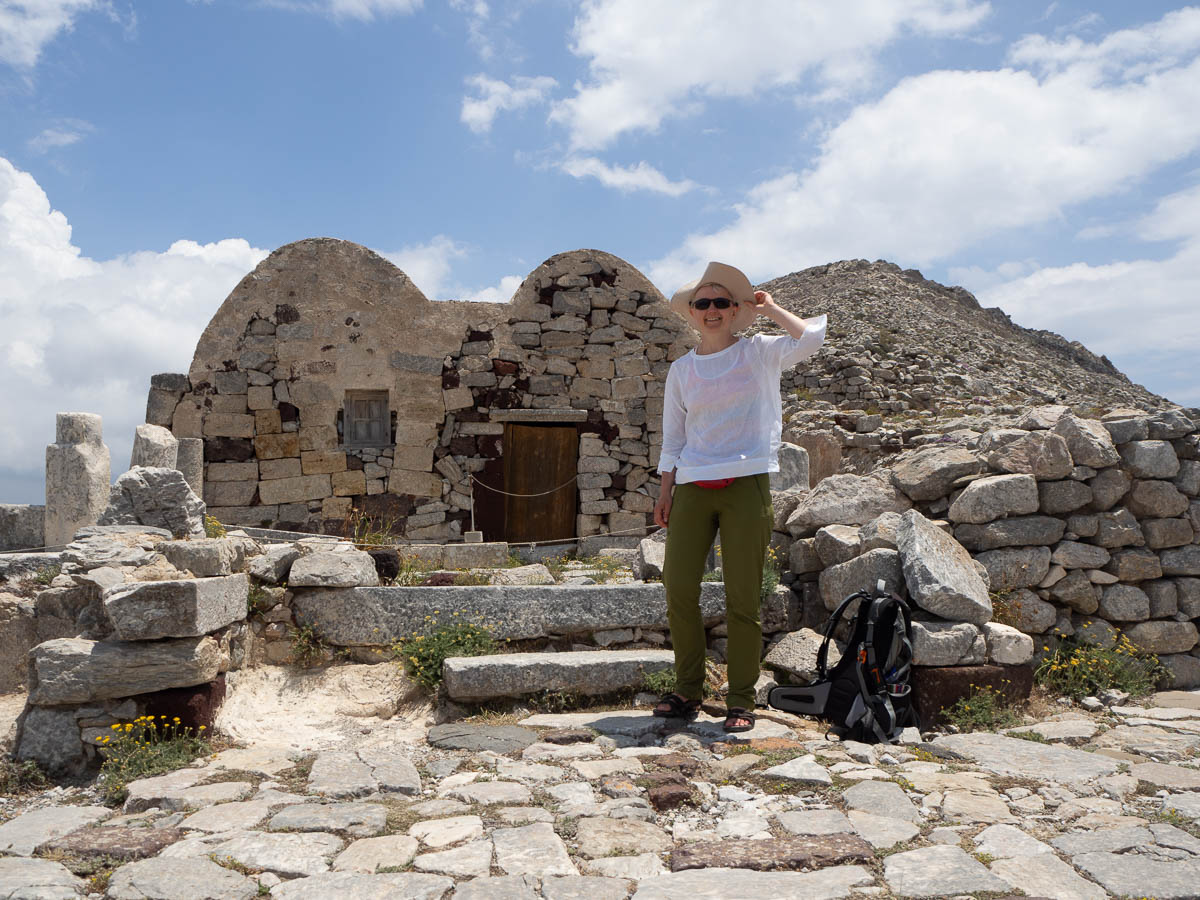
We took a different path down, which gave us a nice view of the road we previously walked to get up the hill.
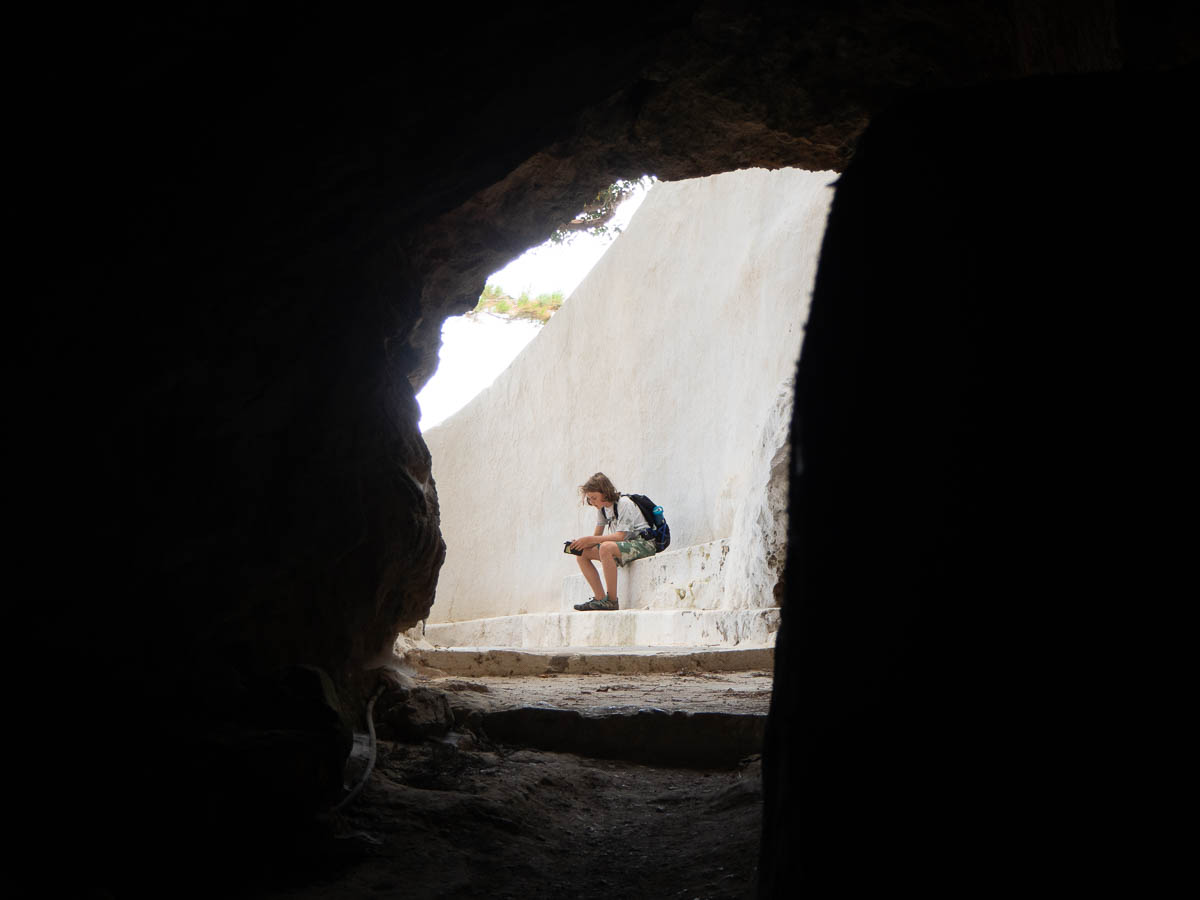
Halfway down there was a cave with a natural spring.
We’d been wondering before why anyone would build a town at the top of the hill where there is no water, but at that time, pre-volcano, the hill was much taller so the town wasn’t at the top. So perhaps they had similar springs there.
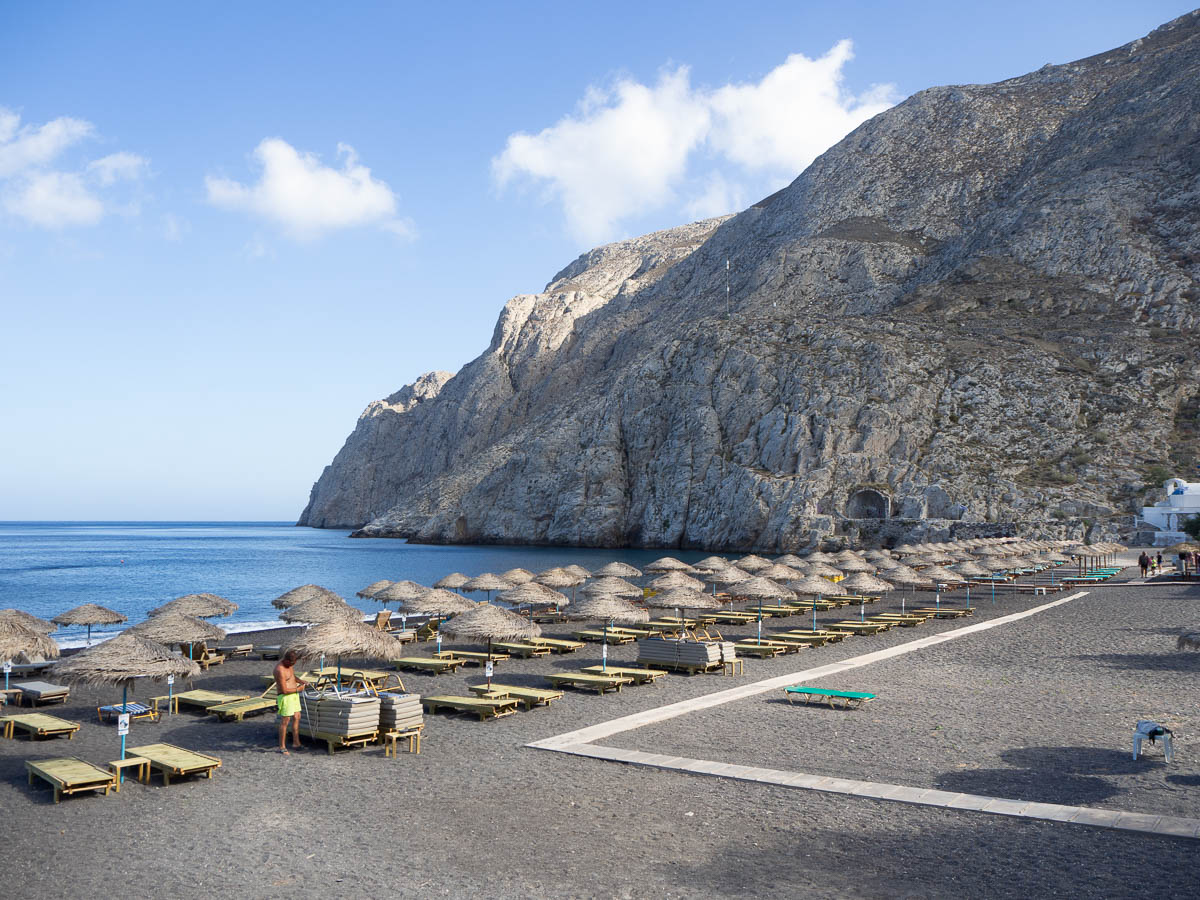
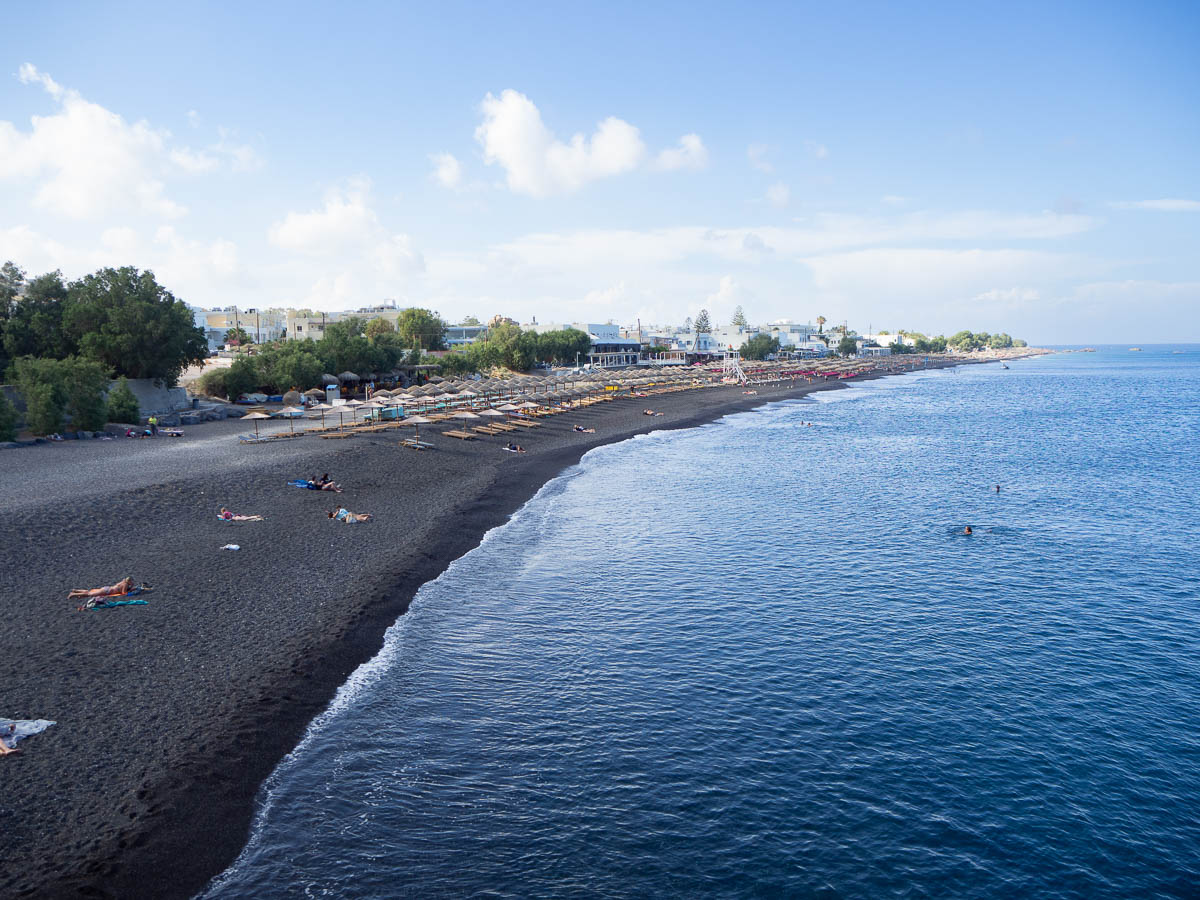
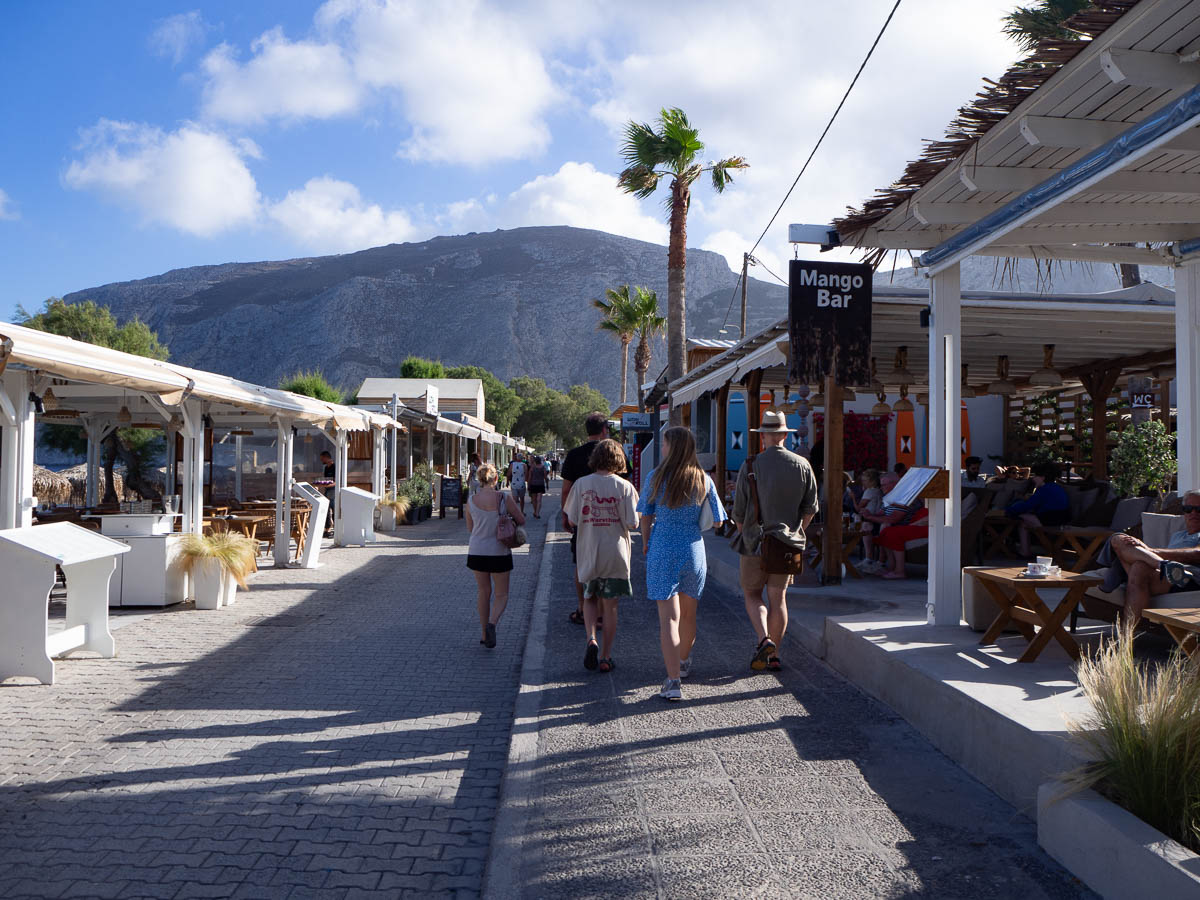
We’re on a week’s vacation on Santorini. Today was mostly travelling, although we had some time in the evening to explore Kamari, the village where we’re staying, and its black pebble beach, and the long beach promenade.
Hoping to not get caught by another heat wave to make hiking difficult, we booked this trip for as early in the season as possible, as soon as school ended. It’s hot, but not unbearably so.
Coming here in June is also good to avoid the crowds that are sure to be here in peak season in July and August – now the restaurants are more than half empty, and there is plenty of room both on the beach and in the streets.
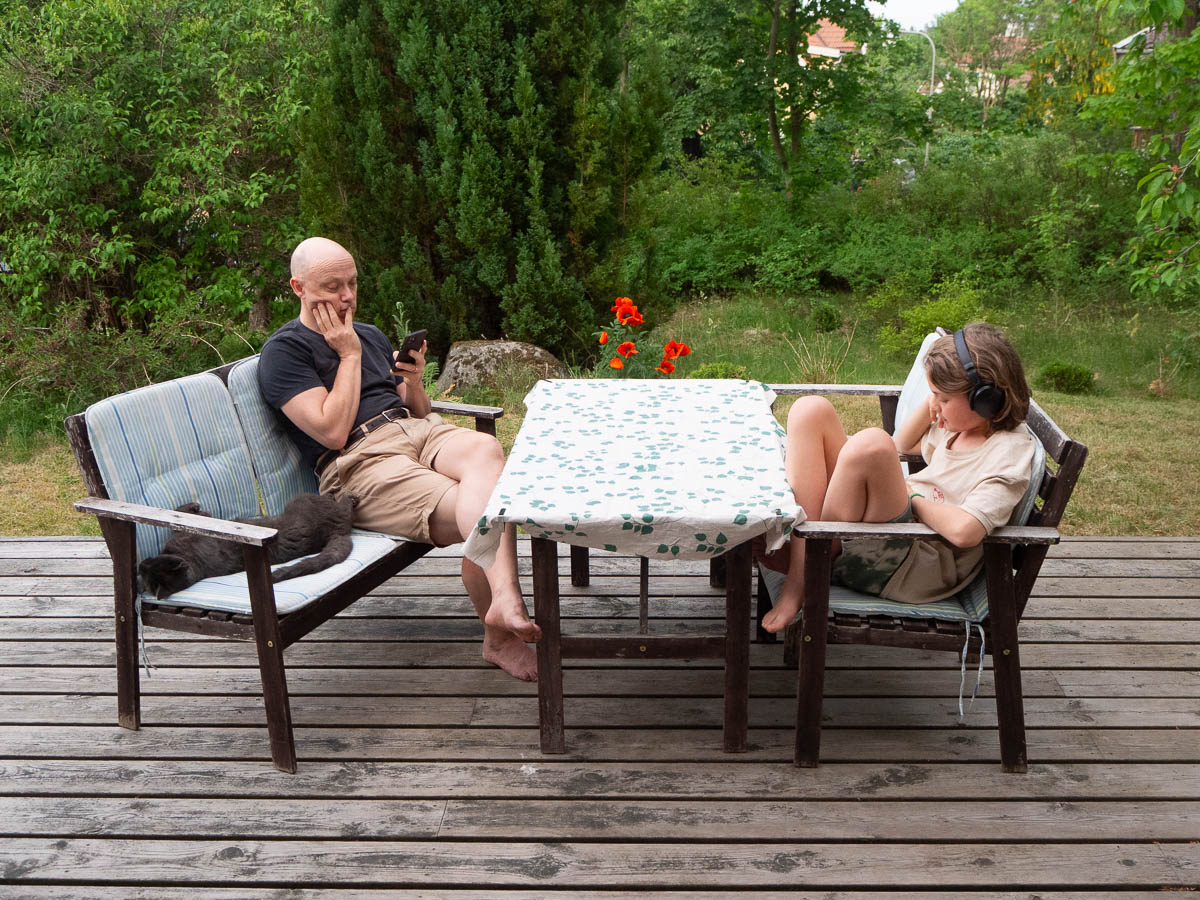
We celebrated end of school with a buffet dinner at Ri Cora, which is becoming something of a tradition.
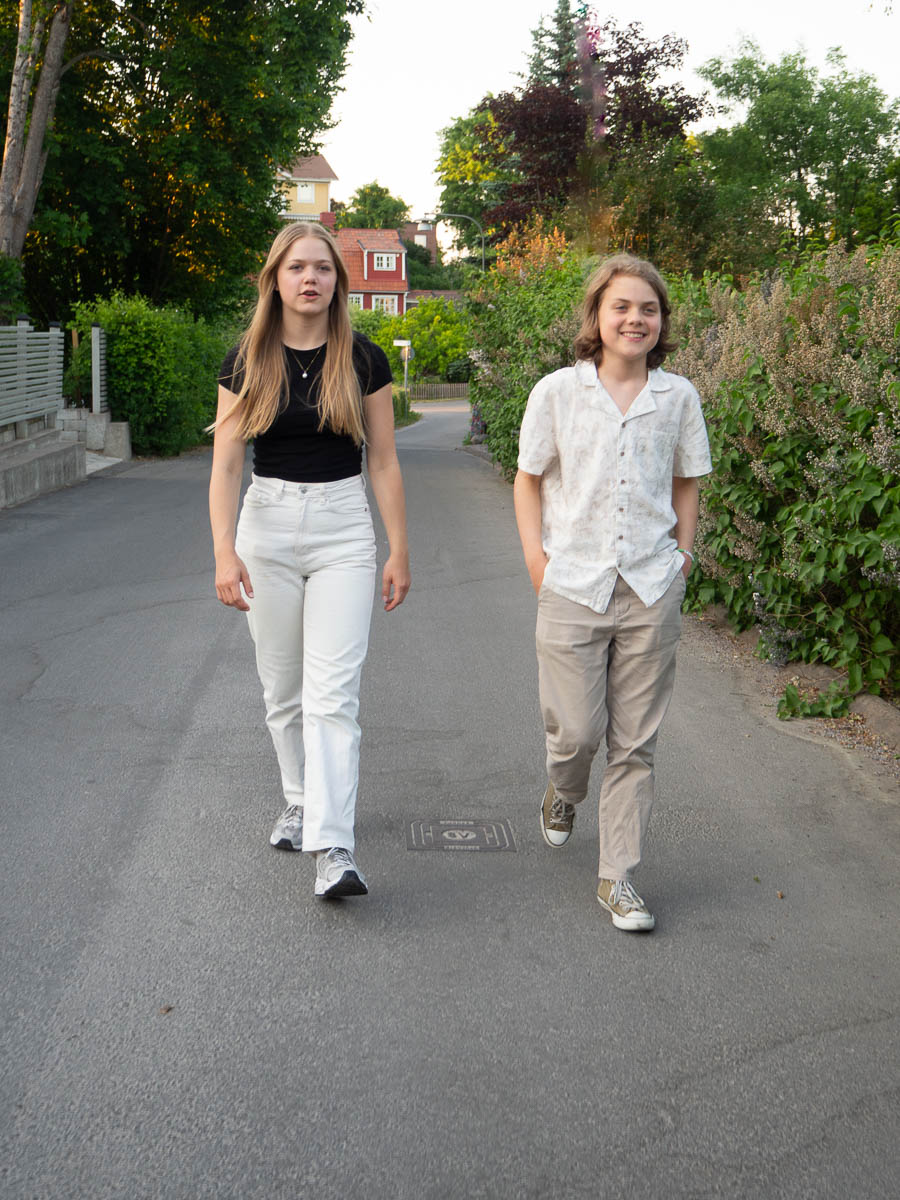
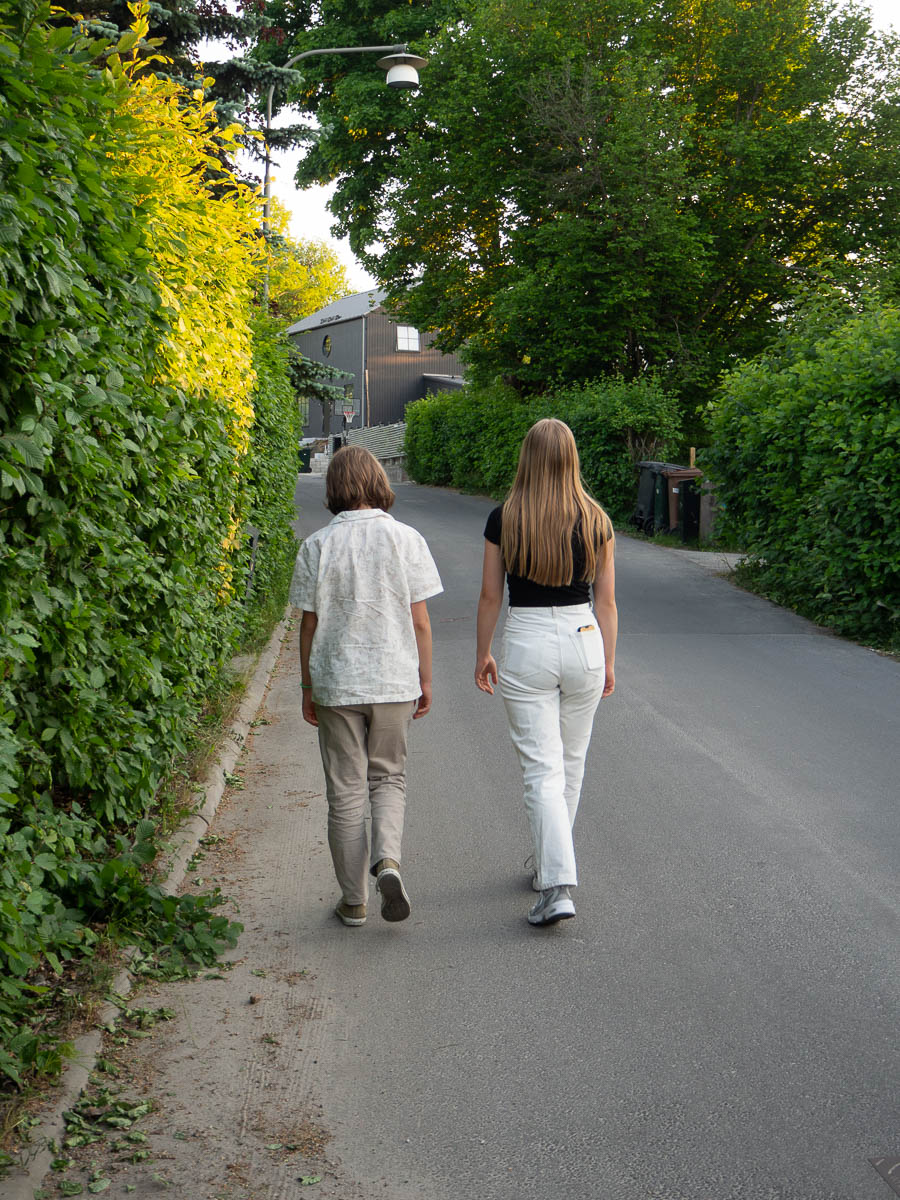
At the end of the evening I realized I hadn’t taken a single photo, although I’d gone there with a firm plan to take some. Especially since I get so few photos of Ingrid and Adrian these days, when they’re mostly doing their own things in their own rooms. We were almost home by this time, so I asked them to slow down to give me time to get out the camera. Their interpretation of “slowing down” was a slow-motion walk.
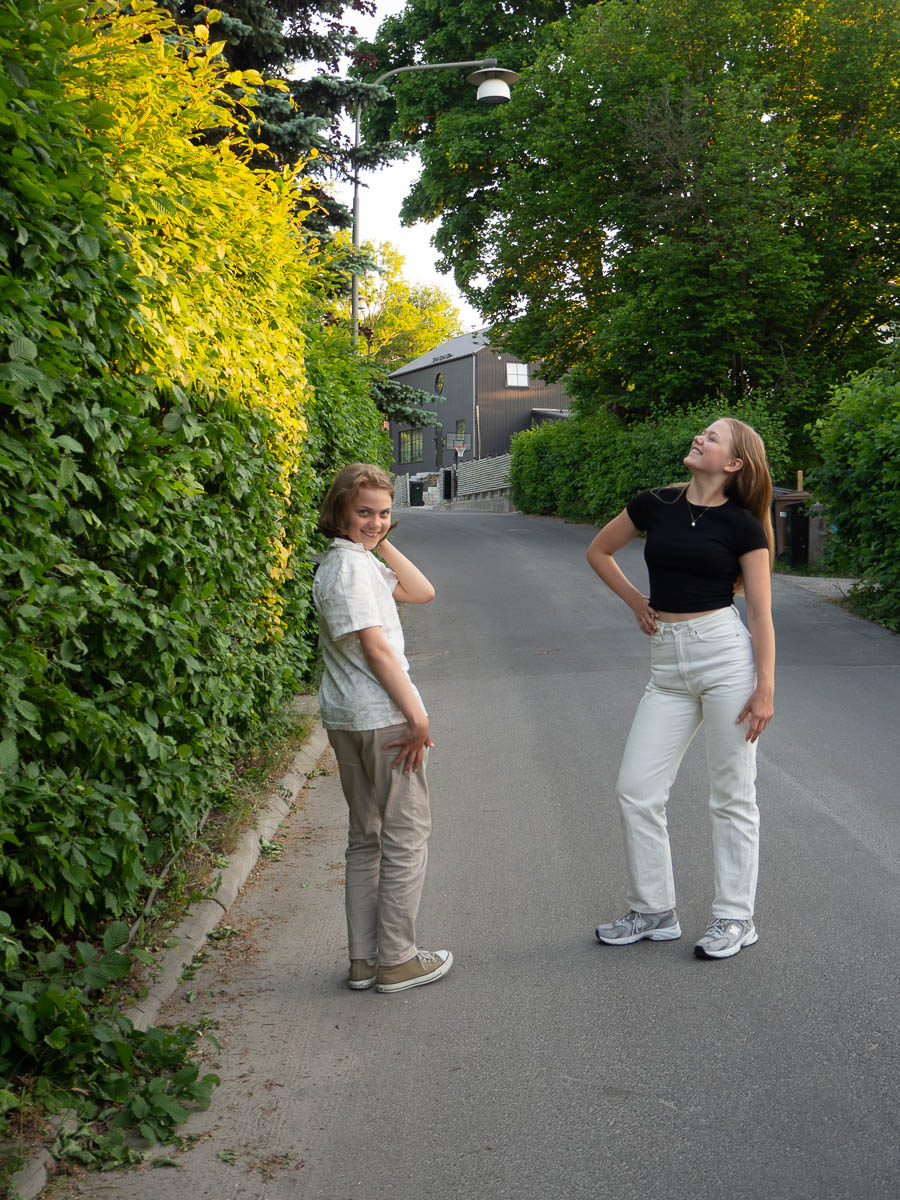
And then posing for the camera, with hair-smoothing and twisted bodies. (For Adrian’s last school photo earlier this year, the photographer had him twist this and turn that and put his hand there, and he said it had felt incredibly awkward.)
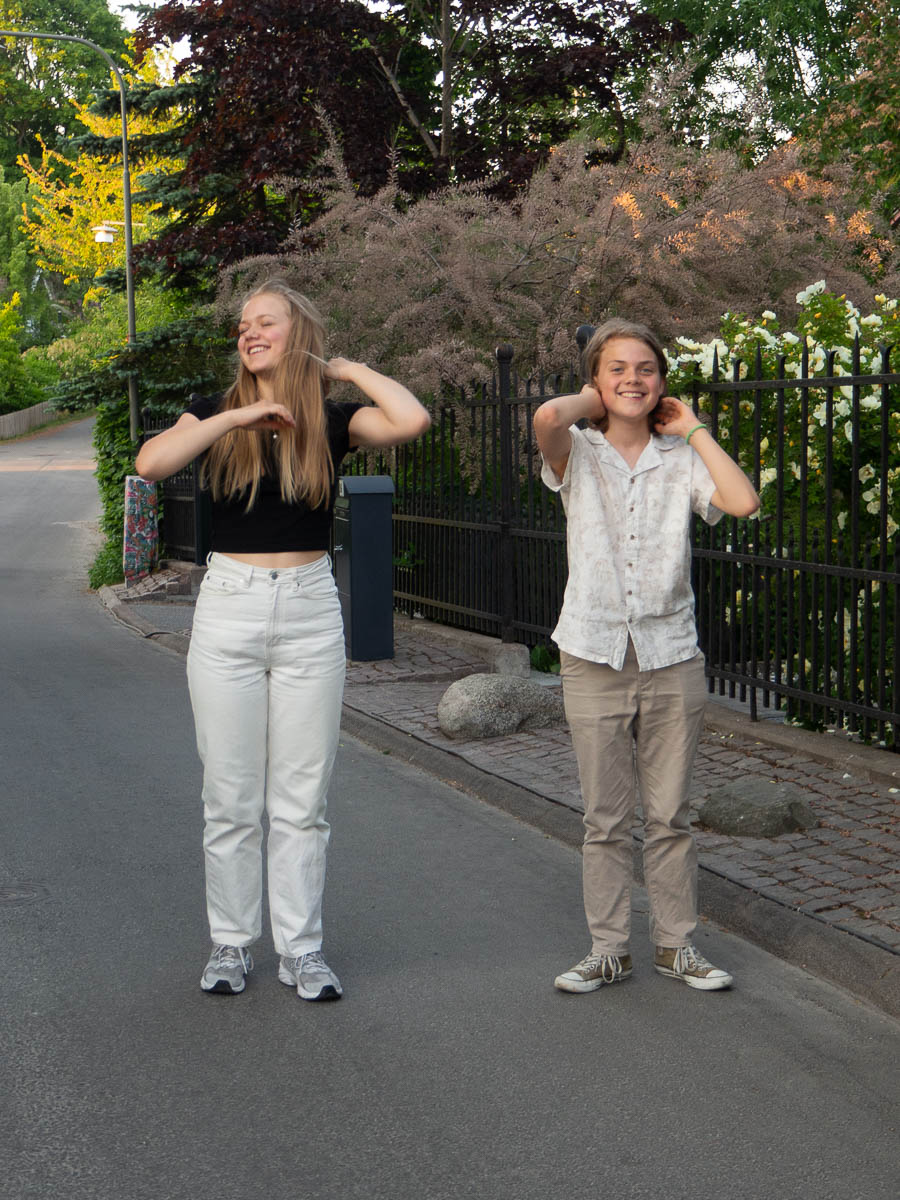
Eric biked home so I didn’t get any of him at all. But we do have a summer vacation coming up so I’ll get more chances.
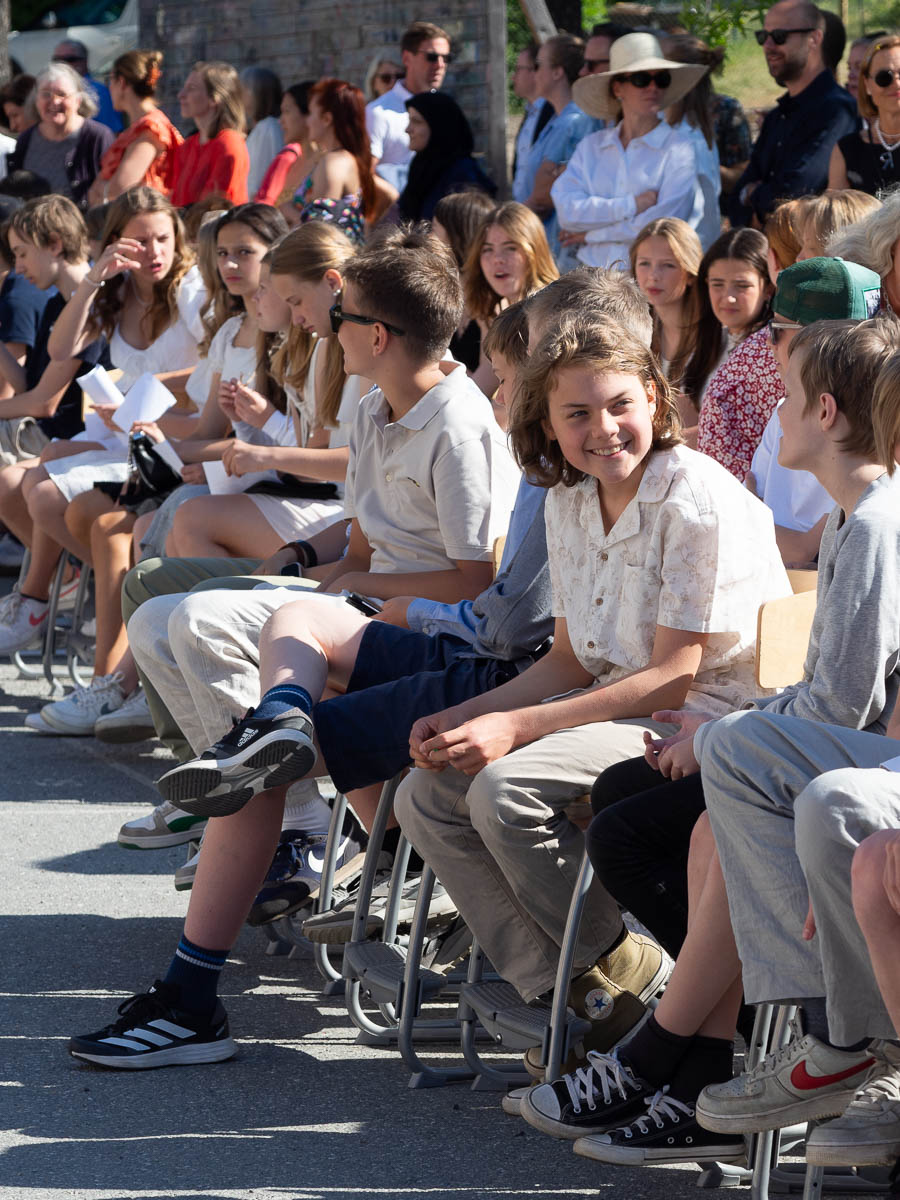
End of school, and Solhemsskolan’s usual ceremony. After 10 year’s it’s becoming a bit old, but I guess the kids appreciate the tradition.
In all the ten-plus years we’ve never had bad weather. There was one year when we brought our umbrellas but ended up not needing them. And it’s not like June is always sunny – there was that one year when we had such horrible weather on midsummer (I think it was only 15°C) that we celebrated indoors. We’ve been lucky.
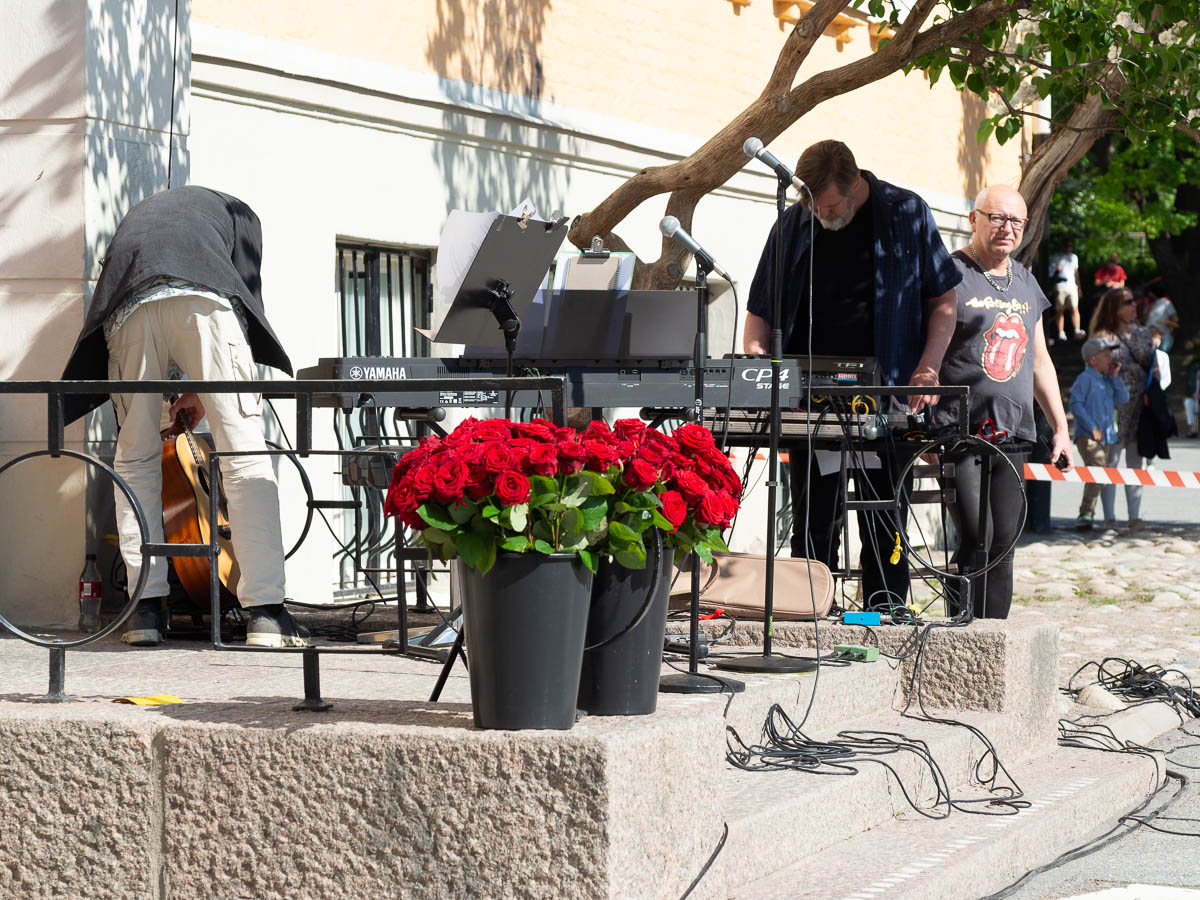
One part of the tradition is that the youngest pupils give roses to the oldest ones, leaving school at the end of grade 6. I remember when Ingrid was giving a rose, how old and big the twelve- and thirteen-year-olds looked. And in a way they still do, but also not.
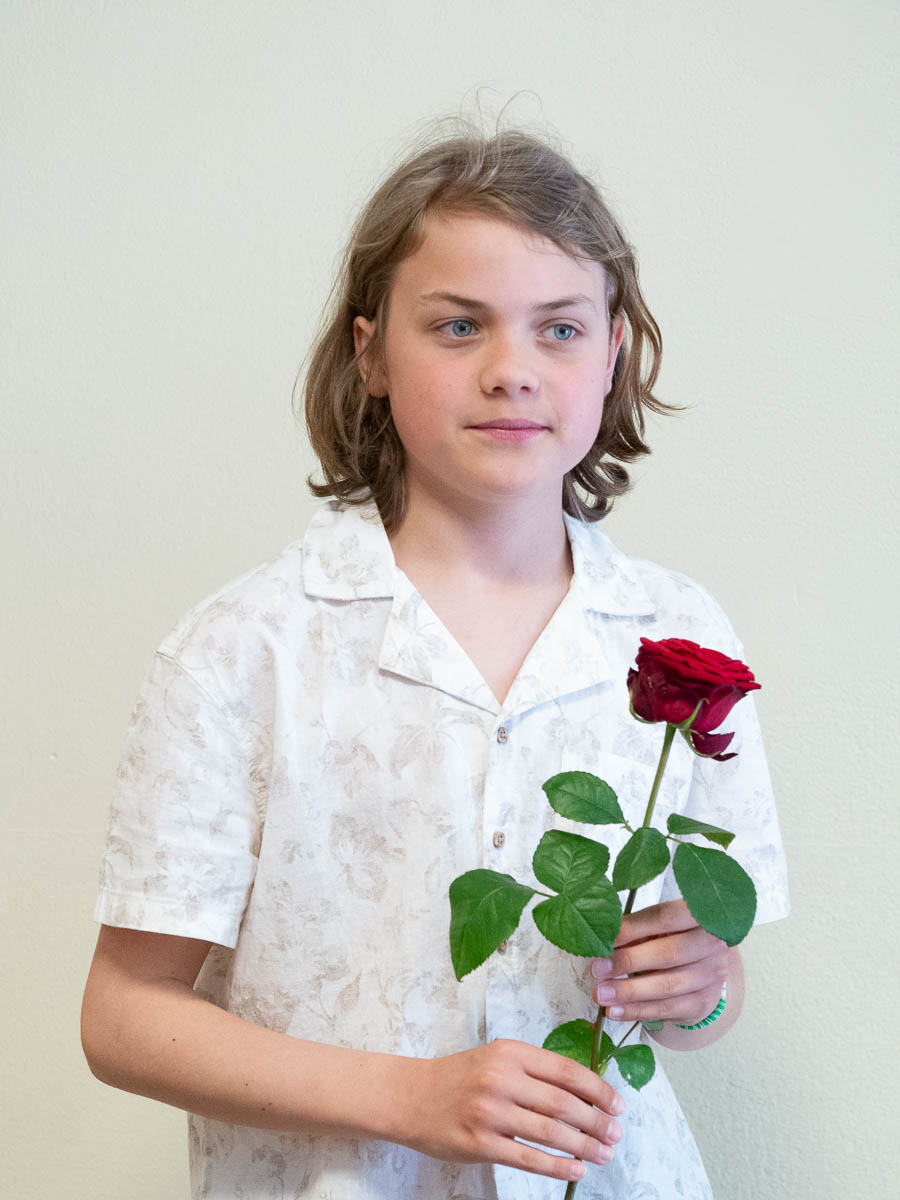
Adrian proudly finished the year with eight A grades.
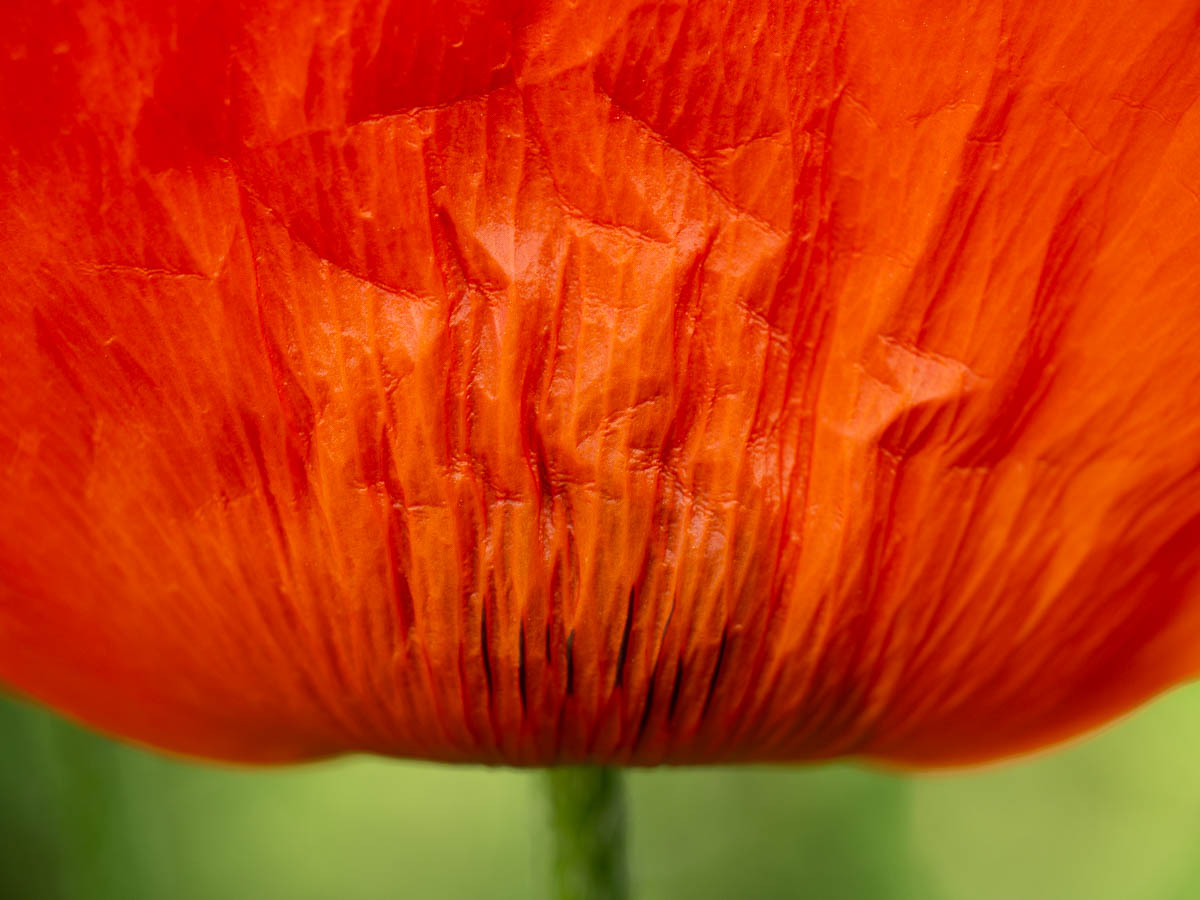
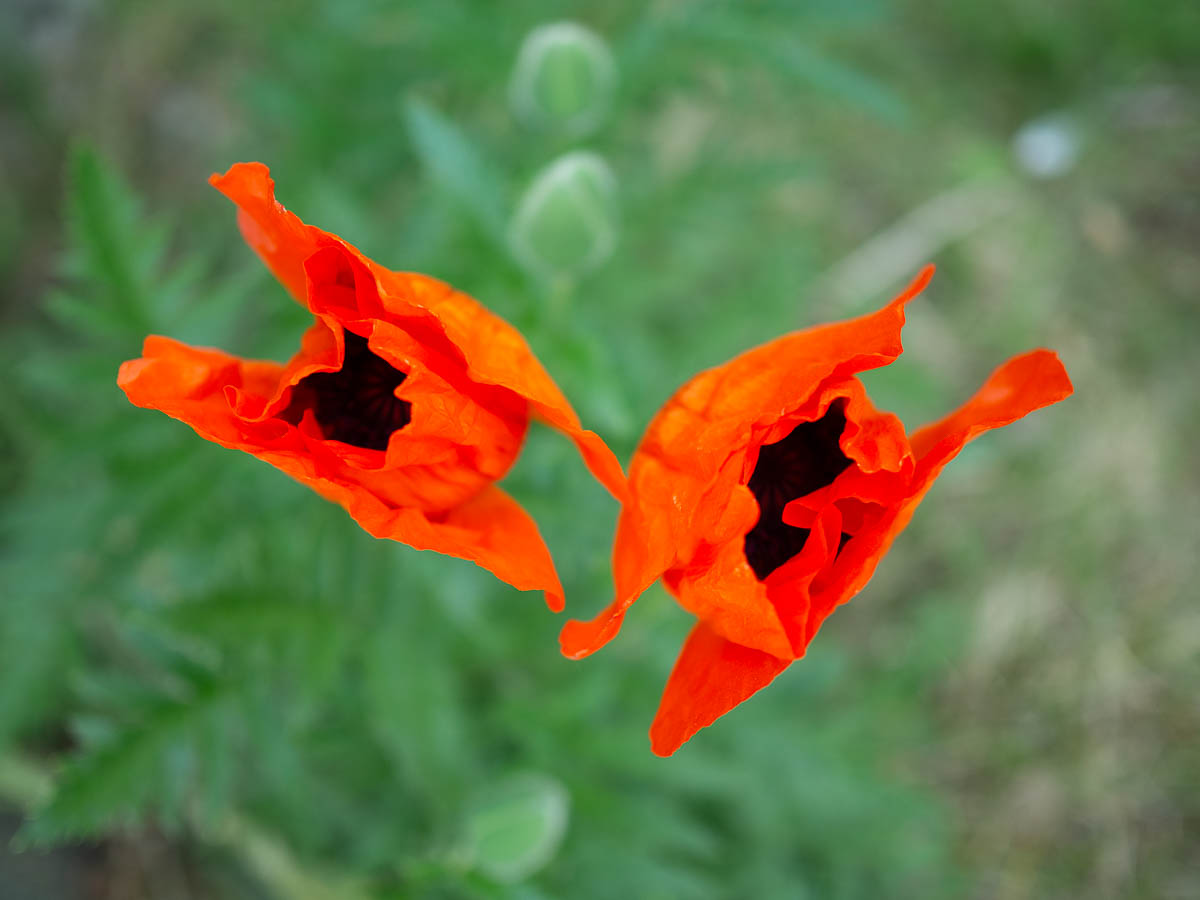
Poppy flowers are so red that it feels like a visual glitch, like burnt-out pixels, like a hole in reality.
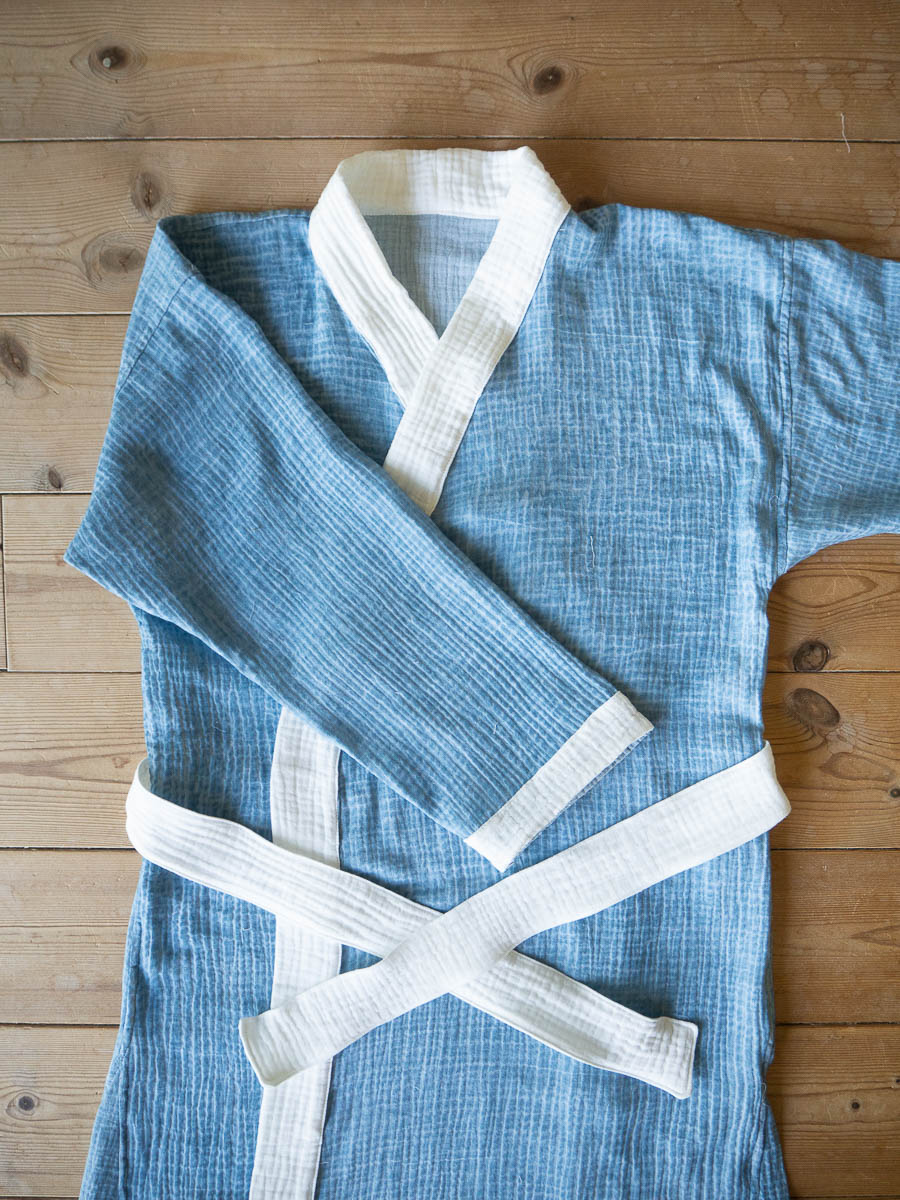
Not bad! Took me most of the weekend, but it came out pretty nice. Incredibly soft and comfy, almost makes me want to cuddle with it. A few slightly uneven seams here and there, but nothing that anyone will notice without a very close inspection. My top-stitching is never as even as I’d like, and it was extra tricky with a floppy fabric that would not stay as folded.

I could probably have had it finished in half the time if I hadn’t decided on flat felled seams. But they’re going to feel so much nicer, and be more durable as well.
The internet, by the way, is full of tutorials for felled seams; there are endless numbers of sewing tutorials out there and felled seams are a popular topic, I guess, because they look so professional but aren’t actually difficult. But those tutorials all stick to the basics and I couldn’t find a single one that covered more advanced topics – such as, how do you sew the meeting of two felled seams? I don’t know if it’s because no sewing expert has written about it, or because Google has gone to the dogs. Which it definitely has; it used to be possible to force the search to include every word in my query but now Google just ignores what I type and goes for the most popular results. “Hey, I know you typed something else, but how about you read this thing instead, I think you’ll like it better.” No, I don’t.
Where my felled seams meet, they sort of fall all over each other and get a bit tangled, but it’s all hidden anyway so that’s OK.
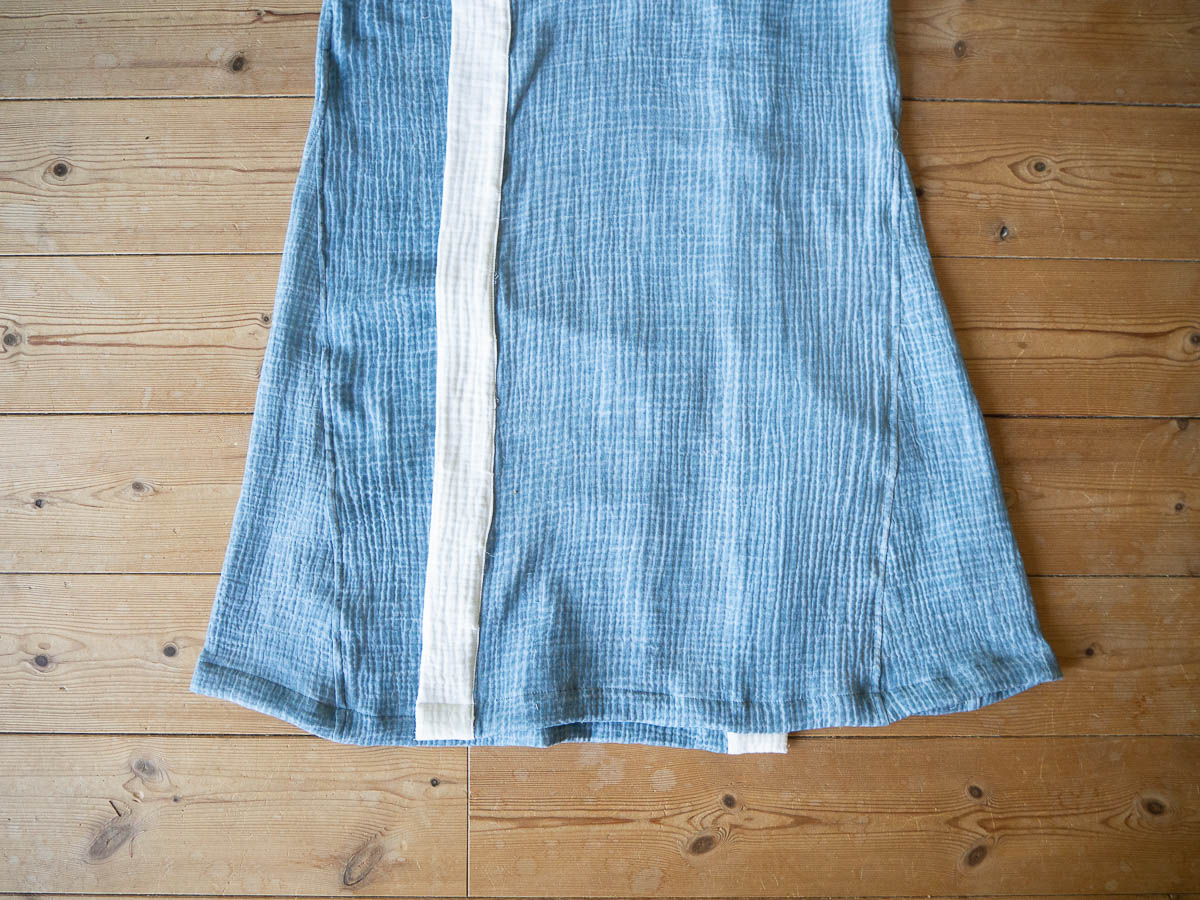
Why do my felled seams need meet each other, anyway? A simple dressing gown just has some straight armhole and side seams, right?
That would have been true if I had just followed the pattern. Unfortunately the pattern I bought looked good on the sketch but that turned out to be an “artist’s impression” only, and reality was different. Like the “artist’s impressions” of proposed new city squares that are all sunny and have trees in little containers and happy young people walking around, and by the time reality arrives the trees are gone and in their places there are garbage bins.
In the sketch the dressing gown was clearly wider towards the bottom and had a nice wide overlap in the front. In reality the body was all straight lines, which was the one thing that I did not want. I am never going to trust another pattern from Svenska Mönster again.
The way the pattern pieces fit on the fabric, I couldn’t easily make them wider, so I added extra pieces in the side seams. (I’ve now learned that the technical term for these is “godet”.) The result is maybe not as sleek as it could have been, but it definitely fits me better. If godets were good enough for the tunic of the Bocksten Man, they’re good enough for me as well.
It was rather satisfying to have filled my need for comfortable summer dresses, so I’m bravely embarking on the next project.
For years now I’ve wanted a nicer light-weight dressing gown. My current one is shiny and glossy and looks almost unworn after fifteen years of use – but it achieves all of that because it’s 100% polyester and feels like plastic against my skin. And it’s too short – I can walk around in it, but not lounge on the sofa without feeling half-naked.
It’s one of those problems that simmers in the background and never becomes urgent. I’ve ordered two potential replacements from a second-hand marketplace; both came with their own problems and ended up donated to a charity shop. Mostly due to fit: standard dressing gowns are straight in shape, which makes them gape around the knees as soon as I move around. And the problem remained.
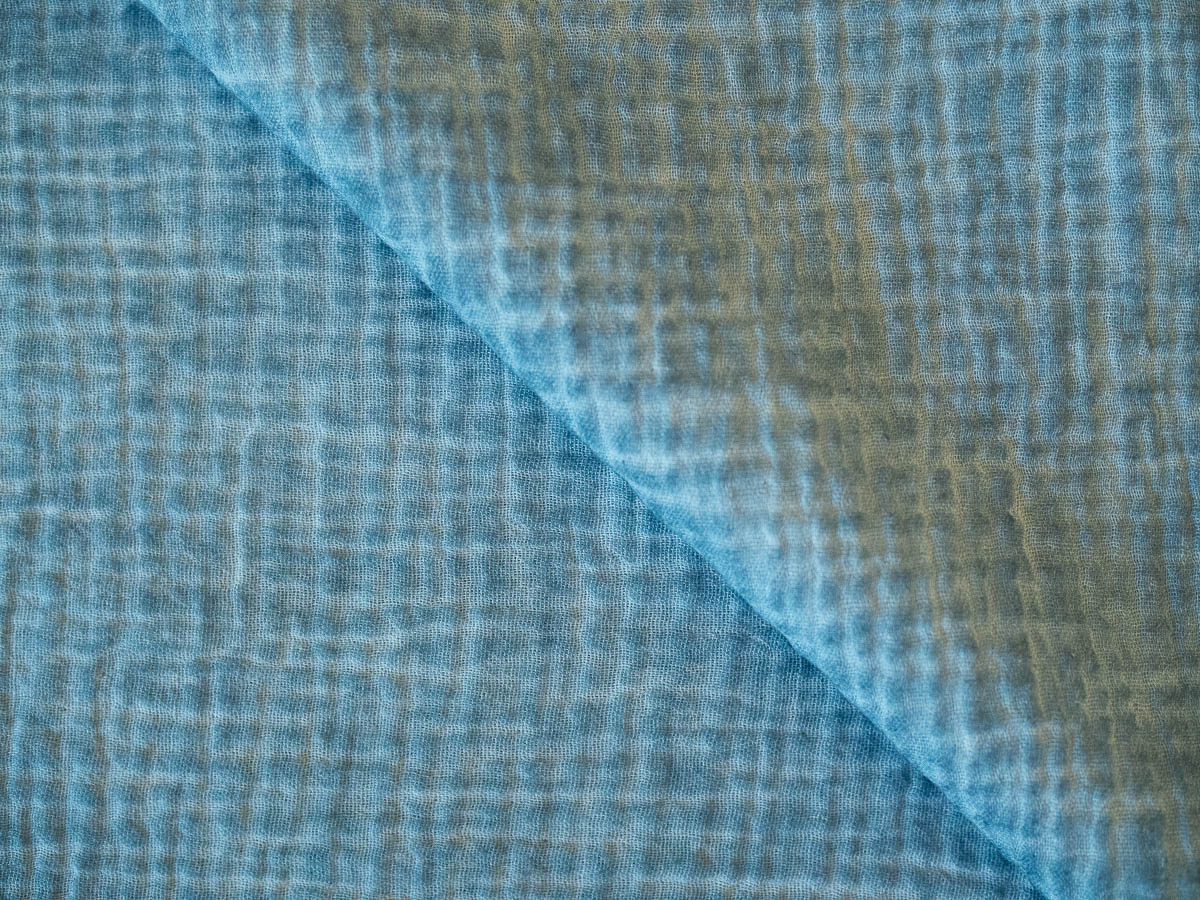
Sewing those dresses was maybe not the most fun I’ve had, but the results were good. How much harder can a dressing gown be? Last week I went fabric shopping again, and found this beautifully soft double gauze. It caught my eye as soon as I entered the store – the light-weight summer cottons were displayed right on the counter – and nothing else could compare. Of course it turned out to be more than twice the price of the other gauzy cottons… Now the result will have to last me another fifteen years. Although since it’s cotton rather than polyester, it might actually wear out with time.
| « Older posts | Newer posts » |
