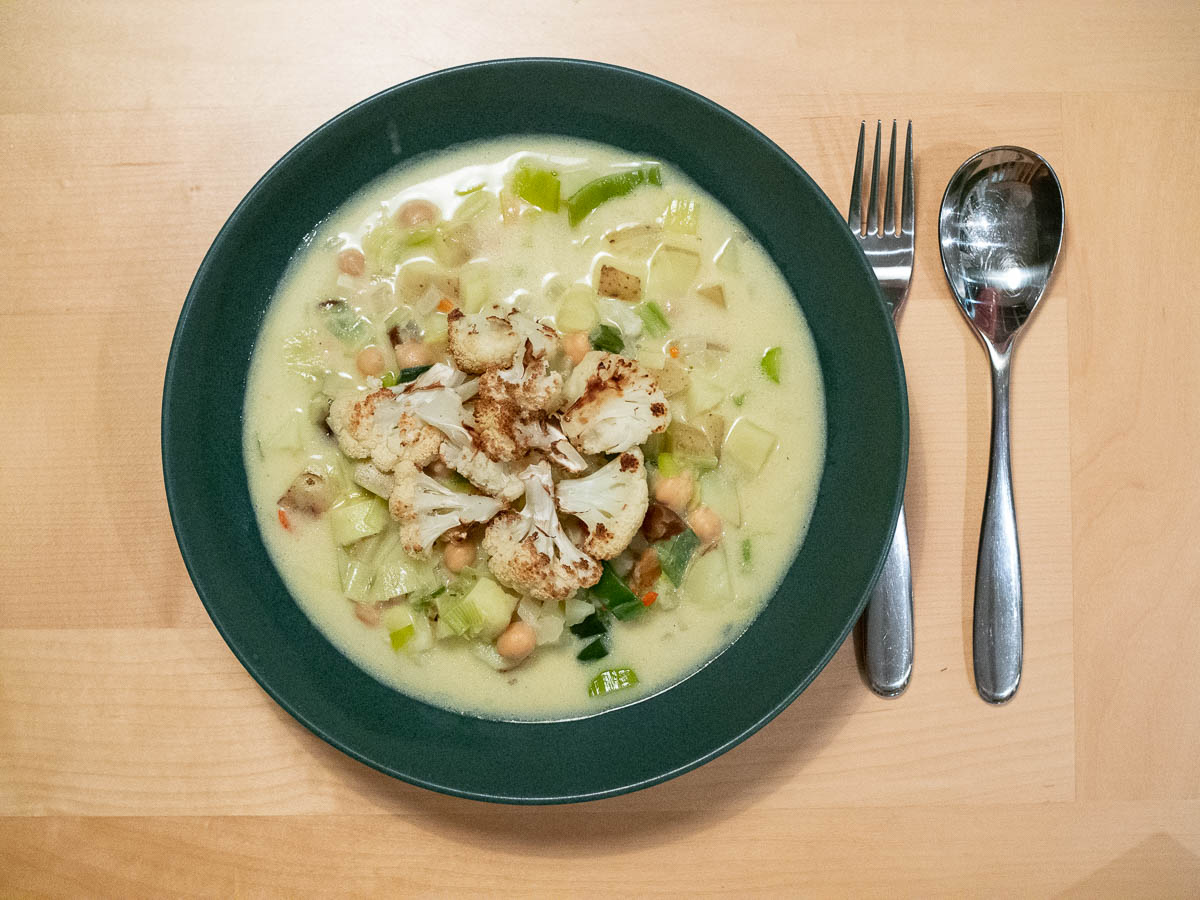
Adrian likes watching cooking shows. We’ve been watching Sveriges mästerkock together, and he likes Sveriges yngsta mästerkock, the junior version, even better. We’re waiting for the new season to be released. He also watches Gordon Ramsay on his own.
He sometimes asks me if I think I could be on that show, or if some meal I cooked would be good enough for it. I guess that’s a sign that he appreciates my cooking.
The most obvious difference is that the contestants always cook carnivore food. Many challenges are explicitly meat-based. But they nearly never make vegetarian meals otherwise either, even when the challenge to me looks incredibly vegetarian-friendly. (I think a very few pastas and soups have been vegetarian.)
But what if they had a “Sweden’s best vegetarian chef” contest, Adrian asked?
I explained that the food I cook – no matter how good – is of a different kind. I cook everyday food.
The flavours are part of it. My cooking is way more varied and interesting and flavourful than what the average Swede cooks, I believe, but ultimately still comfortable rather than adventurous.
But it’s not just that. I could easily use flavours with more edge. What is it really that makes my food “everyday” food and not “master chef” food?
I think the answer is a low level of complexity.
When I improvise a meal without a recipe (which is often how I approach cooking) I tend to end up with a single complex part, with potentially some simple ones accompanying it. And with “complex” I mean something made up of many elements.
Sometimes it’s just the one complex thing on its own: a soup, or a stew, or fried rice, or even something like a lasagna or frittata. Like the stew in this photo.
Sometimes the complex thing could be a rich saucy thing, or a stir-fry, and then it would be accompanied a simple thing like carbs (rice, pasta, potato, bread) or maybe a separate protein (halloumi, tofu) or vegetables (fried broccoli, steamed asparagus). These simple things may be flavoured or marinated etc, but they clearly have just one main ingredient.
Master chef meals often have several complex parts. If there is a soup, then it has a topping and some dipping sauce for the bread. If there is a meaty thing then it has both a fancy sauce and a complex vegetable thing and possibly even more things.
The meal kits from Lina’s Matkasse were also often like that. That’s why I liked those meals: they had not just new flavours, but often a whole different structure.

Leave a comment