This evening I started on this season’s second round of mowing the lawn. I mow in sections, usually about a quarter or a third of the lawn at a time, so it takes about a week or two to do the whole thing.
This is not just to spread out the work – although with about 800 sq m of lawn to mow, doing it all at once would take at least half a day. It’s also because I don’t want to denude the whole garden at once. This way there is always some part that does not look “shaved bare”. Because that is what I think the mowed parts look like: bare and boring.
Most gardeners seem to dream about the perfect lawn. Perfectly even, perfectly uniform… perfectly dull.
I can imagine that one might feel a sense of achievement, of mastery over the forces of nature. I guess. But I really cannot empathize with that. If you don’t want nature in your garden, but rather something more akin to a carpet, why have a garden at all?
It always feels like a pity to mow down all the variety, all the flowers and the different grasses, to an even green surface. Now I only mow at the last responsible moment, when I feel that the lawn is close to becoming unmanageable. Once it grows too tall, it becomes difficult to mow: the thinner grasses bend so the mower runs over them and doesn’t cut them, and in other parts where the grass is particularly lush and thick, the mower simply gets stuck.
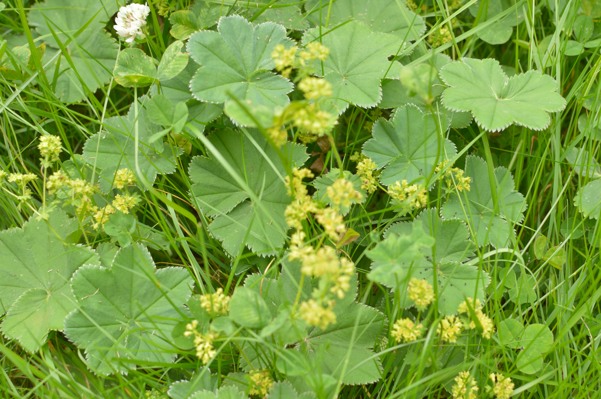
I always make an effort to spare the wildflowers (aka weeds) in the lawn: wild primroses (nurmenukk/gullviva), the ox-eye daisies (härjasilm/prästkrage) and Campanula (sinikelluke/blåklocka), Lady’s Mantle (kortsleht/daggkåpa), larger groups of lawn daisies (tusensköna/kirikakar) and creeping buttercup (revsmörblomma/tulikas) and so on. In a proper lawn, these would all be considered weeds. Here, I’m happy for them to go to seed and spread.
Also totally not a weed (although I don’t go out of my way to spare them) is clover. Its tendency to attract bees is, according to gardening magazines, a reason to get rid of it: you might get stung. To me, something that attracts beneficial insects to the garden is most welcome. We just watch our step when they’re in full bloom to avoid stepping on the bees and bumblebees. (There is a bumblebee nest somewhere in the crawl space under our house.)
I also don’t mind plantains (groblad/teeleht), or any of the other non-lawn species whose names I don’t even know. (I think I should by a book about weeds.) And I don’t mind moss, either. It is soft to walk on, and nice to look at.
There is only one species of plant in our lawn which I do consider a weed, in agreement with mainstream gardeners, and will dig out if I can bother: dandelions.
Then there are things that are technically not weeds, and may even have some positive value, but totally exhibit weed-like behaviour in our garden, and need to be kept at bay: if let loose, they would spread out of control, fast.
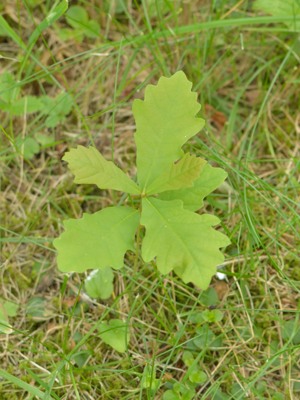
Cherries. They spread by root and by seed, and there is no end to them. In the same category (but without the redeeming berries) are maples: every spring and summer we walk around pulling out maple seedlings. And oaks, too, probably brought here by squirrels or jays, because there are no oak trees here.
Lilacs and snowberries. Both are nice in hedges but send their rhizomes way out into the lawn, and then produce lots of shoots.
As a result of our non-standard way of caring for the lawn (infrequent mowing, no watering, no fertilizer) we have seen new species spreading and thriving. The wood anemones are spread much wider than five years ago. This year we noticed foxgloves for the first time, in a part of the garden that I have left unmowed since spring.
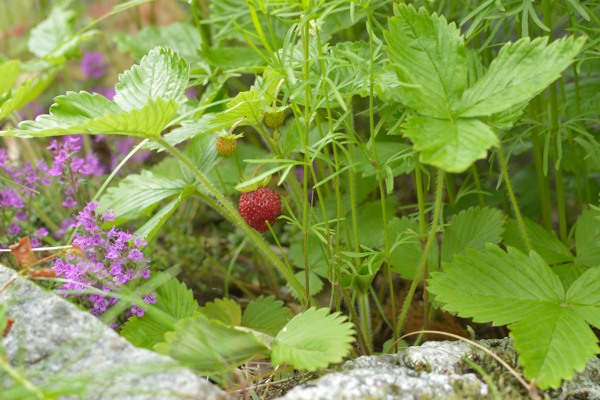
Wild strawberries, which we found in just a few places during the first summer, are now spreading in more places than I can count. Lots of fun for the kids, who go on strawberry hunts in the evenings, and an interesting challenge for me. I don’t want to mow the strawberries of course, at least not the largest, most fruitful patches. But if I don’t do anything then they will get buried under tall grass. My current solution is to simply tear off some of the grass by hand (where the grass is thin) or with grass shears.

Leave a comment