One day, all of a sudden, Adrian fell in love with his soft stuffed doll. Eric made it for him during the schooling-in week last year, and it’s been at nursery since then. They use them occasionally for some sort of group activities I think. And then one day Adrian absolutely wanted to take it home with him, and to hold it all the way home, and to have it with him during dinner, and then in bed.
We gave it a name because I didn’t want to keep calling it “the doll”. I tried a few names and asked if Adrian liked any of them. “The doll” is now called Johan.
Johan was the drop that started a flood. Now Adrian wants to take stuff with him whenever we go out: bags, toy cars, Johan, his favourite jersey hat, an extra pair of mittens, books… At dinner time Johan (or the car) gets to sit on the windowsill. One evening he took three little Chubbies cars with him to bed, and then tried to hold and hug all three while falling asleep.
Taking things with him when going out is OK, but he also wanted to take things home from nursery, and we had a number of tear-filled disagreements about.
Every afternoon, after nursery but before we pick up Ingrid from school, we go grocery shopping. Adrian wants to hold the most important grocieries in his arms both in the supermarket and afterwards on the way home. And just like with the cars, he has difficulty understanding and/or accepting that he only has two hands. He holds a banana, a pair of mittens and a book in his hands, and hugs a large bag of corn snacks, and then asks for the juice bottle as well.
Adrian’s started to pretend and make believe. A piece of fabric becomes a scarf for the hobby horse. An empty bowl in the kitchen sink is cake dough; a pink drinking straw becomes a flamingo. Food, especially, is good fantasy material: the row of apple chunks is a snake; the half-eaten biscuit is a camel, or a dog, or a train.
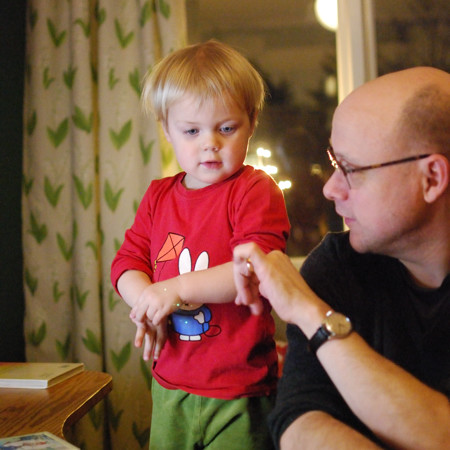
Colours, which he was so interested in last month, have now clicked in place. He still talks a lot about them, but now he actually gets many of them right: red, green, blue, yellow, purple, orange, sometimes white and black.
He often asks, Vad heter den färg?, and he mentions the colours of things he cares about. And he seems to find it fascinated that several things have the same colour. Den vagnen heter röd. Den skorna också röd! Väskan också röd! (“This stroller is called red. This shoes also red! The bag also red!”)
He has started using compound sentences, with a main clause and a subordinate clause. For example using men inte, “but not”, as in “Mommies have boobs but not daddies”.
Miscellaneous items:
- He has learned to jump with both feet.
- Favourite Melodifestivalen song: En riktig jävla schlager.
- Favourite item in the supermarket: Paulun’s raspberry and pomegranate juice. (“Buy raspberries! Green ones!”)

Leave a comment