A friend told me a story about his daughter, not yet a year old. She had been given a little plastic whistle, which she loved to toot. It was her favorite toy. One day one of her parents picked up the whistle, and, seeing that it had holes, like a recorder, began to play a little tune on it. They both amused themselves with it for a minute or two, then gave the whistle back to the baby. To their great surprise, she pushed it angrily aside. At the time her father told me the story, she had not blown it since.

It is certain that a child is greatly inspired and helped by what are often called “competence models” – people who can do things better than he can. But we ought to remind ourselves now and then that sometimes a competence model can be altogether too competent. Child psychologists write a good deal about what they call “infant omnipotence”. Their theory seems to be that infants and young children really believe they can do anything, and only gradually, as they grow up, learn how little they can do. I do not believe this is true, even of babies; I am sure it is not true even of children as young as two or three, who know all too well how little they know, or understand, or can do, and for whom this awareness is very often frightening and humiliating. This does not mean that we must try to keep our superior knowledge and competence a secret from children; it would be impossible even if it were desirable, which it isn’t. But we must be aware that their ignorance and clumsiness are often painful to them, and we must be careful not to rub their noses in it.

It doesn’t take a child long, by such steps, to grasp the basic idea of a cello, the relationship of the bow, the string, and the left hand. But while he has been figuring this out, he has been ceaselessly active. One could say that he is having too much fun – a weak word, really – playing the cello to want to take time to figure it out. A scientist might say that, along with his useful data, the child has collected an enormous quantity of random, useless data. A trained scientist wants to cut all irrelevant data out of his experiment. He is asking nature a question, he wants to cut down the noise, the static, the random information, to a minimum, so he can hear the answer. But a child doesn’t work that way. He is used to getting his answers out of the noise. He has, after all, grown up in a strange world where everything is noise, where he can only understand and make sense of a tiny part of what he experiences. His way of attacking the cello problem is to produce the maximum amount of data possible, to do as many things as he can, to use his hands and the bow in as many ways as possible. Then, as he goes along, he begins to notice regularities and patterns. He begins to ask questions – that is, to make deliberate experiments. But it is vital to note that until he has a great deal of data, he has no idea what questions to ask, or what questions there are to be asked.

But the greatest difference between children and adults is that most of the children to whom I offer a turn on the cello accept it, while most adults, particularly if they have never played any other instrument, refuse it.

A child’s understanding of the world is uncertain and tentative. If we question him too much or too sharply, we are more likely to weaken that understanding than to strengthen it. His understanding will grow faster if we can make ourselves have faith in it and leave it alone.

He has to get the correct hunch many times, and test it, and see it proved right, before he can feel sure of it. Each time he is right, his hunch becomes stronger and surer; but it takes a long time – longer for some children than others – before it becomes what we think of as certain knowledge. […] Children’s first hunches about anything are extremely faint and tentative, the merest wisps of intuition that a certain thing may be so. Each time children test one of these faint hunches and have it confirmed by experience, the hunch becomes a bit stronger. What we might call a 5 percent hunch becomes a 10 percent, the 10 percent a 20 percent, and so, slowly, all the way to the point where they will say with conviction that they know that such-and-such is true – something, as I showed in How Children Fail, that even the “brightest” children in the “best” schools will rarely ever say.
[…]
Knowing this about children’s hunches makes me understand more clearly than every why, and how, our constant checking up on children’s learning so often prevents and destroys learning, and even in time most of the capacity to learn. […]
The first reason has to do with this matter of hunches. When we constantly ask children questions to find out whether they know something (or prove to ourselves that they don’t), we almost always cut short the slow process by which, testing their hunches against experience, they turn them into secure knowledge. Asking children questions about things they are only just beginning to learn is like sitting in a chair which has only just been glued. The structure collapses. Under pressure, children stop trying to confirm and strengthen their faint hunches. Instead, they just give them up. More times than I can remember, I have heard children being tested say of their hunches, “This must be wrong,” or “I know it’s wrong”.

Bill Hull once said to me, “If we taught children to speak, they’d never learn.” I thought at first he was joking. By now I realize that it was a very important truth. Suppose we decided that we had to “teach” children to speak. How would we go about it? First, some committee of experts would analyze speech and break it down into a number of separate “speech skills”. We would probably say that, since speech is made up of sounds, a child must be taught to make all the sounds of his language before he can be taught to speak the language itself. Doubtless we would list these sounds, easiest and commonest ones first, harder and rarer ones next. Then we would begin to teach infants these sounds, working our way down the list. Perhaps, in order not to “confuse” the child – “confuse” is an evil word to many educators – we would not let the child hear much ordinary speech, but would only expose him to the sounds we were trying to teach.

Along with our sound list, we would have a syllable list and a word list.

When the child had learned to make all the sounds on the sound list, we would begin to teach him to combine the sounds into syllables. When he could say all the syllables on the syllable list, we would begin to teach him the words on our word list. At the same time, we would teach him the rules of grammar, by means of which he could combine these newly learned words into sentences. Everything would be planned, with nothing left to chance; there would be plenty of drill, review, and tests, to make sure that he had not forgotten anything.

Suppose we tried to do this; what would happen? What would happen, quite simply, is that most children, before they got very far, would become baffled, discouraged, humiliated, and fearful, and would quit trying to do what we asked them. If, outside our classes, they lived a normal infant’s life, many of them would probably ignore our “teaching” and learn to speak on their own. If not, if our control of their lives was complete (the dream of too many educators), they would take refuge in deliberate failure and silence, as so many of them do when the subject is reading.

Timetables! We act as if children were railroad trains running on a schedule. The railroad man figures that if his train is going to get to Chicago at a certain time, then it must arrive on time at every stop along the route. If it is ten minutes late getting into a station, he begins to worry. In the same way, we say that if children are going to know so much when they go to college, then they have to know this at the end of this grade, and that at the end of that grade. If a child doesn’t arrive at one of these intermediate stations when we think he should, we instantly assume that he is going to be late at the finish. But children are not railroad trains. They don’t learn at an even rate. They learn in spurts, and the more interested they are in what they are learning, the faster these spurts are likely to be.

Not only that, but they often don’t learn in what seems to us a logical sequence, by which we mean easy things first, hard things later. Being always seekers of meaning, children may first go to the hard things, which have more meaning – are (in Papert’s word) less dissociated from the world – and later from these hard things learn the “easy” ones.

[…]
What makes things easy or hard for our minds has very little to do with how little or how much information they may contain, and everything to do with how interesting they are and, to say it once again, how much sense they make, how connected they seem to reality.

It is a serious mistake to say that, in order to learn, children must first be able to “delay gratification,” i.e., must be willing to learn useless and meaningless things on the faint chance that later they may be able to make some use of them. It is their desire and determination to do real things, not in the future but right now, that gives children the curiosity, energy, determination, and patience to learn all they learn.

All I am saying in this book can be summed up in two words – Trust Children. Nothing could be more simple – or more difficult. Difficult, because to trust children we must trust ourselves – and most of us were taught as children that we could not be trusted. And so we go on treating children as we ourselves were treated, calling this “reality”, or saying bitterly “If I could put up with it, they can too”.

It is hard not to feel that there must be something very wrong with much of what we do in school, if we feel that we need to worry so much about what many people all “motivation”. A child has no stronger desire than to make sense of the world, to move freely in it, to do the thing that he sees bigger people doing.

Children resist, almost always angrily, all such unasked-for teaching because they hear in it the (perhaps unconscious) message, “You’re not smart enough to see that this is important to learn, and even if you were, you’re not smart enough to learn it.” Naturally it makes them hurt and angry.

The worst damage we do with all this testing is to the children’s own confidence and self-esteem, their belief that others trust them to learn and that they can therefore trust themselves. For every unasked for test is above all else a statement of no confidence in the learner. That I check up at all on what you have learned proves that I fear you have not really learned it.

This book did not change, as I had hoped it might, the way schools deal with children. I said, trust them to learn. The schools would not trust them, and even if they had wanted to, the great majority of the public would not have let them. Their reasons boil down to these: (1) Children are no good; they won’t learn unless we make them. (2) The world is no good; children must be broken to it. (3) I had to put up with it; why shouldn’t they? To people who think this way, I don’t know what to say. Telling them about the real learning of real children only makes them cling to their theories about the badness and stupidity of children more stubbornly and angrily than ever. Why do they do this? Because it gives them a license to act like tyrants and saints. “Do what I tell you!” roars the tyrant. “It’s for your own good, and one day you’ll be grateful,” says the saint.

John Holt was a teacher, back in the 1950s-60s. Disillusioned with the school system and becoming more and more convinced that schools hindered rather than helped learning, he published several books about education and learning, and later on (as he lost hope that the school system would ever be reformed) about home schooling.

His first book, How Children Fail, talks about the shortcomings of schools. The second, How Children Learn, talks about how children (especially small children) naturally learn.

How Children Fail is a diatribe, and while I can agree with much of what it says (and it made me think seriously about home schooling) it’s rather negative in tone: the focus is on what is wrong, not how to fix it. Not a book I’m going to re-read for fun. How Children Learn on the other hand was interesting and inspiring in a completely different way, and a very enjoyable read.

Because it’s an ideas book, I think the best way to give a feel for what it’s about is through quotes, so I’m going to follow this with a couple of (longish) posts with quotes from the book.

Learn: Amazon US, Amazon UK.
Fail: Amazon US, Amazon UK.

This weekend I was thinking that it was starting to feel like spring, looking at the first tentative crocus shoots outside, and today we woke up to find everything covered with snow again. And it turned into a very slippery day. The small streets around here are quite hilly, and within the first few hundred meters of walking this morning, I passed two cars that had gotten stuck on a slope. One slid sideways diagonally across a T-junction as I was watching it, and then managed to reverse up the slope. The other had managed to get up the slope to a junction and then tried to make a right turn, but had then slid back while still steering to the right, so the rear end was almost off the road and very close to hitting a lamp post.

Later I read that there had been 100 traffic accidents in Stockholm today due to slippery roads.

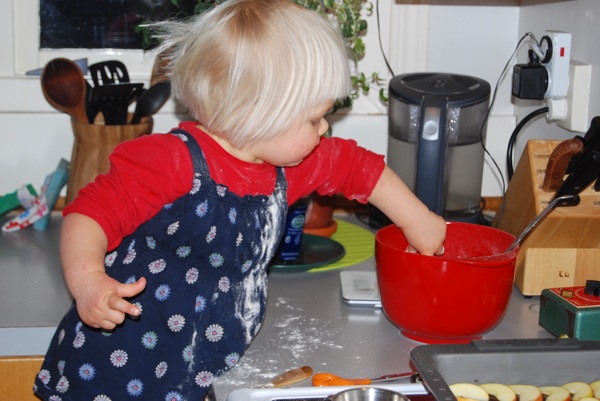
Earlier this evening, Eric was baking a cake, and Ingrid was overseeing the process: watching everything, trying a bit of apple, tasting a pinch of flour, poking at the whisks and bowls.

It was late for her (past 7 o’clock) and she was getting a bit tired and hyper. Which probably explains why she suddenly grabbed our largest and sharpest kitchen knife (which Eric had put down a few minutes earlier) and started swinging it around, as carelessly as if it was a wooden spoon.

Eric had been standing right next to her. He jumped back with a big yell and shouted at her. “Ingrid, put the knife down!!!”

Which she did, quite calmly. Then over the next 5 seconds reality sank in. She had been yelled at! Ingrid realized that things were serious, and that Eric had been really frightened and angry. She became very very frightened herself. Her mouth trembled, her face went red, and tears welled in her eyes. Then she broke down sobbing and crying. Eric picked her up to soothe her, but the more she had time to think, the more upset she became. After a while she just sat in my lap and (barely able to get the words out through her sobs) asked me to sing to her. “Lau… Lau… Laulame! T… Trollmor!”

We sang a lullaby, and then we sang some more. And by the time Ingrid had started to calm down, she was so exhausted that I took her straight to bed, and she didn’t object at all, even though it was an hour before her normal bedtime.

Hopefully, a lesson learned: People get angry when you wave a foot-long piece of sharp steel in their face.

I looked at some browser stats at StatCounter.com today: trends in browser and OS market share for various regions and countries. In addition to the distressingly high level of IE6 usage out there (IE6 is a pain to work with, from a web developer point of view), another slightly interesting pattern appeared: IE6 usage dips significantly during weekends, when people go home and use whatever browser they want. It’s all those slow-moving foot-dragging corporations who keep using it. And since our product is aimed at the corporate market, we’ll be stuck with supporting IE6 for a long long time still.

Den hemlige kocken (The Secret Cook) is about “the unknown cheating with the food on your plate”, i.e. how the food you get is not what you think you get – because of additives, or cheap ingredients replacing the real thing, or shortcuts in the production process.

I care (more than the average consumer, I believe) about what I eat: how it tastes, how it feels, how I feel after eating it, and what’s inside. As a result I do a lot of cooking from scratch so we don’t buy many food products, but we still buy dairy goods, bread and biscuits, and some cooking sauces.

It was interesting and enlightening to read about all the shortcuts and tricks and engineering feats that the food industry has come up with. The concept of producing artificial flavourings to approximate the taste of natural ones (vanillin for vanilla) was no surprise to me, and I was aware of the existence of “smoke aroma”. (Mostly because I avoid products with smoke aroma, because they have a for me unpleasant taste of meat.) But half a dozen different kinds of smoke aroma powders? Spinach to make pistachio ice cream look green? The Chorleywood Bread Process which replaces a few hours of fermentation with a few minutes of intense mechanical mixing? News to me.

But the information content of the book wasn’t as good as it could have been. Of the 263 pages of actual content (before a list of sources and an index) only 161 is actually about the main topic. The remaining 100 pages are filled with a purchasing guide, and a list of all EU approved additives, the so-called E numbers.

(The purchasing guide, by the way, is a weird mixture of instructions on how to choose broccoli, what a Jerusalem artichoke is, etc. Not extensive enough to be of real use, it’s a patchwork list of foods the author cares about.)

The body of the book has two main faults. One: it’s shallowly researched and only skims all the topics it tries to cover. 160 pages isn’t much, but these 160 contain far less actual information than they could. It’s another book written by a journalist who finds a topic he cares about, and decides to write a book without actually knowing anything about the topic, or putting much time into research. He reads some books and articles, surfs the net, interviews a handful of people, and then summarises all the juiciest bits he finds. The E-number guide is very symptomatic of his lack of real knowledge.

And two: I don’t like the author’s tone, which makes everything sound bad. His opinion seems to be that if it’s an additive, it’s got to be bad. And if it’s a modern additive that didn’t exist a hundred years ago, or if it has a long and complex name, it’s got to be even worse.

Not all additives are evil. I’m quite happy that we have additives to ensure that our food doesn’t kill us. And “thickening agents” may sound bad, but any cook would agree that adding cornstarch to thicken a sauce is perfectly OK. The real question is why the additives are used: to create a new kind of food, or to hide problems (such as adding thickening agents to make low-fat cream look creamy). It can be hard to know which is which, and the line between the two is vague.

And not all modern chemical processes make food worse. Packing food in inert gases or a protective atmosphere sounds like a perfect idea to me! I can’t think of a milder way to preserve food.

We want consistent, predictable, pretty-looking, safe food that keeps for weeks. On top of that we want food to be cheap, and most of us wouldn’t be willing to pay the extra price for real (expensive) ingredients, or the cost of food that goes bad before it’s sold. There is no way to get all of that with all-natural ingredients and without technological shortcuts.

What does annoy me is misleading labelling and marketing. The book has made me look more closely at labels. Here’s what I read on the side of a yoghurt package I have in the fridge right now:

Valio Vanilj är en utsökt och lyxig smakupplevelse som för tankarna till mormors hembakta pajer. Mjuk och krämig vaniljyoghurt med bär och frukter, precis som det smakade när vi var små.

Valio Vanilla is an exquisite and luxurious taste experience that brings to mind grandmother’s home-baked pies. Soft and creamy vanilla yoghurt with berries and fruit, just as it tasted when we were small.

And here’s the ingredient list: pasteurised milk, vanilla-berry preparation (sugar, rhubarb, water, thickening agents (modified corn starch, guar gum), aromas (vanilla, vanillin etc), acidity regulator (sodium citrate), colouring (beet red), lactase enzyme, yoghurt culture, Lactobacillus acidophilus, Bifidobacterium sp. and vitamin D.

I know for a fact that my grandmother’s pies did not contain beet juice to make them look redder, and she wouldn’t cover up a added water with guar gum.

I wish I had more room for choice when buying food. I can’t choose a more local or natural product (but with a shorter best-before period, or a higher price) because for most stuff there is no such choice in a normal supermarket. (Bread is a great example.) I can only choose between different brands of what’s really the same thing, with marginal differences. And I don’t have the time to run to 3 different shops daily to buy food.

AdLibris.