When I was in Estonia last summer, I asked what the current “must read” book was. I was pointed towards Andres Kivirähk’s Rehepapp. Now I’ve finally gotten around to reading it, and I can understand why it has been talked about so much.

One of the notable points is that the book defies categorisation. Satirical fairy tale? Folk lore potpourri? In any case, it’s a day-by-day account of the doings in an Estonian village, a few hundred years ago, to a great extent built out of traditional Estonian fairy tale components.

Estonian fairy tales match Estonia’s lowly history. There are no knights or dragons or princesses. Instead there are plucky, cunning peasants who outwit those above them, especially the Devil, who in Estonian stories tends to be a rather stupid character. There are also quite a few animal stories, sort of like the Br’er Rabbit stories in the US, and again they’re often about smaller, weaker animals tricking bigger ones.

But in Rehepapp the attention is on the various demons and goblins of Estonian folk lore. They were perceived to be almost everywhere, and they varied in character from deadly to tameable. But like the Devil, even the deadly ones (like the plague, coming to kill the village) could be tricked if you knew how. And the man who knows how to do it is the rehepapp, the title character of the book, the wise man of the village.

Other creatures are easier to control. There are make-your-own goblins, built out of whatever leftover parts you have at home, who come alive when you buy a soul for them from the Devil (promising him your soul in return, but that’s a deal you can cheat on if, again, you know how). Once built, the goblin has to work for its owner and do anything it’s asked to do. In traditional tales they were often tasked with stealing, bringing its owner all kinds of riches.

And that’s what the people of this village spend most of their time doing. They build goblins who steal food and clothes for them. Some also go stealing directly. All of this is quite open and known; everybody knows that everybody else is also doing it and therefore it becomes accepted. They steal from each other, they steal in revenge when they believe someone has stolen from them, and they steal with particular glee from the lord of the manor. They spend more time stealing than working, so it’s a wonder that there’s anything left to steal after a while. And they steal without discernment, without understanding the value of what they steal: one man steals soap and eats himself sick; a girl steals the dress that the old lady in the manor has prepared for her funeral, and parades it around the village.

It’s a poor and miserable crowd, full of stupidity and greed and envy. And the really sad part is that everyone recognises this as a satirical picture of the Estonian people, past and present. Estonians have spent centuries as serfs, so centuries’ worth of jealousy and cynicism have accumulated in the soul of the nation. If someone has climbed higher than you, you don’t admire them – you try to pull them down. And Rehepapp is also a picture of the new Estonia of the 1990s, when wealth was worshipped, and more was always better, and everyone wanted to get rich without working.

It’s not a happy tale, but it is told with a lot of humour. A painful kind of humour, sort of like Vonnegut’s. And that’s what makes this book worth reading, above all. It is also well written, the language flows well and brings the people to life.

I guess most Estonians will have read the book already. If not, I’d recommend you to do it. I saw translations mentioned, too, but I’m not sure if I would recommend anyone to read one: it’s the kind of book where a translation can never be as good as the original, because the books assumes so much implicit knowledge. At best you get an exotic story.

Read more about it: an article in Estonian and an analysis in English.
No, we haven’t stopped looking for a house. There just hasn’t been anything to look at.

Two weeks were lost to Valborg. All real estate agents sensibly assumed that, since the 1st of May fell on a Thursday, most people would take Friday off and be out of town for the entire 4-day weekend. Therefore no point in having viewings that Sunday. And of course if people are away, they’re unlikely to be bidding on a house, so there were no viewings the weekend before Valborg, either.

This week there was one house for sale in the area we’re interested in. It is built on such a slope that the garden would be unsuitable for anything except sledding or cheese rolling, and you’d need a safety barrier at the bottom of the slope because there’s a road there. We didn’t go to the viewing.

However some promising houses have popped up for next week so there will be more action soon again.

A fashion wave has flooded Sweden, and half of the girls and women in this country, or in Stockholm at least, wear almost identical outfits. This spring’s “must have clothes” and “essential look” consists of 1 pair black leggings, 1 pair canvas shoes, 1 tight micro mini skirt (preferably black, and just long enough to hide the crotch) and some sort of fitted jacket. They are everywhere. Last weekend while I was out with Ingrid I ran across a group of five teenage girls, all wearing “the look” – although one had a white mini skirt instead of black – plus identical half-long blonde hair. Attack of the clones!

What makes these people want to look just like everybody else? I can agree that leggings are practical and comfortable, and I could imagine myself looking reasonably good in them, but not now! There is no way I would, of my own free will, buy clothes that I would see mirrored on every other woman I meet in the street. My instinctive reaction to seeing all these uniformed women is to resist, pull back, find something different.

As an unfortunate side effect, all shops are full of chunky leggings (especially black, but also bold bright colours) and there are hardly any nice tights to be had anywhere.

TV

We’re living in a borrowed flat now. The owner has a TV, so after seven TV-less years we are now sharing a room with a TV set again. (Technically we did have a TV before we moved to England 7 years ago, although we really didn’t use it much.)

Apparently seven years is long enough to totally kill off the habit of watching TV. I haven’t turned it on even once during the past month. Eric has used it for watching DVDs (instead of watching them on the computer), but I don’t think even he has turned it on to watch an actual TV programme.

I have to admit it’s nice to be able to sit in the sofa while watching a movie, instead of a chair in front of the computer. Not nice enough to warrant buying a whole TV, though. I don’t think we’ll be buying one when we finally find a house.

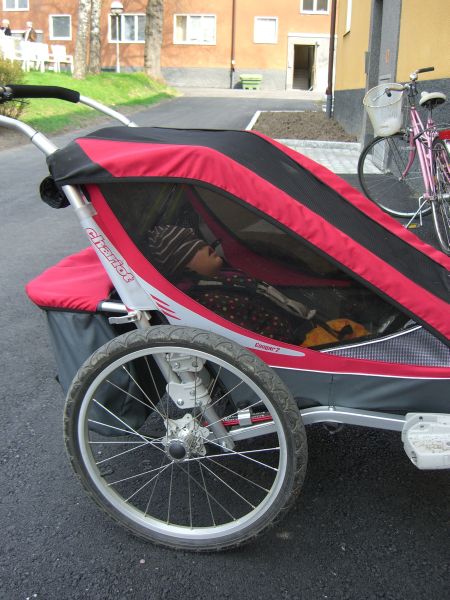
A few weeks ago we bought Ingrid a new spring hat: a stretchy, floppy hat in brown striped cotton jersey. For some reason she loved it from the moment she first held it. I think the softness was part of the reason, but more importantly, the hat is mostly shapeless and just a little bit too big for her, so she can pull it on herself. Her winter hat fit tightly and had ear flaps, so it had to be put on just so. This new hat she can pull sort of kind of roughly in the direction of her head, and it ends up in a reasonable position. Often skewed and wonky, but who cares? She likes this new power.

It also turned out to be a great sleep aid. When she wants to go to sleep, she likes pulling the hat down over her eyes to shut out the world.

A few days ago we somehow lost the hat. It probably got thrown out of the pushchair and we didn’t notice. She missed it. Today we bought a new, identical one, and she was so happy to get her hat back that she didn’t want to hand it to me at the till. For the next hour or two she wouldn’t let go – she would either wear it or hold it all the time.

The picture shows Ingrid and the hat in our Chariot Cougar cycle trailer. It’s one of our best baby investments: expensive, but well worth the money. Well designed and well made, robust, easy to use, convenient and comfortable – great in every way.