 |
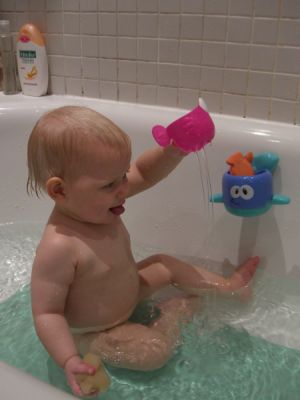
| Experiments with water and sponge |
It’s striking (and funny) how ignorant babies are – how little they know about how the world works. Things we take for granted are all new to them, including such basic concepts as “things fall down” and “you can’t grasp water” and “you can put a small thing inside a big thing but not a big thing inside a small thing”. It’s fascinating to see Ingrid learn this kind of things.
It’s also fascinating to “see” the differences between her brain and an adult brain. Apart from experience, our main advantage is the ability (and tendency) to generalise. I’m guessing that an adult would reach a reasonably firm hypothesis about gravity after having seen, say, five different things drop to the floor. He would probably keep testing this hypothesis occasionally with things that appear markedly different from the original five (things that are very large, or feel very light, or look very red, etc) but he’d probably mark that problem as “tentatively solved” pretty quickly.
A baby, however, will keep dropping things again and again for a long time, and watching them with great interest. She will learn after a while that solid objects fall to the floor. But she will still be surprised when she sees that, when you turn a spoon upside down, food will fall off. And once she has learned that, she will still be surprised to discover that when you turn a bowl of water on the side, the water will also fall down! It’s not obvious for her to expect water to behave the same as a spoon.
We learn to expect consistency, and we learn to expect new things to be similar to old things. Which is practical, but also takes away much of the childish sense of wonder.

Leave a comment