First day of a four-day C# course. Much of the practical stuff I knew, but it was interesting to hear more about the underlying principles and how things REALLY work – things like delegates, for example, and nullable types. And the advantage of already feeling comfortable with code was that I could get the practical exercises done quickly and spend some time doing work as well.
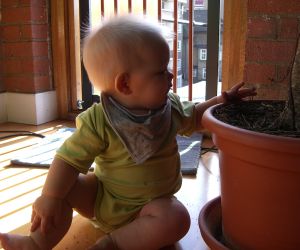
Ingrid has mostly understood that plants are not for playing. Either that, or she’s just trying to lull me into a false sense of security, and then when I look away she will attack them all at once. Seriously, she now actually passes the plants on her way to the CD player, which is a lot more fun because it has a pile of nice hard shiny CD cases that one can play with.
The earth in the flower pots on the other hand is still of great interest. I’m starting to give up on keeping her away from that. As long as she isn’t actually pulling it out and wilfully throwing it around, she can poke at it if she wants to… Of course poking is not what she’s really after; she wants to put the earth in her mouth. My hope now is that she will discover after a while that earth really isn’t such a good thing for babies to eat. Today she already threw up after eating some (probably more than I realised).
Ingrid had an EEG done (as a follow-up after her fainting episode – to rule out epilepsy I guess). Somehow the reception forgot we were there (even though we were right in front of the reception desk, playing not very quietly) so we had to wait for an hour before we were seen. I didn’t even think of complaining sooner than that because I’m so used to hospital delays – and the people who were seen before us had actually arrived before us, too, so I didn’t suspect anything out of the ordinary.
Anyway, the poor girl was kept awake an hour past her normal nap time – using annoying, bleeping, vibrating toys – and was then totally messed up for the rest of the day. She couldn’t even shut her eyes during the bus ride home, and ended up staying awake for 6 hours instead of the normal 2.5. Then a short nap from which she woke crying, add some residual tiredness from yesterday’s fever and you can imagine the state she was in by the evening. So tired she had no appetite, but at the same time so overstimulated that she was unable to go to sleep, oscillating between crying and energetic playing. Even breastfeeding didn’t calm her. She didn’t fall asleep until 20:30.
Oh, and we have no results from the EEG – apparently the person there was just some sort of technician and the recording will be sent to someone else to be interpreted.
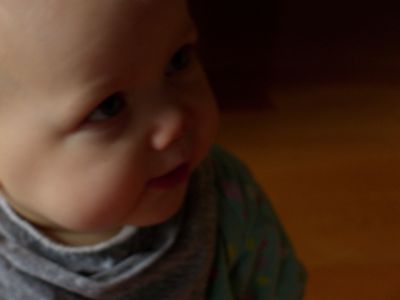
Nine months. Time flies. It doesn’t feel like a month has passed since I last wrote one of these posts.
Ingrid crawls happily around the flat and gradually discovers new parts of the living room. It seems to still be hard work for her, because she doesn’t like to crawl long distances, but it’s certainly made life more fun for her. Not only can she explore the world: she can also reach toys that used to be just out of reach, as well as wholly new toys (shoes are good!) – or simply show that she wants to play with me by crawling towards me.
The plants have survived her attention and I get the impression that she actually understand that she isn’t supposed to pull at them.
Standing up, holding on to my hands, is another favourite pastime. Sometimes, when she’s feeling adventurous, she even takes a few steps. But for some reason hands are the only thing that she uses for support when pulling herself up. Once she is standing, she can let go of my hands in order to grab hold of a chair or my knee, but not before. The farthest she’ll go with just furniture is onto her knees, not to standing.
She hasn’t fallen at all when standing – when she gets tired or loses her balance, she lands on her cloth-nappy-padded bottom. She doesn’t fall forward because there’s always something there to hold on to. She’s more likely to hurt herself crawling, actually – not only when crawling off beds but also when she simply slips on the floor.
The first tooth is halfway out and the second one is already visible and on its way.
The teeth are not exactly useful for eating yet so her food is still mashed and pureed. But lumpy purees are more and more OK: she used to filter them out, swallow the rest and push any lumps out with her tongue. Now she mashes the lumps with her gums. And she is quite happy to eat real pieces of banana. I’d have thought that finger foods would be fun for her by now but she cannot pick things up between thumb and index finger yet, only with a full hand grip, and that makes it hard to actually put small things in her mouth. So I’m still putting all the food in her mouth, one way or another.
On the other hand, she has totally understood how sippy cups work: you grab the handles and pull the cup towards you and put the spout in your mouth and tilt the cup, and then you suck lots of water in your mouth and spit it out in a well-controlled, tight, beautifully curved spurt that soaks everything.
The noises she make are getting more and more differentiated and she is, I think, getting to the point where she purposefully makes different noises in different situations. Nowhere near “emme” yet, but close to being conscious communication. (While crying is communication, it generally seems like an instinctive thing, whereas words seem more conscious.)
Ingrid feverish most of the night and most of the day, not interested in food or drink and sleeping badly. But when I thought she might want an extra nap in the afternoon (because the midday nap was only 40 minutes instead of the more usual 1.5 to 2 hours) she refused. So she got to go out for a walk in the pushchair like we usually do, and she was perfectly happy. The power of routine? Or fresh air curing all ills?

The inevitable happened… Ingrid learned to crawl out of her cot onto our bed (over the pillows and rolled-up blankets blocking her way) and from there onto the floor. Landing nose first.
I thought she was quietly falling asleep until I heard a thud from the bedroom. There was silence for a fraction of a second, just long enough for me to realise what had happened, and then a desperate wail…
It must have really hurt and shocked her, but luckily didn’t do any real damage, other than a bruised forehead and nose.
Edited to add picture.
Storm Constantine’s Wraeththu Chronicles is really a set of three works but since I read them all in one go (the book was a bit difficult to put down) I’m only going to write one review.
First, the plot. Wraeththu is a new race, a mutation from a human base. (Somewhat confusingly an individual of the Wraeththu race is called har, plural hara.) They are stronger than humans, have paranormal powers / magic and are generally rather hard to kill, so they gradually take over most of the world. Men (and only men) can be infected and transformed into hara. There are no female hara; the new race is hermaphroditic. Think vampires but without the bloodsucking and sun-fearing part.
The first book (The Enchantments of Flesh and Spirit) takes place in Wraeththu’s early years when the race is young, somewhat goal-less and life is confusing. Appropriately, the protagonist is a teenager who has just been infected. The book is mostly about the love between him and the har who brings him among Wraeththu, but at the same time it’s about the race finding its feet and trying to figure out what it’s about. What parts of humanity do they keep? How can they make the new race something more and better than human?
The second book (The Bewitchments of Love and Hate) is about a pureborn har, one born from hara parents. This is a drama of passion within a household, with couples emerging and breaking, but it’s also the story of the wars of conquest waged by some Wraeththu tribes against humans and other tribes. In a way it’s about Wraeththu sinking back to human level, or lower. Despite the lack of innate gender, gender roles reappear, and despite Wraeththu’s great powers, many do not use them.
The third book (The Fulfilments of Fate and Desire) takes place some years (or decades?) later, and the external world has sort of settled. This is about one har, burdened by guilt and anxieties about things he has done and gone through, and his journey to find answers.
It’s quite hard to summarise the books and hard to pinpoint what genre they are, because they kept changing all the time, and kept telling many different kinds of stories. But to be honest, plot wasn’t really the book’s strong side. Some characters do strange things for no particular reason and generally just act weird. The third book is the weakest of the three – the plot is really quite predictable and repetitive. It’s almost as if a good writer was given the challenge to write a book based on a bad plot. She mostly succeeds, but the ending quite dissatisfying.
One of the more flawed plot elements is Wraeththu magic. It’s frequently referred to, but rarely used in practice. You’d think something so life-changing would affect their daily doings more. It’s also unclear how their magical practices and rituals would have arisen. Likewise the rest of Wraeththu culture, in particular their tribes. It seems a bit unrealistic that such strong culture and so distinctive tribes would emerge out of nothing so quickly.
Character portrayal on the other hand is far stronger than the plot. There are many charismatic characters, and they all get a lot of space to develop. Many characters recur throughout the three books, which is why I think the books really work better as a whole than they would if read separately.
The hara all have a certain wildness, they are filled with passion and they’re not afraid to show it, which generally makes for a gripping and intense reading experience. Much of it feels quite raw and honest, somehow, even though it’s a fictional book about a fictional race. There is also a sensuous, ever-present eroticism, sometimes stronger, sometimes fainter. A lot is about sex and sexuality seen from many angles – how it relates to love, to power, to beauty; sex as a weapon, sex as healing, sex as magic, etc.
Despite the violence and wildness this somehow felt like a female book. Sexless vampires and gay men tend to be female topics, for starters, but the whole thing felt like it was observed by a woman. For some reason I thought Storm Constantine was a man and I tried to reconcile this with the female feeling of the book and sort of failed, and now I found out she actually is a woman. That explains things.
Wraeththu isn’t exactly what I expected – from my hasty browsing in the bookshop I saw that this was about a new, magical race, but I got the impression that it would be more cerebral and far less sensual. But I’m pleased with what I found instead. Despite the book’s weaknesses (not just the weak plot but also spelling errors and – horror of horrors – a glossary at the end) the whole thing is written with such skill and passion that the characters simply come alive (cliched, I know) and I couldn’t help caring for them and feeling strongly for them. As soon as I’d finished it, I considered re-reading it, and I know I will, sooner or later.
Green Man Review has a good review that does more than rehash the plot.
Went on a pediatric first aid course at work. This was the first of two hour-long sessions. Today’s session was about resuscitation and next week’s will be about choking.
While I sort of knew what one is supposed to do when a child isn’t breathing, I’d never had an opportunity to practice it, so this felt useful. It was good to get some kind of a feel for how hard you need to press/push for heart massage, for example. (The answer is: really hard!) It’s not the kind of thing you want to be experimenting with in an emergency.
Ingrid only woke once during the night. Nursed and went straight back to sleep, and so did I. Next thing I knew, it was 6.30 in the morning and we were both just waking up. This was the best night’s sleep I’ve had in about 5 months, and in the top three since Ingrid was born.
I thought it was interesting that we quite naturally woke up at the same time, without one of us being obviously woken by the other. It’s not the first time, either.
When I am too busy, I easily forget meals. I don’t even notice that I’m hungry, or sometimes I do notice but just tell myself that I’ll eat “soon”. Then I suddenly realise that it’s two o’clock and I haven’t had lunch, and my stomach is growling and my blood sugar is far too low. As a result I’ve had trouble keeping my weight – if I don’t take care, I lose weight. (While that may sound like a good thing if you have the opposite problem, trust me, it’s not.) I’m taking special care now that I’m breastfeeding, because I need to eat enough not only for myself but also for Ingrid.
Two things help me make sure I get enough food. One is to ALWAYS have food at hand. If getting food means interrupting whatever interesting and important thing that I’m doing to take the lift down to the cafeteria and queue to get a muffin and then get back up, well, that’s just too much work and won’t happen. But if all I need to do is to open a drawer, the equation changes. Of course this only works if I actually want to eat whatever I have at hand, so there must be choice, which is why I have a well-stocked snacks drawer at work. There’s always at least two kinds of cereal bars, and one or two kinds of dried fruit, and I usually bring fresh fruit or yoghurt with me every morning.
The other is to remind myself to eat. I actually have reminders in Outlook at work that simply say “Eat”. One at 11, one at 13 for lunch, and one at 16. My colleagues have been laughing at me for years about these (different colleagues over different years) but it really works. I call this my food and sleep clock, or in Swedish mat- och sovklocka. (The food and sleep clock was invented by Skalman, a green turtle in a Swedish children’s comic. He listens to his a bit more slavishly than I do, though. I don’t fall asleep in the middle of the day.)
| « Older posts | Newer posts » |
