Work. Conference call with unhappy baby, and remote debugging while holding wiggly baby.
Due to ridiculous amounts of spam, I’m now junking all comments where the email address is in the @mail.com domain. If you have an @mail.com address and you want to comment, you’re better of not providing an email address at all.
Debugging crashing Excel files (trying to make them crash in order to figure out what causes it) and some more refactoring.
Eric’s brother and his girlfriend arrived and will be staying with us for about a week.
Went to town again to buy a drying rack. Practiced back carries with the wrap.
My grandmother (I only ever met one of my grandparents) died several years ago. In one sense we weren’t very close in the end, because by then we lived thousands of miles apart and only met once a year, and I’m not very good at keeping in touch with people who are far away from me. But at the same time we cared about each other, and she was dear to me, and I still miss her.
Recently I’ve found myself thinking about her more often than I did previously, in the few years just after her death. Because I keep thinking about how she would have loved to meet and hold Ingrid. And despite the utter improbability of it, I like to believe that somehow she can still see us and that she occasionally looks in our direction and smiles at Ingrid and me.
As I said before, I’m an atheist, and I think the likelihood of a God is infinitesimal, and the likelihood of an afterlife of any description is only marginally greater. But there is nevertheless something that gives me “belief in hope beyond reason”, to borrow an expression from Scott Atran (quoted here in the NY Times). I have no reason to believe that my grandmother still “exists”, but I cannot help thinking and hoping that perhaps somehow she does, after all.
Perhaps it is because I cannot imagine what it is like to be dead. My grandmother always existed, how can she suddenly not be?
From the same NY Times article:
We try to make sense of other people partly by imagining what it is like to be them, an adaptive trait that allowed our ancestors to outwit potential enemies. But when we think about being dead, we run into a cognitive wall. How can we possibly think about not thinking? “Try to fill your consciousness with the representation of no-consciousness, and you will see the impossibility of it,” the Spanish philosopher Miguel de Unamuno wrote in “Tragic Sense of Life.” “The effort to comprehend it causes the most tormenting dizziness. We cannot conceive of ourselves as not existing.”
Much easier, then, to imagine that the thinking somehow continues.
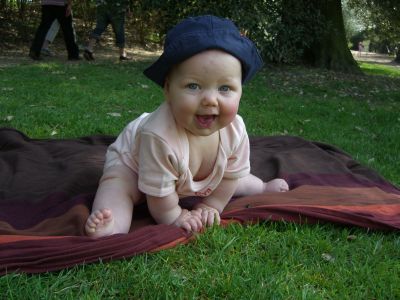
Six months.
Ingrid grows and develops so fast that sometimes I feel like she changes overnight. During the last month she has become so much more of a person, with character and habits and quirks of her own. Every day she seems to become more alert and aware of what is going on around her.
In less than a month she has learned to sit without support, although I do keep a pillow behind her so she doesn’t hit the floor when she falls. She can even twist and look over her shoulder without falling, and lean forward to pick up a toy and then straighten herself again. Very impressive, considering that she could barely sit at all a month ago.
And now that she has seen how nice it is to sit – how easy it is to reach for toys and what a great view one gets – she no longer accepts lying down. (Would you prefer to lie down all day, or to sit up and see what’s going on around you?) Now she rarely spends more than a minute lying down before she not-so-discreetly requests to be lifted up to sitting again.
Her hands can now not just pick things up but also pass them from one hand to the other, turn them around and drop them. And they can splash water in the bathtub. (Speaking of baths, we have definitely abandoned the bath support and she now sits up in the bath. Wobbly and scary, but it works.) The hands still have a life of her own, wandering around and gripping whatever they touch, even if she is busy with something else and not even looking at her hands. And they grip VERY HARD, so hard it hurts, because her grip is still all-or-nothing.
She is still very physically and visually oriented. She is strong and likes to move and be active. She also likes to see things happen – when she gets grumpy, my first move is to put her in a sling and let her watch me hang laundry or empty the dishwasher. She isn’t particularly interested in sounds or talking, however: apparently most children babble quite a lot at this age but I haven’t heard her babbling much at all.
Blindingly hot and sunny day so we went to Hampstead Heath. Lovely, green and restful for the soul even if it was sweaty and a bit tiring for the body.
Did some shopping. Went to the park. Cooked dinner.
Attachment parenting is a fancy name for what I would describe as a kind and natural approach to parenting. It means different things to different people, but generally / often includes extended breastfeeding, babywearing, co-sleeping, and responsiveness (not letting the baby cry in order to “train” it). All very sensible, and while I don’t entirely live by the AP ideals, I agree with the general direction. (An AP mum wouldn’t leave her baby in the care of strangers at 6 months, for sure.)
AP parents are often also ecological parents so AP discussions frequently involve cloth nappies and organic foods etc.
But then, for some reason, some parents add another element: avoiding vaccinations. And that really baffles me. What does it have to do with attachment and closeness? How can you intentionally expose your baby to the risks of catching a serious but fully avoidable disease – and claim that it is good for your baby? Natural is not always necessarily better.
| « Older posts | Newer posts » |
