A blog I happened to read some while ago (how I got there, I no longer remember) pointed out a common feature of many blogs: all too frequently, they descend into endless ranting.

…one thing I have realized is that posting without complaining is a hard thing to do. About a year ago I decided I wanted to try to only post positive things and my post volume has been through the floor ever since. I guess it’s just a lot of fun to post to the world and bitch about whatever it is you feel is wrong with what’s going on. Hence forth, I’m rejecting that position and returning to criticizing all that I think is crap.

Just like the author of that blog, I decided – already when I started this blog – that I would stay away from complaining. I wanted to blog about things I would want to remember and be reminded of later – and to spend my time thinking and writing about things that are worth thinking and writing about. Nevertheless, here I am, in that same sinkhole of complaining.

But unlike that guy, I do NOT want to return to “criticizing all that I think is crap”. On the contrary, I think it is time for betterment. I hereby resolve to stop complaining.

Last Thursday Ingrid was due for her 4-month immunisation. For some reason I was totally sure that Friday was the day, and only found out I was mistaken on Friday morning, when I wanted to check the exact time.

Today I was on my way to the Estonian embassy to get a passport for Ingrid. Halfway there I realised I had forgotten my own passport at home.

So while the acute sleep deprivation phase may be mostly over, long-term chronic sleep deprivation is definitely still here with me, with all its subtle ways of undermining me. My brain feels broken: I forget and misremember things. I cannot concentrate. I am short-tempered and irritable during the day. My immune system is messed up: I was actually really sick for several days, for the first time in at least 3 years.

I need at least 8 hours of sleep a day in order to feel rested and fully charged. In wintertime, with those long dark nights, slightly more. Now, of course, I’m nowhere near that.

A typical night can go something like this:

  • Go to bed at 10. Give Ingrid a last feed. She is done and sleeping by 10.20. I fall asleep a bit later, maybe 10.30.
  • Ingrid half-awake at 0.30. I try to get her back to sleep because if I feed her now she will be hungry twice more before it’s time to get up. Give up at 1 and feed. She falls asleep at 1.20. It takes me a while to go back to sleep since I’m now wide awake.
  • Ingrid wakes again at 3. Feed. So drowsy that both of us are asleep again within 10 minutes.
  • Ingrid starts making noises at 4 – probably because the previous feed was so short (since we both fell asleep halfway through). Feed again. Ingrid asleep 4.10; myself 4.20.
  • Ingrid starts shifting around and floating out of her sleep around 6. I manage to keep her almost-sleeping for another 30 minutes by gently rocking her now and again. At 6.30 she’s awake for real, kicking and wanting to play. I take her out to the living room, change the nappy, and let her spend a while on her own. I go back to bed and doze for 15 minutes, by which time she is bored – not crying, but making enough noise to wake me again. I move her to a new place and doze for another 10 minutes.
  • More noise from the living room at 7. Give up and get up.

Time spent in bed: 9 hours.
Sleep: just under 6 hours, broken into 34 pieces.
Dozing: around 1 hour.

Somehow I still function surprisingly well despite this constant shortage of sleep. Mothers have been doing this for hundreds of years, after all.

Ingrid’s recently discovered ability to fall asleep in the bed has meant a huge improvement in this regard. I used to have to wait until the weekend for a chance to catch up at least part-way. Now I can get an extra hour or so, if I’m lucky, during her morning nap. When the morning nap didn’t work (this weekend) I was reminded again what a difference it makes. I was so relieved when I managed to get her to sleep in the bed again today!

For some reason, I’ve become a slow eater. I’ve never been a particularly fast one, but recently I’ve noticed that I’m really slow. When Eric and I eat identically sized servings, for example, I often have a third or even half of my portion still on my plate, when he has finished. And it’s not because Eric’s a fast eater – I’ve noticed the same thing in company with other people as well.

At home it doesn’t really matter that much. But it’s almost becoming a problem when I eat in company. When I’ve had lunch with people at work, for example, I’ve started buying myself a smallish lunch and added a dessert that I’ve eaten afterwards at my desk. Even so, everyone has usually finished their huge plates of meat and veg, and I’m still sipping on my soup. I have also started to pay more attention to when I talk – I try to keep my contributions to the conversation between courses and let others talk when there is food on the table, in order to have a chance to keep up. Not that it really works, though.

I don’t really know why this has happened… I don’t like my food very hot, so I’m slightly slower to start. I like to drink quite a lot with my meals. But this doesn’t seem sufficient to explain such a huge difference. Do I chew longer? Have a smaller mouth? Don’t know.

On the positive side, slow eating is supposed to be good for you – “the secret of longevity” and all that. And it gives me more time to enjoy my food, because I do enjoy eating.

This month Ingrid has focused on sticking things in the mouth. Hands, above all, seem to be made just for this. Thumbs are great for sucking, but so are all the other fingers, singly or together. Two hands are better than one hand. She even tries to spice up breastfeeding by adding hands to the concoction, and inevitably ends up frustrated when breast and hands don’t mix.

Hands are also slowly becoming useful for other things. First she started pushing the mirror and the stand-up toys on her play mat towards the mouth (where else?) with her whole hand. Then she discovered the meaning of fingers, and started gripping things and pulling them towards her mouth (of course). Next step: gripping things that do not dangle right in front of her mouth. Next step after that: touch typing.

Still, hands are fun rather than useful right now. Screams, smiles and sucking remain her three main means of survival. And luckily the first one is gradually getting less important. Crying used to be the primary method to make things happen, but now she is also using her irresistible smiles to charm people.

Oh, and of course Ingrid is still growing like a maniac. She has practically outgrown her Moses basket, and her bouncy chair (which is supposed to be suitable until 6 months), and the baby insert of the pram, and her bath support as well. The Moses basket is about to be replaced with a cot very soon, and the bouncy chair is gradually being phased out while she’s getting used to a high chair.

The bath support is still in use, because I haven’t found any alternative… She is definitely too wobbly to sit unsupported in the bath. And the only other bath support I’ve seen was labelled “Up to 8 months / 70 cm / 8 kg”. Well, Ingrid is no more than halfway to 8 months, but she’s about to reach 8 kg any moment now, so her chubby little body is certainly not going to fit in that thing!

When I went out with Ingrid today for our afternoon walk / nap, I found several streets around Aldgate East cordoned off, with lots of idle-looking police stopping curious passers-by from entering. Behind the blue-and-white plastic ribbons were more police, several groups of men in hard hats and various unusual vehicles (large trucks labelled “RESCUE”, for example). While there was no frantic action, they didn’t seem to be packing up to leave, either.

Curiously, I asked one of the policemen what was going on, and was told that “a house fell down.”

A house? Fell down? In central London? Not the sort of thing one expects to happen in one’s neighbourhood, in the 21st century!

Once I’d circled round to the other side of the cordoned-off area, I could indeed see a house in a very collapsed state. I vaguely recall seeing that building surrounded by scaffolding for a while, but works had mostly been going on inside. I wonder how they managed this – they (whoever “they” were) must have hollowed out the building completely, or burrowed like badgers, to make it collapse so totally. Luckily no one was hurt.

Things I learned today:

  • Houses do fall down
  • The Salvation Army provides sandwiches to emergency workers. Among the unusual-but-not-surprising vehicles (two large cranes, impressively antenna’ed trucks marked “COMMAND UNIT” and “CONFERENCE UNIT”, etc.) crowding around the remains of the house, I spotted a red canteen truck bearing the Salvation Army logo. What a nice way to make emergency workers’ life easier – every Englishman I’ve ever met is immediately comforted by a hot cuppa.

I am appalled by the amount of garbage that the average baby produces. Dirty nappies make up about half of our household garbage. Or to put it differently, we now produce twice as much garbage as before. Official estimates back up this estimate.

I had a little look on the Internet and it turns out that disposable nappies are even worse than I thought.

  • No one knows how long it takes for disposable nappies to break down in a landfill – they haven’t been round long enough. The first disposable nappies ever used (1970s? 1980s?) are all still around. Estimates range around hundreds of years. And some parts will never break down.
  • Marketing for eco-disposable nappies claims that these break down in six months. But they don’t mention the fact that this only works if the nappies are composted – the breakdown process requires sunlight and air, which the nappy won’t get if it is buried in a landfill.
  • Raw sewage can normally not be disposed without treatment… but dirty nappies go straight into landfills, of course, with all the bacteria they carry. Eeugh!

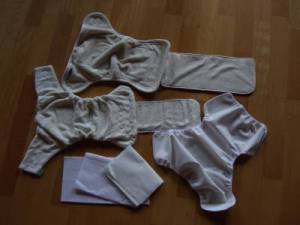
In order to do something about this, I have decided to experiment with cloth nappies. Besides, I’m not very impressed with any of the disposable nappies we’ve used – they leak. The cloth ones can hardly be any worse.

My trial pack from The Nappy Lady arrived today, with one Tots Bots Bamboozle, one MotherEase One-Size, and a MotherEase Air Flow wrap, plus some liner samples.

These things look almost as easy to use as the disposable ones we’ve been buying until now, and a lot more cosy. Soon we’ll see how they work in practice.

I’m an avid reader of blogs and online news sources, especially now that I’m at home almost all day. I’ve found good sources for general news, Swedish news, tech news, quirky stuff, thoughtful essays, book reviews and parenting hacks – you name it.

What I don’t have is good online reading material in Estonian. I’ve been reading EPL mostly out of desperation, but the site is really annoying, with bad layout, slow loading times, and excessive auto-refreshes.

If anyone out there could point me towards a good Estonian news source and/or a well-written blog in Estonian, I’d be most happy.

Random fact of the day:
Did you know that the noise generated by a screaming baby can reach 115 dB, which is roughly the pain/injury threshold for human hearing?

These last two weeks, Ingrid has been uncharacteristically discontented with life. I put her in her dev chair; a few minutes later she’s not happy. I put her on the play mat; moments later she starts whining. I turn her on her tummy; soon she is crying again.

Part of the unhappiness seems to be due to frustration. It looks like she wants to move around and see new things. She seems quite frustrated when her attempts at crawling-like movements lead to nothing. And sitting in a high chair has been more popular than being stuck in the dev chair: she’s upright and higher up, and gets a better view. Being carried around the house is even better.

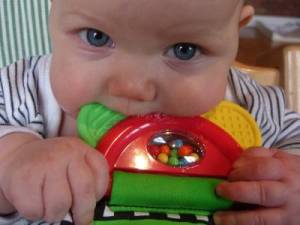
But I’m starting to suspect that some of the fussing may be due to impending teething. No teeth are visible yet, but Ingrid drools like a St. Bernard and suddenly LOVES to chew on things. Everything she gets her hands on has been going straight in the mouth anyway, but now she prefers hard, chewable things, and chews vigourously. Unfortunately she hasn’t yet learned to hold on to things very well, and definitely cannot pick them up. My fingers have therefore gotten a fair chewing – they’re practical because she doesn’t need to hold them in place.

But getting baby drool all over my hands, arms and sleeves is getting tiresome, so today we’ve practiced holding on to things. I tease apart her clenched fist, put a toy in place, and guide her hands to a position that keeps the most chewable part of the toy pointed towards the mouth. It’s going to take a lot more practice, but at least my fingers get a break.

Before I discuss this book, I have to say that I am an atheist. There is a minute amount of agnosticism in me – I cannot be sure that there is no god – but I have encountered no reason to believe in one. My review of this book is strongly coloured by this view, as is every other review you will find on the Internet, positive or negative.

Despite (or maybe because of) my atheism, I find the question of religion very interesting. Why does religion exist? Why do other people believe? How is it possible to actually convert to a different religion – how can you decide to believe?

So I approached this book with curiosity and hoped for an intelligent discussion. I didn’t expect him to prove the non-existence of God (as you can’t really prove a negative) but hoped that he would presented a systematic and coherent overview of the arguments for and against. I was sorely disappointed. It’s not just a bad book, it is an atrocious book – because it works against its own stated goal of convincing people to leave religion. It really is preaching to the choir – I find it very hard to believe that anyone would come round to his point of view because of this book.


The God Delusion has two massive problems: its content and its voice. The book is a disorganised diatribe.

The content is difficult to summarise because it is somewhat unfocused. Dawkins attacks religion from every angle – why arguments for God’s existence are invalid, why we don’t need religion anyway, why religion is bad, etc. He might have done a better job if he had limited himself to fewer themes.

But that’s far from being the main problem with the content. A larger issue is Dawkins’s reliance of cheap rhetoric instead of reasoning. He much prefers anecdotes (“this religious person did this bad thing – isn’t religion bad?”) to actual arguments. He has the bad habit of appealing to randomly-chosen “authorities” such as Thomas Jefferson and Albert Einstein – but only on his side of the debate. I’m convinced that it would be possible to dig up equally famous Americans who are or were strongly Christian, but of course he doesn’t do that.

Where he does attempt to engage in actual argument, I get the impression that he doesn’t know much about religion or philosophy. He just has a loud voice and thinks that qualifies him to write a book about/against religion. I agree that one doesn’t need to be a theologist in order to have an opinion about religion – but in order to refute theologists’ arguments, one needs to know and understand those arguments. But when he sets out to debunk arguments for God’s existence, he makes sure to include and subsequently destroy the weakest ones. Attacking straw men, indeed.

His arguments and anecdotes are very focused on Christianity and to a lesser extent Islam. His chapter about “The ‘good’ book and the changing moral zeitgeist” is an egregious example, where he gleefully points out what a horrible source of moral guidance the Bible is. That may be an argument against Christianity but it is not an argument for either the non-existence of the god or the evils of religion in general.

The chapter titled “What’s wrong with religion” (which mostly talks about the violence that Christianity and Islam frequently lead to) makes the same mistake of focusing on specific religions rather than religion in general. The more valid point (faith as the antithesis of reason, “faith is an evil precisely because it requires no justification and brooks no argument”) gets very little attention. And of course all the good things that people have done in the name of their religions are ignored completely.


The content is also somewhat confusingly organised. I would have liked a clearer separation between discussing the likelihood of a religion (any one) having a point (i.e. God’s existence) and the desirability of having a religion. It is a book against religion from all angles – religion is false, religion is bad, religion leads to bad things. This is too broad an agenda, and these different threads are not kept apart sufficiently clearly.

The central thesis (if there is one) is further weakened by Dawkins’s frequent forays off-topic, whenever something particularly upsetting catches his eye. In a section supposedly discussing polytheism vs. monotheism, he suddenly rants about the “obscene… sums of tax-free money sucked in by churches”. There are several rants about other signs of how religion permeates American society, and how atheists are discriminated against.


Yet while the content might not convince, it does no actual harm to the atheist argument. But his tone of voice does. The whole message is delivered in an almost repulsive tone: obnoxious, raving, condescending. (The title is a good indicator of the general tone.) His introductory statement is “I shall not go out of my way to offend, but nor shall I don kid gloves to handle religion any more gently than I would handle anything else”. Either he’s lying, or I’m glad I’ve never met him in person; based on this he must be the kind of man who throws mud on passers-by and flings insults at people he meets in the street, just because he can.

Whenever he has a choice between two words, he chooses the more offensive one. Introducing Jesus as an insipid milksop is not a good start if you want a Christian reader to actually listen seriously. And instead of refuting arguments he doesn’t agree with, he dismisses them as ludicrous, infantile, vacuous, silly, and so on. (He must have sat there with a thesaurus at hand.) If this is what an atheist sounds like, who would want to be one?

He does better in his more scientifically-oriented chapter on various possible “roots of religion”, where he discusses different darwinist hypotheses for how religion may have arisen. I would think it is because this is an area where he actually has some expertise.


There are only two points of his that I really cannot argue with. One is his opposition to giving religion special status in society, and protecting religious claims from all criticism. As he quotes Douglas Adams:

Religion… has certain ideas at the heart of it which we call sacred or holy or whatever. What it means is, ‘Here is an idea or a notion that you’re not allowed to say anything bad about; you’re just not. Why not? – because you’re not!’

And Dawkins himself continues:

If the advocates of apartheid had their wits about them they would claim – for all I know truthfully – that allowing mixed races is against their religion. A good part of the opposition would respectfully tiptoe away. And it is no use claiming that this is an unfair parallel because apartheid has no rational justification. The whole point of religious faith, its strength and chief glory, is that it does not depend on rational justification. The rest of us are expected to defend our prejudices. But ask a religious person to justify their faith and you infringe ‘religious liberty’.

The other (related) point is religious upbringing and education. He approaches the topic with his usual mixture of anecdote and passionate shouting, rather than rational argument, but I have to agree with his basic points. I think that schools should not be allowed to promote any religion, and I wish it was somehow possible to make sure that parents do not stuff their children’s heads full of superstition.

Dawkins:

I want everybody to flinch whenever we hear a phrase such as ‘Catholic child’ or ‘Muslim child’. Speak of a ‘child of Catholic parents’ if you like; but if you hear anybody speak of a ‘Catholic child’, stop them and politely point out that children are too young to know where they stand on such issues.

At Christmas-time one year my daily newspaper, the Independent, was looking for a seasonal image and found a heart-warmingly ecumenical one at a school nativity play. The Three Wise Men were played by, as the caption glowingly said, Shadbreet (a Sikh), Musharraf (a Muslim) and Adele (a Christian), all aged four. Charming? Heart-warming? No, it is not, it is neither; it is grotesque. […] Imagine an identical photograph, with the caption changed as follows: “Shadbreet (a Keynesian), Musharaff (a Monetarist) and Adele (a Marxist), all aged four.” Wouldn’t this be a candidate for irate letters of protest? It certainly should be.


Conclusion:
I am sorry I supported Dawkins by buying his book and wish I could have my money back.


If this was not enough, here are some other thorough reviews you may want to read:
Daylight Atheism attempts to summarise the book;
San Francisco Chronicle finds it fine and significant;
The Guardian cheers him on;
London Review of Books revels in pointing out Dawkins’s weakest arguments;
Prospect labels him “incurious, dogmatic, rambling and self-contradictory”.


Amazon UK, Amazon US.