A movie by Miyazaki Hayao / Studio Ghibli, based on a book by Diana Wynne Jones.
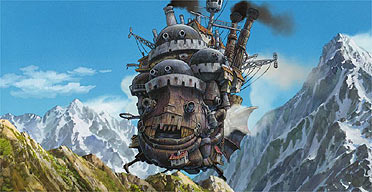
This is a fantasy story or fairy tale for teenagers. (Interestingly a lot of good fantasy writing is labelled “young adult” these days.) It’s got everything from wizardry and dastardly deeds to romance and perilous battles. An evil witch puts a curse on young Sophie, making her appear an old woman. She makes her way to the flying castle of Wizard Howl (who’s rumoured to devour the hearts of young girls) hoping to find a way to remove the curse. There is a complication, though: part of the curse is that Sophie cannot talk about it. And so she becomes a part of the wizard’s household, together with his apprentice and his tame fire demon.

While the story contains a number of fairy tale clichés, Wynne Jones makes obvious fun of them, without trying to be clever about it. Thus, for example, Sophie reflects early on in the book that she is unlikely to achieve much in life, because she is the eldest of three daughters, and only the youngest has any chance in a fairy tale. And despite the consciously clichéd components, the story itself is far from predictable, and kept surprising me to the very end. In fact it is quite a weird story, where people keep doing weird things. Wizard Howl in particular seems rather irrational at times. But then he is a wizard, after all.

The writing is focused, humourous and action-oriented, with hardly a word spent on peripheral details. Places, things and people are described only to the minimum extent necessary, conveying only their essence – often from Sophie’s subjective point of view. Here is how Sophie first sees Howl’s castle, for example:

Wizard Howl’s castle was rumbling and bumping towards her across the moorland. Black smoke was blowing up in clouds from behind its black battlements. It looked tall and thin and heavy and ugly and very sinister indeed.

There’s nothing about the colour or material of the castle, or whether it is square or round, has towers or not: only how Sophie experiences it.

Seeing the world and following the story through Sophie’s eyes adds some spice to the book, since her experience is sometimes very obviously coloured by her expectations and moods – and her often immature and impulsive teenage thinking.

In general I found this a funny, lively and enjoyable book, and would definitely read more of Wynne Jones.


The movie, while visually impressive, was less satisfying than the book. (Luckily I saw the movie first.) Since the book spends little attention on visual detail, this leaves Miyazaki a lot of freedom to invent the looks of the people and the world. And as with all his movies, it really looks like a fairy tale world: beautiful and colourful.

But the movie has a big problem: its failure to tell the story. The plot comes across as barely coherent, and I was completely confused by some turns. To be honest, this is not that uncommon with Miyazaki’s movies: Spirited Away, for example, is similarly beautiful but does not exactly make much sense.

The movie is really only a loose adaptation of the book – Miyazaki has taken some liberties with the story, and that’s putting it mildly. Some side plots have been excluded because they would make the movie too long. Fine. But then for some reason he finds time for other things that do not exist in the original story, and in no way make his version of the story clearer. He makes up a war between Ingary (the kingdom where the story takes place) and a neighbouring country, which lets Howl spend a lot of time fighting for the kingdom. I couldn’t see how this contributed anything but a sinister mood to the story (and some spectacular fighting scenes of course). And for some equally unclear reason, he introduces some sort of weird flying machines (he seems very fond of flying machines; I think all his movies have got some), changes the gender and role of one character, etc.

Since the movie is necessarily shorter than the book, all the characters get less attention, and come across as more superficial in the movie. This is especially true of Sophie, whose thoughts and wonderings get a fair amount of space in the book. And if Howl is somewhat irrational in the book, then in the movie he makes no sense at all as a person.

While the movie isn’t bad, it doesn’t measure up to the book at all. But on the other hand, without the movie I wouldn’t have read the book, either!

(PS: The movie should definitely be seen with the original Japanese voices and English subtitles.)


PPS: I have started adding links to Amazon for the books I write about. Not because I want to encourage you to buy the book, or if you do, to encourage the use of Amazon. I’ve simply noticed that whenever I read an interesting book review elsewhere, the first thing I want to do is check it out on Amazon, and it annoys me when there is no link so I have to copy & paste.
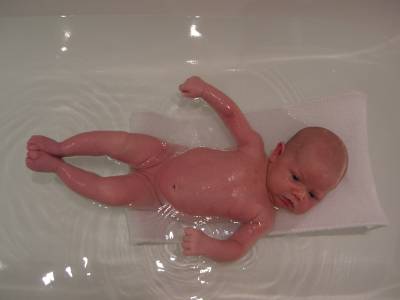
The only time of the day when Ingrid is guaranteed to be totally satisfied with the world is when she is in the bath. No matter how grumpy she is before, I only need to put her in the bath and a second later she is quiet and happy. I guess it must feel just like before she was born, except for the light.

Of course, the moment she leaves the bath is probably her least favourite moment of the day. Even if it takes a fraction of a second to lift her up and wrap her in a towel, she starts her desperate cries of complaint.

And as you can see, she is made up of one large head (for eating and crying) and one large stomach (eating again), to which little skinny crooked limbs have been attached almost as an afterthought (for occasional waving around).

I have, contrary to my expectations, actually managed to finish two books since Ingrid was born. Finding time to blog, however, is harder: I can read while I’m eating breakfast, or putting Ingrid to bed, and I’ve even managed to read a few pages while breastfeeding, but neither of those settings is suitable for blogging. (Typing requires more hands than reading. And the presence of a computer.)

Time for a futile attempt to catch up again. From the backlog, two novels by Tony Daniel: Metaplanetary and Superluminal.


Metaplanetary was a lucky random pick from Forbidden Planet several years ago. It appears to be part of a trilogy (in true SF tradition), or perhaps an even longer series, although the cover doesn’t make that clear – in fact the cover doesn’t even mention this fact. But it was also very readable on its own. I re-read it now that Superluminal, the follow-up that II’ve been waiting so long for, came out in pocket format; part 3 is yet to appear.

The books are about a future where mankind has invented faster-than-light communication and computing, which in turn enables artificial intelligence. Mankind has colonised the entire solar system, and the inner solar system has been linked into a vast network of cables, lifts and connections. It’s a world of flow – of people, information and energy.

All of this is now falling under the rule of a megalomaniacal tyrant. The first book deals with the beginning of the troubles, and how they lead to a civil war within the solar system; the second one is all about the war.

But the civil war is, in a way, just an excuse, a framework to hang a story from. It is not a book about war – it is a book that explores a fantastical yet believable world. It is a combination of fabulously inventive ideas on a vast scale, and an immense amount of detail. There are artificial intelligences, as mentioned, but also Large Arrays of Personalities, and semi-intelligent nanotech life. And spaceships, and tunnels of organic goo going from planet to planet, and so on.

And while the world is based on technical / scientific advances, the book focuses on the effect of those advances on people and society. What would a mixed society of biological and digital humans be like? Would they segregate into enclaves, or mix freely? Would one oppress the other, or look down on the other? What would it be like to have nanotech particles absolutely everywhere – including inside everybody?

But Metaplanetary is not just full of good ideas: there is also an entertaining and well-told story, with plenty of suspense and lots of strong characters. In fact there are a number of storylines, and it is often unclear how they are related – although that did not bother me much, as they were all very readable on their own.

Somewhat confusingly, much of the technology isn’t explained until later, which made the initial chapters a bit hard to follow and understand. Another weakness was the way the story lines are left hanging at the end of the book, to be picked up in Superluminal.

I found Superluminal less engaging than Metaplanetary. Perhaps because it was more linear and focused on a narrower story – that of the war? (Although I have to say it was an interesting and very different war, with planet-scale battles involving sentient spaceships etc.) Or maybe because it is the middle of a story, with neither a real beginning nor a real end.

I do hope that the conclusion is published soon – it would give me a reason to reread these two books yet again.

In an interesting essay, The Myth of the Rational Voter, Bryan Caplan argues that the average voter holds erroneous beliefs about issues they vote on. (Found via Arts & Letters Daily, an excellent daily roundup of thoughtful and interesting writings from all sorts of places.)

…if you know what a voter thinks is best for society, you can count on him to support it.

Before we can infer that the policies that are best for society will actually prevail, however, we have to add the very assumption I am challenging: that the beliefs of the average voter are true. If his beliefs are false, his good intentions lead him to support policies that are less than optimal, and possibly just plain bad.

How can the public keep making costly policy mistakes, year after year, century after century?

Public choice economists are used to blaming what they call “rational ignorance.” In elections with millions of voters, the personal benefits of learning more about policy are negligible, because one vote is so unlikely to change the outcome. So why bother learning?

In my book, however, I argue that rational ignorance has been oversold. Rational ignorance cannot explain why people gravitate toward false beliefs, rather than simply being agnostic. Neither can it explain why people who have barely scratched the surface of a subject are so confident in their judgments – and even get angry when you contradict them.

My view is that these are symptoms not of ignorance, but of irrationality. In politics as in religion, some beliefs are more emotionally appealing than others. For example, it feels a lot better to blame sneaky foreigners for our economic problems than it does to blame ourselves. This creates a temptation to relax normal intellectual standards and insulate cherished beliefs from criticism – in short, to be irrational.

I have to admit that I agree with his proposed remedy of limiting voter power regarding some areas of society. On some topics, opinions are not enough – knowledge is also required to make sensible decisions.

Looking at things objectively (trying to, at least) we’re doing great. Ingrid is eating, sleeping, gaining weight. I am eating, sleeping, and not losing too much weight. But I find it hard to be satisfied. It’s not that I am dissatisfied… I just want things to be even better – NOW.

During the first few days I wished I wasn’t so sore and exhausted. I got that.
The rest of week 1 I wished that breastfeeding wouldn’t hurt so. I got that.
Week 2 I wished for more predictability and routine, and to have time and energy to at least eat regularly. I got that.
Week 3 I wished that Ingrid could fall asleep without an hour of fuss – shushing, rocking, holding, dummy-popping etc. We’re sort of getting there – sometimes it only takes 20 minutes, and sometimes we just give up after a while and let her fall asleep with the dummy.

If week 1 had gone as well as today, or even if I had known that everything will go so well so soon, I would have been ecstatic! But now that we’re here, instead of being satisfied, I wish for more… I wish we could find a predictable way to get her to fall asleep when she is asleep, and I wish I had time and energy for something other than making sure the two of us eat and sleep enough.

All of these things have seemed completely inachievable, which is very frustrating. (Much of that hopelessness has probably been due to my constant tiredness. Things always seem a lot worse when you’re tired!) And now is no different. At least now I know enough to recognise the pattern and know that what I want will indeed be achievable, and even quite soon (if the pattern repeats itself).

I guess its human nature to never be quite satisfied. Or my nature, at least.

Edited on November 6th at 3:30 AM

The advance booking brochure for bite07 (Barbican International Theatre Events) arrived today. Interestingly, 6 out of the 19 shows are marked as “contains nudity”, and one of them has age guidance 16+. Even Peer Gynt and Chekhov have nudity in them. What’s the world coming to?

Got a shower almost before midday, and read almost a third of the latest Economist.