I’ve tentatively decided to get rid of this categories thing here. They’re here because the default setup of Movable Type had categories, and having never blogged before, I just accepted the defaults. Now, half a year later, I’m discovering that many of my posts don’t fit into a neat category. And the other day I noticed that I couldn’t remember which category I’d put a certain post in. If I can’t keep them straight, then you probably can’t either.

Or perhaps I could just reduce them. I might keep the Meta category (for posts about the blog and blogging, like this one), and maybe Books and Art & Entertainment, and The Rest. Or maybe not. But the current setup doesn’t seem good.

I also doubt that anyone comes here to read a particular category and doesn’t care about the rest. If you do, and if you’d like me to keep categorising my posts, now would be a good time to tell me! If you don’t feel like posting a comment, send me an email – the address is simply helen@ + this domain name.

Productivity is a very satisfying feeling. Achievement, in the simplest sense: being able to look back and say, “I have done this”.

I like to have clear markers of progress even in small things. It makes the achievement more concrete and solid. My “to do” lists are tangible, on pieces of paper, because I like the feeling of crossing off tasks one by one and seeing the list shrink. Especially at times when I feel that I am not getting much done – because of tiredness, or because I spend more time learning than producing, or just because I am new to things and not able to move as fast as I want to – the act of crossing off a to do item reminds me that I am actually moving forward.

Not that producing is more important than learning. (If I thought that, I’d still be churning out Excel models with great efficiency, and getting paid very well for it!) But learning is such a never-ending process that it is easy to become oblivious of the speed at which it is happening. There’s an excellent Swedish word, fartblind, that means “speed blind”. In the concrete sense, when you’ve been driving on a motorway and come to an exit, it’s easy to underestimate your speed – and likewise when you’re driving on a very smooth road in a very quiet car. In the figurative sense, it’s only when I do something with what I’ve learned, that I can see, yes, I have actually learned this, I know this now. I need landmarks, lamp posts to help me judge the speed.

From a ticking-off-tasks point of view, this week ended on a very pleasant note. Yesterday and today I submitted my first two formal Change Requests. Once the developer, that is myself, has finished making whatever change I’m making, I need to submit a request for the change to be incorporated into the system (which really deserves to be called The System) – all changes go through a formal process before they’re approved and rolled out. The Change Request explains the reason for the change, summarises the changes made, and links to each of the files that have changed. Submitting a Change Request doesn’t mean that everything is done, but it is a landmark.

These two change requests were not just good because they were the first.
#1 was exciting because each of the steps leading to the Change Request was done on my initiative. The project was given to me, and it was up to me to get it done. Getting it done had me asking a lot of very basic questions and getting a lot of help, but the process was all mine.

#2 was interesting in a completely different, educational way. Out of the ca 15 files involved in the change, there were 2 java source files, 5 configuration files for The System, 4 input files for another proprietary application, 1 Excel template and 3 config files for a job scheduling application. That’s a lot of configuring and very little code. In fact, if we find ourselves making more changes of this sort, the code will be rewritten so that subsequent changes wouldn’t require any code changes at all.

All of which made me realise much more clearly how little of software development is really about code, and how much is about the systems and processes around it. Both in terms of importance, and in terms of how much time they take. It’s something I knew in my head but not in my bones, because I hadn’t been involved in anything like it before.

It would seem that the less code-focused the development process is, the better – because that probably means it is more robust. Processes add overhead, but they also add stability and scaleability. Like a skeleton, really. The formal change management system that we have, for example, may take time, but having an established process means that I do not need to worry about it – I can be sure that a suitable someone will review my changes, and that the changes will be rolled out. And it provides both traceability and transparency: both myself and anybody else can see all the details and the status of the change request at any time.

Perhaps it’s just a personal preference, of course. I like transparency, explicitness and clarity. It seems to echo the GTD approach that I use for keeping my own life in order. I don’t like vague manual processes where you’re sort of supposed to get various people’s approvals, but you need to hunt them down one by one, and then you need to keep chasing them to get their replies, and they will all want to know what the others have said, and it’s never quite clear whether you’re done or not.


Phew… this came out quite a bit longer than I had planned. I have had a week of activity and no blogging, so I guess there was a fair amount that needed to be flushed out of the head. And the two posts I had planned on productivity and on processes appear to have become one.
Well, both the hunger and the tiredness have now subsided somewhat.

Last week both were distractingly strong. I was so sleepy that I actually almost nodded off during the Java course I was attending, several times. Eyelids getting so heavy that it was a physical effort to keep them up – and if I had been anywhere other than a small classroom, I really would have just put my head down on the desk and fallen asleep. But I thought the teacher might not appreciate that. So I guess I just looked really groggy.

Most of that seems to have passed now. I still eat a lot but the hunger is no longer all-consuming. And it’s nice to be able to do something in the evenings, and not just collapse in the sofa. I’ve even started reading a book again.

Hunger leads to eating. Eating leads to weight gain. Weight gain leads to clothes not fitting.

After three weeks of struggling to feed my ravenous hunger, I’ve gained about 4 kg. Well, maybe some of it came a bit earlier, before the hunger came to its peak, but I believe most of it is the result of a few weeks of intense eating.

Those 4 kg appear have gone straight to the waistline, adding roughly 10 cm. As a result, none of my clothes fit around the waist anymore. First they generally became a bit tight. Then the ones that used to sit rather loosely, low on the hips, became tight. Then even those became uncomfortably tight. There’s one woolly skirt that might make it through another week or so, if I move the buttons out a bit.

Yesterday evening I accepted the inevitable fact that I really have nothing to wear any more, and went out for some emergency shopping. The waistline isn’t going to stop expand any time soon, so I needed clothes that would expand with it. Elastic waists, drawstrings, etc. But that sort of thing turned out surprisingly hard to find… elasticated waists really aren’t the in thing right now. Most elasticated things fell into one of two categories: way too casual (skirts in flower-patterned jersey, which I wouldn’t want to wear to work) or ridiculously unstylish (black shapeless trousers with no details). Stretchy things are aimed at teenagers and at women who’ve stopped caring about how they look.

I found some halfway decent skirts in the end. With a bit of work they might even look good. The long simple charcoal one will get a large handful of tiny silk roses – something to keep me busy this weekend. The wide brown skirt in heavy viscose might get some golden pearls, or maybe some sequins along the edges and corners.

No trousers, though. (Sweatpants don’t count. I refuse to wear sweatpants. I’m not that desperate yet.) It might get easier when it gets warmer: drawstring trousers in linen have been popular for a few years, and will hopefully be around this summer as well. And dresses, yes, that’s it. I foresee lots of dresses this summer.

It was a bit of a shock to be trying on clothes in size 14 though… I’ve never worn anything larger than a 10, and mostly 8s. But on the other hand, it was nice not to have to dig around for the smallest size possible, only to discover that even that sits like a sack, and go home with empty hands. I might even try to keep some of this weight afterwards!

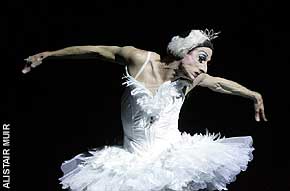
The Trocks, or Les Ballets Trockadero de Monte Carlo, is an all-male classical ballet troupe. What makes them different is that they dance women’s roles, in women’s clothing and style, en pointe: men in tutus and white tights, but with broad hairy chests and muscular arms.

Their show is part serious ballet, part physical comedy, part parody – and it works surprisingly well, and is both funny and interesting. At one end of the scale are the simple jokes about ballet divas: rival ballerinas “accidentally” kicking each other on stage, and dancers devoting more effort to flirting with the audience than to dancing. At the other end, exaggerated interpretations of traditional gestures from the female ballet repertoire, and those pasted-on artificial smiles that ballerinas always seem to wear. And under / over all this, there is obviously a constant play with gender roles: male control and leadership vs. female hand-fluttering. Not surprisingly, when a piece calls for a male role, they picked the smallest guys with the least masculine bodies for those roles.

The Trocks are really good dancers – when they want to be. Occasionally their focus leaned too far towards burlesque parody, for my taste, and technique suffered. But when they focused on dancing, their technique was excellent, with crisp movements, accurate poses, well-controlled pirouettes and sharp timing. And since they are men, their dancing is a good bit more forceful and energetic than women’s. At their best, they work a strong illusion: occasionally I forgot that the piece is performed by men in drag, and only to suddenly be reminded of it by a hairy chest.

One of the best pieces was the Dying Swan solo. Again a combination of physical comedy (where the swan literally collapses on stage) and excellent dancing. To top it off, the solo is performed by a man who looks to be well over 50, and his body shows it: skinny legs, knobbly knees and elbows, plus a nose like a hawk.

The audience appreciated the burlesque parody pieces most, which was to be expected, given the venue. The Peacock Theatre generally runs shows that appeal to inexperienced audiences, and prefer the flamboyant and comical to the refined. One has to admire the Trocks for their skill in combining gags on different levels and satisfying all tastes.