Divers have log books to log their dives. One of the points of this is that you can then prove how many dives you’ve done. It’s not a very secure system – your log book is supposed to be stamped by the dive operator, but all the ones I’ve met just hand you the rubber stamp and you do the stamping yourself. But I guess very few people would want to fake their dive log.

Standard log information usually includes dive location, length (in minutes), maximum depth, start/end time and conditions (current, visibility, sea/wind etc). I usually include a brief note about any other salient points (boat dive vs shore dive) but spend most of the space on what I saw during the dive. Even so, going back two years later I notice that I cannot really recall the dive. But this close after the trip, each dive is still fresh in my memory so the log notes are enough to bring back most of it.

We made 14 dives in total – mostly around 50-60 minutes long, with a max depth of ca 17–20m. The first two were at the house reef, and the very first one was mostly spent getting everybody’s buoyancy right. Buoyancy depends on all sorts of things – water temperature, how salty the water is, the size and material of the air tank you’re using, the type of wetsuit etc. Buoyancy is adjusted so that you can float if you inflate the BCD (= the vest) but sink slowly when the BCD is deflated. You do this by wearing lead weights – either threaded onto a belt, or in the pockets of the BCD. I vaguely recalled having about 6 to 8 kg on our last trip, and started out with 6 this time, but that turned out to be far too little – I just couldn’t get down under the surface. I ended up with 12 kg!

The dives were of all sorts: one day we went out for the whole day in a “big” boat, and did two dives from the boad. Another day we did the same in a speedboat. That was a very windy day so the small boat bounced around a lot – this was the first time I’ve really felt seasick, and I was very happy to get out of the boat and into the water. Even just a metre below surface everything was calm.
Some days we just walked in from the beach, and other times a small Zodiac dropped us a few hundred metres from the shore and we then slowly made our way back. Distances that seemed very small on the surface took surprisingly long time to cover underwater.
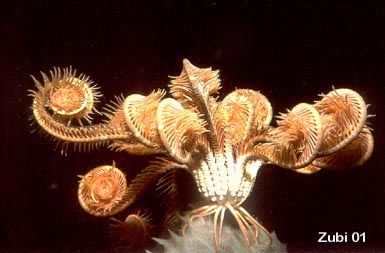
Feather star
A feather star (image borrowed via Google Images)

This trip had several “firsts” for us. We did our first night dives, at the house reef (or dusk/night, to be more precise). Just before 5 when the light started to dim, we had a Zodiac drop us a short way off the beach, and then swum back as it got darker and darker. And it got very dark indeed. When I was the last person in the group, I turned around and looked back, and despite a strong torch, all I could see was blackness. And the lights of the others’ torches became faint very soon – perhaps 10 metres or so would have been sufficient to barely see them. That was quite spooky, actually, so I made sure to keep close to the group. Wouldn’t want to get lost!

Otherwise, night diving was interesting but not spectacular. The colours looked different because the light source was close and didn’t have to filter through 15 metres of water. Many red corals and fishes looked a lot more interesting in torchlight. We did see a feather star. It was fully open when we noticed it, and curled up when we shone our torches on it. Other than that we didn’t really see much that we hadn’t already seen in the daytime. Maybe because it had only just gotten dark; perhaps the real night life comes out later.

We also did our first unguided dives. Previously all our dives had been planned and led by a guide, but this time some of the shore dives were so simple (follow the reef for half an hour, then turn back) that we ventured out on our own. It added some complexity: we now had to take care to keep an eye on the details (the time, how much air we had left, how deep we were) as there was nobody there to remind us. But at the same time it was actually easier in a way, because we only needed to keep track of each other and not worry about keeping up with the group or keeping an eye on the guide. Good practice in any case.

Around the beginning of December I started to get the feeling that some sunshine would be nice – it had been several months since last time. Since half the team at work were going to be gone anyway, nothing much was going to get done, so Christmastime seemed like a good time to go away. We’d been talking about going diving again, so I looked up a few UK dive tour operators with the help of Google, and searched for last minute trips. Half a day later I’d booked a week-long diving trip via Oonas Divers. We’ve never travelled with them before, but all reviews I could find were positive, so I thought we’d give it a go.

They did quite a good job. The place we stayed in was pleasant, the boats and diving equipment in good condition, the dive sites varied and interesting. My only complaint would be that the dive guide was not very good at organising the group or communicating – he had a habit of “mumbling” when signalling to the group, which led to some rather confused dives.


Diving trips come in two varieties: liveaboards, where you stay on a boat for the whole duration of the trip, and shore-based, where you stay in a hotel or resort, and make day trips. We wanted to try a liveaboard – in part just to try it, and in part because those usually go to more distant and interesting reefs. Liveaboards tend to require a minimum number of dives: some require 30, others even 40. That’s more than we’ve got. We took our PADI certificates three years ago on our honeymoon trip, and we’d only been on one trip since then, so we had logged about 20 dives. So we had to make this a shore-based one. Now, however, we’re up to 30 dives each, so next time we’ll take a closer look at liveaboards again.

We stayed in Marsa Nakari (which is near Marsa Alam in southern Egypt) in something called “Eco village” or “Ecolodge”. This turned out to mean a very small low-key resort on a beach in the middle of the desert. The next nearest sign of civilisation was a hotel about 2 km to the south, and beyond that, nothing much at all. Looking inlands, all we could see was desert and sky.

The resort was minimal, having only that which was necessary for diving or for keeping us comfortably housed and fed. This meant about 20–30 small one-room chalets, a dining hall, and a small cafeteria/office/equipment store. There were also communal toilet/shower blocks near the beach, and some small utility buildings. Further off there was a generator (the site was far from the power grid) that we could hear in the evenings. The picture here shows pretty much the whole resort.

During the end of the week, a dozen tents were added, as they were expecting more guests. (We were really supposed to be in a tent as well, but were upgraded upon arrival – I guess they couldn’t be bothered to put them up just for us. Which was nice, as the tents were a bit more basic than I had expected, while the chalets were very cosy.)

It seemed to be a relatively new place, with plans for expansion. The area had an unfinished look, and most of it was just unmodified desert ground, with only small lamps to mark the main paths between buildings. The terraces in front of the chalets seemed to have space for plants, and some greenery would indeed have cheered the place up. But the pared-down style was more to my taste than most beach resorts – I often find them overly opulent and overdone.

A winter with no snow is not a proper winter.

Snow is the definitive separator that cuts the long cold season (“not summer”) into distinct parts. Without snow, autumn just gets colder and and darker until it starts getting noticeably warmer again, and then it is called spring. All rather unsatisfyingly vague. But add some snow, and winter emerges as a proper season, worthy of having a name of its own.

Snow makes the world lighter and cleaner. It brings sharp contrasts, covering up autumn’s indistinct dust and mud, and the black skies of winter evenings are set off against a sharp white ground.

There’s rarely any snow in London… we had one snowy day last year. This year I hear rumours that some snow was sighted between Christmas and New Year, while we were away in a warmer place.

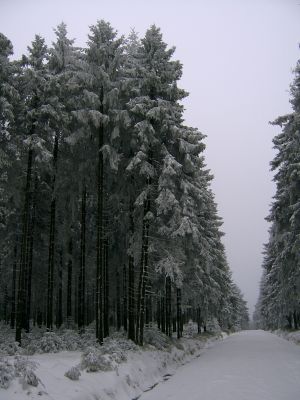
But I got at least one weekend’s worth of snow in the Ardennes (with Kid 2 weeks ago). We wandered around in a beautiful coniferous forest for hours. The snow was wet but fresh, and many paths were untouched by human feet (though there were tracks of hare and squirrel and deer) to the point where it was sometimes difficult to see where the paths were. The thick mists were very pretty but didn’t make pathfinding any easier!