Ingrid is good at keeping Swedish and Estonian apart. When she mixes, it’s mostly semi-intentional: if she doesn’t know the right word in one language, she may borrow from the other.

But then there are some cases where she’s picked one word and keeps using it in both languages, even though a word with the same sound exists in that language and means something completely different. She does it very thoroughly and uses the grammar of the “surrounding” language, which makes it sound even more surreal, and even harder to figure out unless the listener knows both languages.

Thus, we have doppa (to dip) in Swedish – often used at mealtimes because she likes dipping bread in soup, dipping pasta in ketchup, dipping carrots in milk etc. No matter how many times I refer to it as “sa kastad” in Estonian, she keeps saying “ma topin”, which means “I’m stuffing”.

Sticking/piercing (as in sticking a needle in something) is called torkama in Estonian. Ingrid keeps saying torka in Swedish sentences, too, but torka means to dry in Swedish. So when she wants to say “I want to stick the potatoes” (to see if they’re done) she says “I want to dry the potatoes”.

A mug is called kruus in Estonian, and Ingrid keeps calling mugs krus in Swedish, too – “pappa kan du ge mig den blommiga krusen”. But krus in Swedish means ripple, crimp, although there is also an older word meaning large jug. An arrow is called nool in Estonian, and Ingrid uses that in Swedish, too (“vi ska gå dit nålen pekar”), but nål means needle in Swedish.

This is sort of funny to hear, but it is also interesting to observe, because in most cases, when I think about it, the words may mean different things in the two languages today, but they probably share a common root and origin. Needle / arrow is an obvious pair, mug / jug likewise. The Estonian language has gotten a lot of words from its various Germanic neighbours and conquerors, and it’s interesting to see just how deep such loans go, how common and quintessentially Estonian the words now feel. (The homophony of pierce / dry, however, looks to me like a total coincidence.)
Determined not to let one bad circus experience discourage us, we went to see Cirkus Cirkör today, at the Subtopia festival. Cirkör is a Swedish contemporary circus company (which means no clowns and no animals, and about as much theatre as circus).

The title of the show was “Wear it like a crown”, after a song with the same title by Rebekka Karijord, who’s written the music for this show. It was a small and almost intimate performance, with just 5 people on the scene (the 6th artist was absent due to an earlier accident), a simple set, melancholy music and muted lighting. There was juggling (of everything from ping-pong balls to chainsaws and chairs), acrobatics, knife-throwing and trapeze, and more. It is apparently possible to make a circus show out of shoes, plastic bags and plungers.

This is not a children’s show in any way, but it was weird and whimsical enough, and not too loud or scary, so Ingrid enjoyed it. At over two hours (including the interval) it was a bit too long for her, but not so that we’d need to leave early.

I’ve looked for photos of the show but found none that made it justice. There is a trailer but unfortunately it shows nothing of the show itself.

A nice performance, fun, unpredictable, and personal – well worth seeing.

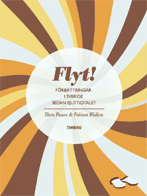
Flyt! (Flow) is subtitled “Förbättringar i Sverige sedan sjuttiotalet”, i.e. “Improvements in Sweden since the seventies”. As the back cover blurb says, it’s about a greyer, duller Sweden – an era when mail for women was addressed to their men, when pink telephones were forbidden, and when travelling abroad was a luxury available only to few. When homosexuality was classed as an illness, when garlic was exotic food, when long-distance calls had to be booked in advance.

It’s a good reminder to all pessimists that life was not better in the good old days. For me (who did not get to experience the seventies in Sweden) it was also interesting to see the similarities and differences between the seventies in Sweden and in Estonia.

The book is light-hearted, and yet packed with information: punchy facts, factoids, statistics, photos and personal memories. At 150 pages it’s a quick and fun read.

The book’s web site. Adlibris.